
GAMING
ROG Xbox Ally X20 Bundle Pairs First OLED Ally With AR Glasses
ASUS pairs the ROG Xbox Ally X20 7.4-inch OLED handheld with ROG XREAL R1 AR glasses as a 20th-anniversary bundle due in the second half of 2026.

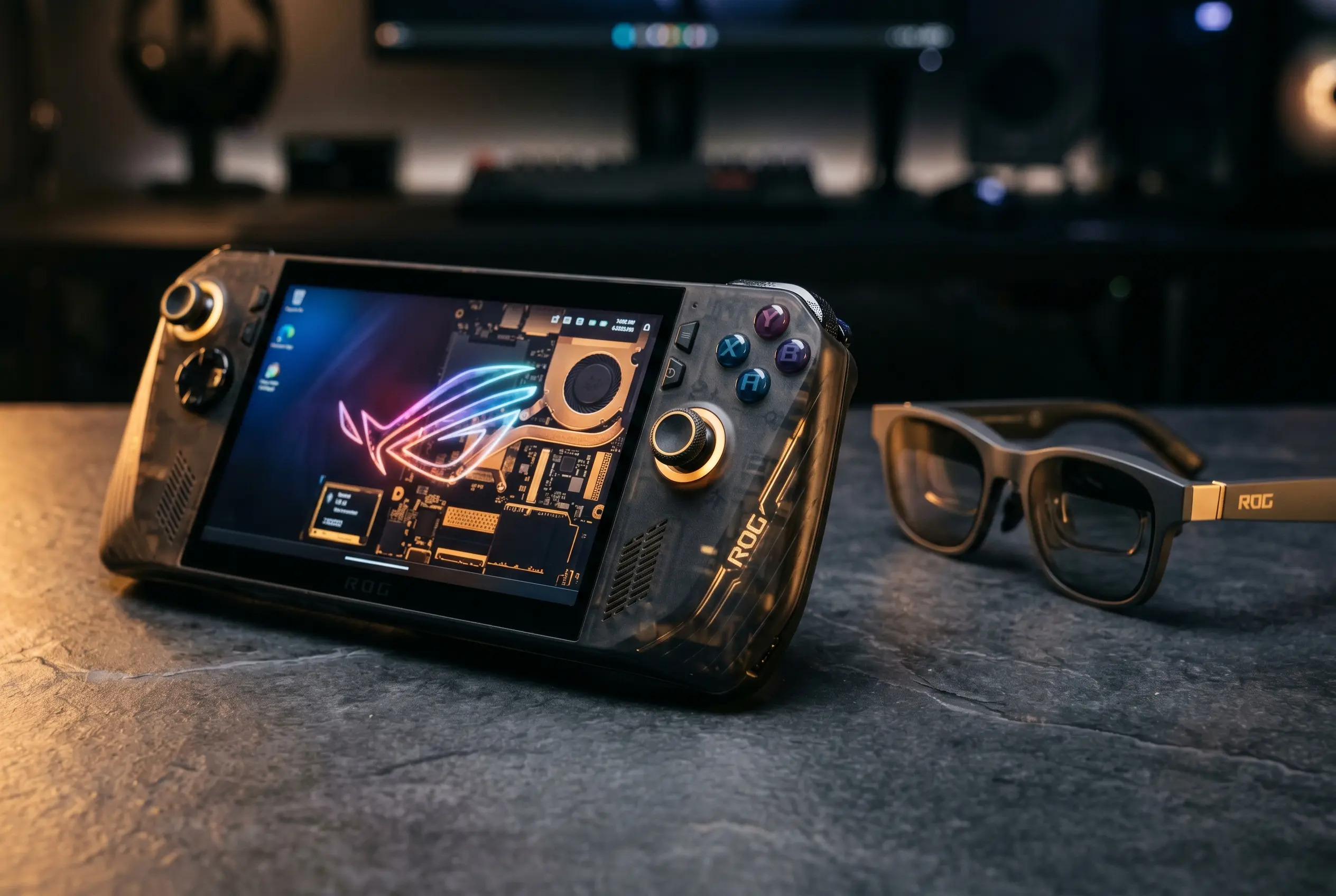
ASUS Republic of Gamers announced the ROG Xbox Ally X20 bundle at Computex 2026 in Taipei on June 1, 2026, marking both the first Ally handheld to ship with an OLED display and the first to be sold only as a pair with AR glasses. The 20th-anniversary Edition 20 collection wraps the redesigned 7.4-inch handheld and the ROG XREAL R1 Edition 20 AR glasses in a matching translucent black and gold colorway. The bundle is listed as “Notify Me” on the ASUS store, with availability set for the second half of 2026 and no official price confirmed.
The bundle announcement, made on the opening day of Computex, is ASUS’s bid to differentiate its flagship handheld in a category where Lenovo and Valve have already shipped OLED panels. Pairing a 7.4-inch OLED screen with a 171-inch virtual display, on the same device, in one box, is a combination no Steam Deck OLED or Lenovo Legion Go 2 currently offers. Reviewers have estimated the total will exceed $2,000 based on the components sold separately, and ASUS has not announced an official price.
The Anniversary Bundle: What ASUS Actually Announced
ASUS Republic of Gamers was formed in 2006, and the Anniversary Edition 20 collection marks two decades of the sub-brand. The ROG Xbox Ally X20 sits at the top of that lineup, dressed in a translucent black chassis with a vibrant gold internal structure. The visual callout is the gold-accented cooling and silicon visible through the plastic, a deliberate throwback to the translucent consoles of the early 2000s. Each Anniversary Edition ships with a commemorative Edition 20 badge and a factory serial number, and a matching finish extends to the bundled AR glasses. The announcement was the centerpiece of ASUS’s Computex 2026 booth, where 15 standout Computex 2026 award picks covered other reveals from the show floor.
The pairing is the headline. Every X20 bundle includes a pair of ROG XREAL R1 Edition 20 AR glasses in the same black and gold finish. The two products are not sold separately as of the announcement, and ASUS has not clarified whether a glasses-free version will follow.
This is the first Ally in the line to use an OLED panel, a request from handheld buyers that has been on ASUS’s radar since the original device launched. The display swap is the first major rethink of the ROG Xbox Ally X formula, even though the underlying compute platform has been carried over from its predecessor. ASUS is shipping the Anniversary Edition as a single product, which means the AR glasses are not an optional add-on but the only way to buy the handheld. The press release frames the X20 as a true collector’s item, alongside the translucency and the factory serial number. More details are in the Anniversary Edition 20 bundle announcement.
The First OLED in an Ally Handheld
The X20’s headline spec is a 7.4-inch ROG Nebula HDR OLED panel. The editorial breakdown of the new handheld notes that is up from the 7-inch IPS screen on the ROG Xbox Ally X, with ASUS trimming the top bezel to fit the larger display.
The panel runs at a 120Hz refresh rate with FreeSync Premium Pro support. Peak brightness is rated at 1,400 nits, with a VESA DisplayHDR 1000 certification and full Dolby Vision support. The 0.2ms response time is on par with desktop OLED monitors aimed at competitive play. ASUS also said the screen is protected by Corning Gorilla Glass Victus with a DXC anti-reflective coating, which it claims cuts glare by 65%.
OLED panels run hotter than the IPS screens used in earlier Ally models, so ASUS redesigned the internal airflow. The X20 picks up a fourth cooling vent on the top edge, with channels directed at the APU and the panel itself to keep surface temperatures down during long sessions. Tom’s Guide editor Anthony Spadafora, who tested the X20 on the Computex floor, reported a stark difference in brightness and color depth compared with the Ally X when the two units sat side by side, with deep blacks and colors that popped noticeably. ASUS’s framing of the swap is that the display, not the silicon, was the experience bottleneck for the games its buyers play. The 7.4-inch diagonal also matches the Steam Deck OLED’s panel size, while the refresh rate and peak brightness outpace what Valve ships.
| Handheld | Panel | Refresh rate |
|---|---|---|
| ROG Xbox Ally X20 | 7.4-inch OLED Nebula HDR | 120Hz |
| Steam Deck OLED | 7.4-inch OLED | 90Hz |
Lenovo’s Legion Go 2 also ships with an OLED panel and detachable controllers, but the company has not published a refresh rate or peak brightness figure in the same announcement cycle. ASUS is positioning the X20’s display as a generational upgrade over the Ally X’s IPS screen, with the thermal rework as the supporting piece. The full display spec sheet is available on ASUS’s product page for the bundle.
TMR Sticks, a Transforming D-Pad, and Other Hardware Upgrades
The X20’s control surface is the second area where ASUS chose to break from the Ally X formula. The thumbsticks now use TMR joystick technology, a contactless magnetic design that ASUS says delivers more precision than Hall effect sensors while reducing the risk of stick drift. The analog triggers still use Hall effect sensors for the trigger pull.
The D-pad is the most distinctive new piece. Inspired by classic XBOX controller layouts, it ships as a standard four-way design, then rotates 90 degrees to expose an eight-way configuration suited to fighting games. A metal dome over the rubber base gives the D-pad a crisp click. Tom’s Guide editor Anthony Spadafora, who tried the mechanism on the Computex floor, confirmed the rotation operates cleanly between modes. The silicon is also the same as the Ally X, with the AMD Ryzen AI Z2 Extreme processor paired with 24GB of LPDDR5X-8000 memory, a 1TB PCIe 4.0 NVMe SSD, and an 80Wh battery.
Other touch points include:
- Face buttons that sit flush with the chassis for smoother thumb sliding
- A rubberized coating on the rear handgrips for longer sessions
- Repositioned bumpers on the motherboard for a crisper actuation angle
- USB4 (Thunderbolt 4 compatible) and USB 3.2 Gen 2 Type-C ports, both with DisplayPort 2.1 support
- A microSD card reader that supports the UHS-I microSD 7.1 standard
The connectivity upgrade is part of the X20’s push toward docked play, which ties back to Microsoft’s Auto SR upscaling. Auto SR, previously limited to Windows 11 Copilot+ PCs, can upscale lower-resolution frames on the X20. A docked session can therefore hit higher frame rates without giving up sharpness on a larger screen. The feature, called Auto SR preview, is one of the first Copilot+ capabilities to reach a non-Copilot+ handheld.
The ROG XREAL R1 Glasses and a 171-Inch Virtual Screen
The AR half of the bundle is what separates the X20 announcement from any other handheld reveal in years. The ROG XREAL R1 Edition 20 AR glasses are an anniversary finish on XREAL’s existing R1 design, the same pair that XREAL already sells for $849 as a standalone product. The Anniversary Edition uses the same translucent black and gold finish as the handheld.
The glasses project a 171-inch virtual screen at four meters, using dual micro-OLED panels running at up to 240Hz with a 0.01ms response time. The 57-degree field of view covers 95% of what XREAL calls the focused field of view. Native 3DoF head tracking lets the screen follow head movement, or stay pinned in place when Anchor Mode is on. Connection is a single USB-C cable into the Ally’s Command Center, with no separate power brick or signal adapter. The full R1 spec breakdown on XREAL’s site lists the rest of the details.
XREAL also lists Sound by Bose audio, three-level electrochromic dimming for ambient light, and a 91-gram weight on its product page. A Frame Rate Boost mode can scale games up to FHD 240Hz through image scaling, with the trade-off of slight sharpness reduction compared to native resolution. Peak brightness on the glasses’ micro-OLED panels is 700 nits. The R1 supports 106% sRGB color coverage for consistent contrast.
The Anniversary Edition of the R1 omits the ROG Control Dock that ships with the standalone R1. That dock is what connects the standard R1 to PCs and non-Ally consoles over HDMI and DisplayPort. Anniversary Edition buyers who want a desktop-style setup will have to buy that piece separately.
A Forced Bundle and an Unconfirmed Price Tag
ASUS has not confirmed an official price for the bundle, and has not said whether the X20 handheld will be sold without the glasses. The bundle is currently listed as “Notify Me” status on the X20 bundle product listing, and ASUS is directing interested buyers to contact their local ROG representative for regional release details. The product is expected to be available in the second half of 2026, with no specific date or region confirmed as of the announcement. Buyers are pointed to their local ROG representative for regional availability, the same path the press release lists for any region-specific question.
The only public price anchors are the standalone products. The standard ROG Xbox Ally X retails at $999, and the standard ROG XREAL R1 AR glasses carry an $849 price tag. Reviewers at Tom’s Guide and GamesRadar have estimated the anniversary bundle will likely cost above $2,000 based on those component prices, though ASUS has not confirmed that figure.
The bundle’s headline numbers, drawn from a sourced press release or product page, stack up as follows. The reviewers’ above-$2,000 estimate is not from ASUS, which has not announced an official price. The figures below are the sourced specs, with the $999 Ally X and the $849 R1 as the only public anchors.
- 7.4-inch OLED Nebula HDR at 120Hz, 1,400 nits peak brightness
- AMD Ryzen AI Z2 Extreme, 24GB LPDDR5X-8000, 1TB PCIe 4.0 NVMe
- 80Wh battery, USB4, microSD UHS-I 7.1
- 240Hz micro-OLED AR glasses projecting a 171-inch virtual screen, 91g
Where the X20 Bundle Sits in a Crowded Handheld Field
The X20 arrives in a handheld market that has spent the last two years catching up to the OLED transition. The silicon fight is now extending to Intel-based handhelds, with the same week’s SteamOS 3.8.7’s first Intel handheld support confirming the category is broadening beyond AMD.
Valve’s Steam Deck OLED set the early consumer expectation for OLED in a 7-inch-class device, and Lenovo’s Legion Go 2 pushed the premium end with an OLED panel and detachable controllers. The Ally X20’s 120Hz panel at 1,400 nits out-specs the Steam Deck OLED’s 90Hz panel on refresh rate, and matches the Legion Go 2’s panel class in a similar device footprint. The AR glasses bundle is the piece no rival currently matches, and ASUS is positioning the X20 around that pairing rather than on the silicon. Intel’s new Arc G3-powered handhelds also debuted at Computex 2026 with competing silicon claims, putting more pressure on AMD’s lead in the category.
For category context, the X20’s flagship 7.4-inch 120Hz OLED panel at 1,400 nits sits above the Steam Deck OLED’s 90Hz panel on refresh rate. The AR glasses pairing is the only category-exclusive feature in the bundle, and the silicon fight is the one area where the X20 is not differentiated. The reviewers’ above-$2,000 estimate for the bundle is based on the $999 Ally X and the $849 standard R1, with no official price from ASUS.
Frequently Asked Questions
What is the ROG Xbox Ally X20?
The ROG Xbox Ally X20 is a 20th-anniversary gaming handheld from ASUS Republic of Gamers, announced at Computex 2026 in Taipei on June 1, 2026. It is the first Ally with an OLED display, a 7.4-inch ROG Nebula HDR panel, and is sold only as a bundle with ROG XREAL R1 Edition 20 AR glasses that project a 171-inch virtual screen.
When will the bundle be available?
ASUS has confirmed the bundle is expected in the second half of 2026. The product is listed as “Notify Me” status on the ASUS store, and ASUS is directing buyers to contact their local ROG representative for regional release details.
How much will the bundle cost?
ASUS has not announced an official price. Reviewers at Tom’s Guide and GamesRadar estimate the bundle will likely cost above $2,000, based on the standalone prices of the ROG Xbox Ally X ($999) and the standard ROG XREAL R1 AR glasses ($849).
Is the X20 sold without the AR glasses?
ASUS has not confirmed a glasses-free sale. As of the announcement, the X20 is listed only as part of the bundle on the ASUS store.
What does the OLED upgrade mean for handheld gaming on the X20?
The 7.4-inch OLED Nebula HDR panel runs at 120Hz with a 0.2ms response time, hits 1,400 nits of peak HDR brightness, and carries a VESA DisplayHDR 1000 rating with full Dolby Vision support. It is the first OLED panel in the Ally line, replacing the IPS displays used in earlier models.
What is the difference between the standard ROG XREAL R1 and the Anniversary Edition in this bundle?
The Anniversary Edition uses the same translucent black and gold finish as the handheld, and is sold bundled with the X20. It does not include the ROG Control Dock that ships with the standalone R1, which is the dock that connects the standard R1 to PCs and non-Ally consoles over HDMI and DisplayPort.


Lenovo Prices the IdeaPad Vibe Against Apple’s $699 Neo

Xbox Caps Game Pass Cloud Gaming at 15 Hours

GTA 6 DualSense Controllers Follow Sony’s Usual $84.99 Script

South Korea Retail Investors Face Reckoning After KOSPI AI Rally Collapses

Surrey AI Maps Three Heart Attack Paths and Their Molecular Roots

Germany Locks Neutral Apple ATT Prompts Across Most of Europe

Apple’s 5% EU Fee Quietly Rewrites Alternative App Store Math

Apple’s EU Fee Truce Cuts Complexity but Leaves Rivals Fuming

Pixel 11 Pro Fold Trades Thinness for Durability and Seven-Year Stay

Mayo AI Flags HCM Obstruction From Everyday Ultrasound Videos

Oracle Cuts 21,000 Jobs in a Year, Cites AI in 10-K Filing

Fable 5 and Mythos 5 Return as US Lifts Anthropic Export Controls

SpaceX’s Google Deal Turns a Rocket Company Into a Cloud Landlord

CD Projekt Red Co-CEO: Redemption Arc Isn’t Done, Witcher 4 in 2027

XPL Rallies 30% Ahead of Plasma One Card Tier Launch

Google Search Profiles Build a Follow Graph Inside Discover

DGO App Brings Rs 549 Mobile Pass for FIFA World Cup 2026 in Nepal

Moonshot AI Targets $30 Billion in China’s Fastest AI Funding Sprint

Oppo’s ColorOS 17 Eligibility List Leaves A-Series Buyers Behind

Microsoft Xbox Layoffs Start in July as Sharma Slams 3% Margin
-
 AI2 months ago
Oracle Cuts 21,000 Jobs in a Year, Cites AI in 10-K Filing
-
 AI2 months ago
Fable 5 and Mythos 5 Return as US Lifts Anthropic Export Controls
-
 AI3 months ago
SpaceX’s Google Deal Turns a Rocket Company Into a Cloud Landlord
-
 GAMING2 months ago
CD Projekt Red Co-CEO: Redemption Arc Isn’t Done, Witcher 4 in 2027
-
 CRYPTO3 months ago
XPL Rallies 30% Ahead of Plasma One Card Tier Launch
-
 NEWS3 months ago
Google Search Profiles Build a Follow Graph Inside Discover
-
 APPS3 months ago
DGO App Brings Rs 549 Mobile Pass for FIFA World Cup 2026 in Nepal
-
 AI3 months ago
Moonshot AI Targets $30 Billion in China’s Fastest AI Funding Sprint