
AI
Meta’s One Internal AI Front Door Just Lost Its Owner
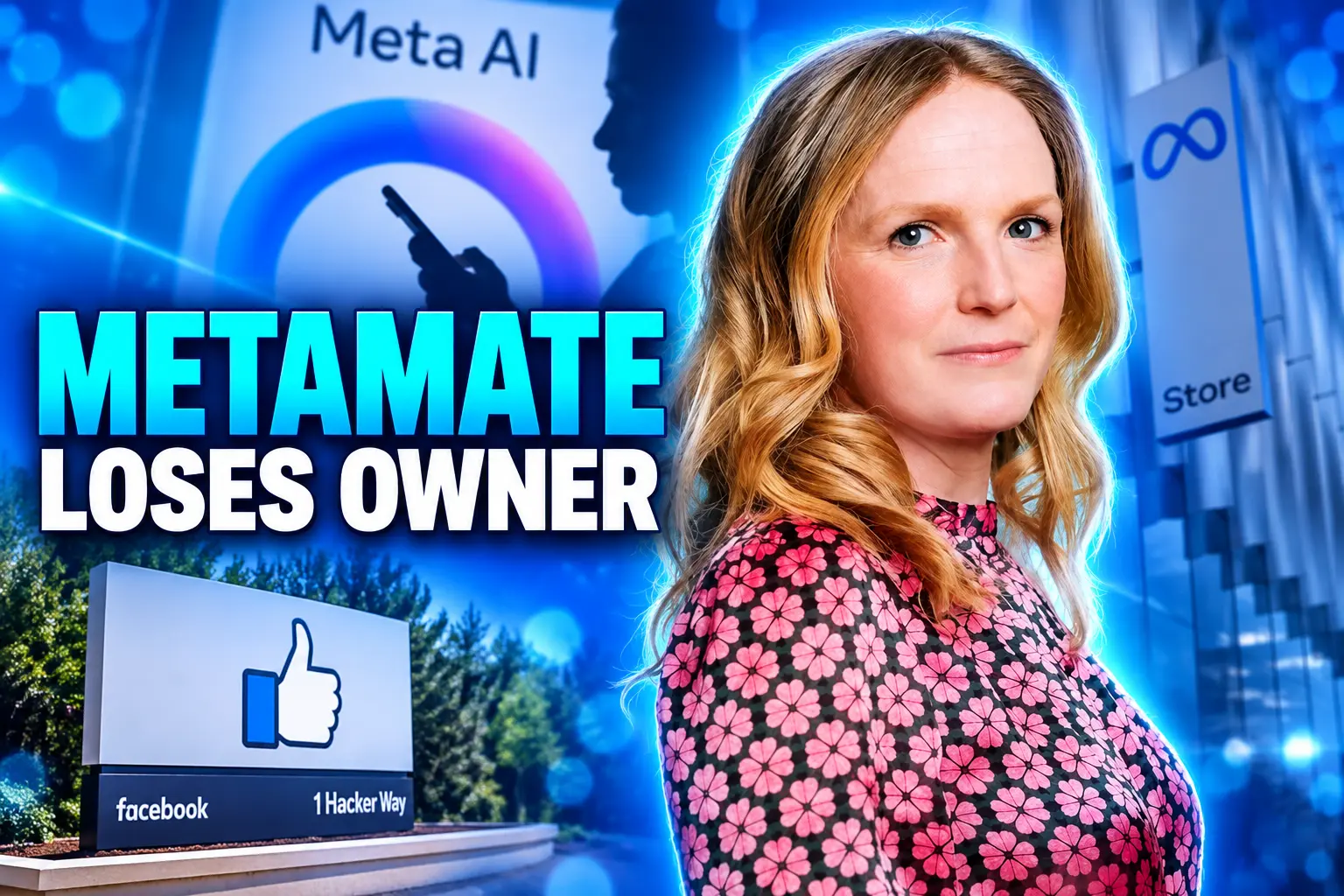
Emily Dalton Smith is leaving Meta two months after taking Metamate, as Manus features missed a June 1 date and a lawsuit later named the assistant.

Emily Dalton Smith told Meta staff on June 17, 2026 that she was leaving, about two months after the company put her on Metamate. She joined in 2015, ran product for Threads, and in April was handed the internal assistant meant to start every job inside the company.
The features her team aimed to land on June 1 included dashboards from Manus, the agent startup Meta had just bought. Meta cut Manus off from internal systems at the start of June. The person who owned the front door walked as that door lost its new hardware.
She Had Two Months to Fix Metamate
Chief technology officer Andrew Bosworth laid out the Agent Transformation Accelerator plan in April. Dalton Smith’s pod would own “the interfaces, platform components, memory systems, automations and shared product experiences that make AI useful for everyone.” That brief included Metamate, Meta’s main internal enterprise assistant.
The job was to collapse a scattered tool pile into one place. In a May memo on the same program, she told staff the existing set was fragmented and that executives wanted one entry point.
Our goal is to make Metamate the starting point for all kinds of work
Emily Dalton Smith, vice president of product, May ATA memo
She wrote that the starting point would cover deep research, prototyping a new feature, and putting together a sales presentation. The team planned to pull in systems that could navigate work files, coordinate coding from chats, and keep persistent memory of people’s work. A Meta spokesperson declined to comment on whether she was leaving and said the company was still folding AI tooling into Metamate.
In the June 17 note she thanked colleagues and said she would stay on briefly to work with Bosworth on moving the team to “what’s next.” She did not name a successor or say where she was going.
The June 1 Features Needed Manus, Then Lost It
The May memo also said the pod would bring in “polished dashboards and microsites,” including those from Manus. She told staff those new pieces were expected inside Metamate as of June 1.
Meta’s own business post on December 29, 2025, said Manus was joining to bring a general-purpose agent into consumer and business products, including Meta AI, and that the startup had already served more than 147 trillion tokens and 80 million virtual computers. Financial terms were not in that post. People familiar with the deal have put the price at around $2 billion.
Alexandr Wang, Meta’s chief AI officer, said the Manus team in Singapore are world class at turning today’s models into agents. China’s National Development and Reform Commission did not share that enthusiasm. On April 27 its foreign-investment security office said it would “prohibit foreign investment in Manus in accordance with laws and regulations, and requires the parties involved to withdraw the acquisition transaction.” Meta said the deal “complied fully with applicable law” and that it anticipated “an appropriate resolution to the inquiry.”
THE MANUS-TO-EXIT CALENDAR
- December 29, 2025: Meta announces that Manus is joining and will keep selling its agent while the talent moves into Meta products.
- April 2026: Bosworth’s ATA memo puts Dalton Smith on Metamate and the shared agent interface layer.
- April 27, 2026: The NDRC orders the parties to withdraw the acquisition.
- May 2026: Dalton Smith tells staff Manus-style dashboards should be inside Metamate as of June 1.
- Start of June 2026: Manus staff lose access to Meta’s internal systems; Meta staff are told to move Manus projects off the tool.
- June 17, 2026: She announces she is leaving and will stay only to help Bosworth hand the pod on.
The ship date and the cutoff sat in the same week. The product chief’s exit sat two weeks after that. Meta has not said whether the June 1 bundle landed in any form once Manus was dark.
The Quarter That Booked $1.18 Billion in Severance
Her two-month mandate ran through the same spring as the headcount cut the assistant was supposed to make easier to live with. On May 20 Meta began a reduction of approximately 8,000 jobs, about 10 percent of the company, and moved about 7,000 other people into new AI-related units. Together those moves hit about 20 percent of the workforce.
Chief executive Mark Zuckerberg wrote the same day that he wanted to be clear the company did “not expect other company-wide layoffs this year.” He also wrote that communication had not been as clear as he wanted. Staff on the internal thread circled “company-wide” and “expect.”
The bill showed up in the next earnings release. For the quarter ended June 30, Meta recorded $1.18 billion of severance expenses tied to the May cut, plus $2.40 billion of charges related to legal proceedings. Reported headcount that day was 75,472, down 1 percent from a year earlier, and still included the approximately 8,000 people hit by the reduction. Most of them, the company said, would drop out of the count by the end of the third quarter.
THE MAY CUT IN META’S Q2 RELEASE
| Item | Figure |
|---|---|
| May 2026 headcount reduction | approximately 8,000 employees |
| People moved into new AI-related units | about 7,000 |
| Severance expense, quarter ended June 30 | $1.18 billion |
| Reported headcount on June 30 | 75,472, still including the 8,000 |
Internal planning documents later described a two-wave “AI native” redesign, with a second company-wide round contemplated for November. Zuckerberg cancelled that second wave hours before the May 20 notices went out. The first wave still happened. Dalton Smith’s product seat sat on top of the tool stack that was supposed to absorb the work those missing people used to do.
Twenty-Six Workers Put Metamate in a Lawsuit
In July, 26 employees filed a 71-page complaint in federal court in Oakland, California, over how that May list was built. They allege Meta did not assemble the termination list “through the considered judgment of managers who knew the work.” They say a cluster of internal AI systems scored, ranked, and selected people instead, and that those scores could not be earned by someone on protected medical or family leave.
Metamate is on that list of systems. The assistant Dalton Smith was told to make the starting point for research, prototypes, and sales decks is the same named tool the complaint says helped rank people for the door. A Meta spokesperson said the claims “lack merit and are not based on facts,” and that “workforce management and organizational decisions were and are made by people, not AI.” The allegations have not been tried. Separations for the plaintiffs were slated to start July 22.
THE SYSTEMS NAMED IN THE COMPLAINT
- Metamate: The internal large-language-model assistant the pod was consolidating other tools into.
- Second-brain agents: Employee-trained agents the complaint says tracked communications and documents, including work some managers trained before leave.
- Activity feeds: Keystroke, screen, email, and browser data used to build a productivity score.
- Token dashboards: Rankings tied to AI-token use and labels such as AI Native, AI First, and AI Enabled.
If even part of that account holds, the irony is mechanical. A system sold as memory and polish for every kind of work is also a system that stores how much work you did, and how much of it ran through the company’s own models.
Who Runs the Starting Point for Work Now?
Bosworth has the handover. The June 17 note said Dalton Smith would stay long enough to move the pod to “what’s next,” and it stopped there. Meta has not named a replacement in public. The spokesperson’s only on-record line on the product was that AI tooling would keep going into Metamate.
WHAT WE KNOW
- The exit note: She announced on June 17 that she was leaving and would help Bosworth on the transition.
- The mandate: April’s ATA plan put her pod on Metamate and the shared agent interface layer.
- The company line: Meta declined to confirm the departure and said Metamate work continues.
WHAT IS UNCONFIRMED
- A successor: No replacement has been named in public.
- June 1: Meta has not said whether the Manus-style dashboards shipped after the cutoff.
- Her next job: The note did not say where she was going.
Parking every internal AI path on one assistant was supposed to end the fragmentation she described in May. It also meant the roadmap had one owner. When that owner left, the starting point for all kinds of work became a sentence in a handover file.
Staff Already Fought the Mouse-Tracking Push
The same spring, Meta rolled out software that captured mouse movements and keystrokes to train agents on how people actually work. Staff treated it as a request to help design their own replacements. They said so in company meetings and on internal boards, and they organized against the collection.
ATA’s stated aim was agents that could carry out tasks human staffers still do. Dalton Smith’s slice was the friendlier face of that aim: one assistant, persistent memory, nicer dashboards. The collection layer sat underneath. People who still had jobs were being asked to generate the traces those jobs would run on.
That is a rotten brief to inherit for two months, and a worse one to hand back with no named owner. The complaint’s scoring story, which Meta denies, sits on top of a fight staff were already having about whether their clicks were training data or performance data. An assistant that remembers your work can help you pick it up on Monday. It can also keep a tally.
Bosworth Keeps the Pod Without a Product Lead
The empty seat is not a model-lab job. It is the product job on the software tens of thousands of remaining employees were told would be where work starts. Threads was a public app with a user count. Metamate is plumbing. Plumbing fails quietly until someone needs the tap.
Bosworth now holds a pod that was told to ship Manus-shaped surfaces on June 1, then lost Manus, then lost the VP. Zuckerberg’s May 20 note promised no other company-wide cuts this year and left the fine print on “company-wide” and “expect” where staff could see it. The assistant that was going to make the smaller company runnable is the assistant whose product chief lasted about two months.
She said she would help with what’s next. Meta has not said who owns that next step, or whether Metamate is still the starting point for all kinds of work now that the person who wrote that sentence is on her way out.

Huang Sells Cybersecurity as AI’s Next Always-On App

Gemini for Windows Cannot Act on Gmail or Drive

Apple Health App Will Sell $119 Quest Blood Tests

AMD’s EPYC Playbook Now Runs Against NVIDIA’s AI Lead

A Nevada Ring Clip Turns a Door Kick Into Evidence

Fable 5 Came Back Under a Commerce On-Off Switch

Google’s SpaceX GPU Lease Has a Sept. 30 Deadline

Plasma One’s XPL Locks Face a 1.81 Billion Cliff

DGO’s Rs 549 World Cup Pass Cost Fans Sleep and Data

Moonshot AI’s $30 Billion Ask Became a $35 Billion Close
-
 AI3 months ago
Fable 5 Came Back Under a Commerce On-Off Switch
-
 AI4 months ago
Google’s SpaceX GPU Lease Has a Sept. 30 Deadline
-
 CRYPTO4 months ago
Plasma One’s XPL Locks Face a 1.81 Billion Cliff
-
 APPS4 months ago
DGO’s Rs 549 World Cup Pass Cost Fans Sleep and Data
-
 AI4 months ago
Moonshot AI’s $30 Billion Ask Became a $35 Billion Close
-

 NEWS4 months ago
ColorOS 17 Device List Spans Oppo, OnePlus and Realme
-

 GAMING4 months ago
Xbox Cuts 3,200 Jobs After Five Years of Thin Returns
-

 GAMING3 months ago
The RTX 4050 Under Rs 70,000 Hides a Wattage Gap