
AI
China Built Its AI Lifestyle on a $98 Billion Backbone
China has 602 million generative AI users. A $98B capex bill, an FNTF compute grid, and a 1,200G backbone explain how AI-to-C and AI-to-H got this far.

China’s AI revolution has progressed beyond research labs and enterprise applications into something more intimate: an AI lifestyle aimed directly at consumers and the home. The country’s two new labels, AI-to-C (AI to the consumer) and AI-to-H (AI to the home), are scaling on infrastructure that the Telecom Review Asia report maps out as the largest in the world. By the end of 2025, China had over 602 million generative AI users, according to CNNIC.
The visible half of this push is the apps and devices. The other half is the network, the capex bill, and the Five-Year Plan that ordered it.
A Decade of Concrete Built for an AI Lifestyle
The base of the AI lifestyle is a decade of network construction. By the end of 2025, China had deployed 34.4 base stations per 10,000 people, exceeding its own national planning target by 8.4 units. That network now carries over a billion users.
Telecom Review Asia’s report on China’s AI-to-C and AI-to-H roll-out ties the figure to consumer AI, not enterprise contracts. Underneath this sits the Future Network Test Facility, or FNTF, described in the same report as the world’s largest distributed AI computing network. It spans 1,243 miles and connects 40 cities through 34,175 miles of optical fiber. That compute grid decides which prompts run locally and which round-trip to a data center.
China’s total AI capital expenditure reached USD 98 billion in 2025, while internet companies contributed up to USD 24 billion on top. China activated the world’s first 1,200G optical backbone spanning Beijing, Wuhan, and Guangzhou, cutting long-haul latency for AI inference. The 15th Five-Year Plan (2026 to 2030) explicitly calls for advances in multimodal AI systems, AI agents, embodied AI, and swarm intelligence.
That is the policy architecture designed to turn this physical network into a platform for daily life. The plan runs to 2030, with the consumer apps as the visible surface of a longer mandate. The 1,200G backbone runs in parallel with the FNTF and the 5G base-station network. None of the consumer launches happen without these three layers working in concert.
For Alibaba, ByteDance, and Huawei, the network is the moat. For consumers, the AI runs in milliseconds. The state-aligned 5G and compute capacity make the consumer-side price possible.
The User Numbers Behind the Strategy
According to the China Internet Network Information Center, China had over 602 million generative AI users by the end of 2025. That figure reflects a 42.8% national penetration rate and a 141.7% year-on-year increase. The growth rate is the part that sets the roll-out apart. CNNIC counts both paid and free generative AI users across the country.
The growth did not happen because of any single viral app. It happened on top of a billion-user mobile network that was already in place. The five headline numbers behind the strategy are listed below. They came from CNNIC for the user figures and from the Telecom Review Asia report for the capex figures. Internet companies, telcos, and the state-funded compute layer each contributed a slice.
- 602 million generative AI users in China, end of 2025
- 42.8% national penetration rate, end of 2025
- 141.7% year-on-year user growth, end of 2025
- USD 98 billion total AI capital expenditure in 2025
- USD 24 billion contributed by internet companies in 2025
The capex split is also revealing: USD 98 billion total, with internet companies contributing USD 24 billion on top. The remainder is split across the telcos, the cloud build-out, and state-backed compute. That consumer-facing spend is what the rest of this article maps back to.
Alibaba, ByteDance, and Huawei Take the AI-to-C Slot
AI-to-C refers to AI applications built specifically for consumers. The Telecom Review Asia report defines the category as tools designed to enhance personal productivity, entertainment, shopping, communication, and overall lifestyle experiences. China has put its biggest tech companies on that category in the past year. Alibaba launched its Qwen app, offering free access and embedding itself into daily-use ecosystems such as mapping, food delivery, ticket booking, shopping, and education services.
On the hardware side, ByteDance partnered with ZTE to launch an agentic smartphone with a voice-activated Doubao AI assistant capable of operating apps autonomously. Huawei built an agent-to-agent framework with app developers to deliver agentic smartphone capabilities. Both moves push AI off the screen and into the device’s actions.
Several structural shifts define the AI-to-C roll-out. The pricing sits at the front: the apps are free at the consumer tier, with the cloud bill underwritten by the company. The phone’s role has changed: it is no longer a passive screen, since the agent acts on it. The talent pipeline is reshaping too, with China’s 12,200-degree cut in the AI pivot reshaping the workforce that ships these features. None of those moves happen without the compute and network layer built in the previous section. Alibaba’s Qwen3.7-Plus going closed-source after topping GUI benchmarks sits inside this same push, with the consumer-facing app changing how the underlying model is licensed.
The same ByteDance that ships Doubao on ZTE is also the ByteDance shopping for inference chips. ByteDance’s reported talks with Iluvatar CoreX on 50,000 AI chips sit alongside the consumer push, not separately from it. The hardware side and the consumer apps run in lockstep, with both feeding off the same compute grid. The pattern across all three companies is the same: free consumer AI on the front, vertically integrated compute on the back.
AI-to-H Turns Smart Homes Into Trillion-Device Surfaces
While AI-to-C targets individual consumers, AI-to-H brings intelligence into the home. The Telecom Review Asia report frames the category as Chinese technology companies connecting appliances, entertainment systems, security devices, and energy management platforms through AI-powered integrations. Modern AI-to-H platforms in China now use large language models to increase the automation and intelligence of IoT systems.
| Aspect | AI-to-C | AI-to-H |
|---|---|---|
| Primary interface | Smartphone | Connected home devices |
| Lead Chinese companies | Alibaba, ByteDance, Huawei | Xiaomi, Huawei |
| Lead AI capability | Agentic apps, chatbots | LLM-orchestrated IoT |
| Capital backing | Up to USD 24B from internet companies, 2025 | Part of USD 98B AI capex, 2025 |
| Adoption baseline | 602M generative AI users, end of 2025 | National robot pilot in 200 families, 2025 |
The Telecom Review Asia report says the LLMs can interpret user intent, adapt to changing environments, and orchestrate complex interactions across interconnected systems. These capabilities are particularly relevant to smart-home deployments, where AI must manage multiple devices, services, and user requests in real time. Xiaomi has built an interconnected Human x Car x Home platform based on smartphones and the Artificial Intelligence of Things (AIoT), positioning the device as the central gateway to a fully connected lifestyle that integrates mobility, smart living, and home automation. Leading Chinese device makers are accelerating the integration of AI across a growing range of connected devices, including smartphones, smart TVs, wearables, robotic vacuum cleaners, home appliances, surveillance systems, and electric scooters. The product list runs from the wrist to the wall socket, with the smartphone as the central controller.
The category does not stop at the front door. The Huawei AI-Centric 5.5G portfolio, comprising GigaGear, GreenPulse, and GainLeap, uses intent-driven automation to optimize network resources. These capabilities are particularly relevant to future smart homes, where AI assistants, connected appliances, security systems, sensors, and autonomous devices must communicate and coordinate in real time. The category’s success depends on the same compute and network layer that powers AI-to-C.
Robots in the Care Economy
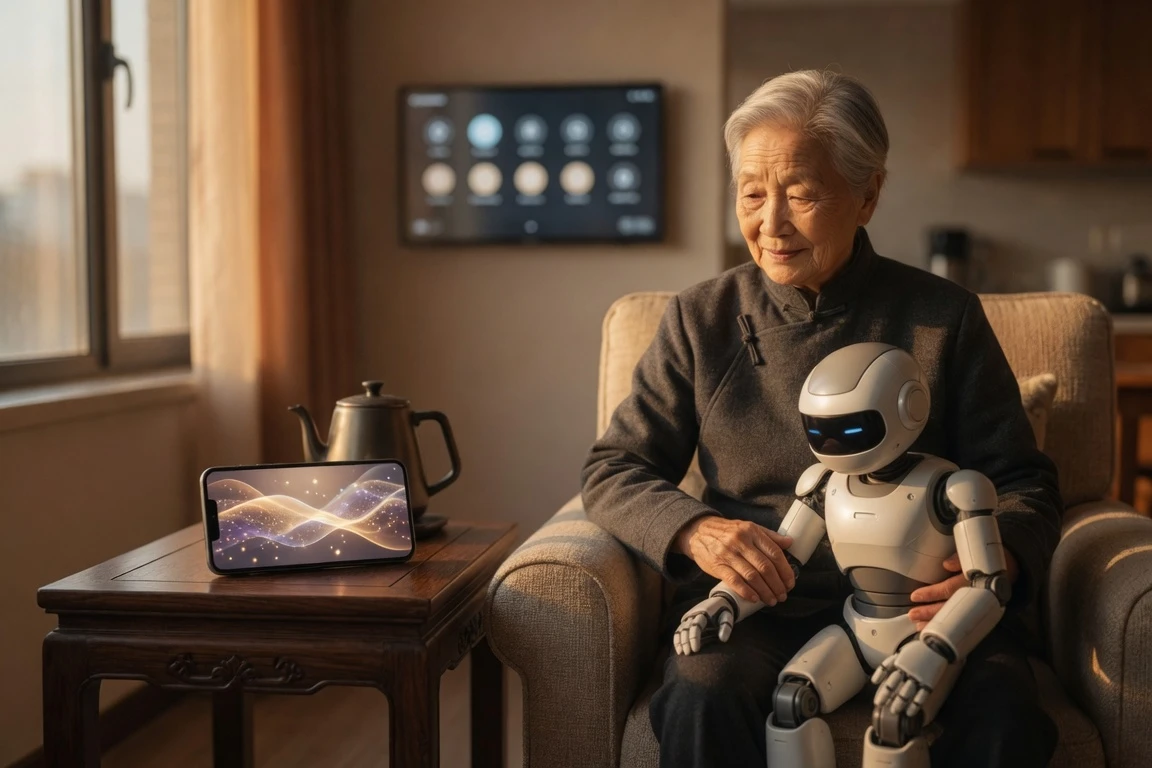
China is also deploying AI directly into human lives through robotics, companionship, and eldercare. The driver is demographic: China’s population aged 60 and above reached 310 million by end of 2024, accounting for 22% of the total population. In Shenzhen, robots are providing mobility assistance for seniors, patrolling rooms at elderly care institutions, and even offering moxibustion therapy in nursing homes. China also launched a national pilot program in 2025, deploying at least 200 robots across 200 families for minimum six-month trials. That trial is the small-scale evidence layer for a much larger bet on physical AI in the home.
The 15th Five-Year Plan adds embodied AI and swarm intelligence to the policy list, and the eldercare robot pilot is the first real deployment against that mandate. Six months is short for a clinical trial, long enough to surface the wiring and software problems a home environment creates. The robots running in Shenzhen right now are a learning batch, not a finished product line. State subsidy makes the early deployments possible; commercial uptake is the unproven step that follows.
The 5.5G Layer That Decides What Reaches You
The consumer app only works if the network delivers it. Huawei unveiled its AI-Centric 5.5G solutions, designed to address the growing demands of mobile AI and support the transition from traditional human-to-human communications to human-to-AI and AI-to-AI interactions. The AI-Centric 5.5G portfolio, comprising GigaGear, GreenPulse, and GainLeap, uses intent-driven automation to optimize network resources, improve energy efficiency, and enable experience-based service delivery.
The Telecom Review Asia report ties the 5.5G push directly to smart-home demand. AI assistants, connected appliances, security systems, sensors, and autonomous devices must communicate and coordinate in real time. The 1,200G optical backbone across Beijing, Wuhan, and Guangzhou is the other half of that latency budget. The 34.4 base stations per 10,000 people carry the wireless traffic; the FNTF carries the wired compute. Together they decide which prompts complete in milliseconds and which queue behind a sleeping sensor on the wall.
The pilot numbers tell the scale of the gap. The Shenzhen robot pilot is the floor. The FNTF compute grid and the 5G base-station layer carry every consumer AI service in the country. The 5.5G stack is what decides which of those services feel instant.
The same network layer also runs the policy enforcement and data residency rules that govern Chinese AI. The state-owned telcos and the cloud providers carry the legal weight, not just the packets. That is why the capex split leans so heavily toward state-backed and state-aligned funding.
What Could Push This Further or Snap It
The Telecom Review Asia report frames AI-to-C and AI-to-H as still under construction. As LLMs become more capable and affordable, the distinction between AI-to-C and AI-to-H may eventually disappear. Consumers will no longer interact with AI solely through smartphones or computers; instead, AI will become an invisible layer embedded throughout homes, devices, and daily routines. China offers a glimpse into this future, where intelligent assistants and connected homes work together to create highly personalized, AI-driven lifestyles.
The upside sits inside the user-count figure: free consumer apps on top of a 1,243-mile compute grid. The cost sits inside the same paragraph: AI is increasingly regulated by state policy and increasingly shaped by the 15th Five-Year Plan. The robot pilot in Shenzhen runs as minimum six-month trials across 200 families, short enough to surface wiring and software problems before scale-up. The policy ceiling runs to 2030. The capex bill, the policy plan, and the consumer apps together make the lead hard to reverse.
The Telecom Review Asia report lays out the build-out and the policy ceiling, then stops. The consumer apps and the eldercare pilot are the two halves of that build-out. The plan runs to 2030.
Frequently Asked Questions
What is AI-to-C?
AI-to-C (AI-to-Customer) labels consumer-facing AI applications: chatbots, agentic phones, and shopping assistants. The category includes Alibaba’s Qwen app, ByteDance’s Doubao phone, and Huawei’s agent framework. Each is free at the consumer tier, with the cloud bill underwritten by the company.
What is AI-to-H?
AI-to-H (AI-to-Home) labels AI applied inside the home: connected appliances, security systems, energy management, and eldercare robots. The lead examples are Xiaomi’s Human x Car x Home platform and Huawei’s AI-Centric 5.5G stack. The category runs on the same compute and network layer as AI-to-C.
How many people in China use generative AI?
Generative AI crossed 602 million users in China by the end of 2025, per CNNIC. The 141.7% year-on-year growth was driven in part by free consumer AI tiers from Alibaba and ByteDance, with state capex underwriting the cloud bill behind them.
What backs the AI-to-C and AI-to-H roll-out?
The Telecom Review Asia report lists four: 34.4 5G base stations per 10,000 people, the FNTF distributed AI computing network spanning 1,243 miles, the world’s first 1,200G optical backbone across Beijing, Wuhan, and Guangzhou, and a USD 98 billion AI capital bill in 2025.
Why is eldercare part of the AI lifestyle?
China’s population aged 60 and above reached 310 million by end of 2024, or 22% of the total population. The 2025 national pilot of at least 200 robots across 200 families is the first major deployment against that demand, and the 15th Five-Year Plan adds embodied AI to the policy list.
How is China paying for the AI lifestyle?
Total AI capital expenditure in 2025 was USD 98 billion, with internet companies contributing up to USD 24 billion on top. The 15th Five-Year Plan runs through 2030 and sets the policy ceiling for the next phase of consumer AI roll-out.


Redmi Note 17 Battery Wins by Leaving Power Behind

WeChat Moments AI Tools Hide a Bigger Skills Redesign

iOS 27 Beta 5 Locks Six iPhones and a Split Launch

Edge AI Forces Hybrid Data Centers Into a Split Reality

Qi2 25W Magnets Quietly Rewrite Desk and Car Charging

Spotify AI Persona Badges Wall Off Synthetic Discovery

GCCs Build AI Bullet Trains on Incomplete Data Tracks

Coreum Bridge Multisig Signed Off on Its Own 200k XRP Drain

AI Shrinks Solar Inspection Crews While Paying Hybrid Skills Far More

Intel Graphics Driver Fixes Still Fight Windows and OEMs

Fable 5 and Mythos 5 Return as US Lifts Anthropic Export Controls

Oracle Cuts 21,000 Jobs in a Year, Cites AI in 10-K Filing

SpaceX’s Google Deal Turns a Rocket Company Into a Cloud Landlord

CD Projekt Red Co-CEO: Redemption Arc Isn’t Done, Witcher 4 in 2027

XPL Rallies 30% Ahead of Plasma One Card Tier Launch

Google Search Profiles Build a Follow Graph Inside Discover

DGO App Brings Rs 549 Mobile Pass for FIFA World Cup 2026 in Nepal

Moonshot AI Targets $30 Billion in China’s Fastest AI Funding Sprint

Microsoft Xbox Layoffs Start in July as Sharma Slams 3% Margin

Oppo’s ColorOS 17 Eligibility List Leaves A-Series Buyers Behind
-
 AI1 month ago
Fable 5 and Mythos 5 Return as US Lifts Anthropic Export Controls
-
 AI2 months ago
Oracle Cuts 21,000 Jobs in a Year, Cites AI in 10-K Filing
-
 AI2 months ago
SpaceX’s Google Deal Turns a Rocket Company Into a Cloud Landlord
-
 GAMING2 months ago
CD Projekt Red Co-CEO: Redemption Arc Isn’t Done, Witcher 4 in 2027
-
 CRYPTO2 months ago
XPL Rallies 30% Ahead of Plasma One Card Tier Launch
-
 NEWS2 months ago
Google Search Profiles Build a Follow Graph Inside Discover
-
 APPS2 months ago
DGO App Brings Rs 549 Mobile Pass for FIFA World Cup 2026 in Nepal
-
 AI2 months ago
Moonshot AI Targets $30 Billion in China’s Fastest AI Funding Sprint