
AI
Meta’s Muse Image Lets Anyone Tag You Into AI Photos
Meta’s Muse Image AI lets anyone tag a public Instagram account and pull their photos into AI art. Subjects get no notification. The opt-out sits in settings.

Meta released Muse Image on Tuesday, its first AI image generator built by Meta Superintelligence Labs, and the launch landed the way Meta AI news often does: half demo reel, half privacy flare. The model is live inside the Meta AI app, on meta.ai, in US Instagram Stories, and in WhatsApp direct chats in a limited set of countries, with Facebook and Messenger to follow. The feature drawing the loudest reaction was not the presets or the QR-code generator.
It was the ability to @-mention any public Instagram account in a prompt and let Muse Image pull that person’s photos into a generated scene, without notifying the subject. The Verge first surfaced how invasive the loop can be, and one X user, quoted by TechCrunch, summed up the reaction: “Pulling real users into generated photos without explicit consent is a privacy landmine waiting to detonate.” Meta’s own policy is explicit on one point: people “may be able to create content with your Instagram content using AI features at Meta,” and “you will not be notified about content created using AI features at Meta.”
What Muse Image Does, and Where You Can Use It
Muse Image is the second major model from Meta Superintelligence Labs, the AI unit Chief AI Officer Alexandr Wang has been building since the spring. The unit’s first release was Muse Spark, a large language model unveiled in April that succeeded the company’s previous Llama family. Muse Image is the first one built for creative work, and it was internally known as Mango.
Meta has pitched Muse Image as an “agentic” model, meaning it plans and uses tools, including coding and web search, before producing a final image. The official Muse Image launch announcement lists everyday use as free, with a paid tier once a heavy user hits the cap. Power users can pick Meta One Plus at $7.99 per month or Meta One Premium at $19.99 per month, both debuted in May.
| Capability | What it does | Where it runs |
|---|---|---|
| Image generation | Text-to-image from a prompt, with optional reference photos | Meta AI app, meta.ai, Instagram Stories (US), WhatsApp (limited countries) |
| Prompt-based editing | Erase a photobomber, swap styles, place you in front of a landmark | Meta AI app, Instagram Stories |
| @-mention Instagram accounts | Tag a public Instagram handle and pull their photos into a generated scene | Meta AI app |
| Room redesign | Snap a room, swap furniture using Facebook Marketplace listings | Meta AI app |
| Instagram Stories effects | More than 30 new AI-powered effects, including customizable filters | Instagram Stories (US) |
| Advantage+ for advertisers | Generate on-brand ad creative variants | Advantage+ (coming weeks) |
The Tag-Anyone Feature at the Center of the Backlash
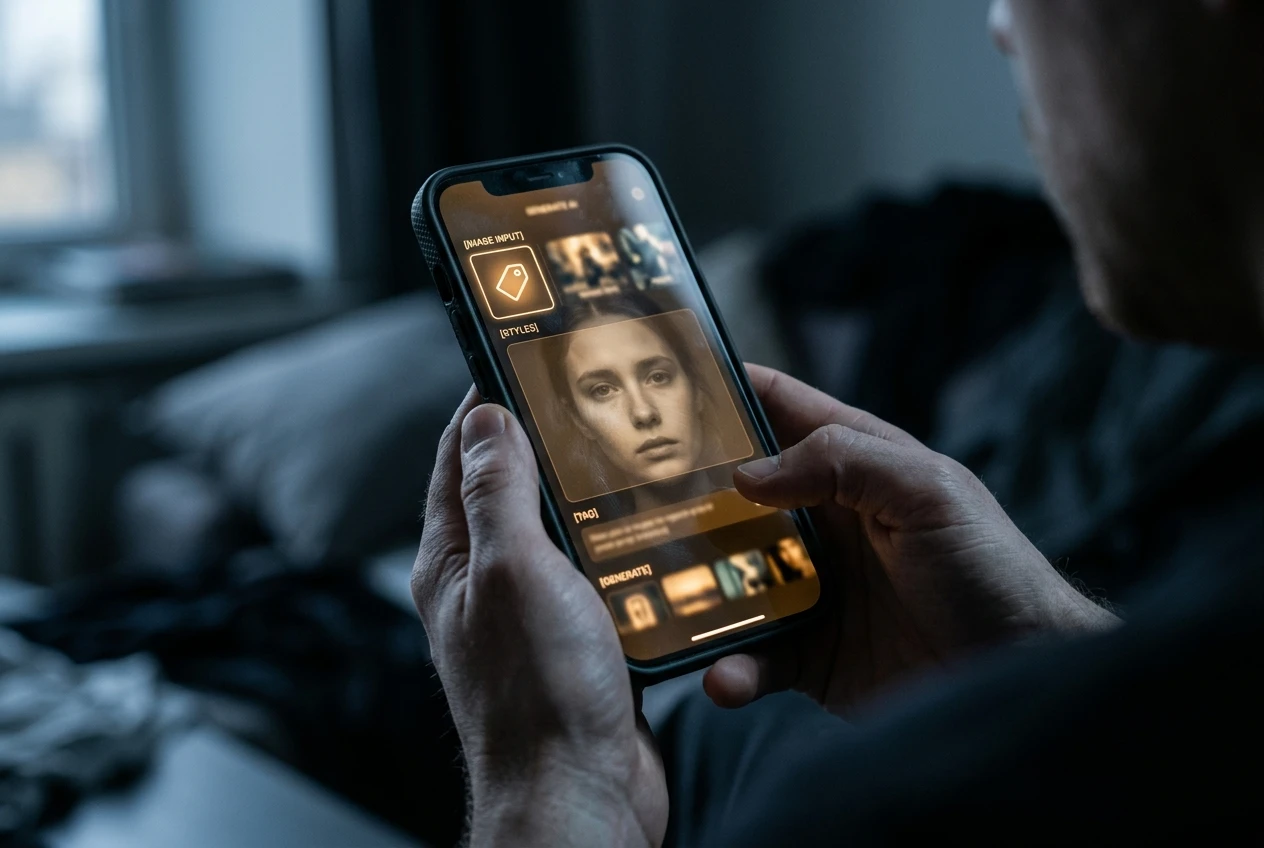
The single Muse Image capability drawing the loudest reaction is the @-mention tool. Inside the Meta AI app, any user can tag a public Instagram account in a prompt and Muse Image will use that person’s public photos to build a generated scene. Meta’s launch post describes the feature as a way to “design a custom event invitation, mock up a collaborative creative concept, or generate a personalized graphic.” It can use public photos to build a visual ready to post, without asking the subject.
TechCrunch quoted one X user on the implications: “Pulling real users into generated photos without explicit consent is a privacy landmine waiting to detonate.” Meta’s policy confirms what that warning implied: subjects get no notification when their photos end up in AI generations, and any user’s Instagram content may be used.
So the headline features, generating scenes and inviting a friend into one, run on a foundation of unconsented photo use. Anyone whose Instagram is public is in the dataset by default.
Meta’s Response, and the Setting Buried in Instagram
Meta’s defense rests on a single switch. The launch post says users “have control over how your content can be tagged for AI creation with an easy setting to turn this feature off at any time.”
Opt-out by default, in other words. TechCrunch noted that the photo-tagging feature “fits a pattern users and regulators have flagged before: broad use of people’s data unless they actively turn it off.” The Verge and CNET both ran walkthroughs of the off switch in Instagram settings; users get no notification, no request, and no heads-up that someone has used their likeness. WIRED framed the rollout as a forced opt-out for public accounts. A public Instagram account is fair game until the owner actively closes the door.
WIRED’s coverage was blunt: “As part of Meta’s Muse Image model rollout, Instagram users with public accounts need to opt out to block AI generations of their content.” CNET went further, with a tester who said they had already used Muse to deepfake a public figure. Meta did not respond to a TechCrunch request for more on the policy at publication.
The relevant control sits inside Instagram, not inside Meta AI. Users who want their photos out of the pipeline have to find the switch themselves.
- Who can be tagged: any Instagram account set to public
- What the subject sees: nothing, no notification, no activity log of use
- Where the setting lives: Instagram settings, per walkthroughs from The Verge and CNET
- What opting out does: stops Meta AI from pulling your public photos into generated images
A Privacy Track Record That Keeps Showing Up
This is not Meta’s first collision between an AI feature and the boundary around user photos. In 2019, the company paid a then-record $5 billion fine to the Federal Trade Commission after regulators found that Cambridge Analytica had improperly harvested data from tens of millions of Facebook users, without their knowledge, to build voter-targeting profiles ahead of the 2016 US election. Facebook had known about the data misuse for years before it became public.
In 2021, Meta shut down Facebook’s facial-recognition system, a tool that had automatically recognized people in photos and videos, amid lawsuits and regulatory pressure over its collection of biometric data. That system identified users without their consent and built face templates from their photos; pulling it cost Meta features it had promoted for years.
The Muse Image tagging loop runs on opt-out by default and uses public photos without notifying the subject. Regulators have already named that pattern twice.
The launch also fits a strategic arc. Meta has been building toward this kind of model under Chief AI Officer Alexandr Wang, who took the reins at Meta Superintelligence Labs and pushed the Muse Spark LLM out the door in April. Muse Image is the unit’s second major release and the first one squarely aimed at creative work in the apps where Meta owns the social graph. Meta’s internal goal, per CNBC, is to “reduce reliance on similar third-party technologies,” specifically Midjourney and Black Forest Labs. Meta’s $145B AI push and what it costs maps the broader spending pressure behind this rollout.
The strategic prize is giving advertisers and creators a generative image model that lives next to the social accounts where the eyeballs already are. The Instagram-owned social graph is the moat. The user photos are the fuel. Meta’s launch language frames the choice: users “have control over how your content can be tagged for AI creation with an easy setting to turn this feature off at any time.” The off switch lives in Instagram, not in Meta AI.
Subscriptions and Advertisers Are the Money Path
The consumer side is free up to a point. Power users and creators who run into the cap can buy a Meta One Plus subscription at $7.99 per month, or Meta One Premium at $19.99 per month, both debuted in May. Under the cap, Muse Image is a funnel into the rest of Meta’s ad stack; over the cap, it is paywalled. Meta also plans to bring Muse Image into Facebook and Messenger later this year, alongside additional Instagram and WhatsApp surfaces.
On the business side, Meta is steering Muse Image into Advantage+, its AI creative suite for brands. The launch announcement says advertisers and agencies “will be able to tap into Muse Image through Advantage+ creative.” That rollout is expected “in the coming weeks.” The infrastructure underneath that push is part of Meta’s plan to sell excess AI compute.
Where Muse Image Stacks Up, and What’s Next
Meta is also playing catch-up in this race. CNBC reported that internal benchmarks show Muse Image trailing OpenAI’s latest GPT Image 2 model, but beating Google’s Nano Banana 2 in tasks like editing single and multiple images. Both rivals got to image generation first. Meta had been using third-party models from Midjourney and Black Forest Labs inside the Meta AI app while it built its own, and Muse Image is the first homegrown replacement.
- More than 30 new AI-powered effects for Instagram Stories
- $7.99 per month Meta One Plus and $19.99 per month Meta One Premium (debuted in May)
- $5 billion FTC fine paid by Meta in 2019, tied to Cambridge Analytica
- Internal benchmark: Muse Image trails OpenAI’s GPT Image 2, beats Google Nano Banana 2
- Second major release from Meta Superintelligence Labs, after Muse Spark in April
The next move is video. Meta confirmed Muse Video is “in development,” built on the same pretraining base as Muse Image. The technical breakdown of Muse Image and Muse Video describes Muse Video as offering “competitive performance in prompt adherence, visual fidelity, and temporal consistency,” without committing to a launch date. Meta said Muse Video is “coming soon to creators and Meta AI.”
The privacy questions travel with each new model. The launch is also a soft launch for the policy underneath it: any future Muse model can pull public Instagram photos by default, and the subject hears nothing.
Frequently Asked Questions
Is Muse Image Free to Use?
Free for everyday creation inside the Meta AI app, on meta.ai, in US Instagram Stories, and in WhatsApp direct chats in a limited set of countries. Power users who run into the cap need a Meta One Plus subscription at $7.99 per month or Meta One Premium at $19.99 per month; both debuted in May.
Can Anyone Use My Instagram Photos in Muse Image?
If your account is set to public, yes, until you opt out. Meta’s policy confirms subjects get no notification when their photos are used in AI generations. The off switch is opt-out, not opt-in.
How Do I Opt Out of Meta AI Using My Instagram Photos?
Open Instagram settings, find the AI tagging or AI creation control, and disable it. Walkthroughs from The Verge and CNET cover the path; the setting is opt-out, not opt-in.
When Does Muse Image Come to Facebook?
Meta says Muse Image is coming soon to Facebook and Messenger, with additional Instagram and WhatsApp surfaces rolling out in the coming weeks. The technical blog confirms Facebook is on the deployment list but does not give a date.
What Is Muse Video?
Meta’s next generative media model, built on the same pretraining base as Muse Image. The company’s technical blog describes it as in development, with a focus on prompt adherence, visual fidelity, and temporal consistency, and says it is coming soon to creators and Meta AI.


CAA Demands Meta Default Muse Image to Opt-In Consent

Memory Costs Are Quietly Squeezing Low-End Phones and PA Suppliers

Social Media Algorithms Now Reward Watch Time, Not Conversation

ResMed Cuts a $490 Million Deal to Exit MatrixCare Software

Nothing’s Phone (4b) Lands at £299, Just £50 Below the Better 4a

Parents’ Phone Distraction Tied to Teen Insecure Attachment

AirPods Custom EQ and Adaptive Audio Slider Arrive in iOS 27 (9A5314b)

EU Court Rejects Apple’s Three Challenges to Its Gatekeeper Status

Black Flag Resynced Playable Build Leaks Ahead of July 9 Launch

Penton Publications Enters Liquidation on 3 July 2026

Microsoft Xbox Layoffs Start in July as Sharma Slams 3% Margin

Google Search Profiles Build a Follow Graph Inside Discover

Google DeepMind and A24 Sign $75 Million AI Partnership Deal

DGO App Brings Rs 549 Mobile Pass for FIFA World Cup 2026 in Nepal

Oracle Cuts 21,000 Jobs in a Year, Cites AI in 10-K Filing

Oppo’s ColorOS 17 Eligibility List Leaves A-Series Buyers Behind

Anthropic Tells Senators Alibaba Ran the Largest Claude Distillation Attack

Apple Strikes Preliminary Deal For Intel To Make iPhone And Mac Chips

Andreessen Horowitz Bets $2.2B on Crypto’s Quiet Cycle

Google Home Spring Update Adds Gemini 3.1 And Old Nest Cam AI
-
 GAMING4 weeks ago
Microsoft Xbox Layoffs Start in July as Sharma Slams 3% Margin
-
 NEWS1 month ago
Google Search Profiles Build a Follow Graph Inside Discover
-
 AI2 weeks ago
Google DeepMind and A24 Sign $75 Million AI Partnership Deal
-
 APPS4 weeks ago
DGO App Brings Rs 549 Mobile Pass for FIFA World Cup 2026 in Nepal
-
 AI2 weeks ago
Oracle Cuts 21,000 Jobs in a Year, Cites AI in 10-K Filing
-
 NEWS1 month ago
Oppo’s ColorOS 17 Eligibility List Leaves A-Series Buyers Behind
-
 AI2 weeks ago
Anthropic Tells Senators Alibaba Ran the Largest Claude Distillation Attack
-
 NEWS2 months ago
Apple Strikes Preliminary Deal For Intel To Make iPhone And Mac Chips