
AI
China to Let Alibaba, ByteDance, DeepSeek Buy Nvidia H200 Chips
China has told Alibaba, ByteDance and DeepSeek they can apply to import Nvidia H200 chips after a January block, but smaller firms stay on Chinese silicon.

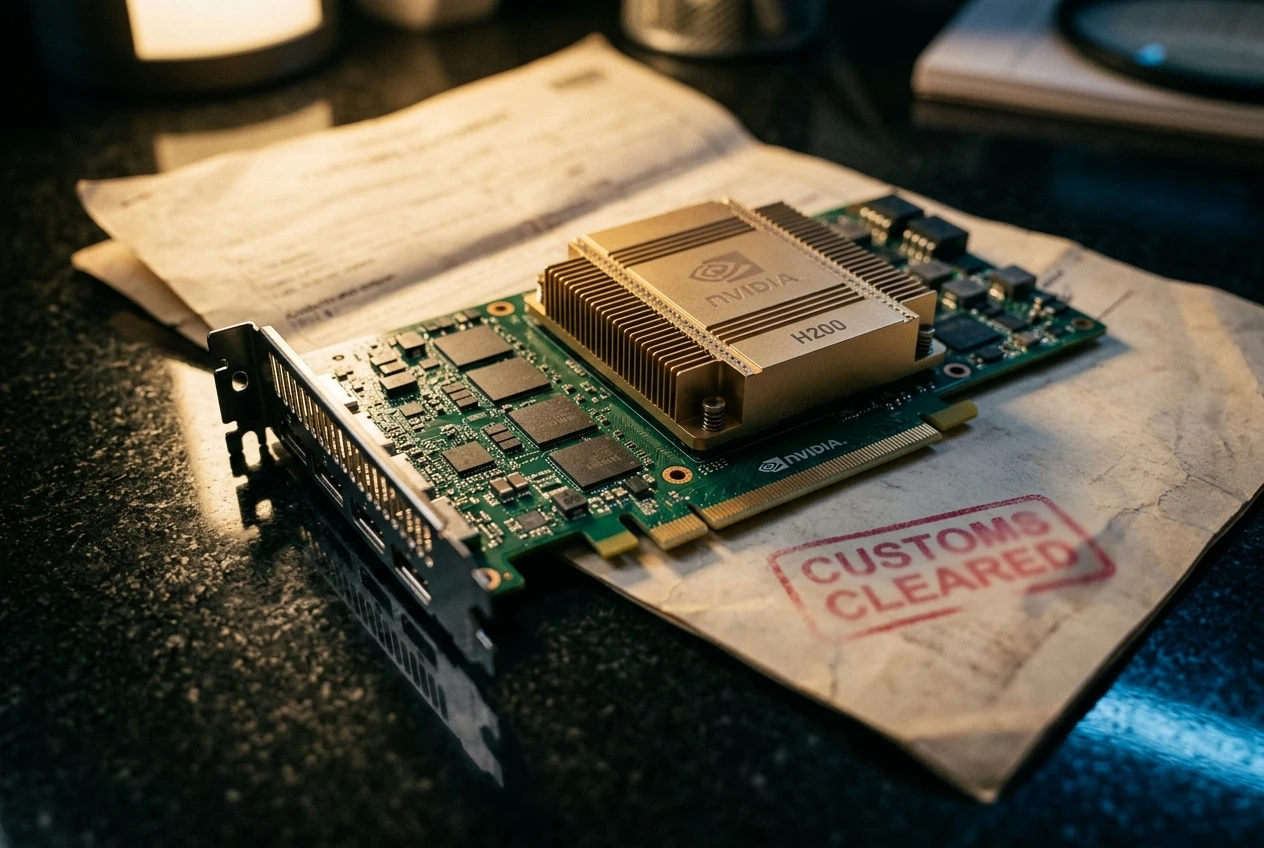
China plans to let Alibaba, ByteDance and DeepSeek buy a limited number of Nvidia H200 AI chips, the latest easing of restrictions Beijing imposed at the start of the year to push the country’s AI labs onto homegrown silicon. Per The Information, Chinese officials have told the three companies in recent weeks that they may soon receive permission to import the chips. The Information, cited by Reuters, said each company must say how many processors it wants and what it intends to do with them.
Alibaba, ByteDance, DeepSeek and Nvidia did not respond to requests for comment outside of regular business hours, Reuters reported on Wednesday. Nvidia already holds U.S. licenses to sell the H200 into China; the new lever is Beijing’s, not Washington’s. President Donald Trump cleared H200 sales to approved Chinese customers in December 2025, a reversal of his predecessor’s tighter controls. The U.S. Commerce Department did not immediately return a request for comment from Reuters.
What Beijing Is Now Letting In
The decision undercuts the most aggressive line drawn by Beijing in 2026. In January, Chinese customs had stopped H200 shipments from reaching the country’s ten licensed buyers, according to a Reuters-cited report. In February, Beijing issued conditional clearance to DeepSeek and earlier approved ByteDance, Alibaba and Tencent for a combined quota of more than 400,000 H200 chips.
The exact ceiling for the new round has not been disclosed in the H200 approval report for China’s top AI labs. Reuters, citing The Information, described the policy as “limited” without printing a number. The requirement for each buyer to justify both volume and use case is unusual for routine chip imports and points to Beijing’s continued interest in keeping its domestic chip industry in the running. Smaller AI firms continue to be steered toward local chipmakers instead of Nvidia. Approval is still case by case, with the Ministry of Industry and Information Technology and the Ministry of Commerce jointly signing off, per the February reporting on DeepSeek.
The latest signal lands on a chip both governments are still negotiating over. The U.S. side carries a 25% revenue share on any H200 shipped into China, an unusual carve-out attached to the December export licence. China’s case-by-case approval now gives Beijing its own lever on the same flow, with each application judged on its own merits. For Beijing, that is more control than it has had over U.S. AI silicon at any point in the past decade.
The paperwork requirement itself is part of the news. Beijing has not previously asked its top AI labs to justify chip imports in real time. The volume of approvals, not the headline, will be the metric to watch.
Why the Door Stayed Shut Through the Winter
The H200 became a geopolitical flash point in late 2025. In December, Trump told President Xi Jinping that the U.S. would allow Nvidia to ship H200 chips to approved Chinese customers, a reversal of the Biden-era ban. Beijing’s response was not the opening Washington had hoped for. In January 2026, Chinese customs began blocking the licensed shipments, an outcome that left Nvidia holding export licences it could not deliver against.
- December 2025 – Trump reverses the Biden-era H200 export ban and attaches a 25% revenue share on sales into China.
- January 2026 – Chinese customs block H200 shipments from reaching ten licensed Chinese buyers.
- January 2026 – Beijing clears Alibaba, ByteDance and Tencent for a combined H200 batch and conditionally approves DeepSeek on January 30.
- March 2026 – Reuters reports that Nvidia has secured Beijing’s broader approval; Jensen Huang confirms the same week on CNBC.
- July 8, 2026 – The Information reports that Alibaba, ByteDance and DeepSeek have been told they may soon receive permission to import additional H200s, with case-by-case paperwork required.
Beijing’s resistance was about industrial policy, not consumer access. The government wants to seed demand for Huawei’s Ascend line, Cambricon processors and the wider domestic stack that officials view as the only durable hedge against future U.S. export controls. The largest AI labs, by contrast, were already running through domestic supply.
By February, the policy was already bending. The first tranche cleared ByteDance, Alibaba and Tencent for a combined total of more than 400,000 H200 units, dwarfing any prior AI-chip order from a Chinese cloud provider. The pattern that emerged was a tiered one: large foundational-model builders get H200s, smaller firms are nudged toward domestic chips. The MIIT and MOFCOM approvals came with conditions: each H200 purchase had to be justified by use case and quantity, per the January approval clearing DeepSeek for H200 imports. By March, Reuters was reporting that Nvidia had secured Beijing’s broader approval, a point Jensen Huang also confirmed to CNBC.
The compromise has been politically useful on both sides. U.S. licences were issued, and Chinese companies are now buying. Beijing is also still directing smaller buyers toward Huawei and Cambricon. The reversal that put the chip back on the table is traced in how Trump’s H200 deal reshaped US-China chip ties.
The December bet has paid for itself in licensing revenue. U.S. licences issued in 2025 have not all delivered against; Chinese clearances have so far covered about 400,000 chips across three named buyers. Both figures are still small relative to total Chinese AI compute demand.
What the U.S. Already Sold, and at What Price
Trump’s December decision did more than unlock the H200 for export. It priced the chips for revenue sharing: the U.S. Treasury collects 25% of the sale price for every H200 that Nvidia ships into China, a concession Nvidia accepted to regain market access. That revenue-share structure is what made the deal politically sellable inside Washington despite AI-safety objections in Congress. Inside the administration, the policy framed the H200 as both a commercial product and a strategic export. Beijing’s July signal accepts both the chip and the price.
The Chinese story has lagged the U.S. timeline by months. U.S. licences were issued in late 2025; Chinese import permission has come in tranches since February, each with conditions aimed at keeping domestic chipmakers in the running. Each new round carries a fresh tier of restrictions: first volume caps, then use-case justifications, then paperwork.
The U.S. side has not been friction-free either. Additional security reviews inside Washington have reportedly delayed H200 shipments that were already cleared. Jensen Huang told reporters in Taipei that the company had not received official confirmation of new orders from China while Chinese licences were finalised. The deal is live but conditional on both sides, and Beijing’s July signal now puts more weight on Washington’s next licensing decisions.
What Doesn’t Change Inside China’s Chip Strategy
Opening the door to H200s for a handful of large AI labs does not unwind China’s broader chip strategy. Huawei and Cambricon still draw the bulk of state-directed demand from data centres and smaller cloud customers. The tiered-licensing logic in place since January pairs foreign H200s with a domestic-only path for everyone else.
The reason is that the gap between a Huawei Ascend chip and an Nvidia H200 is still material for the workloads that matter most. The H200 is Nvidia’s second-most powerful AI processor, six times more capable than the older H20 that Beijing had previously restricted, per specs reported by MLQ.ai. China is also investing heavily in homegrown alternatives: Meituan’s LongCat-2.0 trained entirely on a domestic Chinese chip cluster. For the largest training jobs, however, Chinese chips have not matched the raw compute density of an H200 cluster, a reality Beijing is now acknowledging in policy.
| Company | Status | Source |
|---|---|---|
| Alibaba | Told of permission to apply in recent weeks; case by case | The Information via Reuters, Jul 8 2026 |
| ByteDance | Told of permission to apply in recent weeks; case by case | The Information via Reuters, Jul 8 2026 |
| DeepSeek | Conditionally approved January 30; NDRC setting terms | Reuters via MLQ.ai, Feb 1 2026 |
| Tencent | Cleared earlier in 2026 alongside Alibaba and ByteDance | MERICS China Tech Observatory |
| Huawei, Cambricon | Domestic chipmakers; bulk of state-directed demand | MERICS China Tech Observatory |
China quietly allowing its tech giants to purchase H200s is a reality check for its AI chip ambitions. Despite claims about advances in homegrown semiconductors and their manufacturing equipment, the top AI players still need Nvidia chips to keep pace. Beijing will continue to balance the goals of developing cutting-edge AI and switching to domestic AI chips while US policy allows the export of Nvidia chips.
That is the analysis from Wendy Chang, a senior analyst at MERICS, a Berlin-based China research institute. Even as Beijing runs this two-tier setup at home, it is also tightening outbound access to its own AI models in a parallel push on AI-model export curbs, layering one form of control on top of another. For Huawei and Cambricon, the deal is a partial comfort: they still hold the bulk of state-directed demand from data centres and smaller AI firms.
What the chipmakers miss is the top-end training workload, which remains Nvidia’s strongest hand in this market. That gap is what the July signal concedes, and what Beijing’s tiered policy is designed to keep from widening further.
Where the Final Clearances Could Slip
Even with Beijing’s signal this week, nothing on the policy is final until chips land. Each H200 shipment still needs both a U.S. export licence and a Chinese import approval, a two-key system that has already produced friction this year. MERICS’s reading of the H200 compromise notes that recent H200 exports have reportedly been delayed by additional security reviews inside Washington, a fact that complicates Nvidia’s order book. China’s case-by-case approval creates its own bottleneck; The Information’s report that Alibaba, ByteDance and DeepSeek have been told to file volume-and-justification paperwork is consistent with that pattern. The size of the actual flow will depend on how generously Beijing reads each application.
The unknowns that follow are mostly about timing and totals. Neither Reuters nor The Information has disclosed a cap on H200 units that Beijing will approve in 2026. The 400,000-chip quota granted to ByteDance, Alibaba and Tencent in February remains the largest comparable figure on the public record. The next batch of Chinese import licences will show the actual size of the new flow.


CAA Demands Meta Default Muse Image to Opt-In Consent

Memory Costs Are Quietly Squeezing Low-End Phones and PA Suppliers

Social Media Algorithms Now Reward Watch Time, Not Conversation

ResMed Cuts a $490 Million Deal to Exit MatrixCare Software

Nothing’s Phone (4b) Lands at £299, Just £50 Below the Better 4a

Parents’ Phone Distraction Tied to Teen Insecure Attachment

AirPods Custom EQ and Adaptive Audio Slider Arrive in iOS 27 (9A5314b)

EU Court Rejects Apple’s Three Challenges to Its Gatekeeper Status

Black Flag Resynced Playable Build Leaks Ahead of July 9 Launch

Penton Publications Enters Liquidation on 3 July 2026

Microsoft Xbox Layoffs Start in July as Sharma Slams 3% Margin

Google Search Profiles Build a Follow Graph Inside Discover

Google DeepMind and A24 Sign $75 Million AI Partnership Deal

DGO App Brings Rs 549 Mobile Pass for FIFA World Cup 2026 in Nepal

Oracle Cuts 21,000 Jobs in a Year, Cites AI in 10-K Filing

Oppo’s ColorOS 17 Eligibility List Leaves A-Series Buyers Behind

Anthropic Tells Senators Alibaba Ran the Largest Claude Distillation Attack

Apple Strikes Preliminary Deal For Intel To Make iPhone And Mac Chips

Andreessen Horowitz Bets $2.2B on Crypto’s Quiet Cycle

Google Home Spring Update Adds Gemini 3.1 And Old Nest Cam AI
-
 GAMING4 weeks ago
Microsoft Xbox Layoffs Start in July as Sharma Slams 3% Margin
-
 NEWS1 month ago
Google Search Profiles Build a Follow Graph Inside Discover
-
 AI2 weeks ago
Google DeepMind and A24 Sign $75 Million AI Partnership Deal
-
 APPS4 weeks ago
DGO App Brings Rs 549 Mobile Pass for FIFA World Cup 2026 in Nepal
-
 AI2 weeks ago
Oracle Cuts 21,000 Jobs in a Year, Cites AI in 10-K Filing
-
 NEWS1 month ago
Oppo’s ColorOS 17 Eligibility List Leaves A-Series Buyers Behind
-
 AI2 weeks ago
Anthropic Tells Senators Alibaba Ran the Largest Claude Distillation Attack
-
 NEWS2 months ago
Apple Strikes Preliminary Deal For Intel To Make iPhone And Mac Chips