
AI
Beijing Moves to Wall Off China’s Top AI Models From the World
Beijing’s MOFCOM met with Alibaba, ByteDance, and Z.ai on possibly restricting overseas access to China’s top AI models, including those not yet released.

Beijing is preparing to put a wall around China’s most advanced AI models. Officials from the Ministry of Commerce have spent the past month in meetings with Alibaba, ByteDance, and startup Z.ai about limiting overseas access to frontier models still in development, three people familiar with the talks told Reuters. The conversations, first detailed by Reuters, remain unfinished in scope and may never produce binding rules.
Yet the signal already cuts a sharp shape. China is moving toward the same posture the United States adopted last month, treating top-tier AI models as a strategic asset that should not flow freely to adversaries. Sources briefed on the talks said restrictions would likely apply only to future models. Already-released products like Qwen, Doubao, and GLM-5.2 would stay as they are.
Beijing’s New Line in the Sand for Chinese AI Models
The meetings mark a turn in how Beijing weighs the global spread of Chinese AI. Chinese AI models have made big inroads globally since DeepSeek released its R1 model last year, riding low costs and rising capability. Any Beijing policy that limits that flow would ripple through AI markets, with costs for many businesses likely to increase, Reuters reported.
Three companies sat in the room. Alibaba’s Qwen and ByteDance’s Doubao rank among the most widely used AI models in China. Z.ai, the third participant, has drawn Silicon Valley attention with GLM-5.2, a model whose capabilities come close to leading US offerings at a fraction of the cost. All three run a mix of closed-source and open-weight products, with the open-weight lines freely downloadable for anyone online.
The scope of any restrictions is still under discussion, two of the sources said, and may apply only to future models. Reuters was unable to learn how any formal controls would work. China’s commerce ministry, the National Development and Reform Commission, Alibaba, ByteDance and Z.ai all declined to comment.
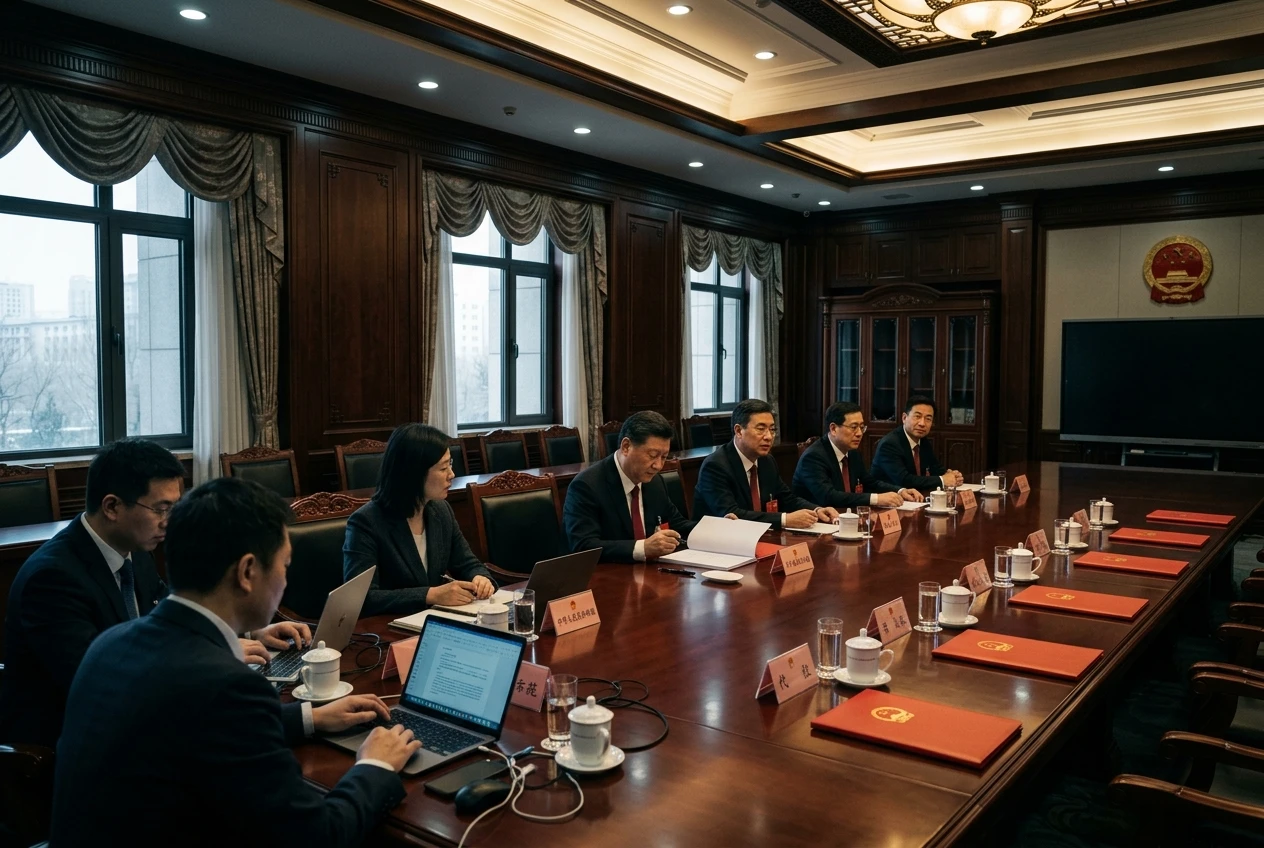
Who’s in the Room and What They Discussed
China’s Ministry of Commerce (MOFCOM), which oversees export rules, led the meetings. Officials from the National Development and Reform Commission, the country’s state planning agency, also attended, according to Reuters. None of the participants responded to requests for comment on the substance of the talks. The story broke through Yahoo carrying Reuters’ byline.
The agenda broke into three buckets:
- Limits on frontier models. The officials discussed putting controls on the most advanced AI models, both closed-source and more open versions.
- Criminal penalties for AI theft. Officials talked about making any leak or theft of proprietary AI technology an offence under China’s national security law.
- Funding curbs on startups. Participants raised the possibility of new restrictions on who can finance Chinese AI startups, a move that could insulate the sector from foreign capital.
Reuters could not confirm whether any of these tracks would become binding rule. The agency’s reporting comes from three people familiar with the talks who were not authorized to speak publicly. None of the involved parties, including Alibaba, ByteDance, Z.ai, MOFCOM, or the NDRC, addressed the specifics before publication. Manus, the Chinese AI startup whose failed Meta deal sits at the center of a separate Beijing crackdown, has also stayed silent.
What the United States Just Did, and Why It Now Hurts
The Chinese push follows a pointed US precedent set two weeks before the MOFCOM meetings began.
On June 12, the Commerce Department’s Bureau of Industry and Security ordered Anthropic to restrict access to its Fable 5 and Mythos 5 models for all foreign nationals, because the agency feared the systems could power devastating cyber-attacks. Anthropic disabled both models globally because it could not verify a user’s nationality in real time.
Over the past two weeks, we have worked closely with Anthropic to analyze and approve Fable 5 to ensure alignment across the US Government and strengthen America’s leadership in AI.
That sentence comes from US Commerce Secretary Howard Lutnick, in a social-media post the day the Fable reversal landed.
The Fable restriction came off June 30, after Anthropic agreed to additional safeguards. Mythos, the model built for cybersecurity professionals, remains limited to some “trusted” US organizations. Chinese authorities are deeply worried Mythos could exploit software vulnerabilities and that Washington might turn the model against Chinese interests, two of the people told Reuters. Sam Altman, the OpenAI chief executive, said publicly that extensive safety testing “is not a bad idea. I just don’t like the idea of the government picking the customers,” flagging the new vetting regime.
The Model That Triggered the Conversation
GLM-5.2 was released the week of June 18 by Z.ai. Axios reported on June 25 that the model carries agentic capabilities that rival those of Claude Opus 4.8 and OpenAI’s GPT-5.5 while costing roughly half as much to run. Graphistry and Semgrep each ran security evaluations and found GLM-5.2 performed on par with leading US models on cybersecurity investigation and vulnerability-discovery benchmarks.
That proximity alarmed Graphistry, whose researchers suggested GLM-5.2 may be an “illegal distillation of both GPT-5.5 and Opus 4.8.” If true, the claim could help explain how Chinese models have been narrowing the gap with US competitors. Z.ai did not respond to Axios’ request for comment. The model’s open-weight license makes those debates largely academic: anyone can download the system, fine-tune it, and strip out safety filters. Hackers have already discussed jailbreaks in Russian-language forums, GuidePoint Security researchers told Axios.
Beijing’s Deeper Pattern: Manus and the Funding Curbs
The MOFCOM meetings sit inside a broader clampdown that has been tightening for months. Beijing has moved to block foreign buyouts of Chinese AI startups and cut off capital flows to founders who might relocate. The pattern sends a single message: a Chinese-origin AI company should not become a foreign-controlled company, and the technology behind it should not move offshore before Beijing decides what it wants.
In April, China’s state planner ordered Meta to unwind its $2 billion acquisition of Manus, a Chinese-founded AI startup that had already moved abroad. Meta has begun dismantling the deal, completing an operational separation from Manus, according to TechCrunch and Reuters. In early June, authorities issued sweeping new rules tightening oversight of overseas deals that touch Chinese investors, technology, data, and national security. China has also opened investigations this year into Manus and other local AI startups that relocated outside the country, seeking to determine whether they had broken export-control laws.
Manus has not responded to Reuters’ requests for comment. The Manus episode sends a second, quieter signal to founders considering an overseas move. Even after a deal closes, Beijing can force a dismantling by invoking national security review. The Manus founders are exploring a separate $1 billion raise to buy the company back, per TechCrunch, a marker that the unwind is real.
This shift complicates the open-source playbook that lifted Chinese AI. Open-weight releases helped models like Qwen and DeepSeek’s R1 spread to developers worldwide at a fraction of the cost of closed US rivals, and Reuters’ reporting on the MOFCOM talks warned that any Beijing policy narrowing that flow would push AI costs up for many businesses. Restrictions like the ones floated in the MOFCOM meetings would freeze that spread for any future frontier model.
Who Gains, Who Loses in This Tradeoff
A Beijing wall on overseas Chinese AI would hand US frontier AI labs an unexpected pricing reset. Companies whose closed models compete head-to-head with open-weight Chinese releases would regain ground on price and reach. So would cybersecurity vendors whose software competes with Mythos-class tools.
The losses stack on a different side of the ledger:
| Side | What changes |
|---|---|
| US frontier AI labs | Open-weight Chinese competition narrows; pricing pressure on closed models eases |
| Chinese AI vendors | Global distribution shrinks once frontier releases lose unfettered overseas access |
| Global developers | Per-token costs likely climb as cheaper Chinese alternatives become harder to obtain |
| Beijing security services | Gain exclusive access to China’s frontier models for national security work |
China’s domestic market would still pay for the wall. A frontier-only-for-China rule would deny Z.ai, Alibaba, and ByteDance the global distribution that built DeepSeek’s R1 into a household name in Silicon Valley. Z.ai founder Jie Tang has said publicly that his company will likely have an open-source model that rivals Anthropic’s Fable before the end of the year. 360 Technology, the Chinese cybersecurity firm whose founder Zhou Hongyi has called for a domestic Mythos, said it has built its own version of Mythos. A domestic-only rule would force both companies to defend at home and lose the open-source flywheel.
What an Export Tier System Could Actually Look Like
Reuters pointed to a hint of structure buried in a Chinese legal journal. In May, a roundtable of Chinese legal experts discussed rules for open-source AI in a session whose summary appeared in an official Supreme People’s Court publication. Participants proposed a tiered system: basic open-source tools subject to a simple filing, more advanced technologies facing security reviews, and the most sensitive frontier models barred from public release or restricted to domestic use.
That three-layer recipe maps onto the closed-source, open-weight, and frontier categories that surfaced in the MOFCOM meetings. It also tracks how Washington now handles Mythos 5: limited release, only to a small circle of trusted US partners, with continued review. If Beijing adopts a mirror image, the next Chinese frontier models could ship to the rest of the world under conditions rather than as freely downloadable weights. Reuters’ sources said the scope of any new restriction is still being discussed and may apply only to future models. The agency could not learn when, or even if, any new restrictions would come into force.
Frequently Asked Questions
Which Chinese AI companies are in the talks with Beijing?
Three companies met with China’s Ministry of Commerce: Alibaba (the maker of Qwen), ByteDance (the maker of Doubao), and Z.ai (the maker of GLM-5.2), according to three people familiar with the discussions. All three companies declined to comment on the substance of the talks.
What restrictions are being considered?
Officials discussed three tracks: limits on the most advanced AI models including open-weight versions, criminal penalties for AI technology theft under the national security law, and new restrictions on who can fund domestic AI startups. Two of the sources said any limits may apply only to future models.
Why would Beijing restrict its own AI?
Two of the sources told Reuters that Chinese authorities are deeply worried about Anthropic’s Mythos model and want to keep advanced Chinese models inside the country to prevent exploitation by foreign adversaries. The talks follow a year of measures aimed at keeping homegrown AI under national control.
Has the US already done something similar?
Yes. On June 12, 2026, the Commerce Department’s Bureau of Industry and Security ordered Anthropic to restrict foreign-national access to Fable 5 and Mythos 5. Fable access was restored on June 30 after additional safeguards; Mythos remains limited to a small circle of trusted US organizations.


South Korea Retail Investors Face Reckoning After KOSPI AI Rally Collapses

Surrey AI Maps Three Heart Attack Paths and Their Molecular Roots

Germany Locks Neutral Apple ATT Prompts Across Most of Europe

Apple’s 5% EU Fee Quietly Rewrites Alternative App Store Math

Apple’s EU Fee Truce Cuts Complexity but Leaves Rivals Fuming

Pixel 11 Pro Fold Trades Thinness for Durability and Seven-Year Stay

Mayo AI Flags HCM Obstruction From Everyday Ultrasound Videos

Indian Brands Quietly Scale Landmark Screens and Home Tech

Navin Vatsa Turns Grief Into a Lifetime of Quiet Seeing

Google Bets Pixel 11 Agentic AI Will Redefine Phones

Oracle Cuts 21,000 Jobs in a Year, Cites AI in 10-K Filing

Fable 5 and Mythos 5 Return as US Lifts Anthropic Export Controls

SpaceX’s Google Deal Turns a Rocket Company Into a Cloud Landlord

CD Projekt Red Co-CEO: Redemption Arc Isn’t Done, Witcher 4 in 2027

XPL Rallies 30% Ahead of Plasma One Card Tier Launch

Google Search Profiles Build a Follow Graph Inside Discover

DGO App Brings Rs 549 Mobile Pass for FIFA World Cup 2026 in Nepal

Moonshot AI Targets $30 Billion in China’s Fastest AI Funding Sprint

Oppo’s ColorOS 17 Eligibility List Leaves A-Series Buyers Behind

Microsoft Xbox Layoffs Start in July as Sharma Slams 3% Margin
-
 AI2 months ago
Oracle Cuts 21,000 Jobs in a Year, Cites AI in 10-K Filing
-
 AI2 months ago
Fable 5 and Mythos 5 Return as US Lifts Anthropic Export Controls
-
 AI2 months ago
SpaceX’s Google Deal Turns a Rocket Company Into a Cloud Landlord
-
 GAMING2 months ago
CD Projekt Red Co-CEO: Redemption Arc Isn’t Done, Witcher 4 in 2027
-
 CRYPTO2 months ago
XPL Rallies 30% Ahead of Plasma One Card Tier Launch
-
 NEWS2 months ago
Google Search Profiles Build a Follow Graph Inside Discover
-
 APPS2 months ago
DGO App Brings Rs 549 Mobile Pass for FIFA World Cup 2026 in Nepal
-
 AI2 months ago
Moonshot AI Targets $30 Billion in China’s Fastest AI Funding Sprint