
COMPUTERS
CCNY’s Quantum Materials Review Shows Light and Magnetism Are Linked
A CCNY-led Nature Materials review maps exciton-magnon coupling in 2D magnets, with a microwave-to-optical transducer already tested in the lab.

Physicists at the City College of New York have mapped how light and magnetism intertwine inside crystals only a few atoms thick, and one experiment from the same lab already turned that physics into a working device. The review, out this week in Nature Materials, surveys a research area barely a decade old: two dimensional magnetic semiconductors where a single particle can sense both a photon and a magnetic spin at once.
That excitement is genuine, but the materials making it possible still need deep cold and careful handling before they leave the lab bench.
Light and Magnetism Share the Same Electrons
The paper, titled “Excitons in van der Waals magnetic materials,” surveys recent advances by the City College of New York (CCNY) team in layered magnetic semiconductors, where light generated electronic excitations called excitons interact with magnetic order and with spin waves called magnons. An exciton forms when light excites an electron inside a material, leaving behind a positively charged “hole.” The electron and hole stay bound together as a neutral but optically active particle. Magnons, by contrast, are collective ripples running through a material’s magnetic order.
Scientists have chased this combination for years, usually by adding magnetic atoms to semiconductors or by stacking thin semiconductors on top of separate magnetic materials. Van der Waals magnetic semiconductors skip that workaround. Inside these crystals, excitons and magnetic moments can come from the very same electronic orbitals, letting light and magnetism act on each other directly.
An exciton is not just a passive light driven excitation sitting on top of the magnetism. It can sense the spin order and magnons, and under the right conditions, even help control the magnetic state itself.
Pratap Chandra Adak, a postdoctoral researcher in physicist Vinod Menon’s lab and the review’s lead author, said light and magnetism “no longer operate as separate channels” inside these crystals once the coupling kicks in.
Co-Authors Span Three Continents
The review comes out of Menon’s Laboratory for Nano and Micro Photonics (LaNMP) at CCNY, which outlined an emerging frontier in quantum materials where light, magnetism and electric charge stay tightly linked. The author list stretches well past one campus.
- Florian Dirnberger, Technical University of Munich
- Swagata Acharya, National Laboratory of the Rockies
- Akashdeep Kamra, Rheinland-Pfälzische Technische Universität Kaiserslautern-Landau
- Xiaodong Xu, University of Washington
The Defense Advanced Research Projects Agency (DARPA, the Pentagon’s advanced research office) and the Gordon and Betty Moore Foundation funded the CCNY side of the work, backing a lab that has been publishing on this exact coupling for at least two years running.
The Lab Already Built a Working Transducer
This review did not appear out of nowhere. In April 2025, the same LaNMP team reported a discovery in Nature Materials showing that spin waves can mediate interactions between excitons in atomically thin magnets, opening the door to optical modulators, all-optical logic gates and quantum transducers.
Datta, a lead researcher on that 2025 work, said the interaction between excitons could be switched externally with a magnetic field, “thanks to the tunable magnetism of 2D materials,” making it possible to flip the coupling on or off in a way that is hard to pull off with other interactions. Adak, a co-lead author on that paper, went further, pointing straight at quantum transducers, devices that convert signals from one frequency to another, such as microwave to optical, calling them “key components for building quantum computers and enabling the quantum internet.”
A year later, Adak led a new paper, posted to arXiv with fourteen other authors, that did roughly what he had predicted. Working with the crystal chromium sulfur bromide (CrSBr), the team drove the material’s magnetic resonance with microwave signals and watched a reflected laser beam pick up optical sidebands riding on that magnon-exciton coupling, achieving a 300 MHz microwave-to-optical conversion window in a bulk crystal with no cavity enhancement at all. The same paper puts the platform’s single-exciton cooperativity around one part in ten thousand for an idealized bilayer device, a number the group says can climb with less magnetic material and better cavity integration.
- April 2025: CCNY reports that spin waves can switch exciton interactions on and off in atomically thin magnets, published in Nature Materials.
- April 2026: Adak and fourteen co-authors demonstrate coherent microwave-to-optical transduction in CrSBr, hitting a roughly 300 MHz bandwidth without any cavity.
- July 2026: The new Nature Materials review folds both results into a field-wide roadmap, naming quantum transducers among the technologies the coupling could unlock.
Superconducting quantum computers, the kind IQM Quantum Computers builds, run at microwave frequencies and would need exactly this sort of optical bridge to talk to fiber networks. IQM spent part of the past year buying Quantistry’s industrial software assets, a sign that hardware makers are racing to close gaps on more than one front at once.
Three Two-Dimensional Magnets Carry the Field
The review leans on a handful of crystals that keep reappearing across this literature, each doing a slightly different job.
| Material | Formula | Distinguishing Feature |
|---|---|---|
| Chromium triiodide | CrI3 | Bilayer form enabled gate-tunable magnetic tunnel junctions and spin tunnel field-effect transistors |
| Nickel phosphorus trisulfide | NiPS3 | Exciton resonance at 1.475 eV with an ultra-narrow 0.35 meV linewidth at low temperature |
| Chromium sulfur bromide | CrSBr | Hosts tightly bound, quasi-one-dimensional excitons and is the crystal behind the 2026 transduction demo |
That NiPS3 number is not a rounding artifact. The review’s own preprint calls an exciton linewidth of just 0.35 meV remarkable for a signal averaged across an entire crystal ensemble, since it points to unusually long-lived quantum coherence in the exciton itself.
Why Do These Quantum Magnets Need Deep Cold?
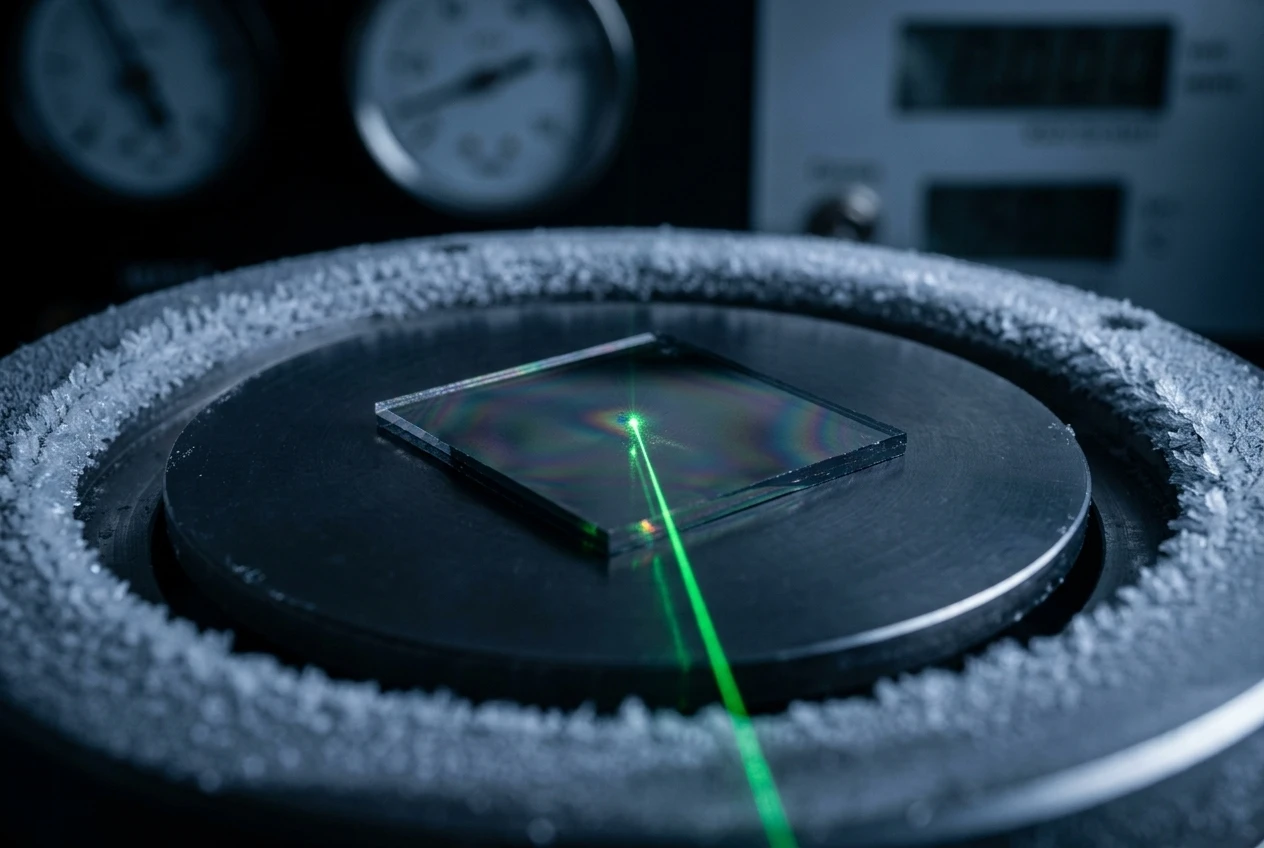
Because the exciton signals these experiments depend on sharpen only near very low temperatures and blur badly as a crystal warms toward its magnetic transition point. Several of the crystals in the review are also chemically fragile once pulled out of a sealed environment, which complicates building anything durable around them.
NiPS3’s narrow linewidth reflects reduced disorder and weak scattering with phonons, defects and spin fluctuations, but that clean signal does not survive heat. As temperature rises, the linewidth broadens quickly, and the exciton resonance eventually fades out entirely near the material’s Néel temperature, the point where its antiferromagnetic order breaks down. A separate Argonne National Laboratory talk on multifunctional van der Waals materials notes that these 2D magnetic semiconductors are insulating in their magnetic phase, which sits awkwardly against the conductive contacts real devices tend to need.
None of that is a reason to dismiss the roadmap. It is a reason to read “could enable next-generation optoelectronic and quantum technologies” as a genuine possibility years out, not a shipping date.
Menon’s Team Eyes Moiré Magnets Next
The review lists concrete uses these coupling effects could eventually support.
- Magneto-photonic memory and data readout
- All-optical logic circuits
- Tunable, adjustable light-emitting devices
- Magneto-optic lasers
- Polaritonic technologies that carry optical information through a material
- Microwave-to-optical quantum transducers for future quantum networks
Menon, professor of physics at CCNY and the review’s senior author, said the field has “moved from detecting magnetism in atomically thin crystals to actively exploring how magnetic order can control light-matter interactions,” adding that the goal of the paper is to pull those scattered developments into one framework and point at where the field can go next. The next experiments on that list include moiré magnetic excitons, optical control of spin textures, magnetic exciton polariton condensation, and further work turning microwave signals into optical ones for quantum communication.
Much of it still depends on materials nobody has grown in usable quantities yet. The review itself flags that many candidate crystals remain unstudied and that theorists still lack models robust enough to predict how excitons, spins, lattice vibrations and photons behave once they interact all at once. Software makers face a parallel gap one layer up the stack: Zapata Computing rebuilt its entire business around closing quantum computing’s application layer gap, betting that programming tools are lagging behind the hardware they are supposed to run.
Menon’s lab has already gone from detecting a magnetic signal to bending it with light in about two years. The next stretch, getting any of it to run outside a cryostat, is the harder problem the review does not pretend to have solved.
Frequently Asked Questions
What is an exciton, exactly?
An exciton is a bound pair made of an electron and the positively charged “hole” it leaves behind after light knocks it loose inside a material. It is electrically neutral overall but still interacts strongly with light, and it is the same basic particle that underlies how LEDs glow and how solar cells turn photons into current, just operating here inside a magnetic crystal instead of ordinary silicon.
What is a magnon?
A magnon is a quantum of spin wave, a ripple that travels through the orderly arrangement of spins in a magnetic material the way a wave moves across a pond’s surface. In the materials this review covers, magnons can trade energy directly with excitons, which is the mechanism that lets an optical signal carry information about a magnetic one.
Why are van der Waals materials special?
Van der Waals materials are held together layer to layer by weak forces rather than strong chemical bonds, the same principle that lets graphite be peeled into graphene with tape. That weak stacking lets researchers isolate single atomic layers and combine them freely, which is why 2D magnets only became available to study starting around 2016 and 2017.
Why did CCNY publish a review instead of a new discovery?
A review paper does not report one new experiment. It surveys and organizes results already published across multiple labs and countries into a single framework, which is exactly what this Nature Materials piece does with years of scattered exciton-magnon findings from CCNY, Germany, Japan and beyond.
How is this different from traditional spintronics?
Conventional spintronics mostly manipulates spin using electrical currents, aiming it at non-volatile memory and magnonic circuits. The approach in this review instead uses light as the control and readout tool, sensing and steering magnetic order optically rather than electrically, which opens different device possibilities like all-optical logic that pure spintronics does not easily offer.
Will this technology reach consumer devices soon?
Not soon. The review’s own authors note that many candidate materials remain unstudied and that reliable theoretical models are still missing, on top of the cryogenic operating temperatures and air-sensitive crystals described throughout this piece. Realistic timelines point toward specialized quantum networking and sensing applications well before anything reaches a mainstream chip.


Redmi Note 17 Battery Wins by Leaving Power Behind

WeChat Moments AI Tools Hide a Bigger Skills Redesign

iOS 27 Beta 5 Locks Six iPhones and a Split Launch

Edge AI Forces Hybrid Data Centers Into a Split Reality

Qi2 25W Magnets Quietly Rewrite Desk and Car Charging

Spotify AI Persona Badges Wall Off Synthetic Discovery

GCCs Build AI Bullet Trains on Incomplete Data Tracks

Coreum Bridge Multisig Signed Off on Its Own 200k XRP Drain

AI Shrinks Solar Inspection Crews While Paying Hybrid Skills Far More

Intel Graphics Driver Fixes Still Fight Windows and OEMs

Fable 5 and Mythos 5 Return as US Lifts Anthropic Export Controls

Oracle Cuts 21,000 Jobs in a Year, Cites AI in 10-K Filing

SpaceX’s Google Deal Turns a Rocket Company Into a Cloud Landlord

CD Projekt Red Co-CEO: Redemption Arc Isn’t Done, Witcher 4 in 2027

XPL Rallies 30% Ahead of Plasma One Card Tier Launch

Google Search Profiles Build a Follow Graph Inside Discover

DGO App Brings Rs 549 Mobile Pass for FIFA World Cup 2026 in Nepal

Moonshot AI Targets $30 Billion in China’s Fastest AI Funding Sprint

Microsoft Xbox Layoffs Start in July as Sharma Slams 3% Margin

Oppo’s ColorOS 17 Eligibility List Leaves A-Series Buyers Behind
-
 AI1 month ago
Fable 5 and Mythos 5 Return as US Lifts Anthropic Export Controls
-
 AI2 months ago
Oracle Cuts 21,000 Jobs in a Year, Cites AI in 10-K Filing
-
 AI2 months ago
SpaceX’s Google Deal Turns a Rocket Company Into a Cloud Landlord
-
 GAMING2 months ago
CD Projekt Red Co-CEO: Redemption Arc Isn’t Done, Witcher 4 in 2027
-
 CRYPTO2 months ago
XPL Rallies 30% Ahead of Plasma One Card Tier Launch
-
 NEWS2 months ago
Google Search Profiles Build a Follow Graph Inside Discover
-
 APPS2 months ago
DGO App Brings Rs 549 Mobile Pass for FIFA World Cup 2026 in Nepal
-
 AI2 months ago
Moonshot AI Targets $30 Billion in China’s Fastest AI Funding Sprint