
AI
The AI Boom’s Hidden Workforce Is Running Out of Electricians
AI’s data center boom faces a 340,000-worker shortage in the US, as colleges and cybersecurity teams race to close a widening skills gap.

The United States needs hundreds of thousands more electricians, cooling engineers and commissioning specialists to keep the artificial intelligence (AI) buildout on schedule, and it does not have them. The Associated Builders and Contractors trade group projects nearly half a million construction openings in 2027, up from 349,000 this year. Employers say the shortfall runs well past construction sites.
It reaches into cybersecurity teams defending systems nobody trained them for. It reaches into classrooms still teaching skills that graduate a year behind what employers need. The chips and the chatbots get the headlines. The people keeping the servers cold and the networks patched are the ones deciding how fast any of it actually ships.
Data Centers Are Hiring Electricians Faster Than Anyone Can Train Them
Four hyperscalers, Alphabet, Microsoft, Meta and Amazon, are committing close to $700 billion in combined capital spending this year toward AI infrastructure. Nearly every dollar of it has to pass through a job site first.
Demand for robotic technicians jumped 107% between 2022 and 2026, based on a global analysis of 50 million job postings from staffing firm Randstad. Cooling system engineers saw 67% growth. Industrial automation technicians grew 51%, and listings for electricians and other traditional trades rose 27%.
“The real constraint on global tech growth isn’t solely related to a shortage of microchips, energy, or capital; it is the severe scarcity of the specialized talent required to build it,” said Sander van’t Noordende, chief executive of Randstad, the world’s largest recruitment firm.
Gary Wojtaszek, executive chairman and interim chief executive of Pure Data Centres, called the shortage “a huge issue now, and it’s only going to get worse.” The race is not confined to American soil. China has built its own AI infrastructure push on top of a $98 billion computing backbone, chasing the same labor math the United States is running.
Power and utility companies feel the same squeeze. Data center executives say 63% cite a shortage of skilled labor as their top obstacle to securing talent, according to Deloitte’s research, while power sector leaders rank that same competition their own top workforce challenge.
Only 15% of Applicants Meet the Bar
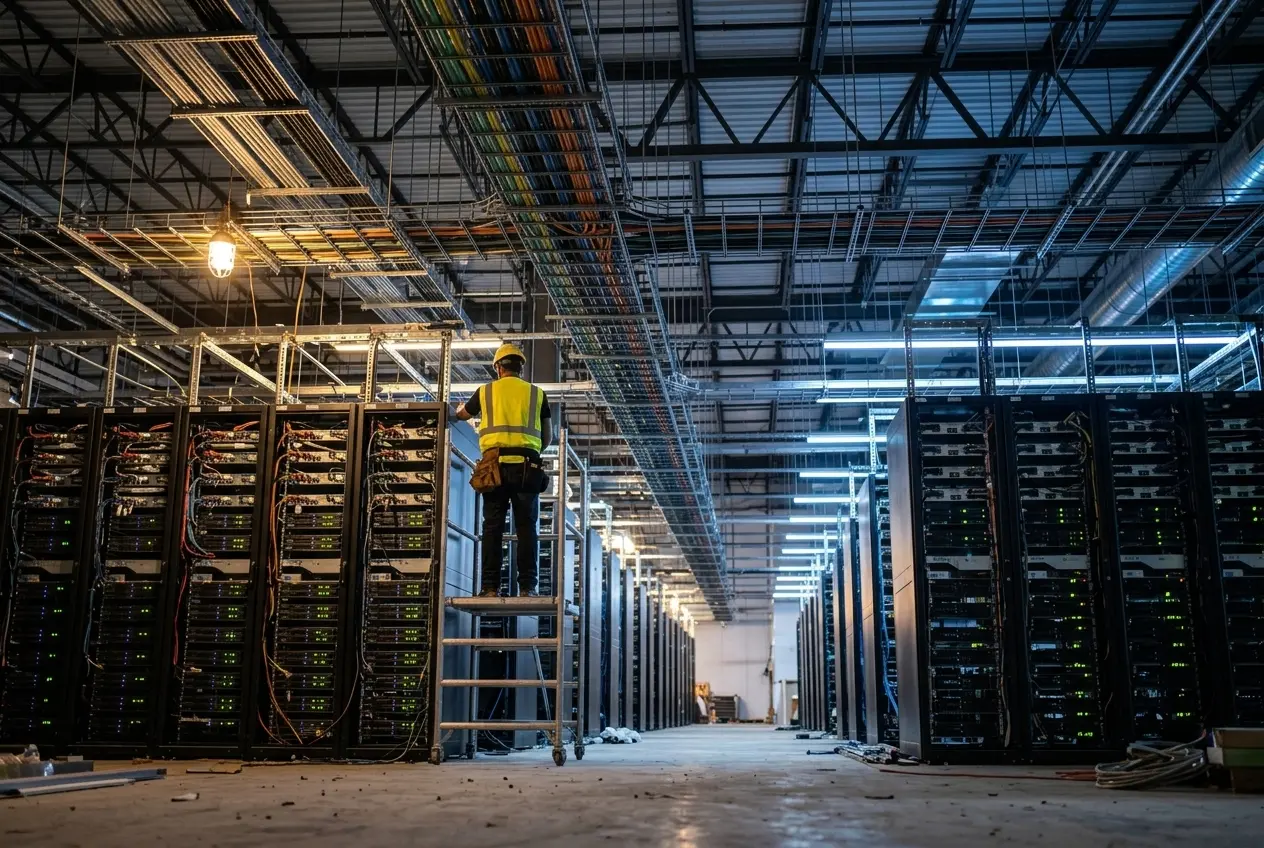
Roughly 650,000 positions across construction and operations are needed to support this year’s data center construction boom. Industry projections say 340,000 of them could go unfilled by year’s end.
The qualification bar is part of the problem. Only 15% of current applicants meet minimum requirements for modern data center roles, which demand knowledge spanning mechanical, electrical and plumbing systems, power distribution and increasingly, AI-driven monitoring tools.
Retirements make the math worse. Roughly one in four workers globally is nearing retirement age, according to Randstad, and 41% of the broader U.S. construction workforce is expected to retire by 2031. The Uptime Institute’s 2024 Global Data Center Survey found 53% of operators struggled to find qualified candidates, up from 38% in 2018.
The hardest roles to fill share one thing in common: years of hands-on training that no software update can shortcut.
- Journeyman electricians licensed for high-voltage, mission-critical work
- MEP (mechanical, electrical and plumbing) engineers who integrate power, cooling and controls systems
- Commissioning specialists who verify a facility before it goes live
- Controls engineers who link power, cooling and telemetry together
- Project managers with prior hyperscale construction experience
The Bureau of Labor Statistics projects roughly 81,000 electrician positions will go unfilled annually through 2034, a gap that predates the AI boom and has only deepened since.
Higher Education Cannot Keep Pace With AI’s Speed
A six-country study released in April by Pearson and Amazon Web Services (AWS) found 53% of employers struggle to find AI-ready graduates. The research drew on more than 2,700 survey responses from students, employers and university leaders across six countries, including the United States, United Kingdom, Brazil, Saudi Arabia, Vietnam and Malaysia.
Only 28% of employers believe universities are keeping pace with AI-driven workplace change. Just 14% of graduates report high proficiency applying AI tools to real professional work, and 39% of employers say hands-on, applied experience is the single most essential change education needs to make.
Chris Campbell, chief information officer at DeVry University, frames the shift as existential for how schools operate. “AI literacy is becoming foundational workforce literacy,” he told The AI Journal. “The pace of technological change means learning can no longer be episodic. It has to be continuous.”
Bill Kleyman, co-founder and chief executive of the data center firm Apolo, sees the same divide from the employer side.
You’re not going to be replaced by AI. You’re going to be replaced by someone who knows how to use AI.
Kleyman made the comment to The AI Journal, arguing that judgment and applied context, not tool access, separate the workers who thrive from the ones who stall out. That same anxiety plays out more broadly in warnings from economists that AI could displace millions of jobs, even as trades and infrastructure roles go begging for qualified applicants.
Cybersecurity Faces the Same Reckoning
The pattern repeats inside security teams. The third annual SANS and GIAC Cybersecurity Workforce Research Report, based on 947 respondents across six global regions, found that skills gaps now outrank headcount as the top workforce risk, a shift from a four-point gap a year earlier to 20 points today.
Twenty-seven percent of organizations report an actual security breach tied to workforce capability gaps, not just theoretical risk. Delayed projects, cited by 57% of respondents, and rising burnout, cited by 47%, round out the fallout.
“This is no longer a story about filling seats,” said Rob T. Lee, SANS Institute’s chief AI officer and chief of research. “Organizations have people. But those people are overwhelmed, under-resourced, and unable to develop the capabilities they need because they’re too busy running today’s operations.”
AI helped create this particular shortage. It is also becoming the tool teams use to survive it. Left unsupervised, automated systems tend to wander off course quietly rather than fail loudly, which is why engineers now warn that unattended AI agents drift until something breaks, reinforcing why human oversight remains the load-bearing part of the system.
Three sectors, three versions of the identical problem.
| Front | Scale of the Gap | Key Signal |
|---|---|---|
| Data center trades | Up to 340,000 U.S. positions unfilled by the end of 2026 | Only 15% of applicants meet minimum qualifications |
| Cybersecurity | 60% of organizations call skills gaps a bigger risk than headcount | 27% report a breach tied to workforce capability gaps |
| Higher education | 53% of employers can’t find AI-ready graduates | Only 14% of graduates rate themselves highly proficient applying AI at work |
Each row points to the same root cause. Systems and demand are moving faster than the pipelines meant to staff them.
Six-Figure Wages Come With Few Permanent Jobs
Money is flowing toward the workers who show up. Specialized professionals moving into data center roles see pay bumps of 25% to 30%, according to staffing firm Kelly Services. A data center technician earns a median $88,000 a year, based on Glassdoor figures cited by CBS News. Northern Virginia electricians, working the country’s densest data center market, clear $120,000 or more annually.
The jobs attached to those wages are not evenly permanent. A host county gains only 2,000 to 4,000 jobs after six years of a hyperscale campus opening, Brookings Institution researchers found, even as wages for existing and new workers rise 3% to 4%. Construction jobs are temporary by design. Long-term operational roles are not, and there are far fewer of them.
“They are pretty sparsely populated,” said Ben Zweig, chief executive of workforce data firm Revelio Labs, describing the permanent jobs data centers create. Lisa Simon, the firm’s chief economist, called the facilities “much more capital-intensive than labor-intensive.”
The backlash has reached Congress. Senator Bernie Sanders and Representative Alexandria Ocasio-Cortez introduced the AI Data Center Moratorium Act on March 25, 2026, seeking to pause new large-scale construction until lawmakers address worker protections and environmental standards. A Hill opinion column framed the trade-off more bluntly, describing tradespeople building the AI economy’s physical shell as feeling “a deep sense of unease” about what they are building.
Even people close to the industry read the trade-off differently.
- Mike Mathews, digital infrastructure leader at Marsh: calls the blend of tradespeople and network engineers working side by side a “great social blend,” describing it as a lasting new-collar career path.
- Revelio Labs’ Ben Zweig and Lisa Simon: counter that permanent operational headcount stays thin because data centers are capital-intensive, not labor-intensive, once construction ends.
- Brookings researchers: found real but modest wage and job gains, adding that state tax incentives, including a $1.6 billion exemption in Virginia in fiscal year 2025, may be subsidizing projects that would have happened anyway.
Companies spending on wages are also spending on training pipelines to keep the current wave from stalling out.
Who Is Training the Next Generation of Technicians?
Technology companies, unions and universities are racing to build that pipeline, sometimes literally. Meta, Siemens and BlackRock have committed hundreds of millions of dollars combined toward apprenticeships and training academies, while schools like DeVry University redesign coursework around applied AI skills instead of one-time certification.
Meta partnered with commercial real estate firm CBRE earlier this year on a training initiative meant to expand the pipeline of workers qualified for data center construction and operations. Siemens Educates America has surpassed 32,000 apprenticeships across 32 states and committed to training 200,000 electricians and electrical workers by 2030. BlackRock launched a $100 million initiative aimed at the next generation of trades workers.
Amazon Web Services is running its own version through its Future Ready 2030 initiative training early-career professionals, built directly off the friction points its research with Pearson identified.
DeVry is trying to close the same gap from the classroom side. “At DeVry, we view the university as a learning environment not just for students, but for innovation itself,” Chris Campbell told The AI Journal. “We experiment carefully, learn from the results and apply those lessons to both the learner experience and how we operate as an institution.”
Cosme Rios II is the kind of graduate that approach is meant to produce. He will deliver DeVry’s undergraduate commencement address this spring after finishing his Bachelor of Science in Engineering Technology. “Now I look at possibilities in data, artificial intelligence and technology with much more confidence, not just interest,” he told The AI Journal. “This journey showed me I’m capable of more than I believed.”
Rios graduates into a job market where the machines get faster every quarter, and the people who install, secure and run them are still the harder thing to find.
Frequently Asked Questions
How Many Data Center Jobs Are Unfilled Right Now?
Industry projections point to as many as 340,000 unfilled U.S. data center positions by the end of 2026, out of roughly 650,000 needed across construction and operations. McKinsey separately projects a gap of 130,000 electricians and 240,000 construction workers specifically by 2030, on top of the near-term shortfall.
Why Can’t AI Just Replace Electricians and Technicians?
Physical infrastructure work has to happen on-site, and equipment technicians cannot work remotely the way software engineers can. Randstad’s Sander van’t Noordende has noted that building a new AI data center can instantly exhaust a region’s local talent pool, since skilled trades have far lower geographic mobility than white-collar tech roles.
What Is Pearson’s AI Readiness Friction Framework?
It is a diagnostic tool from Pearson and AWS’s joint research identifying six frictions slowing the shift from classroom to workplace: pace, connection, capability, governance, experience and skills. Researchers say the six reinforce one another rather than acting as separate, isolated problems.
Are Data Center Jobs Mostly Temporary?
Construction jobs tied to a new data center are almost always temporary, lasting only as long as the build. Operational roles that remain afterward tend to be a fraction of the construction headcount, which is why Brookings researchers found a typical host county gains only a few thousand jobs even six years after a hyperscale facility opens.
How Much Is the AI Skills Gap Costing Cybersecurity Teams?
The 2026 SANS and GIAC Cybersecurity Workforce Research Report found skills gaps, not headcount, are now the top-cited workforce risk for 60% of organizations. Regulatory pressure is compounding it, with demand for new compliance and governance specialist roles nearly doubling year over year, from 23% to 53% of organizations reporting hiring impact.
What Is the Fastest-Growing Pay Premium in AI Infrastructure Jobs?
Demand for robotic technicians grew 107% between 2022 and 2026, the fastest of any category Randstad tracked, ahead of cooling engineers at 67% growth. A data center network engineer in the United States now earns a median $147,461 a year, according to ZipRecruiter data, well above the roughly $123,000 median for general network engineers.


Redmi Note 17 Battery Wins by Leaving Power Behind

WeChat Moments AI Tools Hide a Bigger Skills Redesign

iOS 27 Beta 5 Locks Six iPhones and a Split Launch

Edge AI Forces Hybrid Data Centers Into a Split Reality

Qi2 25W Magnets Quietly Rewrite Desk and Car Charging

Spotify AI Persona Badges Wall Off Synthetic Discovery

GCCs Build AI Bullet Trains on Incomplete Data Tracks

Coreum Bridge Multisig Signed Off on Its Own 200k XRP Drain

AI Shrinks Solar Inspection Crews While Paying Hybrid Skills Far More

Intel Graphics Driver Fixes Still Fight Windows and OEMs

Fable 5 and Mythos 5 Return as US Lifts Anthropic Export Controls

Oracle Cuts 21,000 Jobs in a Year, Cites AI in 10-K Filing

SpaceX’s Google Deal Turns a Rocket Company Into a Cloud Landlord

CD Projekt Red Co-CEO: Redemption Arc Isn’t Done, Witcher 4 in 2027

XPL Rallies 30% Ahead of Plasma One Card Tier Launch

Google Search Profiles Build a Follow Graph Inside Discover

DGO App Brings Rs 549 Mobile Pass for FIFA World Cup 2026 in Nepal

Moonshot AI Targets $30 Billion in China’s Fastest AI Funding Sprint

Microsoft Xbox Layoffs Start in July as Sharma Slams 3% Margin

Oppo’s ColorOS 17 Eligibility List Leaves A-Series Buyers Behind
-
 AI1 month ago
Fable 5 and Mythos 5 Return as US Lifts Anthropic Export Controls
-
 AI2 months ago
Oracle Cuts 21,000 Jobs in a Year, Cites AI in 10-K Filing
-
 AI2 months ago
SpaceX’s Google Deal Turns a Rocket Company Into a Cloud Landlord
-
 GAMING2 months ago
CD Projekt Red Co-CEO: Redemption Arc Isn’t Done, Witcher 4 in 2027
-
 CRYPTO2 months ago
XPL Rallies 30% Ahead of Plasma One Card Tier Launch
-
 NEWS2 months ago
Google Search Profiles Build a Follow Graph Inside Discover
-
 APPS2 months ago
DGO App Brings Rs 549 Mobile Pass for FIFA World Cup 2026 in Nepal
-
 AI2 months ago
Moonshot AI Targets $30 Billion in China’s Fastest AI Funding Sprint