
GAMING
RTX 5080 Cloud Power Puts AAA Games on Any Screen in 2026
NVIDIA’s 2026 GeForce NOW upgrades with RTX 5080 servers and 2200 Install-to-Play titles let players stream top PC games on any device, though monthly caps remain.

NVIDIA GeForce NOW now streams more than 4000 PC games powered by RTX 5080-class cloud servers to laptops, phones, TVs and handhelds. The 2026 upgrades, including Install-to-Play for over 2200 additional Steam titles, let players run Cyberpunk 2077, Forza Horizon 6 and Baldur’s Gate 3 at high settings without buying a gaming PC.
Weekly GFN Thursday drops keep the catalog moving. The service still carries monthly hour caps and publisher opt-in rules that shape who benefits most.
What the 5080 Servers Deliver
Ultimate members now tap GeForce RTX 5080 power that rolls out across more regions. NVIDIA lists up to 5K resolution at 120 frames per second, 360 FPS in competitive titles, DLSS 4 and full ray tracing on supported games.
- 30% faster performance claimed over prior-generation cloud rigs
- Up to 5K 120 with HDR and Cinematic Quality Streaming
- Priority queues and longer 8-hour sessions
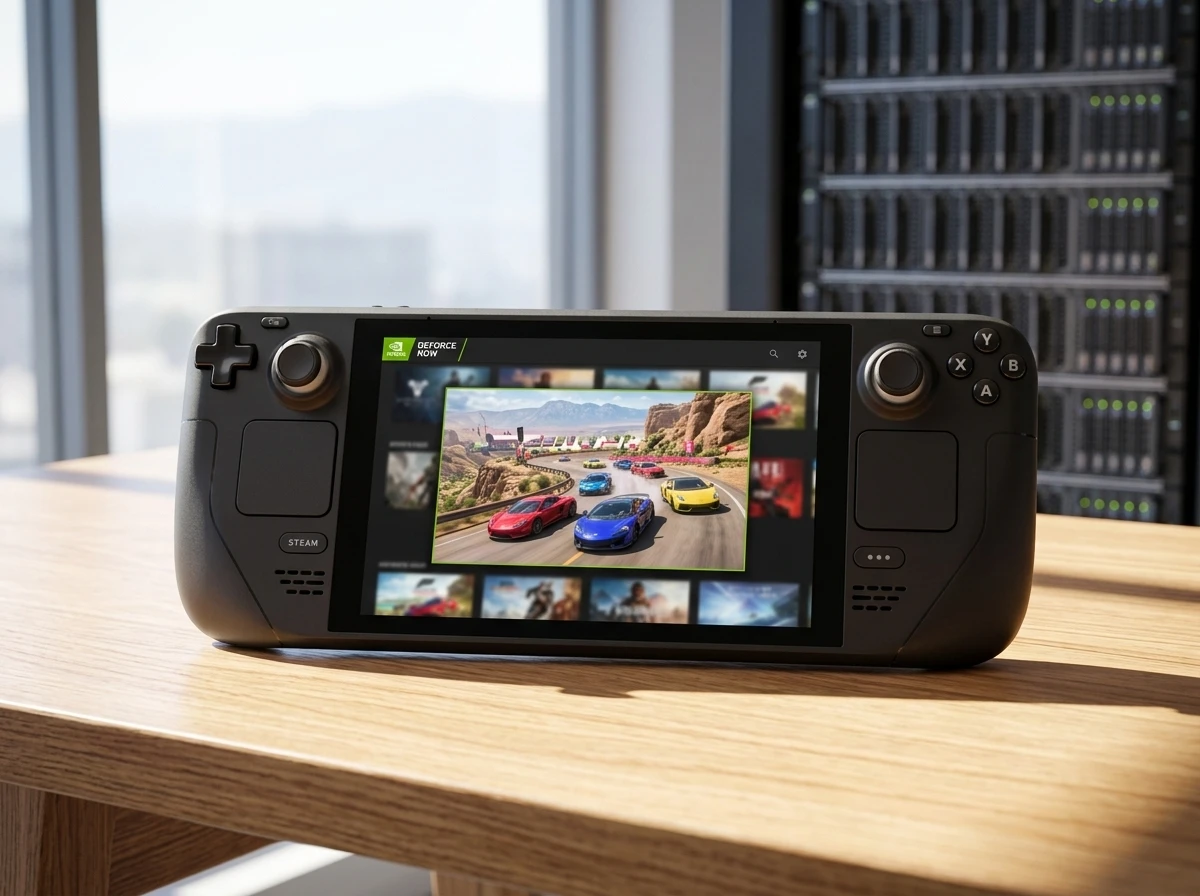
- Native Steam Deck support reaching 90 FPS
The RTX 5080 power streaming around the world reaches Ultimate tier first. Performance tier stays on earlier RTX hardware at lower resolutions. Free users face ads and short sessions on basic rigs.
Digital Foundry noted early 5080 streams delivering 4K 120 with G-Sync and 4:4:4 chroma that felt closer to a desktop than rival services. Latency sits in the low-80 ms range on good wired connections according to independent tests, enough for most single-player and many multiplayer titles.
That gap between tiers is deliberate. Ultimate gets the new silicon, the longer sessions and the priority queues. Performance keeps older cards and lower resolution targets. Free remains a trial lane with ads. The hardware step-up is therefore not universal; it is gated by membership level and by the pace of regional rollout.
On a strong wired link the low-80 ms latency range keeps single-player immersion intact and leaves most multiplayer titles playable. Pure competitive players still notice the difference against a local card, yet the same tests show the stream is no longer the soft option it once was for story-driven or mid-core play.
Titles That Show Off the Cloud Hardware
The source list holds up under the new servers. Several standouts push path tracing, large worlds and dense crowds that once demanded local high-end cards.
| Game | Why It Fits GFN 2026 | Key Tech |
|---|---|---|
| Cyberpunk 2077 + Phantom Liberty | Open Night City with dense detail stays smooth | Path tracing, DLSS |
| Baldur’s Gate 3 | Long sessions and complex battles load quickly | Stable high settings |
| Black Myth: Wukong | Boss fights and detailed environments stay sharp | RTX, DLSS |
| Forza Horizon 6 | Day-one May 2026 launch with big maps and cars | High frame rates on 5080 |
| DOOM Eternal | Recently expanded via Epic storefront | Fast action, high FPS |
| Diablo IV / Dragon’s Dogma 2 | Seasonal and open-world RPGs hold up | Cloud stability |
Multiplayer staples such as Fortnite, Counter-Strike 2, Call of Duty: Warzone, Apex Legends and Rainbow Six Siege remain core draws. Low-latency Ultimate tiers keep them playable for most users, though pure competitive players still report occasional input feel differences versus local hardware.
Indie and mid-tier hits fill the gaps: Hades II, Dave the Diver, Balatro, Vampire Survivors, Hollow Knight and Dead Cells all stream without friction. Racing fans get Assetto Corsa Competizione, WRC and Formula 1 titles alongside Forza.
The mix matters because the 5080-class servers are not reserved for a handful of showcase titles. Path-traced open worlds, long RPG campaigns, seasonal live-service games and lightweight indies all draw from the same upgraded pool. That breadth is what turns a hardware upgrade into a catalog-wide lift rather than a short list of demos.
How the Library Expands
GeForce NOW is not a game subscription vault. Players connect Steam, Epic Games Store, Ubisoft Connect, GOG, Battle.net and Xbox PC Game Pass libraries. Free-to-play titles sit ready. Owned games appear if the publisher has opted in.
The bigger 2026 shift is Install-to-Play. Premium members can download and run more than 2200 additional Steam titles that support cloud streaming onto temporary or persistent cloud storage. NVIDIA states the combined Ready-to-Play and Install-to-Play pool now exceeds 4000+ games waiting in the cloud.
- Steam remains the largest source
- Xbox PC Game Pass titles stream when available
- Epic and Ubisoft libraries fill popular gaps
- Weekly GFN Thursday adds keep the flow constant
August alone brings 26 new games throughout August, starting with eight titles that include World of Warships: Legends and several indie releases. Earlier months delivered Forza Horizon 6 and 007 First Light on or near launch day.
Persistent storage add-ons (200 GB, 500 GB, 1 TB) let players keep Install-to-Play games between sessions instead of redownloading every time. Single-session storage is included but clears when you log off.
The dual-track library is the practical mechanism. Ready-to-Play titles launch at once. Install-to-Play titles need a download step onto cloud storage, then behave like any other stream once the install finishes. Publisher opt-in still decides which owned Steam games cross that line, so the 2200-plus figure grows only as more studios flip the switch.
Who Benefits Most Right Now
The disruption hits hardest for anyone who never wanted a $1,500 desktop. Students, travelers, Mac users, living-room TV players and Steam Deck owners suddenly run modern AAA at high settings. A modest laptop or even a phone becomes the client.
Casual and mid-core players who log 40-70 hours a month get near-full value. The service also suits households that share one account across devices. In markets such as India, where the service went live earlier in 2026, the appeal of skipping a full rig is even stronger.
Heavy users and competitive specialists sit on the other side. A 100-hour monthly ceiling (introduced across tiers in late 2025) means roughly three hours a day. Extra blocks cost more. Any remaining publisher holdouts keep some owned Steam titles offline. Progress or installs can reset without paid persistent storage. Those players still buy or keep local hardware.
Cloud rivals feel the pressure too. Amazon’s own cloud gaming shift folded Luna deeper into Prime Video, showing how every major platform is rewriting its approach. GeForce NOW’s bring-your-own-games model plus 50-series power currently leads on raw fidelity for PC libraries.
| Player type | Typical monthly hours | Fit with current caps |
|---|---|---|
| Casual / mid-core | 40-70 | Near-full value inside the 100-hour ceiling |
| Heavy / daily | Near or above 100 | Overage packs or local hardware still needed |
| Competitive specialist | Variable, latency-sensitive | Playable on Ultimate, yet input feel can differ |
| Shared household | Split across devices | One account covers laptops, TVs and handhelds |
The table restates the same split already visible in the hour math and the device list. Value concentrates where playtime stays under the ceiling and where a tower was never the goal.
The Friction That Still Matters
Two structural limits define the experience in 2026.
What we know
- Ultimate tier priced at Ultimate membership at $19.99 per month (Performance $9.99)
- 100-hour monthly playtime cap on paid tiers; overage packs available
- Install-to-Play requires publisher opt-in and cloud storage choices
- RTX 5080 exclusive to Ultimate; rollout continues by region
What stays variable
- Exact server availability and queue times by location
- Which new releases land day-one versus delayed
- Multiplayer latency on Wi-Fi versus wired Ethernet
- Whether heavy users hit the hour wall regularly
Crowd conversation on X repeatedly flags the hour cap as the point where value flips. One widely shared post compared the annual cost of Ultimate against free self-hosted Docker solutions that stream a personal Steam library with no limits. Input lag complaints still surface in fast-twitch multiplayer. Visuals and single-player immersion draw far fewer complaints.
These limits also touch larger questions around permanent digital ownership. Streaming an owned game is convenient, yet the license and the hardware both sit somewhere else.
Pricing and caps therefore work as a filter. At $19.99 the Ultimate tier undercuts a $1,500 desktop on day one, yet the 100-hour ceiling and the storage add-ons reintroduce recurring cost for anyone who plays past the included block or wants installs to persist. The friction is not hidden; it is written into the membership sheet.
Recent Adds Point to Steady Expansion
GFN Thursday remains the reliable pulse. May brought Forza Horizon 6 and expanded 5080 coverage across nearly the full premium catalog. June and July mixed new releases with classics and demos. August’s slate mixes free-to-play naval combat, indie adventures and upcoming titles such as The Sinking City 2, Mortal Shell II and Resonance: A Plague Tale Legacy.
- May 19, 2026, Forza Horizon 6 launches on Steam, Xbox and Game Pass, day-one on GeForce NOW
- April-May 2026, RTX 5080 access broadens to most of the premium library
- August 6, 2026, Eight new titles including World of Warships: Legends; 26 total for the month
- Ongoing, Install-to-Play list grows weekly as more Steam publishers enable the feature
NVIDIA continues regional server builds (Toronto and others earlier in the year) so more players sit closer to low-latency pods. Day passes let anyone test Ultimate performance without a full month commitment.
The cadence is steady rather than spectacular. A day-one racing launch in May, a hardware wave across the premium catalog in the same window, then a 26-game August slate that opens with eight titles. Each GFN Thursday adds another slice. Server builds in places such as Toronto shorten the physical distance for more members, which is the quiet half of the latency story.
How Membership Tiers Shape Access
The service runs three clear lanes, and the 5080 upgrade makes the differences sharper than before.
- Ultimate at $19.99 per month: RTX 5080-class servers, up to 5K 120, priority queues, 8-hour sessions, native Steam Deck support to 90 FPS
- Performance at $9.99 per month: earlier RTX hardware, lower resolution targets, still inside the paid hour cap
- Free: ads, short sessions, basic rigs, useful mainly as a trial
Install-to-Play and the persistent storage add-ons (200 GB, 500 GB, 1 TB) sit on the paid side. Single-session storage clears at log-off, so anyone who wants installs to survive between nights pays for a storage tier on top of membership. The 100-hour monthly ceiling applies across paid tiers; overage packs extend it when needed.
Day passes sit beside the monthly plans. They let a player sample Ultimate performance and the 5080 pool without locking into a full month. That option matters for travelers, for Steam Deck owners testing cloud play, and for anyone weighing the hour math before committing.
Regional rollout still decides when the top lane appears. Ultimate receives the new servers first; coverage widens by market. Until a region finishes its build, even paying members can remain on prior hardware. The tier chart is therefore both a price list and a timetable.
Why the Bring-Your-Own Model Still Leads
GeForce NOW does not replace a storefront. It connects libraries the player already owns across Steam, Epic, Ubisoft Connect, GOG, Battle.net and Xbox PC Game Pass, then streams the titles publishers have allowed. Free-to-play games need no extra purchase. The 4000-plus total is the sum of Ready-to-Play stock plus the Install-to-Play Steam expansion.
That design keeps the service aligned with existing PC ownership rather than competing as another all-you-can-eat vault. When Forza Horizon 6 arrived day-one on Steam, Xbox and Game Pass, the same launch window opened on GeForce NOW. When DOOM Eternal expanded through the Epic storefront, it widened the cloud list too. Weekly GFN Thursday drops continue the pattern with a mix of free-to-play, indie and premium titles.
Rivals are rewriting their own approaches, including Amazon’s deeper fold of Luna into Prime Video. On raw fidelity for owned PC libraries, the combination of bring-your-own access and 50-series cloud hardware currently sets the pace. The remaining limits are the hour ceiling, the opt-in list and the distance to the nearest server pod, not the absence of a game the player already bought.
For households that share one account, the model also means one membership can feed a laptop, a TV, a phone and a Steam Deck without separate game installs on each device. The library travels with the login. That convenience is the quiet counterpart to the 5080 performance numbers.
For most people who want modern PC games without the tower, the power bill or the upgrade cycle, GeForce NOW in mid-2026 already delivers. The 5080 servers and expanded library removed the old hardware wall. The remaining caps simply decide how many hours that freedom costs each month.


Epomaker GX1 Open Back Headset Trades Isolation for Cheap Spatial Audio

Claude Code Auto Mode Defaults Because Humans Missed Too Many Risks

Zhongji InnoLight’s $6.8 Billion IPO Funds AI Optics Lead Amid US Risk

OpenAI Buys NextSlide and Steps Onto Microsoft’s Lawn

Gamescom Opening Night Live 2026 Already Locks Big Premieres for UK Fans

RTX 5080 Cloud Power Puts AAA Games on Any Screen in 2026

Moto G Max Puts Three-Day Battery Ahead of Specs Race

XRP Hovers Near $1 as XRPL Builds Institutional Rails Quietly

iOS 27 Beta 5 Puts AI Right in the Camera Viewfinder

Whatnot Hits $20 Billion as Live Auctions Fuel Boom and Debt

Fable 5 and Mythos 5 Return as US Lifts Anthropic Export Controls

Oracle Cuts 21,000 Jobs in a Year, Cites AI in 10-K Filing

SpaceX’s Google Deal Turns a Rocket Company Into a Cloud Landlord

CD Projekt Red Co-CEO: Redemption Arc Isn’t Done, Witcher 4 in 2027

XPL Rallies 30% Ahead of Plasma One Card Tier Launch

DGO App Brings Rs 549 Mobile Pass for FIFA World Cup 2026 in Nepal

Google Search Profiles Build a Follow Graph Inside Discover

Moonshot AI Targets $30 Billion in China’s Fastest AI Funding Sprint

Microsoft Xbox Layoffs Start in July as Sharma Slams 3% Margin

Oppo’s ColorOS 17 Eligibility List Leaves A-Series Buyers Behind
-
 AI1 month ago
Fable 5 and Mythos 5 Return as US Lifts Anthropic Export Controls
-
 AI2 months ago
Oracle Cuts 21,000 Jobs in a Year, Cites AI in 10-K Filing
-
 AI2 months ago
SpaceX’s Google Deal Turns a Rocket Company Into a Cloud Landlord
-
 GAMING2 months ago
CD Projekt Red Co-CEO: Redemption Arc Isn’t Done, Witcher 4 in 2027
-
 CRYPTO2 months ago
XPL Rallies 30% Ahead of Plasma One Card Tier Launch
-
 APPS2 months ago
DGO App Brings Rs 549 Mobile Pass for FIFA World Cup 2026 in Nepal
-
 NEWS2 months ago
Google Search Profiles Build a Follow Graph Inside Discover
-
 AI2 months ago
Moonshot AI Targets $30 Billion in China’s Fastest AI Funding Sprint