
AI
Microsoft’s 2.2 Million AI Chips Fit a 2 Gigawatt Slice
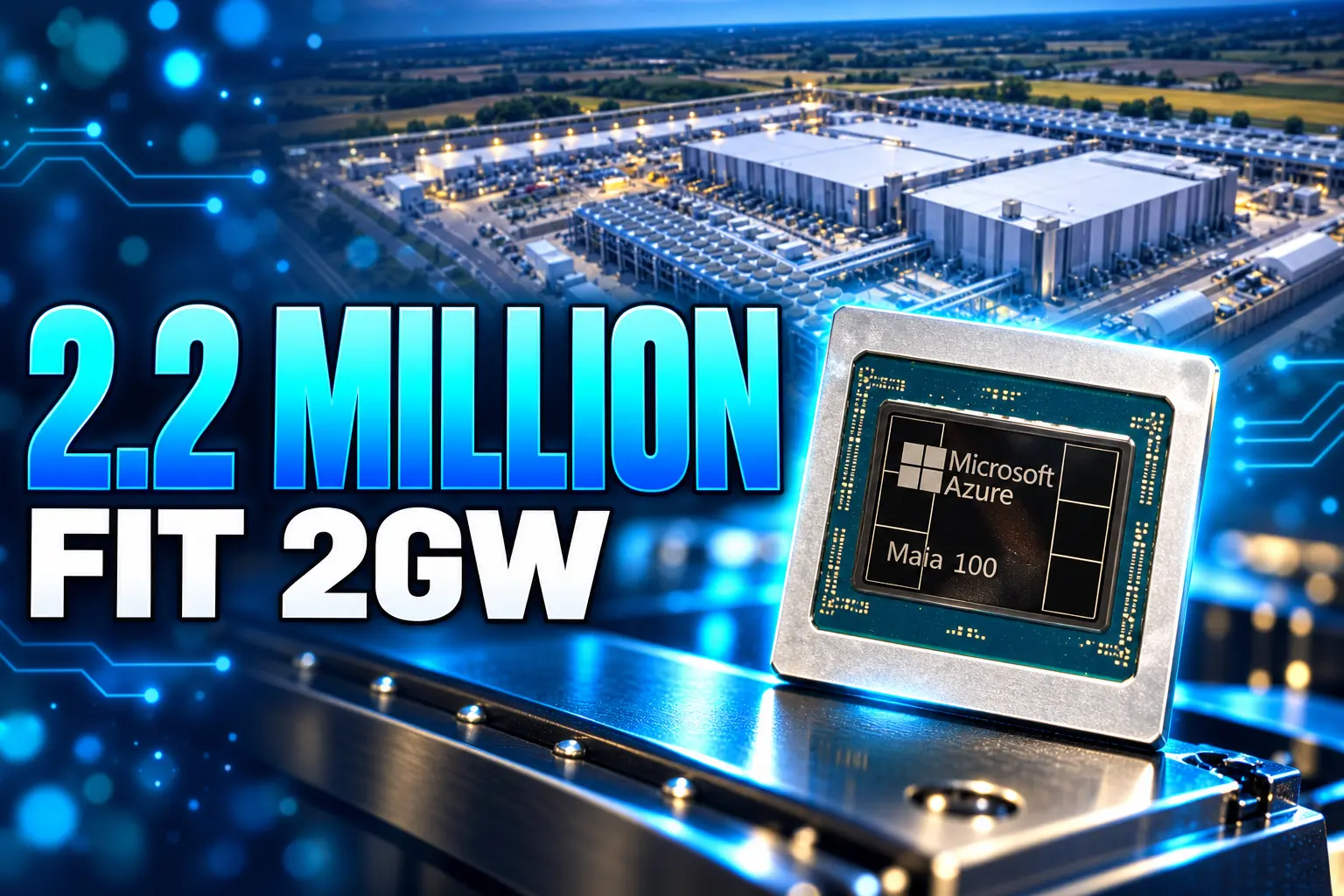
Internal documents put Microsoft at 2.2 million AI chips. That count fits about 2 gigawatts of AI halls, not the 6.4 million a full-estate conversion implied.

Internal documents from August put Microsoft’s installed AI chips at 2.2 million. Some experts treated that as a crisis, because a 10 gigawatt conversion would imply 6.4 million GPUs.
People familiar with the company’s plans said on September 10 that only about 2 gigawatts of a 12 gigawatt estate is built around AI-specific silicon. The gap is in that conversion, which treated almost every Microsoft gigawatt as a GPU hall. Microsoft is still short of powered AI floor, and it has turned work away. The chip count itself is not the hole those conversions described.
Only 2 Gigawatts of This Estate Is AI
The August documents said Microsoft had aimed for 1.8 million AI chips by the end of 2024. The 2.2 million now installed is 400,000 above that target, and people inside the company said the total had barely moved over the past year. That crawl is real. It is also the wrong comparison if the yardstick is every watt Microsoft owns.
The September briefing, which Microsoft declined to confirm, put the global datacenter network at about 12 gigawatts and said only about 2 gigawatts of that is built around accelerators made for the matrix math that large models need. The rest is ordinary cloud: CPUs, storage, and the mixed racks that still run most of Azure. Satya Nadella, Microsoft’s chief executive, told investors on July 29 that Cobalt VMs already carry first-party jobs and customer work for Adobe, Arm, Elastic, OpenAI, Sprinklr, and TomTom, and that Cobalt 200 racks were due in more than 25 datacenters by the end of that month.
Shaolei Ren, a professor at the University of California, Riverside, had already flagged the mix problem from another direction. He read Microsoft’s audited sustainability reports as describing something closer to 1.2 gigawatts of AI capacity in 2024, well below the 5 gigawatts the company said it had added as part of the AI build. “The sustainability reports are audited by a third party. They have more credibility than announcements,” Ren said. A 2 gigawatt AI slice in 2026 is a step up from that reading, not a collapse from a 10 gigawatt GPU campus that never existed as a single class of hall.
Microsoft has spent about $280 billion since 2022 on land, buildings, and compute, including $41 billion in the quarter ended June 30. Capital spending for calendar 2026 is expected at about $175 billion after a change in how long-term leases are classified, and the company told investors the next fiscal quarter would run over $50 billion. Roughly two-thirds of that money still buys CPUs and GPUs with short lives. The spend is not in doubt. What the spend buys, hall by hall, is.
How a Gigawatt Turns Into Chip Counts
Gigawatts became the public scoreboard because Nvidia does not publish customer volumes and Microsoft does not publish chip counts. Convert a gigawatt with crude watt-per-GPU math and you can mint a scandal out of a rounding choice. Abdeltawab Hendawi at the University of Rhode Island reviewed the method with Ren. An H100 draws 700 W. A rack with eight of those GPUs draws about 10 kW once you add the other chips on the board. Cooling and overhead eat the rest. Ren puts about 80 percent of an AI hall’s electricity on computer chips, in line with International Energy Agency figures; Microsoft’s 2024 sustainability report put IT load in new halls at 89 percent.
Treat 10 gigawatts as AI floor, apply the 80 percent factor, and divide by 10 kW per eight-GPU rack, and you land on 6.4 million chips. That is the paper figure that made 2.2 million look like a shortfall. Run the same steps on 2 gigawatts and the implied count falls to 1.28 million. Divide 2 gigawatts by 700 W with no rack overhead and you get 2.86 million. The internal 2.2 million sits between those two 2 gigawatt cases.
THE GW-TO-CHIP MATH
| Assumption | Implied chips |
|---|---|
| 10 GW treated as AI halls, 80 percent IT, 10 kW per 8-GPU rack | 6.4 million |
| 2 GW of AI-specific silicon, same rack method | 1.28 million |
| 2 GW divided by 700 W per H100, no rack overhead | 2.86 million |
| Internal count of installed AI chips, August 2026 | 2.2 million |
A Microsoft spokesperson said the company does not report volumes of specific chips, that its halls mix custom silicon with AMD, Intel, and Nvidia parts across generations, and that “the estimates shared with us are inaccurate, drawing the wrong conclusions from incorrect assumptions.” The company did not say which inputs were wrong. Nvidia did not comment.
Jensen Huang, Nvidia’s chief executive, said in March that orders for Blackwell chips from the top four customers came to 3.6 million. Microsoft has long been near the top of that list, which is why a simple four-way split pointed at something close to a million Blackwells. The August documents showed Microsoft holding well under that implied share. That can mean delayed installs, a smaller Nvidia mix than history suggested, or chips still in crates. It does not, by itself, prove the 6.4 million estate-wide conversion.
Fairwater’s First Hall Came Online in June
The August investigation used Fairwater, Microsoft’s flagship U.S. AI campus in Mount Pleasant, Wisconsin, as the exhibit. Nadella said in April the project was going live. Satellite frames still showed a partial site. In May, Microsoft told a Wisconsin paper the campus was not yet online. On June 23 the company said it had completed construction of its first datacenter facility in Mount Pleasant after bringing equipment online in April and running startup work, and that the hall was fully operational.
Brad Smith, Microsoft vice chair and president, said Wisconsin was now home to the world’s most powerful supercomputer. Nearly 10,000 construction workers had been on the job. Nearly 550 full-time staff are on site, with that number expected to reach about 800 when a second facility next door opens in 2028. Microsoft put local hyperscale construction spend at $4.7 billion between 2024 and 2028, with direct purchases from 29 businesses across 11 Wisconsin counties. The second hall is still foundations, steel, and underground utilities.
FAIRWATER’S PATH TO A LIVE HALL
- May 2024: Microsoft announces the Mount Pleasant campus.
- April 16, 2026: Nadella posts that Fairwater is going live, ahead of schedule.
- April 2026: Equipment comes online and startup work begins.
- May 2026: Microsoft tells a Wisconsin paper the campus is not yet online.
- June 23, 2026: The first facility is declared fully operational.
- 2028: The adjacent second facility is scheduled to finish.
Epoch AI, which scores AI campuses from satellites, permits, and disclosures, now lists Fairwater Wisconsin as operational with chips owned by Microsoft and likely used by OpenAI and Microsoft. It estimates 176,400 Nvidia B200 accelerators, or 446,000 H100-equivalents of live compute, on 369 MW of IT power at a capital cost of $14.0 billion. A May 15 satellite pass showed Building 1 live, Building 2’s shell nearly complete, and grading for a larger multi-building layout to the north. One live hall on a campus still being scraped is not a finished AI factory. It is also not a dark building.
Our Fairwater datacenter in Wisconsin is going live, ahead of schedule.
As the world’s most powerful AI datacenter, it will bring together hundreds of thousands of GB200s into a single seamless cluster.
Congrats to all the teams who made this possible! https://t.co/O586ioWkJK
— Satya Nadella (@satyanadella) April 16, 2026
Maia and AMD Never Enter That Tally
A headcount of Nvidia GPUs will miss the rest of Microsoft’s AI floor by design. Scott Guthrie, executive vice president for Cloud and AI, introduced Maia 200 on January 26 as an inference accelerator on TSMC’s 3 nm process, with 216 GB of HBM3e at 7 TB/s, 272 MB of on-chip SRAM, more than 10 petaFLOPS in FP4 and more than 5 petaFLOPS in FP8, inside a 750 W envelope. He said it delivers 30 percent better performance per dollar than the latest hardware then in the fleet, and that it would serve OpenAI’s GPT-5.2 models as well as Microsoft Foundry and Microsoft 365 Copilot.
On the July 29 call, Nadella said Maia 200 “continues to scale,” repeated the 30 percent performance-per-dollar claim, and added a separate figure: 40 percent better performance per watt when MAI models run on Maia 200. Those are not the same metric. He also said Microsoft would be among the first clouds to deploy AMD Helios and Nvidia Vera Rubin rack-scale systems. Helios packs 72 Instinct MI455X GPUs in a rack. None of that silicon shows up as an extra H100 in an Nvidia-only inventory.
The OpenAI relationship scrambles the books further. An April 27 amendment kept Microsoft as OpenAI’s primary cloud partner and said OpenAI products will ship first on Azure unless Microsoft cannot and chooses not to support the needed capabilities. OpenAI may now serve products on any cloud. Microsoft’s license to OpenAI models and products runs through 2032 and is no longer exclusive. Microsoft stopped paying a revenue share to OpenAI; OpenAI still pays Microsoft through 2030, at the same percentage, under a total cap. Some of Microsoft’s halls, Fairwater among them, are training and serving OpenAI work that would never appear as a neat line in a Microsoft GPU ledger.
WHAT A GPU HEADCOUNT MISSES
- Custom Maia: Inference racks that Microsoft designs and does not report as Nvidia units.
- AMD Helios: Rack-scale Instinct systems Nadella said Azure will take at volume.
- OpenAI’s slice: Fairwater compute that Epoch tags as likely used by OpenAI as well as Microsoft.
- Unplugged inventory: Bought GPUs waiting on finished, powered rooms.
- Neocloud offtake: GPUs rented from operators that never enter Microsoft’s owned-and-leased gigawatt map.
Nadella also said Microsoft has IP rights to OpenAI’s custom chip work as that lab designs with partners. Those designs, if they land in Azure, will not look like a Blackwell on a receiving dock either.
The Chips Are Waiting on Warm Shells
Nadella has already named the constraint, and it is not a missing shipment. On the All Things AI podcast late in 2025 he said the hard part was electrical power and putting halls close enough to that power.
If you can’t do that, you may actually have a bunch of chips sitting in inventory that I can’t plug in. In fact, that is my problem today. It’s not a supply issue of chips. It’s actually the fact that I don’t have warm shells to plug into.
Satya Nadella, chief executive, All Things AI podcast
Ren made the same point in plainer engineering terms. Announcing a gigawatt of power on paper in a single quarter is plausible. Energizing it and filling it with live training jobs in that same quarter is not. That wait is the same power bottleneck on Microsoft AI that turns a purchased GPU into a crate. The International Energy Agency, in an April 2026 update, described physical bottlenecks limiting data centre expansion: tight supply of gas turbines and transformers, strained chip and IT component chains, and planning systems that hold up grid connections. Data-centre electricity use rose 17 percent in 2025. AI-focused halls rose faster. Global data-centre load was about 415 TWh in 2024, or 1.5 percent of electricity demand, and the agency’s base case has that load doubling by 2030.
A live GPU still has to be docked, cabled, burned in, and joined to a cluster before it earns its keep. Nadella told investors Microsoft had reduced dock-to-live times for new GPUs by nearly 50 percent in its largest regions over fiscal 2026. That cut only matters if the room is already warm.
Neocloud Racks Stay Off the 38-Gigawatt Books
The September plan, again from people familiar with it and not from a Microsoft filing, is to take the estate from about 12 gigawatts to more than 38 gigawatts by 2032. That is 26 gigawatts of added halls in six years. AI-specific silicon is expected to grow from about 2 gigawatts to roughly one-third of the future total. The target covers company-owned campuses and long-term leases. It excludes compute rented from neoclouds such as CoreWeave.
That exclusion cuts both ways. The public gigawatt map understates the GPUs Microsoft can call when it is renting clusters. A chip inventory taken only from Microsoft-owned halls understates the other way. Rented racks are not a side channel. They are part of how Azure covers a training run it cannot seat on its own floor. Microsoft has already taken capacity originally lined up for OpenAI, including 30,000 Nvidia Vera Rubin chips at a Narvik, Norway campus through Nscale, on top of an earlier commitment at the same site.
Nadella said on the July 29 call that Microsoft added 31 new datacenters across five continents in the quarter, bringing the fiscal-year total to 88, and that it added another gigawatt of capacity, the third straight quarter at that pace. He said the company remains on track to roughly double overall capacity in two years. Fiscal 2026 revenue was $331 billion, up 18 percent. Microsoft Cloud was $214 billion, up 27 percent. Azure crossed $100 billion, up 41 percent. Copilot workload throughput rose 4X over the year. The financials show demand. They do not show how many of those new halls are GPU floors.
Azure Still Turns Work Away
People familiar with the 38 gigawatt plan said computing shortages had already forced Microsoft to turn away some AI and cloud business. That can be true next to a 2.2 million chip count. A 2 gigawatt AI slice sells out long before a 12 gigawatt estate looks empty. New racks are split among Copilot, paying Azure training jobs, and Microsoft’s own models, so a hall that is live on a satellite pass is not a free queue.
FY2026 BUILD SNAPSHOT
- New halls: 88 datacenters in the fiscal year, 31 of them in the June quarter across five continents.
- Added power: Another gigawatt in that quarter, the third straight quarter at that pace.
- Install speed: Dock-to-live GPU times down nearly 50 percent in the largest regions.
- Quarterly spend: $41 billion of capital expenditure in the June quarter, with about two-thirds on CPUs and GPUs.
Microsoft still will not publish a chip census. Nvidia still will not publish a customer mix. Until those numbers exist, gigawatt slides and satellite frames will keep getting converted into GPU tallies that cannot be checked. The August documents gave one rare installed count. The September briefing gave a mix for the estate those chips sit in. Building 2 at Mount Pleasant is still steel and dirt, with a 2028 date on the door.

Instagram Plus Tests a Read-Only Mode That Cuts Stories

Altman Asks the Public to Accept Some AI Harm

Google Freezes OSS VRP Product Reports After AI Flood

AI Agents Make Payment Rails the Scarce Prize

Turkey’s Crypto Boom Now Runs Through Three Banks

Fable 5 Came Back Under a Commerce On-Off Switch

Google’s SpaceX GPU Lease Has a Sept. 30 Deadline

Plasma One’s XPL Locks Face a 1.81 Billion Cliff

DGO’s Rs 549 World Cup Pass Cost Fans Sleep and Data

Moonshot AI’s $30 Billion Ask Became a $35 Billion Close
-
 AI4 months ago
Fable 5 Came Back Under a Commerce On-Off Switch
-
 AI4 months ago
Google’s SpaceX GPU Lease Has a Sept. 30 Deadline
-
 CRYPTO4 months ago
Plasma One’s XPL Locks Face a 1.81 Billion Cliff
-
 APPS4 months ago
DGO’s Rs 549 World Cup Pass Cost Fans Sleep and Data
-
 AI4 months ago
Moonshot AI’s $30 Billion Ask Became a $35 Billion Close
-

 NEWS4 months ago
ColorOS 17 Device List Spans Oppo, OnePlus and Realme
-

 GAMING4 months ago
Xbox Cuts 3,200 Jobs After Five Years of Thin Returns
-
 GAMING4 months ago
The RTX 4050 Under Rs 70,000 Hides a Wattage Gap