
NEWS
Google Turns 2,000 Pixel Folds Into a Campus Cloud
Google and UC San Diego are wiring 2,000 Pixel Fold boards into a 50-server class cloud, a junk-drawer test rather than an AI hall.

UC San Diego is assembling a campus cloud from 2,000 retired Pixel Fold phones, with Google supplying the handsets and the research. The boards will run Linux and Kubernetes for classwork, and Google puts the stack at about 50 server-equivalents.
In a June 12, 2026 post, Jennifer Switzer, a visiting postdoctoral researcher at Google, and David Patterson, a Google Fellow, called the method phone cluster computing. The target is grading, Jupyter notebooks, and other small cloud jobs, not training a frontier model.
UC San Diego Is Wiring 2,000 Pixel Folds Into a Cloud
Ryan Kastner, an associate professor of computer science at UC San Diego, said the project was Switzer’s idea from her Ph.D. years on campus, and that Google is sending 2,000 Pixel Fold units. A 2023 Fold is the same generation Google used in its public chip comparison.
Each Fold board carries a Tensor G2 chip with two 2.85 GHz Cortex-X1 cores, two Cortex-A78 cores, four 1.80 GHz Cortex-A55 cores, a Mali-G710 GPU, and 12 GB of memory. That is a handful of Arm cores and a laptop’s worth of RAM, not a dual-socket server. Google’s write-up on phone cluster computing at campus scale says the single-thread speed of those performance cores still lands on par with, or ahead of, cores in a modern rack machine.
The comparison device is an ASUS RS720A-E11, a dual-socket rack server, measured with the SPEC CPU 2017 per-core tests. Phones lose on core count and memory capacity. They win, on several of those tests, when you look at one fat core at a time.
Kastner told interviewers the donated Folds are a way to put thrown-away compute back to work, and that shredding phones for scrap is a poor use of the silicon still on the board. Computer science classes in Parallel Computation and Systems Programming are first in line. He said other departments could move some of their jobs onto the same racks later.
What a Phone Cluster Can Run
Google is blunt about the fit. Most campus ed-tech, grading, and research jobs already live on small cloud instances, and a single smartphone can host a large share of them. The example backend is Amazon’s t3.micro, which is 2 vCPU and 1 GB of memory.
A 20-phone test handled peak assignment traffic for a class of more than 75 students, with grading latency below that default AWS path. The plotted load needed at least 50 t3.micro instances. One matrix-multiply assignment ran about 50 seconds on a single device, and the latency numbers include the time to schedule the job across the cluster.
That is the specimen. It is a bursty, CPU-heavy homework kernel, not a training run. Kastner said function-as-a-service jobs look like a natural match because they come in spurts and do not need high-end machines. The 2,000-board rollout is sized for a hundred classes of that 75-student shape at once.
People keep mapping the same photo to a farm of chat models. The Tensor G2 board still does not expose its tensor unit to the Linux stack the team has running, and GPU support arrived only after a long port. The work Google published is the 50-second multiply and the t3.micro-class grader, which is a different machine from an AI hall.
Today on the blog, we discuss a pathway for the second life of phones through the exploration of “phone cluster computing”, which can directly reduce the environmental footprint of computing by avoiding the need for further raw material extraction. More →https://t.co/FFUNjfaEm5 pic.twitter.com/Fvs7ju2r0Y
— Google Research (@GoogleResearch) June 12, 2026
Batteries Out, Ethernet In
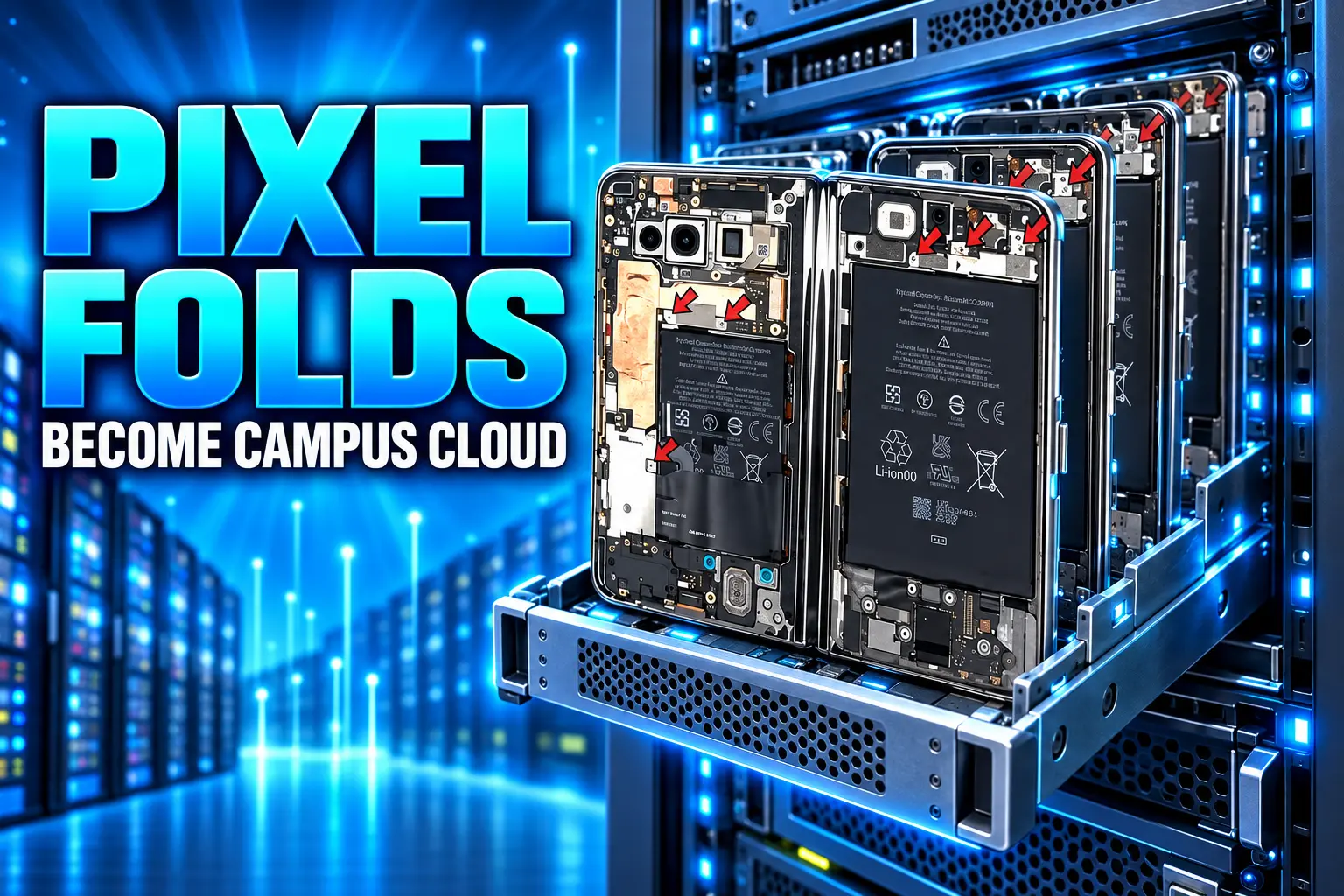
A stock phone is a bad rack part. The display, camera, chassis, and battery eat space, and Google engineers told the UC San Diego group that lithium packs are a fire hazard in a data hall. For the Fall 2026 stack, Google is using a contractor to pull motherboards out of the cases.
HOW A FOLD BECOMES A NODE
- The salvage: Display, battery, chassis, and cameras come off; the motherboard stays, because Google’s internal carbon work puts about 50% of a Pixel’s making-emissions in that board.
- The OS swap: Android’s userland is replaced with a general-purpose Linux distro, which also turns off the low-memory killer that would throttle a hungry server job.
- The network: Cellular and Wi-Fi are out at this scale; custom boards feed power and break out wired Ethernet.
- The control plane: Kubernetes groups 25 to 50 boards into a self-managing cluster, the same scheduler used in ordinary clouds.
- The tray: Kastner said each phone server fits a standard data-center tray, with dozens of stripped boards per tray still being counted.
Linux on the Fold, including the Mali GPU, took serious port work. The on-die tensor block is still out of reach. Until that changes, the cluster is a CPU and GPU farm of mobile parts, not a Gemini box built from leftovers.
Assurant’s trade-in data, which Google cites, puts typical phones replaced every four years. A Fold that left a store in 2023 is inside that window. Pixel software support windows still decide when a handset is treated as retired even if the board boots.
Twenty Boards Beat a Tiny Cloud Instance
The arithmetic Google wants readers to take away is simple, and it is not “one phone equals one server.” It takes a pile of boards to match a rack CPU, and a smaller pile to replace a cheap cloud VM for homework.
HOW THE 2,000-BOARD MATH LANDS
| Setup | What it is asked to do | What Google and UC San Diego report |
|---|---|---|
| 20 Pixel Fold boards | Peak grading for 75+ students | Latency below the default AWS backend |
| 25 to 50 boards | SPEC-style throughput | About one modern server |
| 2,000 donated Folds | Parallel Computation and Systems Programming | About 50 server-equivalents, 100 classes |
| AWS t3.micro (2 vCPU, 1 GB) | The campus grading baseline | At least 50 instances for the 20-phone load |
At 2,000 boards, the university gets a private cloud that would otherwise be bought as new servers or rented as a swarm of tiny VMs. Google frames that as 50 server-equivalents at a fraction of the usual cost, plus a testbed for how consumer parts age when they never sleep.
That is the second move hiding in the press photo. A cracked screen no longer kills the asset if the contractor only needs the board. Repair shops still want working displays. A campus rack wants the Tensor package, the RAM, and a port for Ethernet. Those are different buyers for the same dead handset.
The Idea Started on Pixel 3A Phones
The Fall 2026 rack is a scale-up of work Switzer, Gabriel Marcano, Kastner, and Patrick Pannuto put on arXiv in October 2021 and then into ASPLOS in 2023. The paper on repurposing discarded smartphones to cut carbon built a cloudlet from reused Pixel 3A phones and argued that even decade-old handsets can host modern cloud microservices.
Kastner’s lab said in January 2026 that Switzer had defended the thesis, that the ASPLOS paper took a Distinguished Paper Award, and that Google grants were already funding racks for campus. Patterson’s name on the June blog is the public handoff from that lab into Google Research.
FROM A LAB CLOUDLET TO A 2,000-BOARD HALL
- October 2017: Samsung’s C-Lab shows a Bitcoin mining stack of 40 Galaxy S5 phones, and says eight of them beat a Core i7-2600 desktop on mining efficiency.
- October 2021: Switzer’s group posts Junkyard Computing, with a Pixel 3A cloudlet and a claim that 1.5 billion smartphones ship each year.
- March 2023: The ASPLOS version appears, aimed at extending device life so new servers do not have to be made.
- January 2026: Switzer defends at UC San Diego; the lab cites NSF money and Google grants for campus racks.
- June 12, 2026: Google Research publishes the 2,000-phone plan with Patterson, and says the full system should launch in Fall 2026.
Samsung’s 2017 demo was a conference stunt on a custom OS. The UC San Diego build is meant to sit on trays, speak Ethernet, and take real class traffic for a full term. If the boards hold up, Kastner said the cluster could grow past 2,000.
Two Thousand Boards Against Billions of Idle Phones
The climate case Google wants is about making emissions, not the power bill of a training cluster. Operational carbon can be cut with cleaner electricity. The carbon already spent to fab a Tensor package is sunk unless the board keeps working. Reusing the motherboard, in that framing, avoids another round of mining and fab for a small server.
Set against the junk drawer, 2,000 Folds are a rounding error. UNITAR and the WEEE Forum said in 2022 that the world held 16 billion mobile phones and that 5.3 billion phones left unused that year. Stacked flat at 9 mm, that pile would rise about 50,000 km.
THE DRAWER THE CLUSTER DOES NOT EMPTY
- Idle phones, 2022: UNITAR put 5.3 billion mobiles dropping out of use that year, most headed for drawers, closets, or bins.
- E-waste mass, 2022: The Global E-waste Monitor counted 62 million tonnes of discarded electronics.
- Documented recycling: Only 22.3% of that 2022 mass was logged as properly collected and recycled.
- 2030 path: The same monitor puts generation on track for 82 million tonnes, with small IT gear (phones, laptops, routers) at 4.6 million tonnes and a 22% recycling rate.
A campus rack that keeps 2,000 boards in service does nothing to those headline tonnes. What it can do is change the bid for a board that still boots. Recyclers want gold and copper. DePIN networks that already rent idle phones for tiny jobs want the same unused stock. A university that will take a screenless Fold wants the SoC. Those three markets now sit on one SKU: a phone whose glass is worthless and whose processor is not.
Consumer Boards Were Never Rated for a Rack
Google listed reliability under sustained use as the question the 2,000-board hall is built to answer. Phones were designed for pockets, thermal throttling, and a few years of mixed duty, not for trays that stay on. Failure rates, mixed device generations, and the cost of pulling 2,000 boards are still open.
WHAT WE KNOW
- The workload: Early 20-board tests beat a default AWS grader on a 75-student class, and Google sizes 2,000 boards at 50 server-equivalents.
- The hardware path: Batteries and glass come off; Linux and Kubernetes go on; power and Ethernet arrive on a custom PCB.
- The carbon bet: Keep the motherboard, which Google’s Pixel environmental work treats as about half the making-emissions, instead of buying a new small server.
WHAT IS UNCONFIRMED
- Go-live: The full cluster is still described as a Fall 2026 launch; there has been no public confirmation that the 2,000-board hall is in production.
- Rack life: How fast consumer boards die when they run 24 hours is the measurement the deployment is supposed to take.
- Security and TPU: Wired Ethernet removes the radio path, but the tensor unit is still dark, and no commercial SLA has been published.
The power squeeze on new AI halls is a different market. This stack does not replace the GPUs those halls buy, and it will not move a utility interconnection queue. It can pull a slice of university cloud spend off t3.micro-class instances and off a purchase order for fifty new general-purpose boxes.
It’s just a vast amount of sort of thrown away compute and recycling is a terrible option for most of these smartphones.
Ryan Kastner, associate professor of computer science, University of California San Diego
If the first term goes cleanly, Kastner said the cluster can grow. The test that matters is whether a Tensor G2 board, with its battery and glass gone, still looks cheap after months of class traffic, not whether a photo of 2,000 Pixels can stand in for an AI factory.

Instagram Plus Tests a Read-Only Mode That Cuts Stories

Altman Asks the Public to Accept Some AI Harm

Google Freezes OSS VRP Product Reports After AI Flood

AI Agents Make Payment Rails the Scarce Prize

Turkey’s Crypto Boom Now Runs Through Three Banks

Fable 5 Came Back Under a Commerce On-Off Switch

Google’s SpaceX GPU Lease Has a Sept. 30 Deadline

Plasma One’s XPL Locks Face a 1.81 Billion Cliff

DGO’s Rs 549 World Cup Pass Cost Fans Sleep and Data

Moonshot AI’s $30 Billion Ask Became a $35 Billion Close
-
 AI4 months ago
Fable 5 Came Back Under a Commerce On-Off Switch
-
 AI4 months ago
Google’s SpaceX GPU Lease Has a Sept. 30 Deadline
-
 CRYPTO4 months ago
Plasma One’s XPL Locks Face a 1.81 Billion Cliff
-
 APPS4 months ago
DGO’s Rs 549 World Cup Pass Cost Fans Sleep and Data
-
 AI4 months ago
Moonshot AI’s $30 Billion Ask Became a $35 Billion Close
-

 NEWS4 months ago
ColorOS 17 Device List Spans Oppo, OnePlus and Realme
-

 GAMING4 months ago
Xbox Cuts 3,200 Jobs After Five Years of Thin Returns
-
 GAMING4 months ago
The RTX 4050 Under Rs 70,000 Hides a Wattage Gap