
NEWS
Apple Prices iPhone Duo at $1,999 and Skips the Base Model
Apple priced iPhone Duo at $1,999 and held the regular iPhone 18 for spring, as memory costs split the fall lineup.

Apple unveiled the iPhone 18 Pro, iPhone 18 Pro Max, and a $1,999 foldable called iPhone Duo on September 9, and left the regular iPhone 18 off the stage. Pro pre-orders opened September 12, with stores getting those phones September 18; the fold waits until October 23.
John Ternus, eight days into the CEO job, called Duo the biggest iPhone change since the original. The phone most people actually buy was not in the room.
Apple Left the Regular iPhone Off the Stage
The “Surprise and Shine” keynote at Apple Park was a three-phone show: two Pro slabs and the first foldable iPhone. There was no iPhone 18, no iPhone 18e, and no second Air. Watch Series 12, Watch Ultra 4, and AirPods 5 filled the rest of the hour.
That split is the product plan, not a last-minute cut. Apple still sells last year’s iPhone 17 if you want a non-Pro handset this fall. The new cheap and mid phones, if they arrive, are a spring 2027 problem.
Ternus inherited a memory market Tim Cook had already called unsustainable. Mac and iPad prices moved in June. The iPhone answer in September was a narrower line, a $100 Pro bump, and a halo fold that does not ship with the Pros.
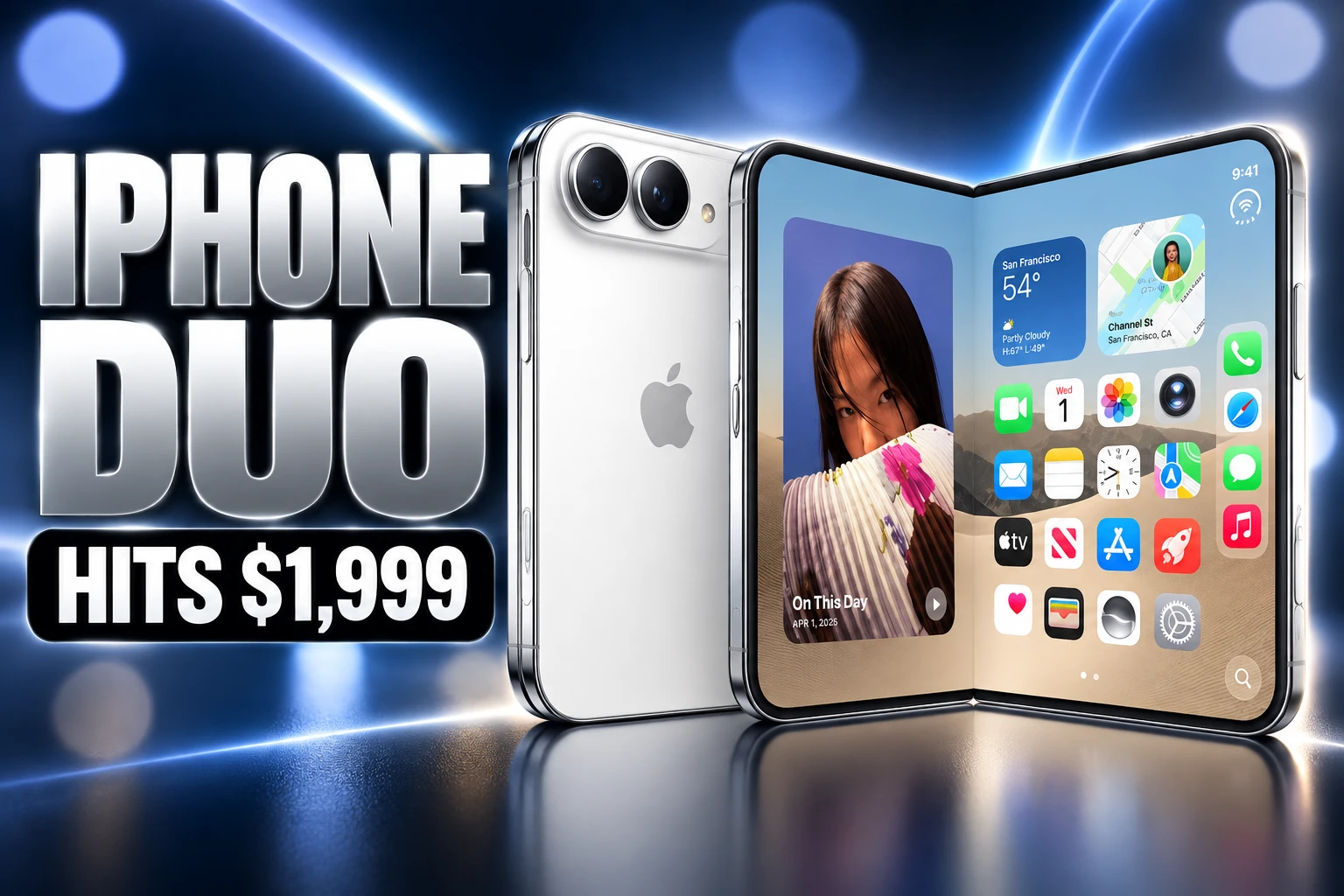
$1,999 for a Fold That Ships in October
Duo opens at $1,999 for 256GB, which is $800 above the 18 Pro and $700 above the 18 Pro Max. The 2TB Duo is $3,199. Samsung’s Galaxy Z Fold 8 still starts at $1,899, so Apple came in $100 higher than that book-style rival and $100 under the scariest pre-event guesses that had the fold crossing well past $2,000.
The calendar gap is exact. Pro phones reach stores September 18. Duo pre-orders open October 16 and the phone is due October 23, five weeks later (35 days). Apple listed more than 70 countries and regions for that first Duo wave, with 28 more on October 30.
FALL 2026 IPHONE PRICES
| Model | 256GB | 512GB | 1TB | 2TB | In stores |
|---|---|---|---|---|---|
| iPhone 18 Pro | $1,199 | $1,399 | $1,799 | $2,399 | September 18 |
| iPhone 18 Pro Max | $1,299 | $1,499 | $1,899 | $2,499 | September 18 |
| iPhone Duo | $1,999 | $2,199 | $2,599 | $3,199 | October 23 |
The 18 Pro’s $1,199 start is $100 above last year’s 17 Pro at $1,099. Some pre-event estimates had put the Pro near $1,299. Apple took the smaller step on the slab and put the real premium on the fold, then asked buyers to wait for it.
A Passport When Closed, an iPad Mini When Open
Closed, Duo is built to sit in a pocket like a passport, with a 5.4-inch outer Super Retina XDR screen that Apple says holds 90 percent of the 18 Pro’s screen area. Open, the 7.6-inch inner panel is 50 percent larger than the 18 Pro Max and is the largest screen Apple has put on an iPhone. Both panels share the same aspect ratio, so a layout does not jump when the book opens.
iPhone Duo is the most transformational change to iPhone since the original. With an entirely new design and intuitive experiences, it shows what’s possible when hardware and software are engineered together and redefines what it means to use a foldable phone.
John Ternus, CEO, Apple newsroom
Apple says the open body is the thinnest iPhone it has shipped, at 5.2 mm, in grade 5 titanium with a mirror polish. The phone weighs 254 grams, a bit more than the 211-gram 18 Pro. Unlock is Touch ID in the side button, with Apple Watch as a backup, because there is no room for the usual TrueDepth Face ID stack.
WHAT APPLE PUT IN THE DUO
- Two screens: 5.4-inch outer and 7.6-inch inner, both with ProMotion, Always On, and 3,000 nits peak outdoor brightness, plus a nano-texture inner finish meant to cut glare and hide the crease.
- Chip and cooling: The same A20 Pro as the Pro phones, a vapor chamber, and a dual-battery pack Apple rates at up to 44 hours of video on the outer screen, 31 hours on the inner screen, and 24 hours if you mix both.
- Cameras: 48MP Fusion Main with 2x optical-quality telephoto, the same 48MP Fusion Ultra Wide as the 18 Pro, an under-display FaceTime camera, and software tricks such as Smart Take, Duo Preview, and Duo FaceTime on the cover screen.
- Finish and durability: Star White or Night Sky, Ceramic Shield 2 on the front, IP68, a hinge Apple says uses more than 100 parts, and Apple Pencil with USB-C due later this year.
Hands-on clips from the event keep pausing on that matte inner panel, which reads almost like paper under the new software. The crease is still there if you look. The closed book is wide for a jeans pocket, and a case would add more bulk, which is the objection that stuck after the price shock faded.
You also do not get the Pro’s variable-aperture main camera or its longer telephoto. The $800 is for the two screens and the hinge, not a better camera system.
Why the Base iPhone 18 Is Missing
Apple did not say the regular iPhone 18 is cancelled. It also did not put one on the table. That silence matches a year in which memory stopped being a rounding error on the bill of materials.
On June 17, Cook told interviewers that price increases had become unavoidable. “We’ve been trying to shield our customers from the increases, but the situation has become unsustainable,” he said. On June 25 the company moved Mac and iPad tags: the MacBook Air went from $1,099 to $1,299, a 1TB MacBook Pro from $1,699 to $1,999, the MacBook Neo from $599 to $699, and the 128GB iPad Air from $599 to $749. An Apple statement blamed “an extraordinary surge in demand for memory and storage” from AI data centers, and said the firm had “never seen a component price increase this much, this quickly.”
Industry tracker TrendForce had DRAM up as much as 98 percent in the first quarter of 2026. TechInsights, publishing the day after the iPhone event, still had mobile DRAM and NAND prices climbing through the launch window and into 2027.
MOBILE MEMORY AT LAUNCH
- LPDDR5 96Gb: About $165 in September, up $25 from June, with a March 2027 read of about $183.
- 256GB TLC UFS NAND: About $82 in September, up $14 from June, heading toward about $92 by March 2027.
- Share of the phone: Memory is more than 30 percent of the bill of materials on a premium device, and about 60 percent on devices under $400, per the same tracker.
That mix is why a $1,999 halo is easier to ship than a $799 iPhone 18 that still needs DRAM, NAND, and a 2nm chip. Analyst Nabila Popal had warned that $50 iPhone bumps were over and that Pro hikes might run as high as $200. Apple kept the slab increase to $100 and withheld the volume SKU instead.
WHAT WE KNOW
- Fall hardware: iPhone 18 Pro, iPhone 18 Pro Max, and iPhone Duo are announced, priced, and dated.
- No base model: Apple did not announce an iPhone 18, iPhone 18e, or iPhone Air 2 on September 9.
- June precedent: Mac and iPad prices already moved on memory, and iPhone was the line left untouched until this event.
WHAT IS UNCONFIRMED
- Spring names: Supply-chain notes still point to an iPhone 18, an 18e, and a second Air in March or April 2027. Apple has not confirmed those products or those dates.
- RAM on the box: Apple did not state a gigabyte figure on stage for any of the new phones.
- How long the squeeze lasts: Cook said in the spring the crunch would not end soon. TechInsights still has both DRAM and NAND rising after launch.
If you wanted a new non-Pro iPhone in September, the company pointed you at last year’s 17, or at a Pro.
The 2nm Chip Finally Reaches iPhone
All three new phones run A20 Pro, Apple’s first iPhone chip on a 2nm process. Apple lists a 6-core CPU, a 7-core GPU it says can run up to 40 percent faster, a dual 16-core Neural Engine, and 50 percent more memory bandwidth than A19 Pro, which it calls the widest memory interface it has put in an iPhone. Packaging sits the die beside the memory, a layout borrowed from Mac chips.
Those gains are why the fall phones can carry the heavier iOS 27 and Siri AI stack. They are also why the chip is expensive in a year when wafers and DRAM both cost more. A separate look at how much of the A20 Pro gain is process math is the right companion to Apple’s stage percentages, which mix node, core counts, and bandwidth.
Spec listings and supply-chain notes put 12GB of DRAM in the Pro phones and in Duo. Apple did not read that number out. Even so, the company spent the hour on on-device models, a 50 percent bandwidth jump, and camera features that run on A20 Pro. The wider memory for on-device AI is the part of the chip story that matches the missing base phone: the AI stack is being provisioned first where Apple can still charge for it.
What $1,199 Buys on the 18 Pro
The 6.3-inch iPhone 18 Pro is the phone Apple expects most upgraders to order this month, and iPhone 18 Pro starts at $1,199 for 256GB. The 6.9-inch Pro Max starts at $1,299. Both add a 2TB option, at $2,399 and $2,499. Colors are burgundy, glacier, silver, and black. Greg Joswiak, Apple’s senior vice president of worldwide marketing, said the work went into camera, performance, battery, and intelligence, and that the steps were not small.
The 48MP Fusion Main camera gets a variable aperture Apple documents at ƒ/1.48, ƒ/1.8, ƒ/2.8, and ƒ/4.0, so the lens can open for night shots or stop down for depth. The Pro keeps a 48MP telephoto with up to 8x optical-quality reach and LiDAR, which Duo does not match. eSIM-only Pro models are rated for up to 36 hours of video playback; the Pro Max is rated for 45 hours. Apple says a wired 18 Pro can hit a 50 percent charge in about 15 minutes.
Pre-orders for those two opened at 5 a.m. PT on September 12. They are due in stores September 18 in 65 launch markets. Anyone rolling an older Pro into that order is already inside the September trade-in window on Pro models, which is the practical deadline if you do not want last year’s quote on this year’s slab.
Nine Gigabytes for the Phones That Wait Until March
TF International Securities analyst Ming-Chi Kuo wrote in June that iOS 27 would lean harder on Apple Intelligence, and that “lower-end 1H27 iPhones, powered by the A20 chip, will move to 9GB DRAM (1.5GB × 6 dies), up from 8GB (2GB × 4 dies) in the current A19 models.” That 9GB figure is a 1GB bump, not the 12GB jump earlier rumors had put on the base iPhone 18. Kuo’s fall phones stay on the 12GB side of that split.
Nine gigabytes is an odd number on purpose. Six smaller dies cost less than stuffing the same package with the Pro’s memory map, and they still give iOS more room than the 8GB A19 phones. Whether that is enough for every iOS 27 Apple Intelligence feature is a question Apple can answer in the spring, when those phones either show up or do not.
THE SHIP DATES APPLE SET
- September 9, 2026: Apple announces iPhone 18 Pro, iPhone 18 Pro Max, and iPhone Duo at the Surprise and Shine event.
- September 12, 2026: Pro pre-orders open at 5 a.m. PT.
- September 18, 2026: iPhone 18 Pro and iPhone 18 Pro Max reach stores.
- October 16, 2026: iPhone Duo pre-orders open at 5 a.m. PT in more than 70 countries and regions.
- October 23, 2026: Duo ships, with 28 more countries due October 30.
The fold is real, named, and priced. The Pro is a $100 hike with a new aperture and a 2nm chip, and it is the phone you can actually order now. The regular iPhone 18, if it still exists as a 9GB spring product, is how Apple keeps memory in the SKUs that can pay for it.

Twelve South’s $40 Cube Fills the Wired CarPlay Gap

The Yemen Cell Kept Claude’s Flight Code After the Ban

Unofficial AI Pages Beat Marshall County’s Sheriff to Every Scare

The SEC Crypto Rule Leaves Exchanges Still Exposed

Brian Bengs Bets His Senate Race on an AI Stop

Fable 5 Came Back Under a Commerce On-Off Switch

Google’s SpaceX GPU Lease Has a Sept. 30 Deadline

Plasma One’s XPL Locks Face a 1.81 Billion Cliff

DGO’s Rs 549 World Cup Pass Cost Fans Sleep and Data

Moonshot AI’s $30 Billion Ask Became a $35 Billion Close
-
 AI3 months ago
Fable 5 Came Back Under a Commerce On-Off Switch
-
 AI4 months ago
Google’s SpaceX GPU Lease Has a Sept. 30 Deadline
-
 CRYPTO4 months ago
Plasma One’s XPL Locks Face a 1.81 Billion Cliff
-
 APPS4 months ago
DGO’s Rs 549 World Cup Pass Cost Fans Sleep and Data
-
 AI4 months ago
Moonshot AI’s $30 Billion Ask Became a $35 Billion Close
-

 NEWS4 months ago
ColorOS 17 Device List Spans Oppo, OnePlus and Realme
-

 GAMING4 months ago
Xbox Cuts 3,200 Jobs After Five Years of Thin Returns
-

 GAMING3 months ago
The RTX 4050 Under Rs 70,000 Hides a Wattage Gap