
GADGETS
Sony Bravia Theater Trio Splits Sound for Huge TVs
Sony’s $2,200 Bravia Theater Trio splits the soundbar for 80-inch TVs, then still asks you to buy a subwoofer and rears.

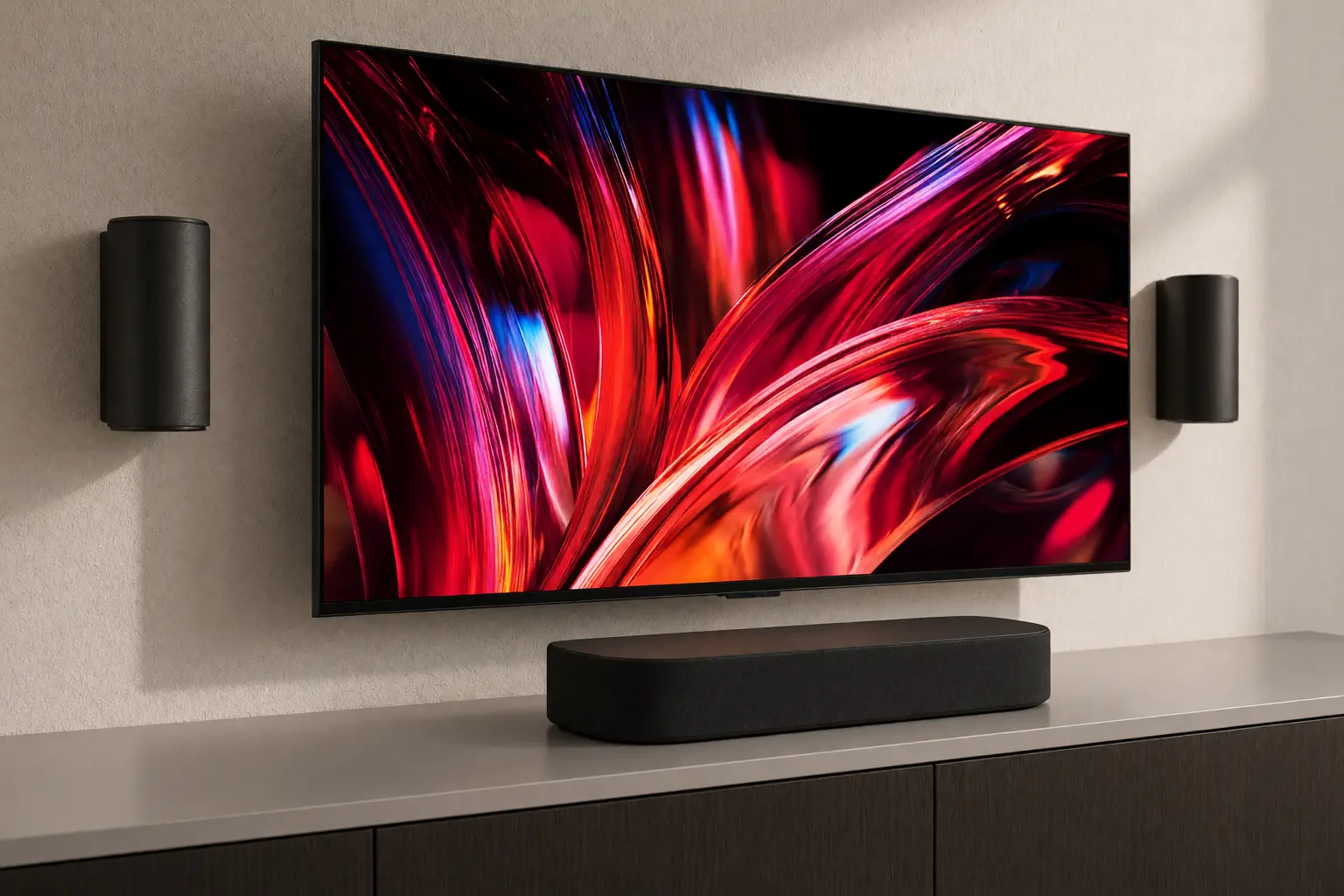
Sony priced the Bravia Theater Trio at $2,199.99 as a three-piece answer to TVs that make a 50-inch soundbar look like a toy. The HT-A8 puts a short center speaker under the screen and two wireless towers at the sides. It is a 3.0.2 setup with no subwoofer in the box.
Review notes keep landing on the same verdict: good for huge sets, then buy more gear. That second shopping trip is how Sony is pricing the first year of a market the rest of the soundbar aisle still treats as a wider living room.
Eighty-Inch Sets Are the Only TV Segment Growing
Omdia puts shipments of TVs 80 inches and larger at 9 million units in 2025 and more than 13 million by 2029, a 44 percent rise. The firm’s wider TV forecast barely moves, from 209 million sets to 211 million over the same stretch. Cheap LCD panels, not OLED, are doing the work, with TCL pushing 85- and 98-inch models and Hisense filling in 100-inch screens.
THE ULTRA-LARGE TV COUNT
- 80-inch class, 2025: Omdia counts 9 million TVs 80 inches and up, already a real slice of living rooms rather than a novelty aisle.
- Same class, 2029: The firm expects that group to clear 13 million units, with China and North America carrying most of the volume.
- The rest of the market: Total TV shipments are forecast at 209 million in 2025 and 211 million in 2029, so almost all of the growth sits in the jumbo sizes.
- 100-inch race: Hisense said it took 55.1 percent of 100-inch shipments in the first half of 2026, per Omdia figures the company released.
Matthew Rubin, Omdia’s principal TV analyst, tied the jump to price, not a sudden love of home cinema rooms.
Considerably lower prices for ultra-large TVs are making this premium category accessible to many more consumers.
Matthew Rubin, Principal Analyst for TV, Omdia
A flagship soundbar can run past 50 inches wide and still sit like a thin stripe under an 85-inch panel. Dialogue and effects then bunch in the middle of a screen that now spans most of a wall. Sony’s own product line for the Trio calls that problem out in plain language: blockbuster sound, built for super big screens.
A 23-Inch Center and Two Towers
Sony’s flagship three-unit home theater system is model HT-A8. The center speaker is 23.25 inches wide, 2.63 inches tall, and 6.50 inches deep, and it weighs about 7 lb 1 oz. Each side speaker is 6.38 by 13.38 by 6.50 inches and about 7 lb 15 oz. Those towers are the tallest living-room satellites most people will park beside a TV.
Sony rates the amp at 405 W, split 135 W left, 135 W center, and 135 W right, across 9 amplifier channels. The labeled layout is 3.0.2, with nine driver units in the three cabinets. The center uses two woofers and a tweeter for talk. Each side cabinet uses a front woofer, a front tweeter, and an up-firing driver aimed at the ceiling.
Only the center box takes HDMI. The sides join over wireless links and need wall power. There are no buttons on any cabinet, so volume and inputs run through the supplied remote or the Bravia Connect app. A USB-C microphone in the box feeds Sound Field Optimization, which measures frequency, phase, and delay in the room. First-run pairing has hung for some testers until a reboot, though the speakers still play as soon as HDMI eARC and power are up.
Sony tuned the kit with Sony Pictures Entertainment and sound designer Andrew DeCristofaro. 360 Spatial Sound Mapping can place up to 24 phantom speakers around the room, including height and rear images the physical boxes cannot cover on their own.
The same HDMI path carries 4K/120 passthrough and 8K HDR, plus Dolby Atmos, DTS:X, and IMAX Enhanced. Music tools include DSEE Ultimate, Multi Stereo (the same mix from every cabinet), Bluetooth 6.0 with LDAC, Wi-Fi, Spotify Connect, and AirPlay. Voice Zoom 3 uses AI to lift spoken lines. On at least one Bravia 9 II pairing, that voice mode has also been turning itself on at boot, and the owner could not tell which box was at fault.
The $2,200 Kit Still Ships Without Bass
The Trio is already more expensive than Sony’s own flagship single bar. The Bravia Theater Bar 9 (HT-A9000) lists at $1,499.99 and has been selling on Sony’s U.S. shop at $1,199.99. The Trio’s street price has slipped too: one U.S. retailer has listed the HT-A8 at $1,798. Neither kit includes a subwoofer.
Sony will sell you the missing low end and the missing rear stage as extras. The Sub 9 listed at $899.99 is the top wireless sub, a 600 W sealed box with two opposing 200 mm drivers. Rear 9 speakers list at $749.99. A Trio plus one Rear 9 pair plus one Sub 9 lands near $3,850 before tax. Two Sub 9 units are allowed, which pushes a loaded stack close to $4,750. The United Kingdom has sold a Trio kit with Rear 9 and Sub 9 for £2,800, which is the honest version of the product Sony is previewing in demos.
WHAT THE HT-A8 COSTS TO FINISH
| System | List price | In the box | Subwoofer |
|---|---|---|---|
| Bravia Theater Trio (HT-A8) | $2,199.99 | 3.0.2, nine drivers | None |
| Bravia Theater Bar 9 (HT-A9000) | $1,499.99 | 13 speakers in one bar | None |
| Trio + Rear 9 + Sub 9 | About $3,850 | Adds rears and one sub | Sub 9, $899.99 |
| LG H7 + two M7 + W7 | About $2,400 | Bar, two speakers, sub | W7, $599.99 |
| LG four M7 + H7 + W7 | About $3,200 | Full Sound Suite stack | W7 included |
Sony also sells cheaper rungs: Sub 8 (300 W, one 200 mm driver), Sub 7 (100 W, 130 mm driver), and Rear 8. The company’s own Bravia Theater Quad, a four-speaker wireless set, is $2,700 before a sub. Anyone comparing those tickets against this year’s bars should read our 2026 soundbar value comparison, because the Trio does not win on dollars per driver.
What Direct Connect Does on a Bravia TV
The quieter product in the same May 27 launch is Direct Connect, which lets a compatible Bravia TV talk to Sony rears and a sub with no soundbar on the stand. The TV keeps center and front duty. Up to two Rear 8 or Rear 9 speakers and one Sub 7, Sub 8, or Sub 9 join over Sony’s own wireless link, not Dolby Atmos FlexConnect. Sony has said it is not interested in FlexConnect because it sees limits around its own audio features.
BRAVIA SETS THAT GET DIRECT CONNECT
- In the box at launch: Bravia 9 II and Bravia 7 II ship with Direct Connect built in.
- Later firmware: Bravia 8 II, Bravia 8, Bravia 5, Bravia 9, Bravia 7, and A95L are on the update list.
- The cap: Two rear speakers and one sub, with the TV doing the front stage.
- The catch in rooms: Early demos left the TV as the weak front speakers, which is why the paid Trio still exists.
That split is the product map for 80-inch rooms. Pay $2,200 for a dedicated front stage that is wider than the panel, or spend less and let the TV keep talking while a sub and two rears fill in. The second path is the one Sony is quietly training its own TV buyers to expect.
Dialogue Stays Centered, Bass Does Not
In a month of living-room use on a 50-inch set, which is smaller than Sony’s target, talk stayed parked in the center box while the towers handled movement. Fight scenes and grand prix clips gained a left-right sweep the single-bar layout cannot fake with width alone. Acoustic records from Punch Brothers, Tyler Childers, and Billy Strings let guitars and mandolins sit in a warm mix, and a Billy Strings live album threw crowd noise around the room for a short stretch.
Bass-heavy tracks are where the missing sub shows. Bayside’s “Already Gone” loses the kick that usually drives the song, and dense synth records run out of low end the same way. Multi Stereo helps parties by sending the same music to every cabinet, so vocals do not get stuck in the center while the sides play the band. The only dropout in that month was the center speaker cutting out once on Disney+ through an Apple TV, fixed with a power cycle.
Sony’s mapping software does more work than the 3.0.2 label implies, and 5.1 or 7.1 shows still get a usable wrap from three boxes. Anyone who wants a blanket of rear effects still adds Rear 8 or Rear 9. The recurring complaint after the launch is that bass, not the three-piece layout. Owners are not arguing about towers beside an 85-inch set. They are arguing about a $2,200 kit that still needs the $900 box on the floor.
LG Sells the Same Idea as Separate Parts
LG got to mix-and-match first. Sound Suite U.S. component pricing puts the H7 soundbar at $999.99, each M7 speaker at $399.99, each M5 at $249.99, and the W7 sub at $599.99. FlexConnect lets those speakers sit off-grid, and a recent LG TV can run the system with no H7 at all. A four-speaker plus sub stack is about $3,200. Sony’s Trio cannot skip its center the same way unless you walk over to Direct Connect and accept the TV as the front speakers.
The Trio’s bet is physical width. Three cabinets spread along an 85- or 98-inch screen, a 23-inch center that does not pretend to span the panel, and software that invents the rest. That is a cleaner match for the only TV size band that is still growing. It is also an unfinished stereo until a sub is in the cart, and Sony has not hidden that. The honest bundle is the UK kit with rears and a Sub 9. The U.S. shelf still sells the front stage first, then invoices the cinema later.
One U.S. shop already has the HT-A8 at $1,798, which only trims the opening bill. Direct Connect firmware for older Bravia sets is still queued, so the three-piece kit remains the paid front end for rooms where a single bar looks lost under the screen.
Frequently Asked Questions
What Speakers Ship in the Bravia Theater Trio Box?
The HT-A8 carton holds the SA-CSA8 center, the SA-FLA8 and SA-FRA8 side speakers, an HDMI cable, a remote and batteries, feet, wall-mount brackets and plates, a USB-C calibration microphone, and a reference guide. No subwoofer ships in that box, and the sides still need their own power outlets once they leave the foam.
Can You Pair Two Different Sony Subwoofers With the Trio?
Dual-sub playback is supported, but Sony requires two units of the same model, so two Sub 9s or two Sub 8s or two Sub 7s, not a mix. If the pair sits far apart, the company says you should use the Phase setting because bass can change with seat position. Rear 8 and Rear 9 remain a separate add-on path and do not replace that same-model sub rule.
Which Bravia TVs Support Direct Connect?
Bravia 9 II and Bravia 7 II include Direct Connect at launch. Sony has listed a later firmware pass for Bravia 8 II, Bravia 8, Bravia 5, Bravia 9, Bravia 7, and A95L. The TV-side mode still tops out at two rear speakers and a single sub, and it is Sony’s own wireless scheme rather than Dolby Atmos FlexConnect.
Does the HT-A8 Pass 4K/120 and Variable Refresh Rate?
The HDMI input is specified for 4K/120 passthrough and 8K HDR, with Dolby Vision, HDR10, and HLG. Sony also lists VRR, ALLM, and SBTM for games, plus Auto HDR Tone Mapping and Auto Genre Picture Mode when the Trio sits in front of a compatible Bravia and a PlayStation 5. You still spend the one HDMI input on that console or streamer if the TV’s eARC port is the only path to the center speaker.


Pixel 11 Trails Galaxy Phones That Last as Long

OpenAI’s Research Intern Arrives With a Warning Attached

Robinhood Prices XRP Into a Two-Cent 9 a.m. Bet

Sony’s 10 Percent Disc Drop Leaves the 2028 Cutoff Intact

Chip Allocation Sidelines the Base iPhone 18 This Fall

Miami-Dade Fights the Vice City Brand It Already Wears

IFA 2026 Awards Put Tecno Ahead of Flagship Phones

USB-C Gadgets Made the Junk Drawer Rechargeable

Pixel 11 Pro Asks $1,099 for a Light Google Locked

The iPhone Ultra Sells Two Retired Minis as One Foldable

Oracle Cuts 21,000 Jobs in a Year, Cites AI in 10-K Filing

Fable 5 and Mythos 5 Return as US Lifts Anthropic Export Controls

SpaceX’s Google Deal Turns a Rocket Company Into a Cloud Landlord

CD Projekt Red Co-CEO: Redemption Arc Isn’t Done, Witcher 4 in 2027

XPL Rallies 30% Ahead of Plasma One Card Tier Launch

Google Search Profiles Build a Follow Graph Inside Discover

DGO App Brings Rs 549 Mobile Pass for FIFA World Cup 2026 in Nepal

Moonshot AI Targets $30 Billion in China’s Fastest AI Funding Sprint

Oppo’s ColorOS 17 Eligibility List Leaves A-Series Buyers Behind

Microsoft Xbox Layoffs Start in July as Sharma Slams 3% Margin
-
 AI3 months ago
Oracle Cuts 21,000 Jobs in a Year, Cites AI in 10-K Filing
-
 AI2 months ago
Fable 5 and Mythos 5 Return as US Lifts Anthropic Export Controls
-
 AI3 months ago
SpaceX’s Google Deal Turns a Rocket Company Into a Cloud Landlord
-
 GAMING3 months ago
CD Projekt Red Co-CEO: Redemption Arc Isn’t Done, Witcher 4 in 2027
-
 CRYPTO3 months ago
XPL Rallies 30% Ahead of Plasma One Card Tier Launch
-
 NEWS3 months ago
Google Search Profiles Build a Follow Graph Inside Discover
-
 APPS3 months ago
DGO App Brings Rs 549 Mobile Pass for FIFA World Cup 2026 in Nepal
-
 AI3 months ago
Moonshot AI Targets $30 Billion in China’s Fastest AI Funding Sprint