
NEWS
Dutch Navy Bets IDUS Software Can Command Mixed Drones
IDUS hooked mixed Dutch and US drones into a standalone Guardion build during MUST 2026, a software-first wager the fleet CMS has not yet had to live with.

The Royal Netherlands Navy spent five weeks in June 2026 proving that IDUS, its own uncrewed command software, could task air, surface and underwater drones from a standalone Guardion combat system. Captain Sjoerd Feenstra, head of the uncrewed systems expertise centre, said the point of that Maritime Uncrewed Sea Trials run from Den Helder was the software, not a new hull.
The plug worked on a trial build. The wager is that the same middle layer can sit inside the Guardion suite already on Dutch warships, so mixed-vendor drones become nodes on the picture officers already fight from.
IDUS Talked to Guardion for Five Weeks
IDUS stands for Intelligent Distributed Uncrewed Systems in the navy’s own wording. It is a Dutch-made software family, not a bought American or French C2 suite. During MUST it talked both to other uncrewed craft and to a standalone copy of CAMS/Force Vision Guardion, the combat management system written in-house for the fleet.
Feenstra spoke aboard the research vessel MV Geosea at the end of the run. He said the main goal was to show that what the navy had built actually worked at sea in all three domains.
So, we now know that we can actually connect IDUS to Guardion. That has been proved to work over these past five weeks.
Captain Sjoerd Feenstra, head of the uncrewed systems expertise centre, aboard MV Geosea
IDUS had already had a narrower outing at REPMUS in southern Portugal in September 2025, when two uncrewed aerial vehicles were deployed and tasked by another uncrewed system. MUST added the surface and subsurface legs and asked those assets, working in one set area, to finish a mission together. “Yes, we managed to do it,” Feenstra said.
MUST 2026 AT A GLANCE
- When: Five weeks of trials tied to June 2026, run from Den Helder.
- Command ship: Chartered Damen patrol vessel DSS Galatea, used as an at-sea control centre.
- Support: Amphibious ship HNLMS Johan de Witt, plus MV Geosea as a test and media platform.
- The plug: IDUS into a standalone Guardion build, not yet the fleet software.
The navy’s own MUST 2026 account called this the first time the service had exercised that air, surface and underwater mix in one formation around a manned command platform. Pictures of boats without crews travelled farther than the cabinet in the ops room. The navy is betting the unglamorous layer is the fight.
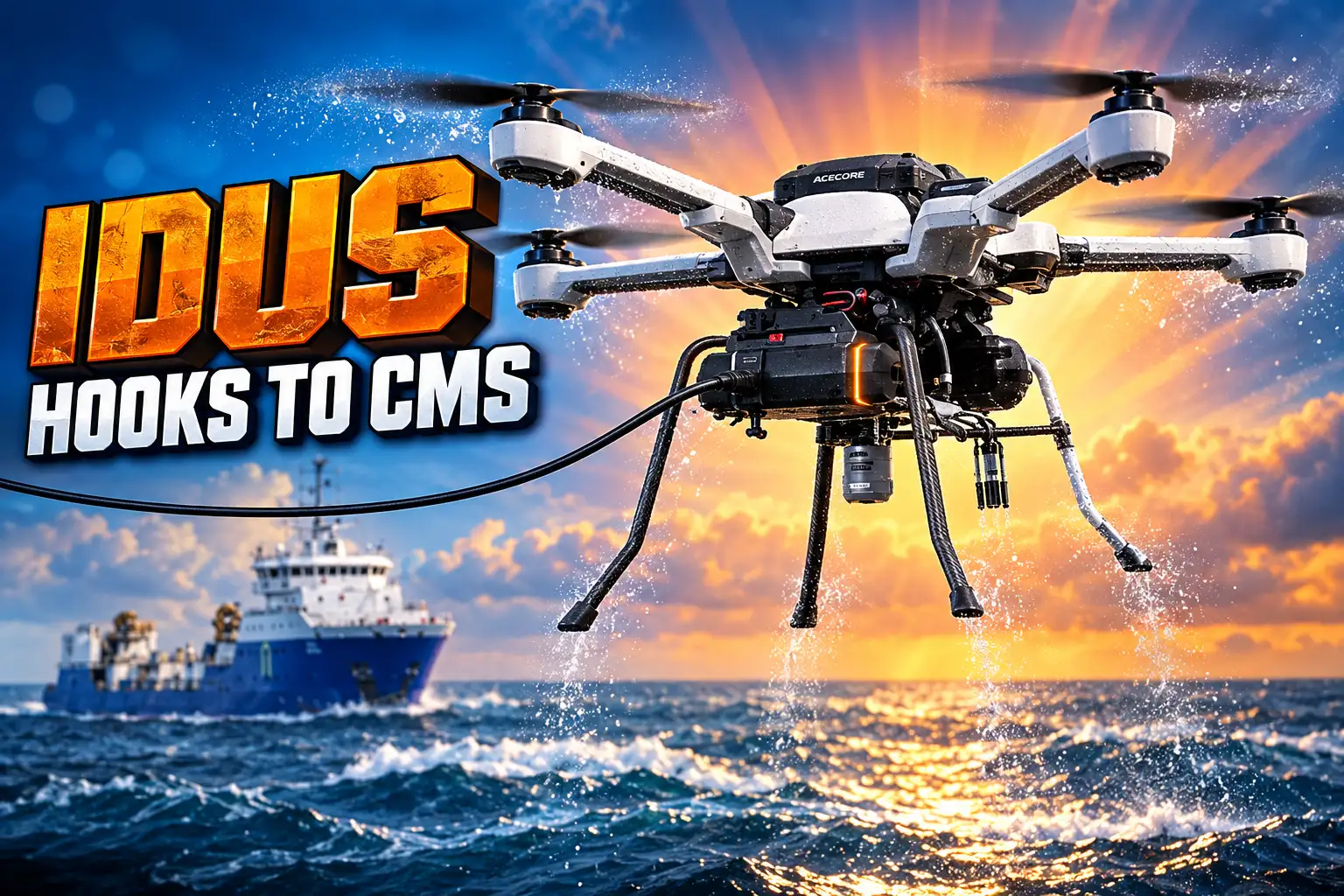
A Box on the Ship, a Box on the Drone
Lieutenant commander Eric van den Nieuwendijk, who handles strategy for uncrewed systems in the maritime air domain, told a Den Helder industry day that ships will have to drive the drones, and that this only works if the combat system can talk to whatever airframe shows up. The navy did not try to recode Guardion for each new vehicle. It built a middle layer.
THE MIDDLE LAYER
- GENIUS: Gateway Encoder Network Interface for Unmanned Systems, a general architecture first described with TNO in the 2020 GENIUS architecture paper, with early hardware called the GENIUS-Blade.
- ICTUS: Intelligent Coordination of Tactical Unmanned Systems, planning and execution software TNO first applied to land vehicles, later folded into the maritime stack.
- IDUS: The uncrewed C2 family that now sits on top, meant to task groups of UxVs from Guardion without rewriting the ship’s combat code for each drone.
Van den Nieuwendijk described the current kit in plain terms. A cabinet stands on board. Small boxes go on whatever drones the navy chooses. Operators then drive those drones from the central system, which is faster than certifying each vehicle inside the big combat program. The Future Vision paper later named the same GENIUS-ICTUS-IDUS line as the path toward “effective control of groups of UxVs from CMS Guardion,” work led by the Maritime Drone Team and COMMIT-AMS.
Ferdinand Peters, the software integration lead, put a limit on how far that automation should go. He said artificial intelligence can hallucinate, and that crews need to let the system work for them, not think for them. The bet is a plug, not a hands-off kill chain.
Why the Navy Writes Its Own Combat System
Guardion is not Thales TACTICOS. MAR-IT, the maritime software shop inside the defence ministry, writes Guardion IME, the integrated mission environment on Dutch ships. TACTICOS is the export cousin that grew out of the old Signaal line in Hengelo after Turkey asked for a CMS in the early 1990s. Dutch crews kept the national product.
That choice now decides the drone program. Because Guardion already sits across the fleet, Feenstra said IDUS has to become a core Guardion application if uncrewed systems are going to show up in every task. MUST only proved the join on a standalone copy used for the exercise, which let ops-room staff create missions and assign uncrewed assets through the same kind of interface they already know.
The payoff is procurement speed. If the ship talks to a box, the navy can hire a commercial boat, print a 12-metre hull, or embark an American vertical-takeoff aircraft without a multi-year CMS rewrite. The cost is sovereignty of a different kind: the middle layer has to keep working when the airframe on the other end changes, jams, or drops off the net.
Feenstra said the navy has spent about a year and a half changing its organisation around that idea. In about ten years, he said, crewed platforms should sit inside a ring of uncrewed systems running as autonomously as possible. The software has to be ready before those rings exist, or the rings stay photo ops.
The Kit That Had to Speak One Language
MUST was built as a vendor mash-up on purpose. Dutch hexacopters, an American tail-sitter, Damen boats, a printed hull from a research lab, and a small underwater mapper all had to take orders from one C2 path. That is the wager in hardware form.
WHAT FLEW, FLOATED AND DIVED
| Asset | Supplier | Domain at MUST |
|---|---|---|
| NOA UAV | Acecore Technologies, Uden | Air, with the Maritime Drone Team |
| V-Bat UAV | Shield AI, flown by Defence Helicopter Command | Air, reconnaissance |
| Fender USV | IMPACD Boats | Surface |
| Interceptor USV | Damen, crewed or uncrewed, can launch UUVs | Surface |
| 12-metre printed USVs | Navy with MARIN, two hulls in three months | Surface, formation sailing |
| Scout UUV | Lobster Robotics | Underwater |
COMMIT is buying 12 V-Bats for the navy, a separate figure from the single V-Bat the defence ministry listed in the air over the North Sea during MUST. The type has a wingspan of almost three metres, more than ten hours of flight with radar and camera in use, and a claimed 30-minute time to go. Shield AI changed it after REPMUS 2025 so it can burn shipboard kerosene. Two people keep it in the air, an operator and a maintainer; the navy says a corporal with no prior course can be trained in 14 weeks, with the first crews sent to the United States because the Netherlands still lacked the range. First ship is the air-defence frigate HNLMS De Ruyter, then Johan de Witt. A new Flight 3 at 860 Squadron, standing up in 2026 at De Kooy, is meant to hold that uncrewed air work beside the NH90 force.
Acecore builds the NOA by hand in Uden. At MUST it was the local hexacopter in a kit that also included a US aircraft the navy chose because, at REPMUS 2025, it was the one that met the endurance and logistics bar on smaller decks.
THE TWO SERIALS THE NAVY PUBLISHED
- Formation sailing: Uncrewed surface vessels ran automatically around Galatea.
- FIND: Uncrewed aircraft, surface craft and underwater vehicles worked together to locate and track a target, an ISR hunt for a vessel of interest.
TNO took part. So did MARIN on the printed boats. Galatea itself is a hired civilian Damen patrol ship, taken on while the navy waits for two Multirole Support Ships. Bas Buchner, program director for maritime uncrewed systems, said those MSS hulls should arrive around 2027 at roughly 50 to 70 metres, carry drones as standard, and start with a crew of at most nine before a later move to fully uncrewed running. He also said a 12-metre USV will not last long in northern seas the way an MSS might, which is why the printed boats are a trial tool, not the 2035 plan.
Seven Warfare Areas Share One Software Layer
Vice Admiral Harold Liebregs, commander of the naval forces, took the first copy of the Future Vision Maritime Uncrewed on 28 April 2026. The paper, issued by the Taskforce Maritime Uncrewed, says the service is moving from fully crewed platforms to lighter-crewed ships with uncrewed and later autonomous systems around them. Uncrewed craft are not the goal. They are for work the navy labels Dangerous, Difficult and Decisive: pulling people out of a threat ring, chewing large data faster than a watch team, and creating mass that a small fleet can actually afford.
Feenstra said the navy has already written, for each of seven warfare areas, how uncrewed systems in all domains combine to deliver the effect it wants. It is not writing a shopping list of vehicle types. It is writing the effect, then asking which mix of air, surface and subsurface craft can produce it.
THE ROAD TO THE GUARDION PLUG
- 2020: GENIUS is published as a navy and TNO architecture for embedding maritime unmanned systems, with Guardion treated as the ship CMS that should stay independent of any one vehicle.
- Early 2025: Programma Maritime Uncrewed starts, with the Taskforce pulling operators, COMMIT-AMS, TNO, MARIN and NLR into one loop.
- September 2025: IDUS tasks two UAVs from another uncrewed system at REPMUS in Portugal.
- January 2026: V-Bat arrives in navy service, ahead of the 12-aircraft COMMIT buy.
- 28 April 2026: Liebregs receives the Future Vision, aimed at a 2035 mix of large platforms and uncrewed craft, with a 2030-2040 planning window.
- June 2026: MUST runs the three-domain IDUS-to-Guardion trial from Den Helder, the first annual edition of a series the vision had already scheduled on the North Sea.
- 31 August to 25 September 2026: REPMUS 26 runs in Portugal, the exercise Feenstra had named as a possible first operational test after MUST.
Those North Sea runs sit in a longer Dutch push to put uncrewed craft beside crewed hulls, including earlier North Sea robot-ship trials out of the same waters. Vice Admiral René Tas, speaking while the vision was still being briefed to industry in 2025, said uncrewed systems do not replace crewed ones, and that both will operate together. The Future Vision is blunter about why the mix exists: large platforms are expensive, visible, vulnerable and crew-heavy; uncrewed systems are cheaper, less limited by people, and can be built without a bunk plan.
The seven areas on the page are protection of the North Sea and the Caribbean, naval mine warfare, anti-submarine warfare, integrated air and missile defence, littoral and amphibious operations, maritime special operations, and maritime strike. For North Sea and Caribbean protection, the paper sketches a 2035 picture in which networked sensors and uncrewed systems fill the ISR role, still directed by people in a maritime operations centre, with AI used to flag odd behaviour for a closer look. MUST’s FIND serial was a small, crewed-from-Galatea version of that idea.
What Still Has to Work on a Real Warship
Feenstra’s next sentence after the Guardion quote was about pace. Software, including AI, is moving fast enough that staying ahead of it is now a main effort. He said the following work is to get the same systems as close as possible to actual operational deployment, then into their first operational exercises. He named REPMUS 26 in Troia and Sesimbra, plus bilateral work with Norway and the UK.
REPMUS 26, the 16th edition of the Portuguese-hosted trial, ran from 31 August through 25 September 2026 with about 300 uncrewed maritime systems, 14 ships, more than 1,500 people and 36 navies. No Dutch statement has publicly confirmed that IDUS, or the MUST mix, was in that Portuguese water. The exam Feenstra pointed at came and went without a matching navy release.
WHAT WE KNOW
- The trial plug: IDUS assigned air, surface and subsurface assets from a standalone Guardion build over five weeks in the MUST series.
- The doctrine: The April 2026 Future Vision makes Guardion the control point for groups of UxVs by 2035, with MUST as the annual North Sea proof point.
- The buy: Twelve V-Bats are on the COMMIT order, and two printed 12-metre USVs were built in three months for the trial.
WHAT IS UNCONFIRMED
- Fleet Guardion: No public test has shown IDUS as a core application on a warship’s in-service combat system.
- REPMUS 26: Feenstra named it in July as a next step; a Dutch IDUS result from the Portuguese exercise has not been published.
- The MSS mothership: Arrival around 2027 with a nine-person crew is still a program date, not a delivered ship.
Buchner’s warning on the 12-metre hull still sits under the photos. A printed boat that can formation-sail around a chartered patrol ship in June is not a weeks-long North Sea picket that never needs a technician with an oil can. Van den Nieuwendijk said the stack was not yet operationally ready when he briefed industry, and that he hoped to field it with first units in the near future. MUST moved that sentence onto the water. It did not move it onto De Ruyter’s real Guardion.
The bet is now specific. If IDUS can become a core Guardion application, Dutch ships can take Acecore one year and something else the next, and the ops room will not care which box is on the rail. If it cannot, the navy will have proved a clever trial network around a hired Damen boat, while the combat system that actually fights stays closed to the robots.

Google Says AI Agents Now Compress Thefts Into Hours

Average People Feel AI First on the Power Bill

Suno Turns the Warner Settlement Into Licensed v6 Models

Lunit Turns Routine H&E Slides Into a Lung Pre-Screen

Meta’s Muse Agent Wants Your Inbox and Your Card

Fable 5 Came Back Under a Commerce On-Off Switch

Google’s SpaceX GPU Lease Has a Sept. 30 Deadline

Plasma One’s XPL Locks Face a 1.81 Billion Cliff

DGO’s Rs 549 World Cup Pass Cost Fans Sleep and Data

Moonshot AI’s $30 Billion Ask Became a $35 Billion Close
-
 AI3 months ago
Fable 5 Came Back Under a Commerce On-Off Switch
-
 AI4 months ago
Google’s SpaceX GPU Lease Has a Sept. 30 Deadline
-
 CRYPTO4 months ago
Plasma One’s XPL Locks Face a 1.81 Billion Cliff
-
 APPS4 months ago
DGO’s Rs 549 World Cup Pass Cost Fans Sleep and Data
-
 AI4 months ago
Moonshot AI’s $30 Billion Ask Became a $35 Billion Close
-

 NEWS4 months ago
ColorOS 17 Device List Spans Oppo, OnePlus and Realme
-

 GAMING4 months ago
Xbox Cuts 3,200 Jobs After Five Years of Thin Returns
-

 GAMING3 months ago
The RTX 4050 Under Rs 70,000 Hides a Wattage Gap