
AI
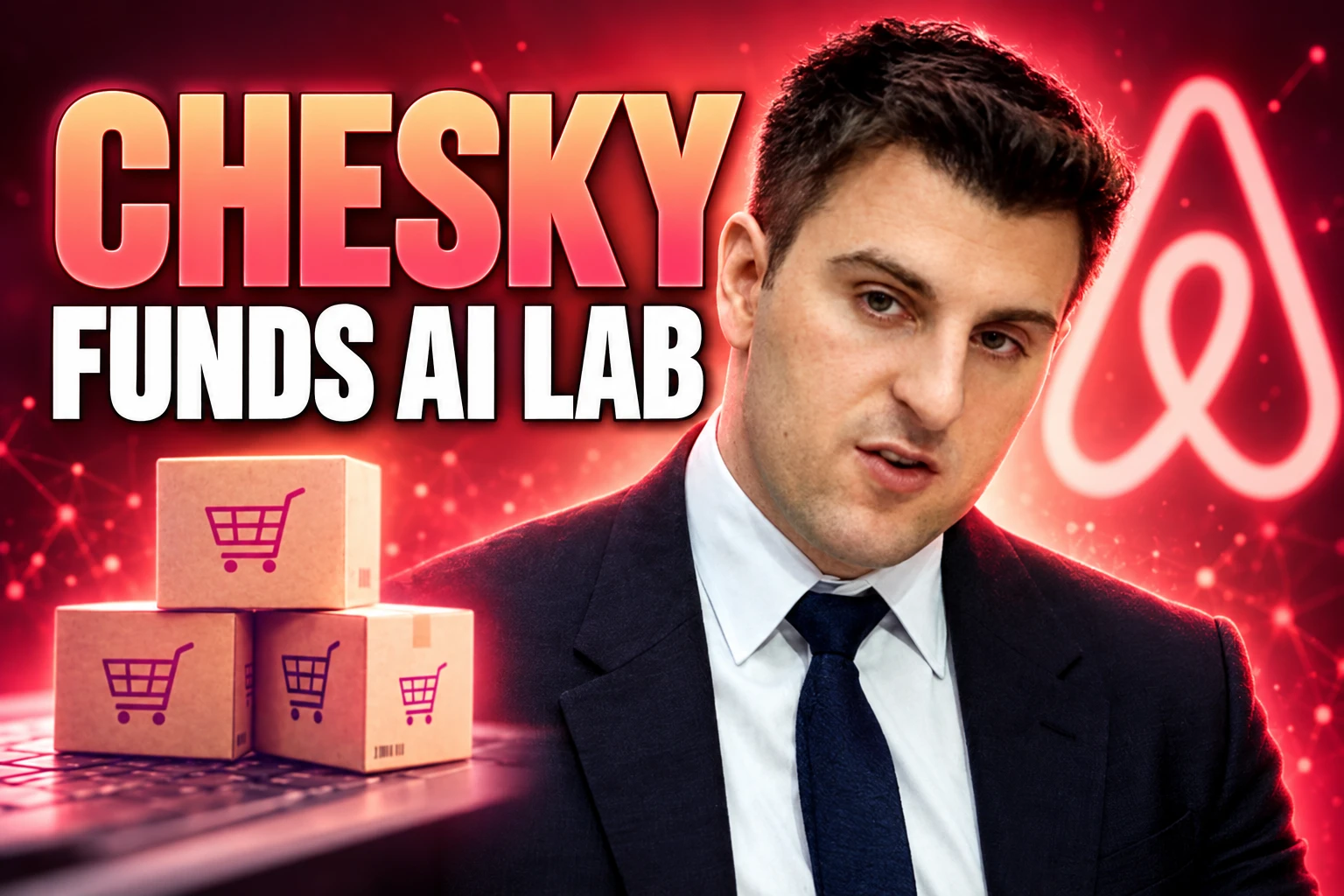
Chesky Is Funding the AI Lab Airbnb Refused to Own
Brian Chesky confirmed a standalone AI lab in August 2026, then kept Airbnb on the promise that it applies models and does not train them.

Airbnb CEO Brian Chesky confirmed in August 2026 that a separate AI lab exists, then declined to name it. He is still running Airbnb. He will not run the lab.
People familiar with the plan said in June that he was in the early stages of funding a venture to build models, with a possible focus on how people actually use them. Airbnb and Chesky declined to comment at the time. The structure is the wager: the company he takes to investors does not train models. The lab next door would.
Chesky Confirmed the Lab, Then Stopped Talking
On June 4, 2026, people familiar with the matter said Chesky was standing up an AI lab as his first direct move into the model race. They said details could still change. They said he would remain Airbnb’s chief executive and would not serve as the lab’s CEO.
For two months he said nothing in public. That changed on August 10, when he finally put a single sentence on the record and then closed the door.
I’ve never actually publicly even confirmed that this exists. I can confirm it exists, but I’m going to not say anything more about it right now.
Brian Chesky, CEO, on the Power Players podcast
No name followed. No hire. No figure. A sitting public-company founder funding a side lab used to trigger a week of focus lectures. In 2026 it landed like a product note. The old rule of one founder, one company has gone quiet, and Chesky is using the silence.
THE 2026 SPLIT
- January 14, 2026: Airbnb names former Meta generative AI chief Ahmad Al-Dahle as CTO and talks about applying models to search and the app, not about training a frontier system.
- Fourth-quarter 2025 call: Chesky tells investors Airbnb is not building models, does not have a huge capex base, and will not let AI spend hit the P&L the way hyperscalers do.
- June 4, 2026: People familiar with the plan say he is funding a separate lab to develop models, with design and user interaction as a possible focus.
- August 6, 2026: Airbnb posts second-quarter results that still sell the capital-light story, with AI showing up as code, support, and faster shipping rather than as a training budget.
- August 10, 2026: Chesky confirms the lab exists and refuses to describe it.
- September 8, 2026: At Goldman Sachs’s Communacopia conference he again draws a line: Airbnb will apply AI. It will not be a company that develops it.
That last line only holds if the lab is not Airbnb. The confirmation did not put the venture on the company’s org chart. It put it beside the company, which is the point.
The Capital-Light Promise on the Earnings Call
Chesky has spent more than a year telling investors what Airbnb will not buy. It will not stack GPUs. It will not train foundation models. It will not run data centers. On the fourth-quarter 2025 call he put it in the plainest words he had.
Unlike other companies, we’re not building models. We do not have the huge CapEx cost base. So, our investment in AI will not affect the P&L.
Brian Chesky, CEO, on Airbnb’s fourth-quarter 2025 earnings call
He also said the firm would grow without investing billions or tens of billions of dollars, because it does not own homes, does not operate experiences, and is not building data centers. That is the investor story. The lab is what he does with the part of the story the P&L is not allowed to hold.
Airbnb’s second-quarter 2026 results still read like that promise kept. Revenue was $3.6 billion, up 17 percent. Gross booking value was $27.2 billion, up 16 percent. Nights and seats booked rose 10 percent to 148.3 million. Net income was $816 million. Free cash flow was $1.3 billion in the quarter and $4.8 billion over the trailing twelve months, a 37 percent free cash flow margin.
Those figures are what a marketplace prints when it rents other people’s homes and other people’s models. They are also why a frontier training run cannot live on the same slide.
Why the Lab Sits Outside Airbnb
If Chesky believes travel needs new models, the obvious home is Airbnb. He did not choose it. The lab is being built as a standalone venture, described by later accounts as a mix of his own money and outside investors, run by someone else. Airbnb stays the application layer. The model work, if it happens, never has to show up as a line the market can punish.
Meta taught every public-company CEO the cost of a visible moonshot. Chesky’s move is the inverse: take the bet, hide the spend. Airbnb can keep saying it wins on what it does with commodity models. He can still fund the research he thinks those models will not do for travel.
The hole is ownership. If the lab produces the interface he has been describing, the intellectual property sits outside the company whose guests would use it. If it fails, Airbnb’s books never took the hit. Shareholders get the discipline. They do not automatically get the upside he is privately underwriting.
WHAT WE KNOW
- The structure: The lab is separate from Airbnb, Chesky remains Airbnb’s CEO, and he will not be the lab’s chief executive.
- The aim: People familiar with the plan said it would develop AI models and was considering a focus on user interaction and design.
- The status: Chesky confirmed on August 10, 2026, that it exists and then refused to add detail.
- The company line: On September 8, 2026, he again said Airbnb will apply AI and will not be a company that develops it.
WHAT IS UNCONFIRMED
- The name: No legal name, product name, or brand has been disclosed.
- The check: No funding amount, round, or investor list has been made public.
- The leader: No lab CEO or founding research hire has been named.
- The work: It is not public whether the lab would train its own models or build on systems from OpenAI, Anthropic, or others.
That blank is not a reporting gap he forgot to fill. He has had three months of interviews since the leak, including one in which he confirmed the lab, and he has used every one of them to talk about Airbnb’s app instead.
AI Already Writes Most of Airbnb’s New Code
Inside the public company, AI is already a production tool. Chesky has said it writes 60 percent of Airbnb’s new code. He has also said it is the best thing that has ever happened to the company, a line he used on the August 6 earnings call. The work is applied, not foundational. Coding agents, support models, and search tests, not a training cluster on the balance sheet.
He told investors that AI had become an existential risk to Airbnb a year earlier, then called 2026 the moment of truth. The answer he wanted was speed: more features, cheaper support, shorter path from idea to live product. The table is the operating picture he is selling while the lab stays unnamed.
AIRBNB’S APPLIED AI IN 2026
| Measure | Figure | When he cited it |
|---|---|---|
| Share of new code written by AI | 60 percent | May 2026 |
| Customer inquiries closed without a human | nearly 45 percent | Second quarter 2026 |
| Support cost per booking | down 16 percent | Second quarter 2026 |
| Features shipped versus a year earlier | up 80 percent | Second quarter 2026 |
| Time from concept to launch | cut by as much as 60 percent | 2026 earnings |
CFO Ellie Mertz said the updated 2026 guidance assumed a material increase in AI spend and that the company was still expanding margins while absorbing it. Early offsets included that 16 percent drop in customer service cost per booking. Chesky’s own argument is that Airbnb’s bookings are large enough that a small lift in conversion more than covers token bills, so there is no need to “tokenmaxx.”
He has been using the tools on himself. He said he trained a custom system on 1 million of his emails, 50,000 Google documents, and 8,000 Keynote slides, then started running it as an agent to help him manage the company. That is a CEO with a private corpus. It is not a lab that ships a new consumer interface.
Expedia Opened Its Inventory to Agents
While Chesky kept Airbnb off ChatGPT, the other large online travel companies walked in. Expedia Group and Booking Holdings both put plug-ins inside OpenAI’s chatbot. Airbnb did not. Chesky has said OpenAI’s tools were not robust enough for the experience he wants, and that a chatbot is the wrong surface for travel and commerce.
Expedia is now trying to be the inventory layer underneath other people’s agents. At its Explore 2026 partner meeting it opened partner tools for outside AI agents, including new agents inside Partner Central and B2B kits meant to help airlines, banks, and agencies stand up their own AI travel surfaces. It has also talked about paid ads inside ChatGPT. The bet there is blunt: if a guest starts in Claude or ChatGPT, Expedia still wants the booking.
Google has been building a similar pipe in AI Mode, with Booking, Expedia, and hotel groups such as Marriott taking the payment when a trip is booked through the assistant. Airbnb is not on that partner list. The company Chesky runs still wants the guest inside its own app. The lab is how he tries to own the next interface without renting one from OpenAI.
That split will decide who becomes a feed. If agents plan trips and only tap an API for a room, Airbnb’s photographs, host stories, and maps are scenery the guest never opens. Expedia is volunteering to be that API. Chesky is refusing the plug-in and funding a different front door, just not on Airbnb’s Form 10-K.
Four Things a Chatbot Cannot Do on a Trip
The design argument is the one part of this story Chesky will still talk about. He has said a chatbot is not the right interface for 90 percent of things, and that almost no home-screen app, including Airbnb’s, has really changed since ChatGPT launched. He wants something between a store and a chat window: visual, conversational, and shared. He has said Airbnb is in pilot on that idea and does not know if it will be the company that ships it.
He has also spent a year making the case against travel chatbots as a booking surface. The four failures he keeps listing are practical, not philosophical, and they map to how a group actually picks a place to sleep.
CHESKY’S CHATBOT FAILURES
- Text first: The thread is words, and photographs are an afterthought, which is a problem for a product that sells rooms through pictures.
- No comparison: A guest who wants to weigh ten listings has to scroll back through a conversation instead of scanning a grid.
- One player: He notes that the average Airbnb stay is 3 guests, so the tool has to be multiplayer, not a private chat.
- No hands on the map: You cannot tap a filter, drag a pin, or poke at a listing the way you can in an app. You have to type the next prompt.
He has said the consumer wave is still ahead, maybe 18 to 24 months from his September 2026 remarks, and that most of the money will go to the consumer layer rather than to the GPU stack. That claim is doing a lot of work. It lets him tell investors that data centers are someone else’s bill. It also explains why he would fund models anyway: if the winning consumer product needs weights that do not exist yet, someone has to train them, and he has already promised it will not be Airbnb.
The CTO Hire Was for Applying Models
The person hired to make Airbnb “AI native” is not the lab’s missing CEO. In January, Chesky named Ahmad Al-Dahle as chief technology officer in a note to staff. Al-Dahle had led Meta’s generative AI group and the Llama family of open models, which he said had passed 1.2 billion downloads and 60,000 derivative models. He spent 16 years at Apple before that, including work on the original iPhone and later on the car project.
Al-Dahle’s own line on joining was about application, not a new foundation model. He wrote that capabilities were moving fast and that the question now was how to put them into products that get people into the world. Chesky told investors Al-Dahle had taken Airbnb from a middle-of-the-pack AI company to a leader among firms that are not frontier labs or hyperscalers. That sentence only makes sense if Airbnb stays in the second group.
The company around them is still a marketplace. Airbnb says it now has more than 5.5 million hosts and has passed 2.5 billion guest arrivals. Chesky is trying to hang more on that core, including cars, hotels, and other add-on services he has said could eventually bring in $1 billion or more a year. AI is how he wants those pilots to go from years to weeks. The lab is how he wants a new interface to exist at all.
He still will not say who is building it, what it is called, or how much of his own money is in the round. Until he does, the public company gets the cash engine and the applied-AI story. The model bet lives in a vehicle he has confirmed and then refused to describe.
Disclaimer: This article is news reporting and analysis of public statements, earnings remarks, and company notices. It is informational only and is not investment advice, a recommendation to buy or sell Airbnb stock, or a judgment on the private lab’s prospects. Readers who are considering a position in Airbnb or in any related private venture should consult a qualified financial adviser who can review their own holdings, time horizon, and risk. Revenue, cash flow, margins, and product claims reflect the cited company materials and interviews as of the dates given in this piece and can change with later results or filings.

Instagram Plus Tests a Read-Only Mode That Cuts Stories

Altman Asks the Public to Accept Some AI Harm

Google Freezes OSS VRP Product Reports After AI Flood

AI Agents Make Payment Rails the Scarce Prize

Turkey’s Crypto Boom Now Runs Through Three Banks

Fable 5 Came Back Under a Commerce On-Off Switch

Google’s SpaceX GPU Lease Has a Sept. 30 Deadline

Plasma One’s XPL Locks Face a 1.81 Billion Cliff

DGO’s Rs 549 World Cup Pass Cost Fans Sleep and Data

Moonshot AI’s $30 Billion Ask Became a $35 Billion Close
-
 AI4 months ago
Fable 5 Came Back Under a Commerce On-Off Switch
-
 AI4 months ago
Google’s SpaceX GPU Lease Has a Sept. 30 Deadline
-
 CRYPTO4 months ago
Plasma One’s XPL Locks Face a 1.81 Billion Cliff
-
 APPS4 months ago
DGO’s Rs 549 World Cup Pass Cost Fans Sleep and Data
-
 AI4 months ago
Moonshot AI’s $30 Billion Ask Became a $35 Billion Close
-

 NEWS4 months ago
ColorOS 17 Device List Spans Oppo, OnePlus and Realme
-

 GAMING4 months ago
Xbox Cuts 3,200 Jobs After Five Years of Thin Returns
-

 GAMING4 months ago
The RTX 4050 Under Rs 70,000 Hides a Wattage Gap