
CRYPTO
SBI and Dentsu Soken Are Building Japan’s DLT Rails
Japan’s DLT push is a set of bank, trade and prefecture contracts. Dentsu Soken, SBI, ITOCHU and MOL are the buyers, not retail crypto.

Osaka Prefecture selected an SBI XDC trade-finance project for public funding on August 28, 2026, backing a demo that records export factoring and digital company certificates on a blockchain. TOPPAN and Ginco joined SBI XDC Network APAC on the bid, which Osaka’s Global Financial City team is paying for as a proof of concept inside the prefecture.
Crypto boards still file this as a Quant, XDC, Algorand and XRP adoption wave. The invoices go to Dentsu Soken, SBI, ITOCHU, MOL, TOPPAN and Osaka Prefecture.
Dentsu Soken Already Sits on BOJ-NET
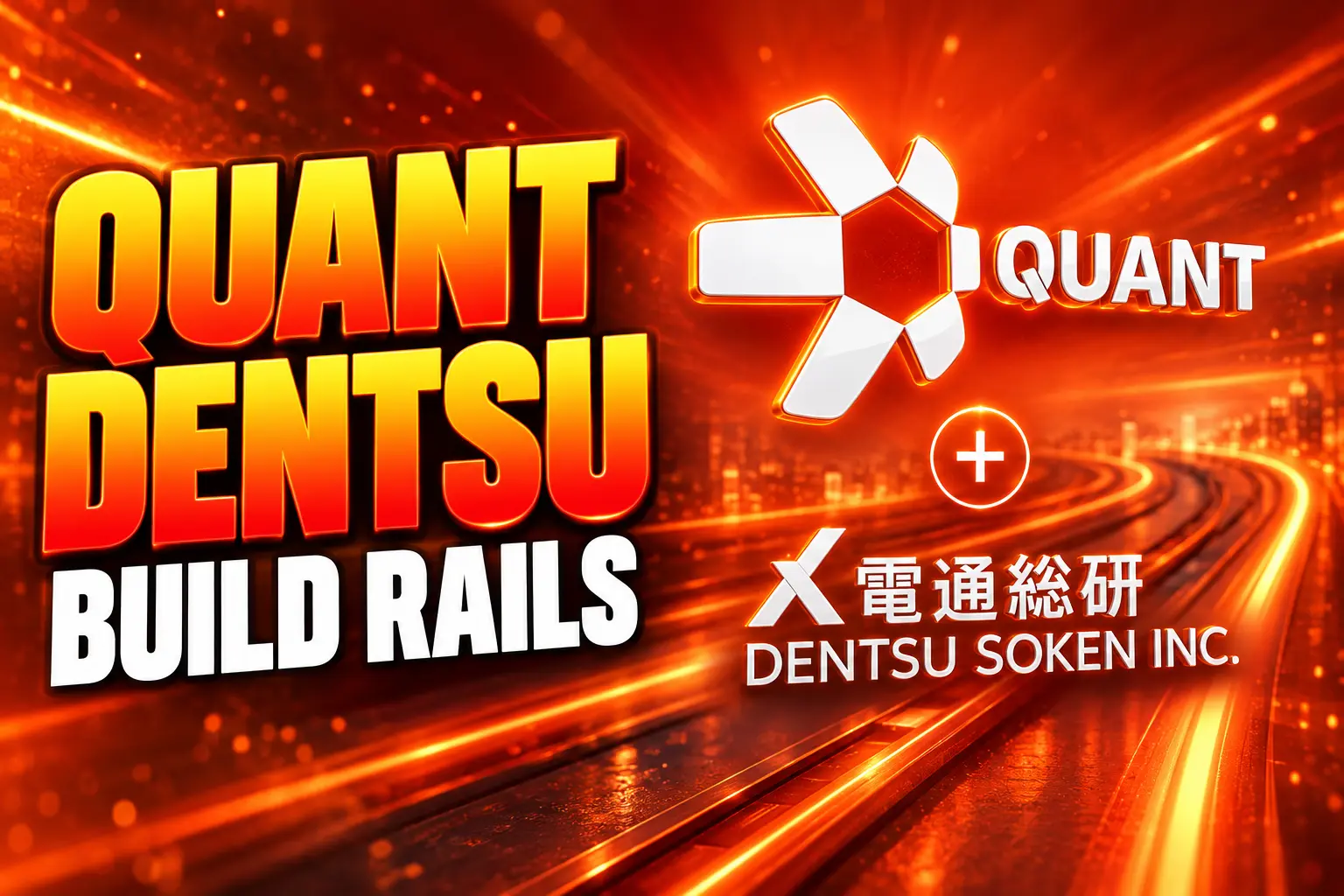
On January 14, 2026, Quant and Dentsu Soken signed a partnership on tokenized deposits, bank-issued stablecoins and programmable settlement for Japanese financial firms. Quant is bringing the orchestration stack it has already used in Bank of England and BIS Project Rosalind work, European Central Bank pilots, the UK Regulated Liability Network and the Great Britain Tokenised Deposit project. Dentsu Soken is bringing the local install base.
That install base is the point. Dentsu Soken builds payment and settlement systems for large Japanese banks, including Stream-R, a BOJ-NET settlement management system used for current-account, Japanese government bond and foreign-exchange settlement on the Bank of Japan’s real-time gross settlement network. The firm has sold Stream-R since RTGS went live in 2001, and it shipped a full SWIFT ISO 20022 version in December 2024. It also builds core banking, internet banking, cash-management, SWIFT reconciliation and CLS settlement systems, and it has done research on decentralised identifiers and cryptoasset wallets.
Banks in Japan do not rip out BOJ-NET because a public chain is fashionable. They buy a coordination layer that talks to the systems they already run, then add tokenized deposits and conditional payments on top. Quant’s own release frames the work as programmable settlement, ledger synchronisation, audit-ready event records and intraday liquidity automation, delivered through a joint go-to-market plan with Dentsu Soken’s implementation teams. The QNT token is not named in that document.
Japan is at an important turning point in the evolution of its financial infrastructure. Banks are preparing for tokenised deposits, new forms of digital money and more interoperable settlement systems. Partnering with Dentsu Soken lets us support Japan’s transition to digital assets and tokenised money with technology that is proven, compliant and designed for institutions.
Gilbert Verdian, Founder and CEO, Quant, partnership announcement
Chie Ito, executive officer and head of business development at Dentsu Soken, tied the deal to the firm’s BOJ-NET work and to fintech networks at FIBC and FINOLAB, and said 2026 is widely viewed in the industry as a moment of change for stablecoins. Quant posted the same day that digital money is no longer theoretical and that Japan is moving from pilot to production.
Digital money isn't theoretical anymore.
Quant and Dentsu Soken are partnering to build #programmablesettlement & #tokeniseddeposit infrastructure in Japan.
The UK tested it in regulated systems. Now Japan is moving from pilot to production, combining regulatory experience with… pic.twitter.com/38nUGy9aEW
— Quant (@quantnetwork) January 14, 2026
Four Japan DLT Contracts and Their Jobs
Put the four names from the token boards next to the actual buyers and the jobs look less like a single “Japan DLT stack” and more like four separate contracts. Japan’s enterprise blockchain partnerships have been drifting from slideware into production work all year; the table below is who is on the hook now.
THE FOUR JAPAN DLT CONTRACTS
| Who is paying | Named rail | The job | Where it stands |
|---|---|---|---|
| Dentsu Soken | Quant Overledger | Tokenized deposits and programmable settlement for banks | Partnership signed January 14, 2026 |
| SBI XDC Network APAC, TOPPAN, Ginco | XDC Network | On-chain export factoring and vLEI identity | Osaka subsidy selected August 28, 2026 |
| MOL and ITOCHU | 123Carbon (Algorand, per Algorand Japan) | Environmental attribute certificates for Scope 3 | Mutual EAC trades; MOU January 9, 2026 |
| SBI VC Trade and Ripple | RLUSD | Regulated dollar stablecoin on VCTRADE | Live June 24, 2026 after JFSA approval |
Only one of those four is a token you can buy on an exchange and then spend under a Japanese payment licence. The other three are a system integrator’s settlement overlay, a trade-document ledger, and a Dutch carbon registry that happens to sit on Algorand.
SBI Is Wiring Trade Finance Onto XDC
SBI Holdings is the firm that shows up more than once. It is the Japanese parent behind SBI XDC Network APAC, the Ripple joint history, and SBI VC Trade, the licensed exchange now distributing RLUSD. If there is a hidden stakeholder with skin in more than one ledger, it is this group, not a retail token holder.
SBI XDC Network APAC was set up in December 2023 as a joint venture between SBI Holdings and TradeFinex Tech, the UAE firm behind XDC Network. The Osaka filing describes XDC as a hybrid blockchain aimed at trade finance, supply-chain data and cross-border payments. The job in Japan has been paper: export documents, receivables, and the identity of the companies on each side of a shipment.
HOW SBI BUILT ITS DLT STACK
- 2016: Begins working with Ripple on cross-border payments and digital-asset infrastructure in Japan and Asia.
- December 2023: Sets up SBI XDC Network APAC with TradeFinex Tech to push XDC into Asia-Pacific trade finance.
- August 22, 2025: Signs a memorandum of understanding for SBI VC Trade to distribute RLUSD in Japan.
- June 23 to July 6, 2026: Runs an online factoring proof of concept with TOPPAN on XDC, using past used-auto-parts export data from SS Trading.
- June 24, 2026: Lists RLUSD on VCTRADE after Japan Financial Services Agency approval.
- August 28, 2026: Wins Osaka Prefecture’s FY2026 pioneering-finance subsidy for a vLEI and on-chain factoring demo.
That 10-year Ripple thread and the XDC venture are parallel, not the same product. One is a listed dollar stablecoin under the Payment Services Act. The other is a trade-document and factoring workflow. Treating both as “SBI adopted XRP and XDC” flattens two different buyers, two different licences and two different failure modes.
Osaka Put Public Money Behind On-Chain Factoring
The Osaka award is the first time a Japanese prefecture has put a named public subsidy behind this XDC workflow. SBI XDC Network APAC, TOPPAN and Ginco were selected for the FY2026 Osaka Prefecture Pioneering Financial Market Formation Support Project, run by the Global Financial City OSAKA team in the prefectural government. The submission title is blunt: build a know-your-business scheme with digital corporate certificates, then execute export factoring on-chain.
The demo uses exporters of used vehicles and auto parts based in Osaka. In partnership with TOPPAN, which can issue vLEI digital company certificates, and Ginco, which is building the business system, SBI XDC will take trade data and vLEI records for exporters and importers, write them to a blockchain, and try to run one flow from customer inquiry through KYB to payment collection. The companies also plan to study vLEI issuance in one destination country for those exporters.
WHO DOES WHAT IN OSAKA
- SBI XDC Network APAC: Supplies the trade platform on XDC Network and runs the demonstration.
- TOPPAN: Issues and checks vLEI certificates; the group dates to 1900 and employs more than 50,000 people.
- Ginco: Builds the system that inputs, aggregates and records factoring data on-chain.
- Osaka Prefecture: Funds the proof of concept to back new financial services that use blockchain or AI.
This is not a nationwide live trade network. It is a prefecture-backed PoC that SBI XDC says it will finish in fiscal 2026, then try to add customers in Osaka, then used-vehicle and parts traders across Kansai and the rest of Japan, then other industries and inbound shipments. The same filing says the partners want to look at stablecoin settlement and the tokenization of trade receivables once the on-chain flow exists. Public money here is buying a workflow, not a ticker.
SBI XDC Network APAC has been selected for the FY2026 Osaka Prefecture Pioneering Financial Market Formation Support Project Subsidy.
In collaboration with TOPPAN and Ginco, we will commence a demonstration of a next-generation trade finance platform utilizing vLEI and…
— SBI XDC Network APAC 株式会社 (@sbixdc) August 28, 2026
SBI XDC’s own post on the Osaka Prefecture subsidy for on-chain factoring is the cleanest primary record of that award. A June 23 to July 6, 2026 dry run with TOPPAN had already connected vLEI checks to SBI XDC’s trade platform and, the two firms said, showed that a factoring application and review could be done online, with the receivables record tied to a certificate that can be checked in a tamper-evident way.
The Carbon Trade That Never Named Algorand
The Algorand line on those token boards is a shipping and trading-house carbon deal. On January 9, 2026, Mitsui O.S.K. Lines and ITOCHU Corporation signed a memorandum for what MOL called Japan’s first shipping-aviation EAC partnership, based on MOL’s own research as of January 2026. Takeshi Hashimoto is MOL’s president and CEO. Keita Ishii is ITOCHU’s president and COO.
The two firms already swapped environmental attribute certificates as users of transport. MOL bought air-transport certificates issued by ITOCHU to cover greenhouse gases from staff air travel, logged as Scope 3 Category 6. ITOCHU bought maritime certificates issued by MOL to cover sea-freight emissions, logged as Scope 3 Category 4. The trades ran on 123Carbon, a Netherlands platform that issues, transfers, stores and retires the certificates under an audit setup MOL says is meant to keep a traceable chain of custody.
MOL’s English release never mentions Algorand, ALGO, or a public blockchain. It names 123Carbon, Scope 3, sustainable aviation fuel and low-carbon marine fuel. Algorand’s Japan account said on January 19, 2026 that the 123Carbon case in Japan is powered by Algorand. The Algorand Foundation pointed at the same MOL page. The ledger is the vendor’s rail. The buyers are two of Japan’s largest transport and trading names, shopping for a way to cut reported Scope 3, not for a token position.
That gap is the whole hidden-stakeholder problem in miniature. A carbon registry can change vendors. MOL and ITOCHU still have the emissions, the ships, the flights and the counterparties. If Algorand wants this to become infrastructure rather than a logo, it has to stay the registry 123Carbon cannot drop.
RLUSD Cleared Japan’s Foreign Stablecoin Test
The XRP-linked product that actually went live in Japan this year is a dollar stablecoin, not a new national currency. On June 24, 2026, Ripple and SBI Group announced the RLUSD launch through SBI VC Trade after Japan Financial Services Agency approval. RLUSD is classed as a new type of electronic payment instrument under the Payment Services Act, the bucket Japan uses for foreign-issued stablecoins that meet local safety rules. It is offered to institutions and retail users on VCTRADE.
Ripple said RLUSD had reached US$1.7 billion in market capitalization since its late-2024 launch. Jack McDonald, Ripple’s senior vice president of stablecoins, said the token should work as a bridge for payments, tokenization and collateral management between Japanese users and global liquidity. The firms have worked together since 2016, a 10-year span Ripple itself calls a decade-long relationship, and they signed the Japan distribution memorandum on August 22, 2025.
Japan has long been a leader in digital asset adoption, underpinned by both regulatory clarity and financial innovation. This launch marks an important step in expanding access to transparent, regulated USD-backed stablecoins like RLUSD for financial institutions, consumers and businesses in Japan.
Jack McDonald, Senior Vice President of Stablecoins, Ripple, June 24, 2026 announcement
Launch-day product notes add two limits the press release does not dwell on. The Japan listing runs on Ethereum, not on Ripple’s XRP Ledger, and each transfer is capped at 1 million yen, a ceiling that still sits well below the size of a typical trade-finance payment. SBI people have already said a cap at that level gets in the way when the ticket is a shipment or an investment, not a retail transfer. RLUSD is the most token-like of the four Japan stories, and it is still a listed payment instrument with a small ticket, not a wholesale yen replacement.
A correction that keeps getting restated around these headlines is the simple one. Japan is not making XRP its national currency. The yen remains the unit of account. What cleared the JFSA is a foreign dollar token on a licensed exchange, sitting beside whatever yen instruments Japanese banks and trusts issue on their own licences.
Several of These Rails Can Run Without the Token
Read the four official documents in a row and a pattern holds. The buyer is a Japanese SI, conglomerate, trading house, shipping line, printer or prefecture. The job is deposits, factoring, carbon certificates or a listed stablecoin. The public chain or the overlay vendor is named when it helps the buyer, and omitted when it does not.
WHAT WE KNOW
- Signed contracts: Quant-Dentsu Soken, MOL-ITOCHU, Ripple-SBI RLUSD, and the Osaka SBI XDC-TOPPAN-Ginco subsidy are on official paper with dates.
- Live listing: RLUSD is available on VCTRADE to institutions and retail users after JFSA approval.
- BOJ-NET adjacency: Dentsu Soken’s Stream-R already manages RTGS flows; the Quant deal is a go-to-market overlay, not a replacement of BOJ-NET.
- Prefecture money: Osaka is funding a fiscal 2026 proof of concept, with a stated path to Kansai and then nationwide used-vehicle trade.
WHAT IS UNCONFIRMED
- QNT inside BOJ-NET: Quant’s Japan release does not say the QNT token will be held, staked or spent by Dentsu Soken or by Japanese banks.
- DCJPY on Overledger: Claims that Japan’s DCJPY deposit network will run on Quant remain outside the official Quant and Dentsu Soken texts.
- ALGO as MOL’s chain of record: MOL names 123Carbon; Algorand’s Japan account names Algorand as that platform’s rail.
- XRP as Japan RLUSD settlement: The Japan listing described at launch is Ethereum-only, with a 1 million yen cap per transfer.
Token holders keep treating each press release as a demand event for QNT, XDC, ALGO or XRP. Japanese banks keep buying the thing they always buy, which is a vendor who will connect a new rail to Stream-R, to a factoring desk, to a carbon book, or to a licensed exchange, without asking the core ledger to move. Several of these jobs can keep running if the token is a licence coupon, a gas asset the end customer never sees, or a brand that a Dutch software vendor can swap.
SBI XDC said that after the Osaka demonstration it wants more customers in the prefecture, then used-vehicle and parts traders across Kansai and the rest of Japan, and later stablecoin settlement and tokenized receivables on the same flow. That is the next contract on the table, and it will be written by the same class of buyer that wrote the last four.
Disclaimer: This article is news reporting and analysis of public company statements, prefecture filings and product launches. It is informational only and is not investment, trading, legal or tax advice, and it is not a recommendation to buy or sell QNT, XDC, ALGO, XRP, RLUSD or any other digital asset. Readers should consult a licensed financial adviser and, where needed, a lawyer familiar with Japan’s Payment Services Act before acting on any contract, listing or token mentioned here. Figures, licences and project statuses reflect the cited company and government documents as of the dates in the piece and can change as demos finish, listings are updated or regulators amend rules.

Instagram Plus Tests a Read-Only Mode That Cuts Stories

Altman Asks the Public to Accept Some AI Harm

Google Freezes OSS VRP Product Reports After AI Flood

AI Agents Make Payment Rails the Scarce Prize

Turkey’s Crypto Boom Now Runs Through Three Banks

Fable 5 Came Back Under a Commerce On-Off Switch

Google’s SpaceX GPU Lease Has a Sept. 30 Deadline

Plasma One’s XPL Locks Face a 1.81 Billion Cliff

DGO’s Rs 549 World Cup Pass Cost Fans Sleep and Data

Moonshot AI’s $30 Billion Ask Became a $35 Billion Close
-
 AI4 months ago
Fable 5 Came Back Under a Commerce On-Off Switch
-
 AI4 months ago
Google’s SpaceX GPU Lease Has a Sept. 30 Deadline
-
 CRYPTO4 months ago
Plasma One’s XPL Locks Face a 1.81 Billion Cliff
-
 APPS4 months ago
DGO’s Rs 549 World Cup Pass Cost Fans Sleep and Data
-
 AI4 months ago
Moonshot AI’s $30 Billion Ask Became a $35 Billion Close
-

 NEWS4 months ago
ColorOS 17 Device List Spans Oppo, OnePlus and Realme
-

 GAMING4 months ago
Xbox Cuts 3,200 Jobs After Five Years of Thin Returns
-
 GAMING4 months ago
The RTX 4050 Under Rs 70,000 Hides a Wattage Gap