
COMPUTERS
ASRock’s Phantom Gaming Prototype Signals a 12V-2×6 Shift
ASRock showed an unannounced Phantom Gaming Radeon prototype at Computex 2026 using a 12V-2×6 connector, a design previously exclusive to its flagship Taichi cards.

ASRock showed a prototype at Computex 2026 in Taipei built around Radeon RX 9070 XT hardware, fitted inside a new Phantom Gaming shroud with revised cooling and a single 12V-2×6 power connector. The company told TweakTown it is a next-generation design in testing, with no current plan to release it.
Within ASRock’s current Radeon lineup, the 12V-2×6 connector appears on exactly one product: the RX 9070 XT Taichi 16GB OC. Phantom Gaming sits below Taichi in ASRock’s product stack, aimed at gaming mainstream pricing and performance. The Computex prototype puts that connector on a different tier.
What ASRock Displayed at Computex
TweakTown, which reported on the card directly from ASRock’s booth, attributed this description to company representatives:
A next-generation Phantom Gaming design with a new look, feel, and cooling, currently in the testing or prototype stage.
ASRock confirmed the GPU inside is the Radeon RX 9070 XT, AMD’s RDNA 4 flagship silicon with 64 Compute Units, 16GB of GDDR6, and a 256-bit memory interface. VideoCardz confirmed independently that the card was displayed openly at the booth but was not presented as a retail product.
Using current-generation silicon for a cooler prototype is standard practice at board partners. Thermal validation, PCB layout testing, and shroud geometry review all happen on known hardware before the next-generation die exists. The card is a test platform.
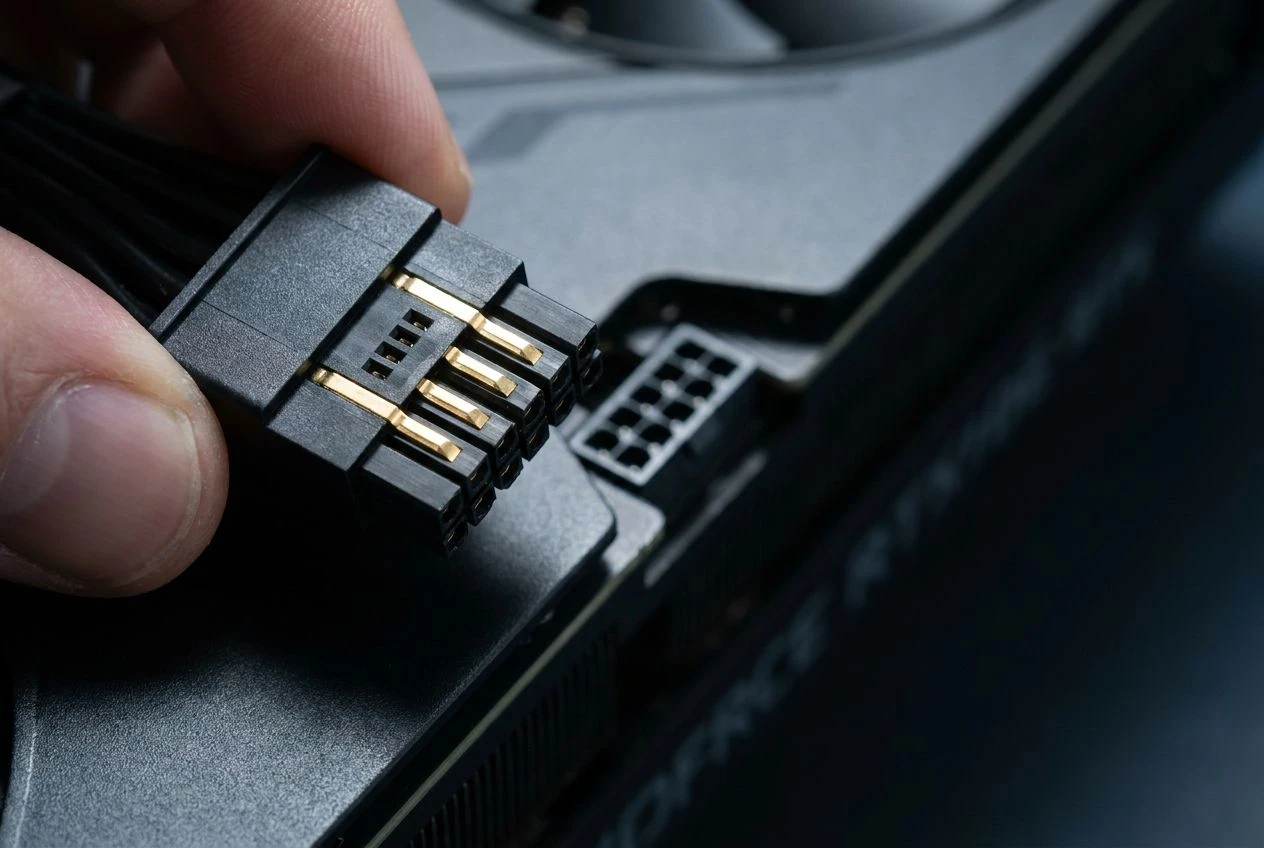
TechPowerUp’s Computex 2026 coverage offered one useful design comparison: the prototype looks “very different” from the previous Phantom Gaming Radeon generation. The Radeon RX 7900 XT Phantom Gaming used triple 8-pin power delivery, three separate cable terminations. The new design replaces all three with a single 16-pin 12V-2×6 connector, consolidating cable runs and freeing the PCB surface area those headers occupied.
The Connector Leaving the Flagship Tier
Where 12V-2×6 Has Appeared in ASRock’s Radeon Stack
The 12V-2×6 connector is uncommon on Radeon hardware across the board partner ecosystem. Most RX 9070 and RX 9070 XT designs ship with dual 8-pin PCIe power. VideoCardz noted the connector has appeared on a small number of premium designs, with ASRock’s Taichi and Sapphire’s Nitro+ RX 9070 XT as the clearest examples on AMD’s side of the market.
Within ASRock’s lineup specifically, the split is clean. The RX 9070 XT Taichi 16GB OC carries a 12V-2×6. The Steel Legend 16GB uses dual 8-pin. The Challenger stays on dual 8-pin. That pattern fits each tier: Taichi buyers tend to build with premium ATX 3.1 power supplies and the installation attention a demanding connector requires; lower-tier buyers get the established, widely compatible standard.
The engineering case for the single-plug design is straightforward. One 12V-2×6 socket replaces two or three separate 8-pin headers, simplifies cable routing inside the case, and removes two seating points that each carry their own failure risk. For a Taichi card with a premium cooler, an LCD panel, and three large fans, that consolidation fits the overall design budget.
What a Phantom Gaming Prototype Changes
Phantom Gaming targets a different buyer than Taichi: solid gaming performance at lower prices, fewer premium extras, a broader range of build configurations. Bringing a 12V-2×6 connector to that tier puts it in front of builders who may be running older PSUs, third-party adapter cables, or systems without ATX 3.1 compliance. ASRock has not confirmed that plan (the prototype carries no release date), but the design choice is deliberate. A Phantom Gaming card could ship with dual 8-pin, exactly as the Steel Legend and Challenger do.
| Model | Power Connector | Memory | Product Tier |
|---|---|---|---|
| RX 9070 XT Taichi 16GB OC | 12V-2×6 (single) | 16GB GDDR6 | Flagship |
| RX 9070 XT Steel Legend 16GB | Dual 8-pin PCIe | 16GB GDDR6 | Mid-high |
| RX 9070 XT Challenger 16GB | Dual 8-pin PCIe | 16GB GDDR6 | Mainstream |
| Phantom Gaming prototype (Computex 2026) | 12V-2×6 (single) | RX 9070 XT base | Testing / unconfirmed |
VideoCardz also noted that ASRock released a 12V-2×6 cable with built-in temperature monitoring earlier in 2026, describing it as part of the company’s “wider move toward 16-pin power support on Radeon products.” The cable infrastructure arrived before the GPU prototype appeared publicly.
A Track Record That Can’t Be Ignored
The Connector’s Documented Failures
PCI-SIG, the standards body governing PCIe specifications, redesigned the original 16-pin 12VHPWR connector into the 12V-2×6 after melting incidents on NVIDIA RTX 4090 hardware starting in 2022. The RTX 4090 drew up to 450W, a new consumer peak at the time. The revision lengthened the power pins and shortened the sense pins, ensuring full current only flows after proper contact is established. NVIDIA adopted 12V-2×6 for the RTX 50 series. Melting incidents continued.
RTX 5090 owners reported connector damage through 2026. Testing of 12V-2×6 cables under sustained full load measured housing temperatures exceeding 150°C at the PSU-side connection. RTX 5070 cards produced damage from a single bent or improperly seated pin. Tom’s Hardware’s analysis found that each pin in the 12V-2×6 spec “is operating with a minimal safety factor when carrying that much current,” compared against the wide margins traditional 6-pin and 8-pin PCIe connectors carry.
By December 2025, at least five documented 12V-2×6 connector failures had been recorded on the same Radeon GPU model, including one on an ASRock Taichi unit. All five showed burn damage on the top row of pins, the same failure pattern seen across NVIDIA hardware incidents. Manufacturers typically attributed individual cases to user error: an improperly seated cable, a third-party adapter, a bend near the connector head. Five distinct incidents across different cards, users, and PSU configurations produced the same pattern.
Radeon’s Lower Power Draw and the Safety Calculation
The RX 9070 XT carries a total board power of around 330W, well below the 600W ceiling the 12V-2×6 specification allows. That gap places it far from the failure scenarios affecting RTX 5090s drawing 575W near the connector’s rated limit, and every documented Radeon incident was traced to an aggravating installation factor.
The broader industry’s response suggests confidence in the connector remains qualified. Gigabyte built its T-Guard active thermal monitoring into its 2026 Gaming PSU lineup to address connector overheating on high-wattage graphics cards. CORSAIR released the ThermalProtect 12V-2×6 cable, a passive bimetallic switch that cuts power when the connector reaches 65°C. Thermal Grizzly markets the WireView Pro 2 as a dedicated connector protection device. These products exist because the connector’s failure modes have not been eliminated by the revised specification.
Design Decisions Before the Chip Exists
TweakTown’s language about the prototype’s connection to AMD’s next architecture was careful: the design “could be for RDNA 5” (AMD’s anticipated next Radeon gaming generation) and the Radeon RX 10000 Series was described as “expected around 2027.” VideoCardz called it a design ASRock “may preview” for a future series. No official ASRock statement connects this prototype to any confirmed upcoming GPU, and AMD itself has not publicly confirmed the RDNA 5 name.
Board partners do not wait for official launch windows to begin physical design work. A cooler intended for day-one availability on a new GPU generation needs injection-molded shroud tooling, heat-pipe geometry validation, and PCB attachment point specifications finalized months before that chip’s launch date. Testing that cooler on current-generation hardware is the only practical option while the new die is still in design. Multiple independent sources, including well-regarded hardware leaker Kepler_L2, have placed RDNA 5’s consumer debut in mid-to-late 2027, giving board partners a working target even without an official AMD announcement.
Trade shows add a specific function to that process. Displaying an unfinished design in front of press, distributors, and channel buyers at Computex gives ASRock reaction data on connector placement, shroud aesthetics, and cooling geometry before it commits tooling costs. The response from the room feeds the internal decision on whether to build one at scale.
The Ecosystem ASRock Is Building Around the Connector
The Computex prototype is one piece of a broader infrastructure ASRock presented at the same show. Its PSU and cable lineup covers the full chain from wall outlet to GPU connector, with thermal protection at multiple points:
- Taichi and Steel Legend ATX PSU series (750W, 850W, 1000W, 1200W): ATX 3.1 and PCIe 5.1 CEM-compliant, each with a single 600W-rated 12V-2×6 connector output, 80 Plus Platinum efficiency certification, and a 10-year product warranty
- Phantom Gaming SFX series (850W and 1000W): compact form-factor units with ASRock’s Cable Over-Temperature Protection, which OC3D reported “shuts down a system when the GPU’s 12V-2×6 power connector overheats” and has “been known to save graphics cards during imbalanced 12V-2×6 loads”
- L-type 12V-2×6 cable kits: the 90-degree connector end eliminates the cable bend near the GPU socket that has appeared as a contributing factor in several melting incidents; built-in NTC (negative temperature coefficient) sensors provide continuous thermal monitoring, and the over-temperature protection feature activates only when paired with compatible ASRock Taichi or Phantom Gaming PSUs
ASRock’s Computex 2025 press release introduced a dual-color L-type 12V-2×6 cable with over-temperature protection, restricting the protection feature to Taichi and Phantom Gaming PSU pairings. The 2026 retail kits expand the cable options while keeping that pairing requirement. Thermal protection activates only when the GPU-side cable connects to ASRock’s own power supplies.
The pairing requirement has worked for Taichi buyers because they tend to purchase premium ATX 3.1 PSUs. At the scale of the Phantom Gaming product line, more buyers will pair ASRock cards with other brands’ power supplies. Whether the safety infrastructure follows the connector into that broader install base is a question the prototype doesn’t answer.
If AMD’s next Radeon generation arrives on the 2027 timeline, it’s the hardware that goes under the cooler ASRock is shaping now.


South Korea Retail Investors Face Reckoning After KOSPI AI Rally Collapses

Surrey AI Maps Three Heart Attack Paths and Their Molecular Roots

Germany Locks Neutral Apple ATT Prompts Across Most of Europe

Apple’s 5% EU Fee Quietly Rewrites Alternative App Store Math

Apple’s EU Fee Truce Cuts Complexity but Leaves Rivals Fuming

Pixel 11 Pro Fold Trades Thinness for Durability and Seven-Year Stay

Mayo AI Flags HCM Obstruction From Everyday Ultrasound Videos

Indian Brands Quietly Scale Landmark Screens and Home Tech

Navin Vatsa Turns Grief Into a Lifetime of Quiet Seeing

Google Bets Pixel 11 Agentic AI Will Redefine Phones

Oracle Cuts 21,000 Jobs in a Year, Cites AI in 10-K Filing

Fable 5 and Mythos 5 Return as US Lifts Anthropic Export Controls

SpaceX’s Google Deal Turns a Rocket Company Into a Cloud Landlord

CD Projekt Red Co-CEO: Redemption Arc Isn’t Done, Witcher 4 in 2027

XPL Rallies 30% Ahead of Plasma One Card Tier Launch

Google Search Profiles Build a Follow Graph Inside Discover

DGO App Brings Rs 549 Mobile Pass for FIFA World Cup 2026 in Nepal

Moonshot AI Targets $30 Billion in China’s Fastest AI Funding Sprint

Oppo’s ColorOS 17 Eligibility List Leaves A-Series Buyers Behind

Microsoft Xbox Layoffs Start in July as Sharma Slams 3% Margin
-
 AI2 months ago
Oracle Cuts 21,000 Jobs in a Year, Cites AI in 10-K Filing
-
 AI2 months ago
Fable 5 and Mythos 5 Return as US Lifts Anthropic Export Controls
-
 AI3 months ago
SpaceX’s Google Deal Turns a Rocket Company Into a Cloud Landlord
-
 GAMING2 months ago
CD Projekt Red Co-CEO: Redemption Arc Isn’t Done, Witcher 4 in 2027
-
 CRYPTO3 months ago
XPL Rallies 30% Ahead of Plasma One Card Tier Launch
-
 NEWS3 months ago
Google Search Profiles Build a Follow Graph Inside Discover
-
 APPS3 months ago
DGO App Brings Rs 549 Mobile Pass for FIFA World Cup 2026 in Nepal
-
 AI3 months ago
Moonshot AI Targets $30 Billion in China’s Fastest AI Funding Sprint