
AI
Huang Said No to Warren, Then Dined With Republicans
Jensen Huang declined Elizabeth Warren’s public China-chip hearing, then dined with Senate Republicans while diversion questions stayed off the record.

Nvidia chief Jensen Huang declined Sen. Elizabeth Warren’s June 4 invitation to testify about the company’s China chip sales, and the June 11 Senate hearing ran without him. He offered a headquarters visit in Santa Clara instead of five minutes of sworn opening remarks plus questions.
Warren put the empty chair into the record that morning, then on July 28 noted that he had found time for a private dinner with Senate Republicans. The China file she wanted on camera stayed in letters, Justice Department cases, and rooms the public cannot see.
Warren’s Letter Put China on the Witness List
Warren, the ranking Democrat on the Senate Committee on Banking, Housing, and Urban Affairs, wrote Huang on June 4 and the committee posted the invitation the next day. The session was titled “AI and the American Dream: Promoting Innovation, Affordability, and American Dominance,” and it was set for the Dirksen Senate Office Building.
Appearing as a witness, she wrote, would give him a chance to testify about Nvidia’s views on U.S. export control laws and regulations and Nvidia’s business in China. Witnesses would get five minutes for oral testimony and then face questions from senators in the room. She asked him to confirm by Monday, June 8.
The letter was short. It did not list other witnesses and did not spell out smuggling cases. Those details lived in a separate June 1 demand to the company’s lawyers and board, already on a June 18 clock when the hearing invite went out.
Warren had previewed the political charge before the letter landed. She said Chinese buyers take American gear, U.S. firms pocket the profit, and long-term security takes the hit. Huang sits on President Donald Trump’s Council of Advisors on Science and Technology and had traveled in the orbit of a Trump meeting with Chinese President Xi Jinping. That access is the reason she wanted him under oath, and the reason he had other rooms to work.
A Campus Tour Instead of Five Minutes
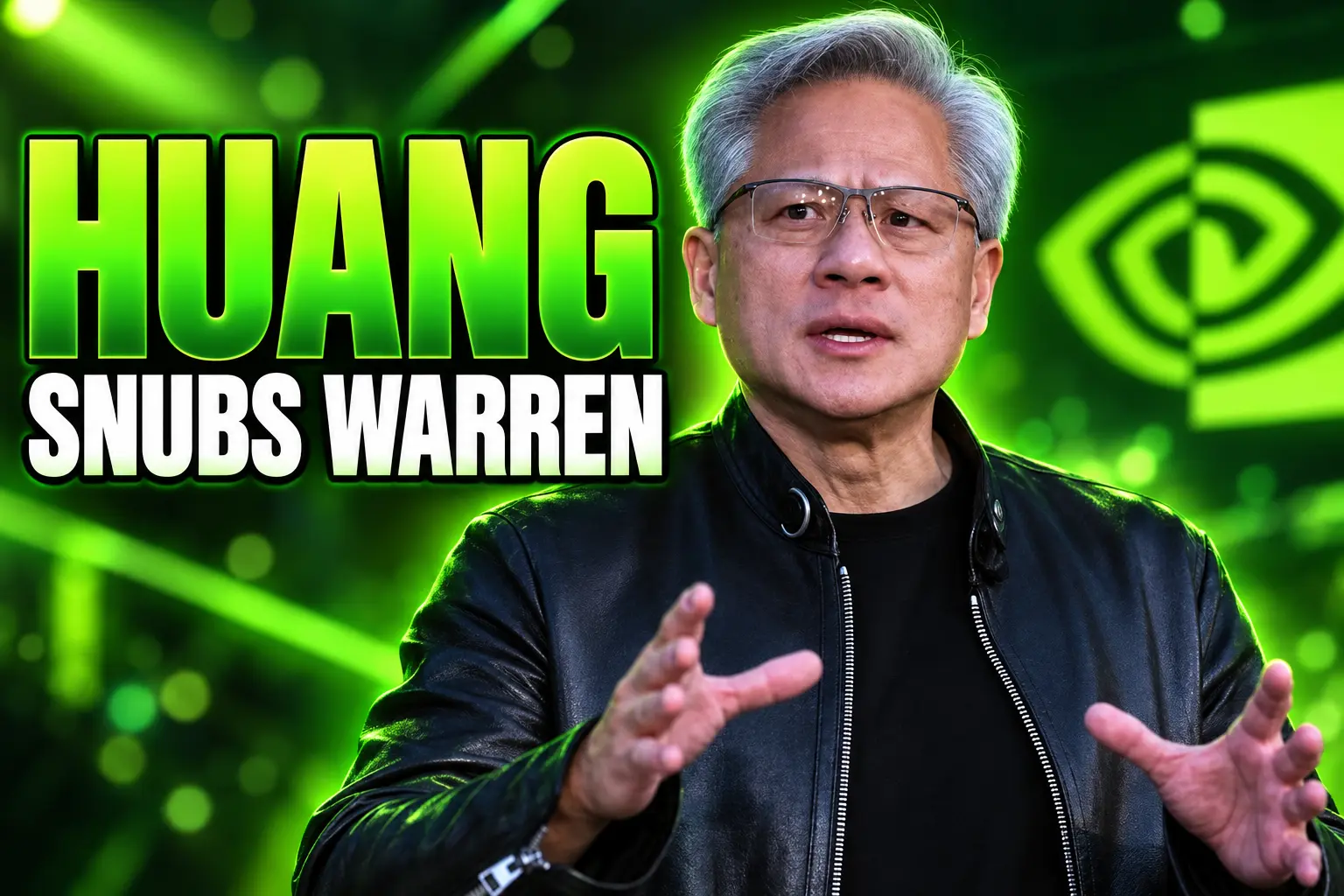
Huang’s reply is dated June 6, two days before her deadline. He said he was unable to attend, thanked the committee for focusing on the subject, and invited Warren or any member to Nvidia headquarters in Santa Clara to talk about the company’s technology and U.S. leadership.
I am unable to attend, but appreciate the Committee’s focus on these important issues.
Jensen Huang, founder and CEO, letter to Sen. Elizabeth Warren, June 6, 2026
He wrote that Nvidia designed, built, and delivered the first AI supercomputer to American researchers more than a decade ago and has tried to keep American labs, startups, and companies at the front of the field. American leadership in AI cannot be taken for granted, he said, but he is confident in the American system.
Warren’s public answer treated the campus offer as a dodge. Nvidia sits at the center of questions on AI, economic competition, and national security, she said, and if Huang had time for a $1 million-a-head dinner at Mar-a-Lago and a trip to meet Xi, he could find time for Congress. Minority staff kept asking for another open-session date. The June 11 panel was not rewritten around him.
The loudest defense of that choice treats the Banking Committee as a television set, a place where a chip CEO burns an hour so senators can clip a China sound bite. That reading is useful in one Washington. It also hands the other Washington a fact it can reuse: the most valuable AI-chip maker in the country would not sit in public.
Four Witnesses Filled the Seat He Left
The June 11 hearing notice and witness list named four people. None of them ran Nvidia. Chairman Tim Scott’s committee still convened, and Warren used her opening to talk about the man who was not there.
THE JUNE 11 WITNESS PANEL
- Mike Flynn: Senior vice president and counsel at the Information Technology Industry Council.
- David Feith: Senior fellow at the Hudson Institute.
- Will Rinehart: Senior fellow at the American Enterprise Institute.
- Sarah Myers West: Co-executive director of the AI Now Institute.
Warren told colleagues she had invited Huang and that he refused to join them. Nvidia’s value, she said, had ballooned to nearly $5 trillion, which made Huang a very powerful person who wants to sell chips to China, profit his own company, and advance China’s AI. She said she asked him there because he and Nvidia were lobbying hard for a blank check from the Trump administration to allow sales of advanced chips to China.
The rest of the morning was not an empty-chair stunt. Senators also pressed the panel on AI-related debt, data-center power costs, and whether households would eat the bill if a leveraged buildout cracked. Democrats on the dais still kept returning to chip flows into China and to Huang’s closeness to Trump. The substitute witnesses could describe industry views. They could not swear to Nvidia’s China books.
What the June 1 Letter Asked Nvidia’s Board
Three days before the hearing invite, Warren had already sent questions for Nvidia’s audit committee. The addressees were Tim Teter, executive vice president, general counsel, and secretary, and Brooke Seawell, a director who chairs the audit committee. She asked whether the board was actually overseeing export-control compliance, and whether Huang’s public lines still held up next to recent Justice Department cases.
Those cases, she wrote, allege schemes to move Nvidia products toward China. She set them against Huang’s claims that there is no evidence of any AI chip diversion and that Nvidia chip market share in China has dropped to zero. Recent indictments, she said, raise urgent questions about board oversight and about risk to investors and national security.
ALLEGED NVIDIA PRODUCT DIVERSION CITED BY WARREN
| Product or path | Amount in the letter | How she framed it |
|---|---|---|
| GPUs routed through Malaysia and Thailand | Millions of dollars | Unlawful diversion to China |
| H100 and H200 chips | $160 million | Exports and attempted exports |
| Servers | $510 million | Diverted servers |
The allegations are for prosecutors to prove, and they describe third-party schemes rather than a charge against Nvidia itself. What Warren wanted from Teter and Seawell was whether those cases had triggered board-level review or changes in customer checks. She also pointed at a short-seller note that tried to keep a large China share in Nvidia’s compute sales; that note is an interested bet against the stock, not a finding, and she used it as a prod, not as a verdict.
One of the criminal files she leaned on involves people tied to Super Micro, the server firm Huang had publicly urged to tighten compliance during a Taiwan trip. He has said Nvidia is rigorous with partners and that Super Micro has to run its own company. A campus tour in Santa Clara would not have put that distinction on a Senate transcript.
Huang Dined With Senate Republicans on July 28
The June clock ran out in public. The July clock ran in a dining room.
FROM THE JUNE LETTERS TO THE JULY DINNER
- June 1, 2026: Warren writes Teter and Seawell on export-control oversight and asks for answers by June 18.
- June 4, 2026: She invites Huang to the June 11 AI hearing and asks him to confirm by June 8.
- June 6, 2026: Huang declines and offers a Santa Clara visit.
- June 11, 2026: The hearing proceeds with four witnesses. Warren says Huang refused to join.
- June 18, 2026: The written deadline on the board letter lands.
- July 28, 2026: Huang attends a private dinner with Republican senators. Warren issues a new statement.
In December 2025, Huang had already held a closed-door meeting with Senate Republicans. Warren criticized that session at the time, saying he was lobbying to kill the bipartisan GAIN AI Act and to preempt state AI rules. The July 28 dinner, in her telling, was the same pattern with better catering.
Mr. Huang has found time for a $1 million-a-head dinner at Mar-a-Lago, a trip across the world to meet with President Xi, and now a private dinner with Senate Republicans. But he can’t find even an hour to answer questions from Congress in public?
Sen. Elizabeth Warren, ranking member, Senate Banking Committee, July 28, 2026
She added that the public deserves to hear why Nvidia wants to sell advanced AI chips to China and whether Huang has been lobbying senators to kill bipartisan bills that would keep those chips from China’s military. He still had not taken the witness chair she offered in June.
Off Camera, the China Questions Kept Moving
Export licenses are written at Commerce, not in Dirksen. Criminal diversion cases sit with the Justice Department. The GAIN AI fight lives in defense bills and leader offices. Banking’s hold on Huang was the threat of a public transcript, and that threat bounced.
The archived video of the June 11 session is the record of what a ranking member can do with an absence: name the CEO, name China, name the blank check, and move on to debt and power bills. It is not a record of how Nvidia tracks a GPU once a partner takes title, or of what Huang tells Trump about H200 licenses.
WHAT STILL SITS OFF THE PUBLIC RECORD
- Sworn China answers: Huang has not given the five-minute statement plus questions Warren scheduled for June 11.
- Board reply: The June 18 ask to Teter and Seawell was a written oversight demand, not a press release, and the committee has not posted Nvidia’s answers beside the letter.
- Open-session makeup date: Staff wanted another public slot after June 8. No such hearing with Huang has been noticed.
- Third-party cases: The Malaysia, Thailand, H100, H200, and server allegations remain matters for courts, not for a CEO campus tour.
The fight over China chip export controls did not begin with the June 4 note, and it did not end when the witness list went out without him. Huang’s bet is that the rooms that issue licenses and kill bill text matter more than a Banking Committee clip. Warren’s bet is that an empty chair is itself an answer, and she has now used it twice.
Frequently Asked Questions
Did Jensen Huang Testify at the June 11 Senate AI Hearing?
No. The hearing was noticed for 10:00 a.m. in room 538 of the Dirksen Senate Office Building in open hybrid format, and Huang was not among the four listed witnesses. After his June 6 decline, committee staff still sought a later date for him to appear in an open session.
How Long Did the June 11 Hearing Run?
The archived recording runs 1 hour, 47 minutes, and 32 seconds. Senators used that time on AI debt, power costs, export controls, and Huang’s absence, and the listed witnesses could also file written testimony with the committee.
What Separate Nvidia Letter Had Warren Already Sent?
On June 1 she wrote Nvidia general counsel Tim Teter and audit committee chair Brooke Seawell, asking whether the board had reviewed export-control compliance after the Justice Department diversion cases, with answers due June 18, 2026. That letter is a different document from the June 4 hearing invitation.
What Bill Did Warren File on the Morning of the Hearing?
With Sen. Richard Blumenthal she introduced the AI Bubble Transparency Act, which would direct the Treasury Department’s Office of Financial Research to collect data from financial companies on their AI-related exposures. She also asked Chairman Tim Scott for a follow-up hearing with Trump administration officials on the White House approach to AI firms.
On July 28 Warren asked whether Huang was lobbying senators to kill bills that would keep advanced chips from China’s military. The public chair she opened on June 4 was still empty.

Instagram Plus Tests a Read-Only Mode That Cuts Stories

Altman Asks the Public to Accept Some AI Harm

Google Freezes OSS VRP Product Reports After AI Flood

AI Agents Make Payment Rails the Scarce Prize

Turkey’s Crypto Boom Now Runs Through Three Banks

Fable 5 Came Back Under a Commerce On-Off Switch

Google’s SpaceX GPU Lease Has a Sept. 30 Deadline

Plasma One’s XPL Locks Face a 1.81 Billion Cliff

DGO’s Rs 549 World Cup Pass Cost Fans Sleep and Data

Moonshot AI’s $30 Billion Ask Became a $35 Billion Close
-
 AI4 months ago
Fable 5 Came Back Under a Commerce On-Off Switch
-
 AI4 months ago
Google’s SpaceX GPU Lease Has a Sept. 30 Deadline
-
 CRYPTO4 months ago
Plasma One’s XPL Locks Face a 1.81 Billion Cliff
-
 APPS4 months ago
DGO’s Rs 549 World Cup Pass Cost Fans Sleep and Data
-
 AI4 months ago
Moonshot AI’s $30 Billion Ask Became a $35 Billion Close
-

 NEWS4 months ago
ColorOS 17 Device List Spans Oppo, OnePlus and Realme
-

 GAMING4 months ago
Xbox Cuts 3,200 Jobs After Five Years of Thin Returns
-
 GAMING4 months ago
The RTX 4050 Under Rs 70,000 Hides a Wattage Gap