
NEWS
iOS 27 Lands Monday With Siri AI Still in Beta
iOS 27 arrives September 14 with Siri AI as an English beta, an EU block, a $250 million hangover from 2024, and two June features already pulled.

Apple will release iOS 27 on September 14, with Siri AI arriving as an English-only beta on phones that support Apple Intelligence.
The assistant Apple previewed in 2024 now has a ship date, a dedicated app, and a long list of limits. It is still a beta. It is blocked on iPhone in the European Union. Two of the smarter app tricks shown in June will not be in Monday’s build.
iOS 27 Lands Monday With Siri AI Still in Beta
The public build of iOS 27 goes out with iPadOS 27, macOS 27 Golden Gate, watchOS 27, tvOS 27, and visionOS 27. Apple confirmed the date at its Surprise and Shine event on September 9, then seeded release candidates the same day. Developers have been on the betas since the June 8 keynote at Apple Park.
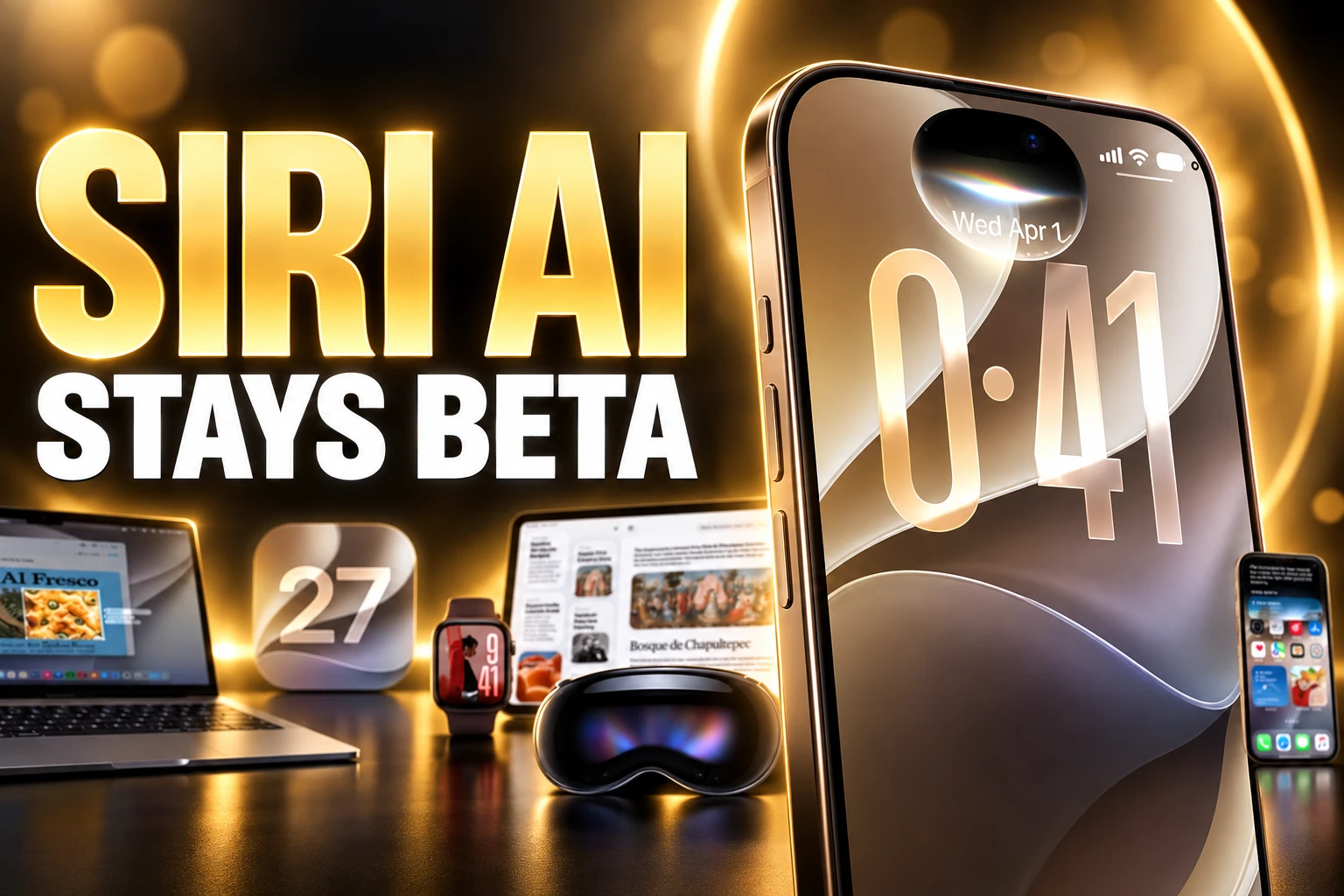
Siri AI is the headline, and Apple’s own iOS 27 page is blunt about the terms. The assistant rolls out in English. Usage limits may apply. Extra headroom sits behind iCloud+ plans, with a paid expansion flagged for later. People under 13 do not get Siri AI at all.
THE MONDAY SHIP WINDOW
- Public release: All six OS 27 updates go out Monday, September 14, 2026, as a free software update.
- Siri AI at launch: A beta for supported devices set to English, with French, Japanese, Korean, Portuguese, and Spanish listed for October.
- Hard blocks: No Siri AI on iOS, iPadOS, or watchOS in the EU, and none in China while Apple works through local rules.
- New hardware: iPhone Duo, iPhone 18 Pro, and iPhone 18 Pro Max, announced September 9, ship on iOS 27.
John Ternus took over as CEO on September 1, so the first software drop of his tenure is this one. Tim Cook’s last WWDC as CEO was the June show that put Siri AI on a calendar. Monday is when that calendar runs out.
The 2024 Promise Apple Could Not Keep on Time
Apple first showed a more personal Siri at WWDC 2024 and advertised it against that fall’s iPhones. The phones shipped without the assistant people had been shown. In March 2025 the company said the overhaul would slip. The features sat in limbo through another full software year.
On May 5, 2026, Apple agreed to pay $250 million to settle a U.S. consumer case, Landsheft v. Apple Inc., over those missing features. The company did not admit fault. In a statement it said it had settled “claims related to the availability of two additional features” so it could stay focused on shipping products. The class covers iPhone 15 Pro, iPhone 15 Pro Max, and iPhone 16 models bought in the United States between June 10, 2024, and March 29, 2025. The working payout is $25 per device, which can rise to $95 depending on how many claims come in. A final approval hearing is set for September 29, 2027.
That is the bill attached to Monday’s download. Siri AI is not a fresh idea from June. It is the 2024 demo, rebuilt, renamed, and sent out as a beta.
SIRI’S PATH FROM STAGE TO PHONE
- June 10, 2024: Apple shows Apple Intelligence and a smarter Siri at WWDC and starts advertising the features for that fall’s iPhones.
- Fall 2024: iPhone 16 launches without the personal Siri capabilities that were in the ads.
- March 2025: Apple delays the Siri overhaul after quality problems inside the original design.
- May 5, 2026: Apple agrees to the $250 million consumer settlement over the missing features.
- June 8, 2026: WWDC 2026 introduces Siri AI, a standalone app, and developer betas of iOS 27.
- September 14, 2026: iOS 27 goes public and Siri AI arrives as an English beta on supported hardware.
The rebuilt stack is also not the in-house story Apple sold in 2024. Reporting around the keynote, including our own on the WWDC 2026 Siri overhaul that runs on Gemini, put a custom Google model under the heaviest questions. Apple’s newsroom does not name Google. It says Siri AI runs on the next Apple Foundation Models, on the device and on servers through Private Cloud Compute, with personal data neither stored nor opened to Apple. The privacy pitch is the same one the company has used since Apple Intelligence launched. The partner underneath it is new.
What Siri AI Can Do on Monday
On a supported iPhone, Siri AI is meant to hold a back-and-forth conversation, see what is on the screen, and search a person’s own messages, mail, photos, and notes. Craig Federighi, Apple’s senior vice president of Software Engineering, called it a dramatically more capable assistant that can help people find information and get things done through the day.
iPhone owners can still say “Hey Siri” or hold the side button. They can also swipe down from the Dynamic Island to open a longer chat. On iPad and Mac, the same assistant sits in Spotlight and in context menus. Apple Watch can start a session from the wrist or surface a Smart Stack suggestion to pick up a recent one.
WHAT LANDS IN THE SIRI AI BETA
- A real app: The dedicated Siri app that syncs via iCloud keeps chat history across iPhone, iPad, Mac, Watch, and Vision Pro.
- On-screen awareness: Siri AI can answer questions about what is in front of you, then take the next step in another app.
- Siri mode in Camera: Tap the shutter and the assistant can identify what it sees, pull nutrition facts, or split a bill with Apple Cash.
- Writing tools: Siri can draft from a prompt, match the tone you use with a given person in Mail and Messages, and proofread as you type, including in most third-party apps.
- Visual Intelligence off iPhone: iPad gets it in screenshots, Mac gets a keyboard shortcut, and Vision Pro can answer questions about things you look at.
Photos picks up Spatial Reframing, which rebuilds a shot’s composition after the fact, plus a heavier Clean Up tool. Image Playground can now make photorealistic pictures for wallpapers and Contact Posters. Those are the pieces of Apple Intelligence that do not need you to open Siri at all.
The beta still has a ceiling. Apple says some features that lean on server models have daily caps. Higher iCloud+ tiers raise those caps. The company has already said expanded access will cost extra later, without naming a price.
Siri AI Stops at the iPhone 15 Pro Line
iOS 27 itself is a wide release. It runs on every iPhone that ran iOS 26, back to iPhone 11 and iPhone SE (2nd generation). Stacey Ford, Apple’s vice president of operating systems program management, said during the June show that the update would reach more users than any iOS release before it, in part because an optimized CPU scheduler is going to those older chips.
Siri AI does not ride along. Apple Intelligence and the new assistant need iPhone 16 or later, or iPhone 15 Pro and iPhone 15 Pro Max. A base iPhone 15, and every 14, 13, 12, and 11, get the faster launches and the Liquid Glass slider. They do not get the assistant the keynote was built around.
OS 27 SUPPORT VERSUS SIRI AI
| Hardware | Gets the new OS | Gets Siri AI |
|---|---|---|
| iPhone 11 through iPhone 14, base iPhone 15, iPhone SE (2nd gen) | iOS 27 | No |
| iPhone 15 Pro, iPhone 15 Pro Max, iPhone 16 and later, iPhone Duo, iPhone 18 Pro, iPhone 18 Pro Max | iOS 27 | Yes, English beta |
| Apple Watch Series 8, SE (2nd gen), original Ultra | No watchOS 27 | Cut from the OS |
| Apple Watch Series 9 and later, SE 3, Ultra 2 and later | watchOS 27 | Yes, if the paired iPhone has Siri AI; not in the EU |
| Intel Macs | No macOS 27 | Cut from the OS |
| Apple silicon Macs, M1 and later, including MacBook Neo | macOS 27 Golden Gate | Yes, including in the EU |
On Watch, Siri AI also needs a nearby iPhone that already has the feature. That pairing rule is why the EU Watch block is automatic: if the phone cannot run Siri AI, the wrist cannot either.
EU-based developers are in a tighter spot than EU customers. Apple said they cannot test or use the new Siri AI features for their apps on iOS 27, iPadOS 27, or watchOS 27. The only official test benches inside the bloc are Mac and Vision Pro. Some developers have had to leave the EU just to see whether their iPhone integrations work.
We’re deeply disappointed that our EU users won’t have Siri AI on iPhone or iPad when we share our new software releases later this year.
Craig Federighi, senior vice president of Software Engineering, Apple newsroom, June 8, 2026
Federighi also said Apple has no timeline for Siri AI in the EU on iOS and iPadOS. The company’s account is that the Digital Markets Act would force it to give any virtual assistant direct access to private data and to other apps the moment Siri AI ships. Apple offered a middle layer it called Trusted System Agent and an 18-month phase-in. It says the European Commission rejected every proposal. Mac and Vision Pro still get Siri AI in the EU when the device language is supported. The UK is outside that block.
The Two Features Apple Pulled From iOS 27
Even the June demos that survived the two-year slip did not all make Monday. On September 11 Apple updated its iOS 27, iPadOS 27, and macOS 27 pages to move two Apple Intelligence tricks to “a future software update.”
One is one-tap suggestions in Messages. In the betas, the app read a thread and offered to make a reminder, a note, or a calendar event, or to hunt down the photos someone had just asked for. The other is in Passwords. Apple showed the app using Apple Intelligence and Safari to sign into a site and replace a weak or leaked password, with a Live Activity tracking the work.
Both were in the summer betas. Automatic password changes disappeared for testers around beta 5. Apple has now said the same thing in public, without a new date. A point release is already expected later in October, because iPhone Duo is due then with iOS 27.1 on it. That is a window, not a promise.
The pattern is familiar. Apple puts the ambitious agentic work on stage, then holds it when the agent has to act on a live website or a live conversation. Siri AI still ships. The two features that most looked like an agent doing a job for you do not.
30 Percent Faster App Launches and a Glass Slider
Most people who tap Install on September 14 will notice the plumbing before they notice the assistant. Apple says iPhone and iPad apps launch up to 30 percent faster, photos show up in the library up to 70 percent faster after you shoot them, and AirDrop transfers run up to 80 percent faster. Moving files between an iPad and an external drive is listed as up to five times faster. Handoffs between Wi-Fi and cellular are supposed to stutter less.
THE PARTS OF iOS 27 THAT DO NOT NEED SIRI
- Liquid Glass: A Settings slider runs from ultra-clear to fully tinted, after a year of complaints that last year’s look washed out text.
- Icons: Home Screen glyphs pick up extra refraction so they read sharper on the new glass.
- Mail and search: Top Hits in Mail get a new ranking system, and Spotlight, Photos, and Mail search were rebuilt to stay stable.
- Family controls: Child accounts can lock in age filters at setup, require approval for new contacts, and set daily time allowances for Entertainment, Games, and Social Media.
- Health: Cycle Tracking adds perimenopause and menopause support, with alerts when a cycle looks off.
- Photos sharing: iCloud Shared Albums accept full-resolution pictures from Android and Windows.
Those are the pieces an iPhone 11 owner actually gets. They also include a lot of the iOS 27 features that missed the keynote glare, from independent alarm volume to auto captions on videos to Dual Capture in FaceTime on last year’s iPhone 17, 17 Air, and 17 Pro. Custom EQ lands on AirPods. Maps Flyover gets a denser aerial pass. None of it needs a 15 Pro.
Safari, Wallet, and Weather were on the pre-WWDC rumor list as redesign targets. The shipping story is narrower: Safari picks up Apple Intelligence help while you browse, and the visual refresh is the system-wide glass slider plus sharper icons, not a new browser chrome. The Camera change that did ship is Siri mode, not a full app rebuild.
Which Apple Watches Lose Support in watchOS 27?
watchOS 27 is the first Watch update in this cycle to drop hardware. Series 8, SE (2nd generation), and the original Ultra stay on watchOS 26. Series 9 and later, SE 3, and Ultra 2 and later move up. Workout Buddy can now run without the iPhone nearby and adds Spanish. A new Find My app on the Watch merges devices, items, and people. The Smart Stack gains a single-tap way to open a widget, plus suggestions for birthdays, a parked car, and transit balances.
On September 9 Apple also showed Siri Modular, a new face for both Series and Ultra watches. It puts a wide Siri suggestion under the time and a row of three round complications at the bottom, with extra bezel options on Ultra. It is the old Siri face in Modular clothes, built for the assistant that only some wrists will have.
Mac users hit a harder line. macOS 26 was the last major release for Intel machines. Golden Gate is Apple silicon only. Apple has told developers to set Xcode to arm64 if they want to stay on the Mac App Store, and App Store submissions for iOS 27 are already open against the Xcode 27 release candidate. From April 2027, new iOS, iPadOS, tvOS, visionOS, and watchOS binaries will have to be built with the 27 SDKs.
iOS 27 goes out Monday. Siri AI follows on the phones that can run it, in English, as a beta, with Europe still waiting on a date Apple will not give.

Huang Sells Cybersecurity as AI’s Next Always-On App

Gemini for Windows Cannot Act on Gmail or Drive

Apple Health App Will Sell $119 Quest Blood Tests

AMD’s EPYC Playbook Now Runs Against NVIDIA’s AI Lead

A Nevada Ring Clip Turns a Door Kick Into Evidence

Fable 5 Came Back Under a Commerce On-Off Switch

Google’s SpaceX GPU Lease Has a Sept. 30 Deadline

Plasma One’s XPL Locks Face a 1.81 Billion Cliff

DGO’s Rs 549 World Cup Pass Cost Fans Sleep and Data

Moonshot AI’s $30 Billion Ask Became a $35 Billion Close
-
 AI3 months ago
Fable 5 Came Back Under a Commerce On-Off Switch
-
 AI4 months ago
Google’s SpaceX GPU Lease Has a Sept. 30 Deadline
-
 CRYPTO4 months ago
Plasma One’s XPL Locks Face a 1.81 Billion Cliff
-
 APPS4 months ago
DGO’s Rs 549 World Cup Pass Cost Fans Sleep and Data
-
 AI4 months ago
Moonshot AI’s $30 Billion Ask Became a $35 Billion Close
-
 NEWS4 months ago
ColorOS 17 Device List Spans Oppo, OnePlus and Realme
-

 GAMING4 months ago
Xbox Cuts 3,200 Jobs After Five Years of Thin Returns
-

 GAMING3 months ago
The RTX 4050 Under Rs 70,000 Hides a Wattage Gap