
AI
Applied Digital’s $3.6B AI Campus Breaks Ground in Rapides Parish
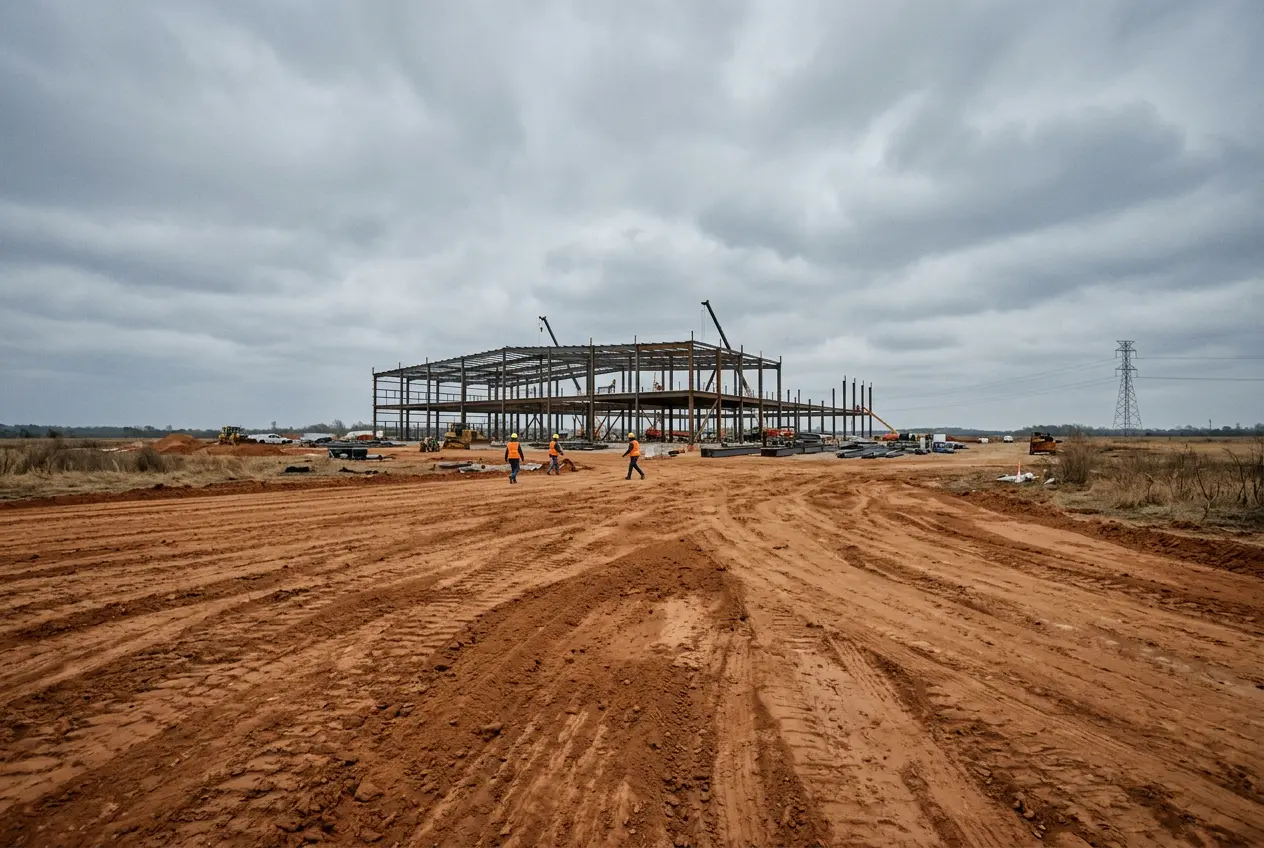
Six months after site work began quietly near the I-49 interchange south of Boyce, Governor Jeff Landry made Applied Digital Corporation’s $3.6 billion AI data center campus in Rapides Parish official on Tuesday. The project, called Delta Forge 1, will occupy approximately 300 acres within the England Airpark Authority’s jurisdiction, drawing a combined 300 megawatts of critical IT load across two purpose-built facilities designed for large-scale AI training and inference workloads.
The project marks the company’s first Louisiana location and the first major AI campus to land in Central Louisiana, arriving as Louisiana has become one of the most concentrated targets for data center investment in the country, with Meta, Amazon Web Services, and Hut 8 each financing or building campuses across four other parishes.
A 672-Acre Parcel, Two Buildings, Mid-2027
The Dallas-based company (Nasdaq: APLD), founded in 2021, purchased a 672-acre parcel near Boyce in December 2024. Rapides Parish’s economic development district formally designated the full lot as England District Subdistrict No. 4 in February 2026, establishing the local tax structure the project will operate under. Roughly 300 of those acres form the active campus area; the remaining 372 will stay undeveloped, listed by the company as available for uses not yet announced.
Site preparation started in January 2026. The campus runs on a 15-year initial lease with three five-year renewal options, giving the project a framework of 27 years in total. Initial operations are scheduled for mid-2027, according to Louisiana Economic Development’s official Delta Forge 1 announcement.
An AI training and inference workload is among the most power-dense computing uses a data center can host, typically requiring ten to twenty times the power density of conventional enterprise computing. At 300 megawatts of critical IT load, the campus would draw electricity at a scale comparable to a small city, and that figure drives every aspect of site selection, from proximity to regional transmission infrastructure along the I-49 corridor to the closed-loop cooling design the company deploys across its campuses, which eliminates the continuous water draw that most comparably sized facilities require.
The State That Became a Data Center Destination
Delta Forge 1 joins three other confirmed AI infrastructure commitments that have concentrated more than $50 billion in planned data center capital across five Louisiana parishes in under 18 months.
| Project | Developer | Parish | Investment | Phase 1 Status |
|---|---|---|---|---|
| Hyperion | Meta | Richland | $27 billion | Under construction |
| Amazon AWS Campuses | Amazon / STACK Infrastructure | Caddo & Bossier | $12 billion | Announced Feb 2026 |
| River Bend | Hut 8 | West Feliciana | Up to $10 billion | Under construction |
| Delta Forge 1 | Applied Digital | Rapides | $3.6 billion | Site prep underway |
Act 730, enacted in Louisiana’s 2024 regular legislative session, created a state and local sales tax exemption covering qualifying purchases or leases of data center equipment. The statute defines eligible equipment as hardware or software used for “processing, storage, retrieval, or communication of data,” including servers and routers. Applied Digital confirmed its campus qualifies, and the program also covers the other three major projects committed to the state. Full eligibility criteria are outlined on Louisiana Economic Development’s data center incentives page.
The exemption carries no cap on eligible spend. For a campus where a substantial portion of total investment flows into servers, storage systems, and networking hardware, the tax relief scales proportionally with project size, which is precisely why Act 730 has functioned as an effective draw for commitments of this magnitude.
Chris Masingill, president and chief executive of Louisiana Central, the economic development connector for the ten parishes of Central Louisiana, called the project “one of the most transformational in the history of Rapides Parish, surpassing even the major industrial investments of the 1950s and 60s.” He added that it “positions Central Louisiana to compete for major economic opportunities in ways we haven’t seen in generations.” For a region that has not attracted capital formation at this scale in decades, placement alongside Meta’s Richland complex and Amazon’s Shreveport-area campuses is a qualitative shift in economic geography that no prior announcement cycle produced.
Louisiana Economic Development Secretary Susan B. Bourgeois captured the state’s positioning at the event: “With stronger alignment, greater speed and a clear focus, we are seeing unprecedented momentum and growth reach every region of our state.”
Applied Digital’s Built Record
Applied Digital is not a promotional announcement vehicle. The company operates AI factory campuses in North Dakota under signed contracts with CoreWeave, the AI hyperscaler backed by Nvidia, and has delivered phase milestones on schedule across active construction sites, a track record that distinguishes a credible $3.6 billion groundbreaking from a speculative one.
- Polaris Forge 1, Ellendale, North Dakota: A 400-megawatt campus contracted entirely to CoreWeave under leases projected to generate approximately $11 billion in total revenue over their 15-year terms, including $7 billion from the two initial agreements executed in May 2025. Phase I delivered in October 2025; Phase II completed on schedule in November 2025.
- Polaris Forge 2, Harwood, North Dakota: A separate AI factory campus with investments projected to exceed $3 billion, backed by a $5 billion perpetual preferred equity facility from Macquarie Asset Management covering multiple company campuses.
- Named Best Data Center in the Americas for 2025 by Datacloud, an independent industry recognition program.
- A $300 million senior secured bridge facility announced earlier this year for continued development at Polaris Forge 1, demonstrating continued capital market access through active construction cycles.
The Nvidia connection predates the Louisiana groundbreaking by roughly three years. Officials at the Boyce announcement noted that the path to building this campus began when Nvidia made an early investment in the company, providing pre-boom validation of its power-dense AI factory design before that model became the industry default. The company structures its business around long-duration infrastructure leases, converting large external financing, including the Macquarie preferred equity facility, into predictable multi-decade revenue streams closer to an infrastructure company’s cashflow profile than a technology cyclical’s. The pattern established at Polaris Forge 1 and Polaris Forge 2 is what gives the Rapides Parish commitment its practical credibility.
Cleco, 300 Megawatts, and the Rate Question
Cleco Power will supply all electricity to the campus. Bill Fontenot, president and chief executive of Cleco, described the contract in terms that left no ambiguity about how the utility views the project’s scale.
This is the largest economic development opportunity in Cleco’s 90-plus year history and reflects the region’s growing competitive position for major infrastructure and technology investments.
The standard concern around data center announcements of this size is that residential ratepayers end up absorbing the cost of new transmission and generation infrastructure built to serve a single industrial-scale customer. Fontenot pushed back on that directly, saying the project structure prevents cost-shifting and that the company has agreed to fully reimburse all infrastructure expenses associated with delivering power to the campus. Spreading a large fixed-cost utility system across a broader customer base, Fontenot argued, reduces per-customer costs rather than concentrating them. Cleco confirmed in a separate statement that it has received assurances preventing the shifting of costs onto existing customers.
Applied Digital Director Richard Nottenburg pointed to the company’s existing North Dakota operations, where he said residential electricity rates in surrounding communities declined after that campus came online. Louisiana’s grid context amplifies the stakes of those assurances; the state ranks third among all states in per-capita electricity consumption, meaning the grid already carries one of the country’s heaviest residential loads before any new industrial demand arrives. On water, Nottenburg said the closed-loop cooling design applied across the company’s campuses eliminates continuous water draw, with each building consuming roughly as much water as a single-family home.
The Economic Deal: Jobs, Taxes, and a 27-Year Clock
Louisiana Economic Development and the company released detailed figures covering construction employment, permanent hiring, annual payroll, and payments to local government across the full term of the agreement.
- 200 direct full-time on-site jobs at approximately $90,000 annually, representing salaries at 150% of Louisiana’s average state wage
- More than 1,000 construction jobs expected at peak development activity
- 218 additional indirect jobs estimated by Louisiana Economic Development, for a combined regional impact of 418 new positions
- $32.67 million in combined annual payroll from campus operations, per the company’s published figures
- $575.5 million pledged to ten Rapides Parish taxing bodies over the 27-year agreement
- $3.3 million per year to the parish Sheriff’s Office, totaling $88.1 million over the full term
Ralph Hennessey, executive director of the England Economic and Industrial Development District, called the investment “a defining moment” for the region. The long-term payment schedule to local taxing bodies is more durable than the construction-phase employment figure that typically dominates announcement-day coverage; it commits revenue to parish governments for nearly three decades, outlasting multiple election cycles and budget seasons.
What Tuesday’s official materials do not include is a publicly named tenant for the campus. No lease disclosure accompanied the groundbreaking announcement, though the company has a documented pattern of signing customer agreements concurrent with or shortly before public construction milestones. At Polaris Forge 1, the CoreWeave agreements were executed in May 2025, months before the first building reached service readiness. Who signs the campus lease, and at what contracted revenue total, is the figure that ultimately converts a long-term economic projection into a schedule of actual payments for Rapides Parish governments.
Site preparation is underway, the Cleco power contract is confirmed, and initial operations are set for mid-2027. By then, Louisiana will have multiple major AI campuses approaching operational status simultaneously, and the state’s grid operators will face their first real test of whether aggregate industrial demand from five parishes can be absorbed without the rate increases that state officials have pledged, repeatedly, will not come.
AI
Asos AI Stylist Sends Shoppers to Competitors When Inventory Falls Short
Asos launched Stylist in ChatGPT this month, a shopping assistant that surfaces fashion picks and video content for UK and US customers. The app runs on Bambuser’s video commerce platform and turns Asos’s product library into machine-readable data that ChatGPT can retrieve and return as shoppable videos. Shoppers ask for outfit ideas, browse by occasion or trend, and click through to buy on Asos. The pitch is frictionless discovery inside an environment where 17 million people already spend time. The execution reveals a structural problem no one designing AI commerce tools wants to admit: the AI will always try to be genuinely helpful, and genuine helpfulness does not respect single-retailer distribution.
Steve Webster, an e-commerce executive whose career includes stints at Barbour and Liwa Trading Enterprises, tested Stylist and documented the failure mode in a LinkedIn post. He asked the app to build a smart casual wardrobe for a middle-aged man. Stylist returned a Mango blazer, Jack & Jones shirts, Thomas Crick Evers trainers. Competent enough. Then it reached fragrance. The AI recommended Tom Ford Oud Wood, a luxury scent that fits the brief perfectly. It also linked directly to tomfordbeauty.co.uk, a competitor Asos does not stock. Within three minutes, the AI stylist had sent a paying customer to another retailer.
What Bambuser’s Intelligence Layer Actually Does
Bambuser’s new Intelligence Layer converts Asos’s video library and product catalogue into structured data that large language models can process and retrieve in real time. The system ingests product metadata, video timestamps, styling context, and availability flags, then packages everything so ChatGPT can return shoppable video clips alongside product cards. The technical architecture is sound. A human stylist working exclusively for Asos would navigate the Tom Ford gap by suggesting a different fragrance the retailer actually carries. ChatGPT does not operate within those constraints.
The AI optimizes for the stated need, not for the conversion rate. When a customer asks for a specific product category and the retailer’s catalogue does not contain the best answer, the model fills the gap with whatever it knows. ChatGPT knows Tom Ford Oud Wood is the right fragrance for a mature man building a smart casual wardrobe. It also knows Asos does not stock it. So it linked out, because the right answer for the customer is not always the commercially convenient answer for the retailer.
The Attribution Problem No One Is Measuring
Webster raised a question that will prove uncomfortable for every retailer building on top of third-party intelligence layers: for every session that produces a shoppable Asos purchase, how many produce a visit to Tom Ford, Hermès, or wherever else the AI concluded was the better answer? The channel looks like distribution. In some sessions it probably is. In others, Asos is funding a sophisticated referral engine for everyone else.
No public data exists on how often AI shopping assistants route customers to competitors. The metric is not tracked in standard analytics dashboards, and the platforms hosting these tools have no commercial incentive to surface it. A session that ends with a click to tomfordbeauty.co.uk still counts as engagement. Whether that engagement converts into revenue for the retailer who paid to build the experience is a different question.
The structural tension is this: AI models are trained to be helpful across the entire internet, not helpful within the boundaries of a single retailer’s inventory. When you build a commerce experience on top of someone else’s intelligence layer, you inherit that layer’s associations, its breadth of knowledge, and its definition of a good answer. A good answer for the customer is not always a good answer for the retailer.
Why Human Stylists Do Not Have This Problem
A human stylist working for Asos would never recommend a product the retailer does not carry. The constraint is built into the job. If a customer asks for Tom Ford Oud Wood, the stylist pivots to a fragrance Asos stocks that shares similar notes or positioning. The recommendation is still helpful, but it operates within commercial boundaries the stylist understands implicitly.
ChatGPT does not understand those boundaries because it was not trained to respect them. The model’s objective is to provide accurate, useful information. When the most accurate answer involves a product outside the retailer’s catalogue, the model provides it. The fact that this behavior undermines the retailer’s business model is not a bug the AI recognizes. It is a feature of how the system was designed.
Webster’s observation is not a criticism of the ambition. Placing a brand inside an agentic platform where millions of customers already spend time is a reasonable strategic bet. The Bambuser integration is technically well conceived. The problem is structural, not executional. The AI will always try to be genuinely helpful, and genuine helpfulness and single-retailer distribution are not the same objective.
What This Means for AI-Mediated Commerce
The Asos case is not an outlier. Every retailer building shopping experiences on top of third-party AI platforms will face the same tension. The more helpful the AI becomes, the more likely it is to recommend products the retailer does not carry. The less helpful it becomes, the less reason customers have to use it.
One solution is to constrain the AI’s knowledge base to only the retailer’s inventory. This eliminates the competitor-referral problem but introduces a new one: the AI can no longer answer questions about products the retailer does not stock, which makes it less useful than a standard search bar. Another solution is to accept that some sessions will route customers elsewhere and treat the AI as a top-of-funnel awareness tool rather than a direct conversion channel. This requires a different attribution model and a willingness to fund discovery that does not always convert.
A third option is to build the intelligence layer in-house, training a model specifically on the retailer’s catalogue and styling philosophy. This is expensive, time-consuming, and requires machine learning expertise most retailers do not have. It also does not solve the underlying problem: customers will still ask for products the retailer does not carry, and the AI will still need to decide whether to admit the gap or pretend it does not exist.
The Uncomfortable Question Retailers Are Not Asking
The fundamental question is whether AI-mediated commerce serves the retailer or the customer. If the objective is to maximize customer satisfaction, the AI should recommend the best product regardless of who sells it. If the objective is to maximize retailer revenue, the AI should recommend only products the retailer carries, even when better options exist elsewhere. These objectives are not compatible.
Most retailers building AI shopping assistants have not decided which objective they are optimizing for. The assumption is that the two objectives align, that helping customers find what they want will naturally drive revenue to the retailer. The Asos case proves that assumption is false. The AI helped the customer find the right fragrance. It just did not help Asos make the sale.
Webster’s post has not prompted a public response from Asos or Bambuser. The silence is telling. The problem he identified is not unique to Asos, and it is not a problem any retailer has figured out how to solve. The AI will always try to be genuinely helpful. Genuine helpfulness and single-retailer distribution are not the same objective. Until retailers decide which one they are optimizing for, every AI shopping assistant will face the same structural tension.
Frequently Asked Questions
What is Bambuser’s Intelligence Layer?
Bambuser’s Intelligence Layer is a capability that converts a retailer’s product catalogue and video library into structured, machine-readable data that large language models can process and retrieve in real time. It allows AI platforms like ChatGPT to return shoppable video content and product recommendations based on customer queries.
Why did Asos’s AI stylist recommend a competitor’s product?
ChatGPT recommended Tom Ford Oud Wood because it is the most accurate answer to the customer’s request for a fragrance suitable for a smart casual wardrobe. The AI does not restrict its recommendations to products Asos carries; it optimizes for the best answer based on its training data, which spans the entire internet.
Can retailers prevent AI assistants from linking to competitors?
Retailers can constrain the AI’s knowledge base to only their own inventory, but this makes the assistant less useful when customers ask about products the retailer does not stock. Another option is to build a proprietary AI trained exclusively on the retailer’s catalogue, though this requires significant machine learning expertise and investment.
How common is this problem among AI shopping assistants?
No public data tracks how often AI shopping assistants route customers to competitors. The metric is not part of standard analytics dashboards, and platforms hosting these tools have no commercial incentive to surface it. The Asos case suggests the problem is structural and likely affects every retailer using third-party AI platforms.
What is the best way for retailers to use AI shopping assistants?
Retailers must decide whether they are optimizing for customer satisfaction or conversion rate. If the goal is awareness and discovery, accepting that some sessions will route customers elsewhere may be acceptable. If the goal is direct revenue, constraining the AI to the retailer’s inventory is necessary, even if it reduces the assistant’s usefulness.
AI
AI Chiefs Walk Back Job Apocalypse Warnings as IPO Pressure Mounts
Jensen Huang called it lazy. Sam Altman called it wrong. Dario Amodei softened the math to 90 percent automation with 10 percent human productivity gains. The three most-quoted voices in artificial intelligence spent the past month walking back the job apocalypse they spent two years selling, and the timing is anything but coincidental.
Speaking to Channel News Asia on Monday, Nvidia’s chief executive took direct aim at fellow executives who have publicly blamed AI for workforce reductions. “The narrative that connects AI to job loss, for many of the CEOs that are doing it, it is just too lazy,” Huang said. “AI has just arrived. How is it possible they’re already losing jobs?”
The Reversal Arrives as IPO Windows Open
Huang’s comments follow a pattern. OpenAI CEO Sam Altman told the Commonwealth Bank of Australia’s Accelerate AI Conference in Sydney last week that he “thought there would have been more impact on entry-level white-collar jobs being eliminated by now than has actually happened.” Anthropic boss Dario Amodei, long criticized as an AI doomer by peers including Huang, recently predicted that even if 90 percent of jobs are automated, the remaining 10 percent would be handled by vastly more productive human workers.
The reversals from Altman and Amodei come as their companies, OpenAI and Anthropic, are expected to embark on high-profile initial public offerings that will require broad buy-in from investors to succeed. Public sentiment toward AI has soured in recent polling, particularly in the United States, where voters voice serious discontent over the disruption that tech companies and political leaders predict from the technology.
Huang pushed back against the doom-and-gloom forecasts directly. “How is it possible that AI became productive and useful only six months ago, and they were somehow laying people off two years ago because of AI? It doesn’t make any sense,” he said. “It was just a way for them to sound smart, and I really hate that. I think we’re scaring people and that’s irresponsible.”
Corporate Layoffs Cite AI, Data Shows Otherwise
The disconnect between executive rhetoric and actual AI deployment is stark. British bank Standard Chartered announced plans last week to axe thousands of jobs by 2030 as artificial intelligence replaces employees in administrative roles. Snapchat parent company Snap cut 1,000 jobs last month, citing AI-driven efficiency gains as it pushes toward profitability.
Huang’s argument is that the timeline does not add up. AI tools capable of replacing white-collar workers at scale became widely available in late 2022 with the launch of ChatGPT, yet corporate layoffs citing automation began well before that. The narrative, Huang suggests, was a convenient cover for cost-cutting decisions driven by other factors, including over-hiring during the pandemic and rising interest rates that made growth-at-all-costs strategies untenable.
| Executive | Company | Earlier Position | Current Position |
|---|---|---|---|
| Sam Altman | OpenAI | Predicted significant entry-level job displacement | “My intuitions were just off” on job impact timing |
| Dario Amodei | Anthropic | Warned of broad automation risks | 90% automation offset by 10% hyper-productive humans |
| Jensen Huang | Nvidia | Argued AI creates as many jobs as it displaces | Blames executives for “lazy” AI-job-loss narrative |
Federal Reserve Warns the Disruption May Still Be Ahead
Not everyone is convinced the threat has passed. Federal Reserve Governor Lisa Cook warned on Wednesday that the full effects of AI on employment may still be ahead. “We could be approaching the most significant reorganization of work in generations,” she said in a speech at Stanford University, adding that AI-related job losses could precede any gains, even if the overall long-run picture remains positive.
Most economic institutions, including the European Central Bank, say that artificial intelligence has had only minor effects on employment so far. The gap between executive predictions and measurable labor-market impact has widened over the past 18 months, fueling skepticism about whether AI will deliver the productivity revolution its backers promise or the job displacement its critics fear.
The Timing Problem
Cook’s warning highlights a timing problem that Huang’s critique does not fully address. If AI tools are only now becoming capable of replacing knowledge workers at scale, the disruption those tools cause may not show up in employment data for another 12 to 24 months. Corporate adoption cycles are slow, and the integration of AI into workflows that genuinely displace workers, rather than augment them, is still in early stages.
The Productivity Paradox
The productivity gains AI is supposed to deliver have not yet materialized in aggregate economic data. Labor productivity growth in the United States has been modest since 2023, despite widespread deployment of generative AI tools in white-collar settings. The disconnect between hype and measurable output mirrors earlier technology waves, including the internet boom of the late 1990s, which took years to translate into productivity statistics.
Public Sentiment Turns Against AI Hype
The reversals from Altman, Amodei, and Huang’s criticism of peers arrive as public opinion on AI shifts. Polling conducted in the United States over the past six months shows growing skepticism about AI’s benefits and rising concern about its risks, particularly around job displacement and misinformation. The backlash has been sharpest among younger workers, who were initially the most enthusiastic adopters of AI tools.
The shift in sentiment poses a challenge for OpenAI and Anthropic as they prepare for public offerings. Investors will weigh not only the companies’ revenue growth and technical capabilities but also the regulatory and reputational risks that come with being the public face of a technology that large segments of the population view with suspicion.
- Regulatory pressure is mounting. Lawmakers in the United States and European Union are drafting legislation that would impose disclosure requirements, liability standards, and safety testing on AI systems, particularly those used in hiring, lending, and law enforcement.
- Corporate customers are slowing adoption. Enterprise buyers, initially eager to deploy AI tools, are now conducting longer pilot programs and demanding clearer return-on-investment metrics before committing to large-scale rollouts.
- Talent retention is becoming harder. AI researchers and engineers, once drawn to the mission-driven rhetoric of companies like OpenAI and Anthropic, are increasingly skeptical of leadership claims and are leaving for competitors or starting their own ventures.
What the Data Actually Shows
Employment data from the U.S. Bureau of Labor Statistics shows that job losses in sectors most exposed to AI, including customer service, data entry, and basic coding, have been modest. The unemployment rate for workers in computer and mathematical occupations stood at 2.1 percent in April 2026, down from 2.3 percent a year earlier. Administrative support roles, another category frequently cited as vulnerable to AI displacement, saw employment grow by 1.2 percent over the same period.
The disconnect between executive warnings and labor-market outcomes suggests that either the technology is not yet capable of the displacement its backers predicted, or that companies are slower to adopt it than the hype cycle implied. Huang’s argument leans toward the latter, suggesting that executives used AI as a convenient narrative to justify layoffs driven by other factors.
It was just a way for them to sound smart, and I really hate that. I think we’re scaring people and that’s irresponsible.
Huang’s comment, delivered in an interview with Channel News Asia, was unusually blunt for a CEO whose company supplies the chips that power AI systems. Nvidia has been the primary beneficiary of the AI boom, with its data center revenue growing 427 percent year-over-year in fiscal 2025. Huang’s willingness to criticize the job-loss narrative suggests he views the backlash as a threat to the broader AI ecosystem, not just to individual companies.
The IPO Calculus for OpenAI and Anthropic
OpenAI and Anthropic face a delicate balancing act as they prepare for public offerings. Both companies have raised billions in private funding at valuations that assume continued rapid growth in AI adoption. OpenAI was last valued at $157 billion in a funding round led by SoftBank in January 2026. Anthropic raised $7.3 billion in a Series D round in March 2026, valuing the company at $60 billion.
Public investors will scrutinize not only the companies’ financials but also their exposure to regulatory risk, reputational risk, and the sustainability of their growth trajectories. The job-loss narrative, which both companies’ leaders helped amplify in earlier years, now complicates that pitch. If AI does not displace workers at the scale predicted, the addressable market for enterprise AI tools may be smaller than investors assumed. If it does, the regulatory and public backlash could constrain the companies’ ability to operate.
Revenue Growth vs. Profitability
OpenAI reported $3.7 billion in annualized revenue as of December 2025, driven primarily by subscriptions to ChatGPT Plus and enterprise API contracts. The company remains unprofitable, with operating losses estimated at $5 billion in 2025 due to the high cost of training and running large language models. Anthropic’s revenue is smaller, estimated at $1.2 billion annualized as of March 2026, with similar profitability challenges.
Competitive Pressure from Open-Source Models
Both companies face growing competition from open-source models, including Meta’s Llama 4 and Mistral AI’s latest releases, which offer comparable performance at a fraction of the cost. The open-source threat is particularly acute in enterprise markets, where customers are increasingly reluctant to lock themselves into proprietary platforms.
Huang’s Long-Standing Position on AI and Jobs
Huang has consistently argued that AI will create as many jobs as it displaces, a position that puts him at odds with some of his peers. In a 2024 interview, he predicted that AI would enable new categories of work, including roles focused on training, auditing, and managing AI systems. He has also argued that AI will make existing workers more productive, allowing companies to grow without proportionally increasing headcount.
The Nvidia CEO’s criticism of executives who blame AI for layoffs is consistent with that view. If AI is a productivity tool rather than a replacement for workers, then layoffs attributed to AI are either premature or disingenuous. Huang’s comments suggest he believes the latter, and that the narrative has done more harm than good by fueling public fear and regulatory scrutiny.
The reckoning Huang describes is not just for the executives who used AI as cover for cost-cutting. It is also for the AI industry itself, which must now convince a skeptical public and wary investors that the technology’s benefits outweigh its risks. The reversals from Altman and Amodei, and Huang’s blunt criticism, signal that the industry recognizes the problem. Whether the course correction comes in time to salvage public trust, and the IPO valuations that depend on it, remains an open question.
Disclaimer: This article is for informational purposes only and does not constitute investment advice. The views expressed are those of the sources cited and do not reflect the opinions of Oton Technology. Readers considering investments in AI companies should consult a qualified financial advisor. Figures are accurate as of publication.
AI
H1-B Returnees Hit AI-Reshaped India Job Market at Worst Time
Seven thousand three hundred Indian tech professionals have already returned from the US in the first five months of 2026, matching the full-year 2023 total and putting this year on track to nearly double 2025’s flow. The pull is real: front-row seats to India’s growth story, a booming Global Capability Center (GCC) sector, and the third-largest startup ecosystem in the world. The friction is equally real: a job market that has not had two consecutive stable quarters since 2021, AI tools reshaping demand faster than hiring can adjust, and package expectations that often exceed what Indian employers will pay.
The reckoning arrives quietly. H1-B visa tightening in the US has historically triggered waves of return migration, accompanied by optimistic narratives about opportunities waiting at home. This time, the narrative meets a market where traditional IT services roles are shrinking, generative AI has compressed hiring timelines, and risk capital remains scarce. Returnees hold valuable skills, but the Indian tech sector’s current trajectory favors a narrow band of AI-native capabilities over the broad enterprise experience many bring back.
The Hiring Landscape Has Shifted Beneath Returnees’ Feet
India’s tech sector entered 2026 on a downward hiring slope. Xpheno, a specialist staffing firm, reports that May 2026 saw lower active talent demand than April, continuing a pattern of instability that began after the 2021 hiring surge. Kamal Karanth, Co-founder of Xpheno, states bluntly that this is
-
CRYPTO3 weeks agoAndreessen Horowitz Bets $2.2B on Crypto’s Quiet Cycle
-
CRYPTO3 weeks agoCathie Wood Calls SpaceX IPO Demand ‘Voracious’ Ahead Of $1.75T Debut
-
NEWS3 weeks agoGhana CSA Plants Office In Ho As Volta Cybercrime Climbs
-
APPS3 weeks agoGoogle’s Buried Page Reveals 500 Niche Websites Still Making Cash
-
NEWS3 weeks agoHormuud Bets $19 Down Will Finally Pull Somalia Online
-
NEWS3 weeks agoApple Strikes Preliminary Deal For Intel To Make iPhone And Mac Chips
-
NEWS3 weeks agoMetalenz Polar ID Hides Face Unlock Under OLED Smartphone Screens
-
AI3 weeks agoGoogle AI Overviews Adds Subscribed Label, Reddit Quotes Inline





