
APPS
Arriva’s Passenger App Is Built for Franchised Buses
Passenger’s Arriva Bus app unifies seven UK companies as franchising and a £2 fare cap pull routes, fares and branding away from the operator.

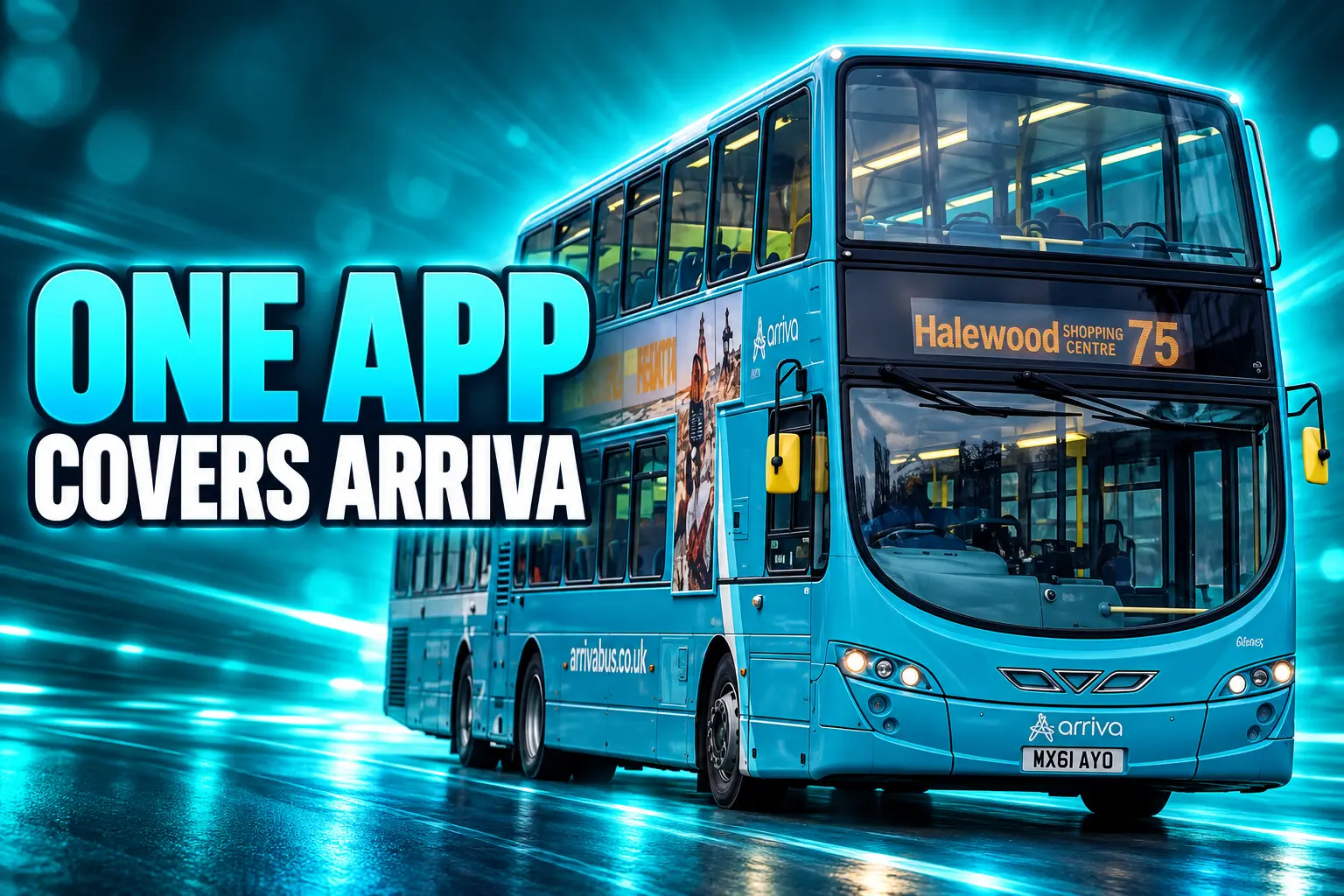
Passenger has put Arriva UK Bus’s seven companies outside London onto one customer app and website. The Bournemouth firm, now part of Masabi, sells the branded layer for tickets, live maps and journey plans. Masabi’s launch note said the same stack is how Arriva will handle franchising, multi-modal hubs and multi-operator fare caps.
That last job is already in the timetable. St Helens buses moved to a franchised network on 6 September 2026, and a national £2 single-fare cap starts on 1 January 2027.
One App Now Covers Arriva’s Seven UK Companies
Masabi’s 15 June 2026 notice said Passenger had launched the next generation of Arriva’s customer-facing digital services across its seven bus operating companies outside London. Arriva London is not in the bundle, because those routes already run under Transport for London contracts, where the authority, not the contractor, owns fares and the customer brand.
The June unification of Arriva’s seven UK companies sits on Passenger Cloud, with mobile ticketing, data management, journey planning and live vehicle tracking in one account. Masabi said the new website is “secure, functionally rich, clear and informative, and intuitive to use,” and that the launch adds tools across “almost every part of the customer journey.”
Arriva Group, the parent, delivers more than 1.2 billion passenger journeys a year across 11 European countries. UK Bus is the British division inside that total, not the whole figure. Tom Quay, listed on the June notice as Advisor to the CEO at Masabi, said Arriva had chosen the Passenger stack to meet “the needs of millions of passengers.”
WHAT THE NEW STACK SHOWS RIDERS
- Fares and tickets: Buy a mobile ticket with Apple Pay or a card and show it to the driver, with digital access that Passenger said it had tightened.
- Live map: Real-time bus locations sit next to stop departures, so a wait is a dot on a map rather than a printed time.
- Service file: Accessibility notes, disruption alerts, vehicle branding, and whether a bus has Wi-Fi or USB charging.
- Operator console: Arriva’s team gets a view of the online business that Masabi said should feed later strategy calls.
Cora Woodhouse, Arriva’s Marketing and Customer Experience Director, said the firm would keep spending after launch, with “further enhancements planned.” The public list is a rider product. The private list is a bus firm trying to keep a customer file while local leaders take back routes and prices.
St Helens Buses Left Arriva on 6 September
Liverpool City Region is the second English area outside London to put local buses under public control, after Greater Manchester’s Bee Network finished its switch on 5 January 2025. Combined-authority papers and Stagecoach’s own award notice put the first live tranche in St Helens on 6 September 2026, with Stagecoach running 26 routes from the Jackson Street depot on a fleet of 113 buses. Go-Ahead takes the Wirral later in 2026. The rest of the city region is due in 2027.
The Department for Transport, in a 7 September 2026 notice, put £86.3 million of funding until 2029 behind that shift, plus a share of a one-off £3 million pot to help mayors stand up control. It said bus travel is the most used mode in England, with 93 million bus journeys in the Liverpool City Region last year, and named the city region as one of six mayoral authorities it is backing to franchise.
From this weekend, that change will be impossible to miss. Almost overnight, people will start seeing our new yellow British-built buses appearing on the roads
Steve Rotheram, Mayor of the Liverpool City Region, GOV.UK notice, 7 September 2026
Arriva is the operator that used to run a large share of those Merseyside corridors. A new Arriva app does not put those contracts back. It does keep a digital shop window in the many towns where Arriva still runs on a commercial licence.
THE FRANCHISE MAP AROUND ARRIVA
| Area | Network status | Who runs the buses | Date |
|---|---|---|---|
| Greater Manchester (Bee Network) | Fully franchised | Local control, 577 routes and 1,600 buses, more than 160 million trips a year | 5 January 2025 |
| Liverpool City Region | First tranche live | Stagecoach in St Helens; Go-Ahead on the Wirral later in 2026 | 6 September 2026 |
| West Yorkshire | First contracts signed | First Bus in Huddersfield and parts of Leeds; Transdev Blazefield in Dewsbury | Spring 2027 |
West Yorkshire Combined Authority signed those opening deals on 1 September 2026. Round one is a Kirklees and Leeds split; Wakefield, Bradford and Calderdale still sit in later rounds through late 2028. Arriva Yorkshire was on the bidder list. It did not win the first awards.
Why a Bus App Matters After Franchising
Under a franchise, the local transport authority sets routes, times, fares and often the livery. The private firm bids to run buses to a spec, then collects a contract payment rather than keeping the retail customer. Greater Manchester already runs that model. Liverpool has started. West Yorkshire has signed paper for it.
The Bus Services Act 2025 was written to make that path faster, and the Department for Transport published a 138-page franchising manual on 29 January 2026 for authorities that want to use it. Operators still need a way to sell tickets and talk to riders in places that have not franchised, and a way to plug into someone else’s fare cap when they have.
Masabi said Passenger’s UK-built kit positions Arriva for “operational challenges created by franchising, multi-modal transport hubs, and multi-operator management of capped fares.” That sentence is the product pitch and the political weather at once. A bus firm that loses a city still has neighbouring networks, school contracts and commercial routes. The app is the account it carries across that jagged map.
Nine days after the Arriva notice, Masabi said Transdev Blazefield had also chosen Passenger for customer-facing digital services. Transdev is the firm that then picked up the Dewsbury franchise. The white-label vendor can sell to the company that lost a city and to the company that won it.
Masabi Bought Passenger in February 2026
On 4 February 2026, Masabi acquired Passenger Technology Group. Financial terms were not disclosed. The buyer’s stated aim was to bolt its Justride fare-collection and payments system onto Passenger’s operator-branded apps, websites and live-information tools.
Brian Zanghi, Masabi’s chief executive, cast the deal as a single plan-pay-ride path: mobile tickets, account-based ticketing and open payments in one cloud stack. Quay, then still Passenger’s chief executive, said joining Masabi would let the firm take the customer-experience product into new markets while keeping current clients.
Passenger has cultivated an excellent reputation for delivering intuitive, high-quality digital experiences that put customers first.
Brian Zanghi, CEO, Masabi, 4 February 2026 acquisition notice
Passenger’s own client list already ran through Go-Ahead, Transport for Wales, Cardiff Bus, East Yorkshire, Brighton & Hove, Reading Buses, Nottingham City Transport and Go-Ahead Ireland. Reading Buses had extended its app and website licence for a third term in 2024, and Transdev Blazefield had been on the stack since a 2017-era multi-brand build. Arriva is a large new logo on a product that was already sitting in several UK depots.
By June, Quay’s public title on the Arriva notice had moved to Advisor to the CEO at Masabi. The Bournemouth product is now a module inside a global fare-collection firm, which is the point of the February cheque: one vendor can sell the rider screen and the back-office ledger to the same operator, or to the authority that replaces it.
Riders Hit a Login Wall in April
Riders met the new app months before the trade notice. Arriva told customers the new Arriva Bus app is now here, and that the old app would stay up only until 21 April 2026. From 14 April 2026 it also stopped printing and posting tickets, sending those products into the app instead.
THE CUTOVER
- 4 February 2026: Masabi buys Passenger Technology Group, terms undisclosed.
- 14 April 2026: Arriva stops posting paper tickets and sends them to the new app.
- 21 April 2026: The old Arriva Bus app loses support.
- 15 June 2026: Masabi publishes the Arriva digital-services launch.
- 6 September 2026: St Helens buses start under a Liverpool City Region franchise.
- 1 January 2027: England’s £2 single-fare cap is due to replace the £3 cap.
On the April cutover, paid monthly tickets sat behind a login that did not accept the old email. The working path was to create a fresh account with the same address, wait for a “move tickets” mail, then tap through. At least one driver, on the day, told boarding riders the new app was down. That is a hard way to retire a ticket wallet.
The same complaint is still around. A 10 September 2026 post described older riders who cannot parse the screens and have no one at home to walk them through it. A rebuild that Masabi called easier to discover still assumes a smartphone-native customer, while a large share of bus trips are made by people who only wanted the pass they already paid for.
What the Arriva Bus App Shows Riders
The UK App Store listing, published by Arriva Plc, describes a free iPhone app that needs iOS 13 or later and weighs 43.2 MB. Version 122, shipped in September 2026, is logged as bug fixes. The store copy is the plainest specimen of the product Masabi is selling.
It promises mobile tickets via Apple Pay or card, live departures on a map, a journey planner, full timetables, and a favourites list for regular trips. Riders can send feedback from inside the app. The listing does not mention franchising, fare caps or Passenger. Those words live on the vendor’s side of the wall.
The new Arriva app, powered by Passenger, is making it easier for our customers to plan, track and enjoy their journeys, helping them get where they need to go with greater ease and confidence. Following the successful launch of our new app we’re continuing to invest, with further enhancements planned to make every journey smoother, simpler and more convenient for our customers.
Cora Woodhouse, Marketing and Customer Experience Director, Arriva
Woodhouse is talking to riders. The enhancements that matter for the next contract round are the ones that let Arriva plug a ticket into someone else’s cap, show another operator’s bus at a shared hub, and keep a clean record of who bought what when the brand on the metal is no longer Arriva’s.
The £2 Cap Needs Shared Tickets
On 22 July 2026 the government told Parliament that single bus tickets will be capped at £2 in England outside London from 1 January until 31 December 2027. The scheme replaces the £3 cap and is backed by £400 million of extra funding. Ministers said some passengers could save up to a third on a single trip, with the largest gains on longer rural and coastal rides.
A national cap is a simple number for a rider and a messy one for a firm that still sets its own returns, day tickets and multi-operator add-ons. Arriva already sells shared products in several towns, including Octopus in Southend, Leicester Flexi with First, Centrebus, Hinckleybus, Kinchbus and Stagecoach, and 1Bws tap-on tap-off capping across North Wales. Those are still special cases. Franchising and a national cap push that logic toward the default.
THE FARE RULES THE APP MUST FOLLOW
- National cap: Eligible singles in England outside London are due to cost no more than £2 through 2027, on participating services.
- Local caps: Greater Manchester already runs its own £2 single on the Bee Network, separate from the national scheme.
- Authority control: Once a city franchises, the combined authority, not the bus firm, chooses whether to join a cap and what a day ticket costs.
- National tap-and-go: The Department for Transport has also described Project Coral, a technology path for multi-operator bus and tram tickets on contactless cards with daily capping.
Passenger’s pitch is that one console can price those products, push them to phones, and still show Arriva whether the online shop is paying its way. That is a reasonable claim for a vendor that already runs multi-brand apps. It is also unproven on Arriva’s own network, because the June notice gave no sales figures, no app-store rating, and no share of tickets that have moved off cash.
Arriva still runs a large commercial map across the North East, Yorkshire, the Midlands, the South East and Wales. The app is the customer file it takes into a market where the next contract, not the next timetable, decides whose name is on the bus.

Instagram Plus Tests a Read-Only Mode That Cuts Stories

Altman Asks the Public to Accept Some AI Harm

Google Freezes OSS VRP Product Reports After AI Flood

AI Agents Make Payment Rails the Scarce Prize

Turkey’s Crypto Boom Now Runs Through Three Banks

Fable 5 Came Back Under a Commerce On-Off Switch

Google’s SpaceX GPU Lease Has a Sept. 30 Deadline

Plasma One’s XPL Locks Face a 1.81 Billion Cliff

DGO’s Rs 549 World Cup Pass Cost Fans Sleep and Data

Moonshot AI’s $30 Billion Ask Became a $35 Billion Close
-
 AI4 months ago
Fable 5 Came Back Under a Commerce On-Off Switch
-
 AI4 months ago
Google’s SpaceX GPU Lease Has a Sept. 30 Deadline
-
 CRYPTO4 months ago
Plasma One’s XPL Locks Face a 1.81 Billion Cliff
-
 APPS4 months ago
DGO’s Rs 549 World Cup Pass Cost Fans Sleep and Data
-
 AI4 months ago
Moonshot AI’s $30 Billion Ask Became a $35 Billion Close
-

 NEWS4 months ago
ColorOS 17 Device List Spans Oppo, OnePlus and Realme
-

 GAMING4 months ago
Xbox Cuts 3,200 Jobs After Five Years of Thin Returns
-
 GAMING4 months ago
The RTX 4050 Under Rs 70,000 Hides a Wattage Gap