
NEWS
Australia’s Search Engines Face A$49.5M Fine From Saturday
From 27 June 2026, Google and Bing must age-check logged-in Australian users and filter adult content for under-18 accounts, with A$49.5M fines per breach.

Australia’s new search engine age verification rules take effect on Saturday 27 June 2026. From that day, Google and Microsoft Bing must run age checks on every logged-in Australian user, filter pornographic and high-impact violence material from results shown to anyone judged to be under 18, and face civil penalties of up to A$49.5 million per breach for falling short. The deadline is the next domino in a staggered rollout that already removed 4.7 million under-16 social media accounts.
Search engines used by more than 90% of Australians are the third pillar of a nine-code package co-developed with industry and registered by the eSafety Commissioner. Children as young as 13 can still create a Google account today, and from Saturday that account will be treated as “likely to be an Australian child” and switched to the strictest safety settings by default.
What the 27 June Deadline Actually Requires
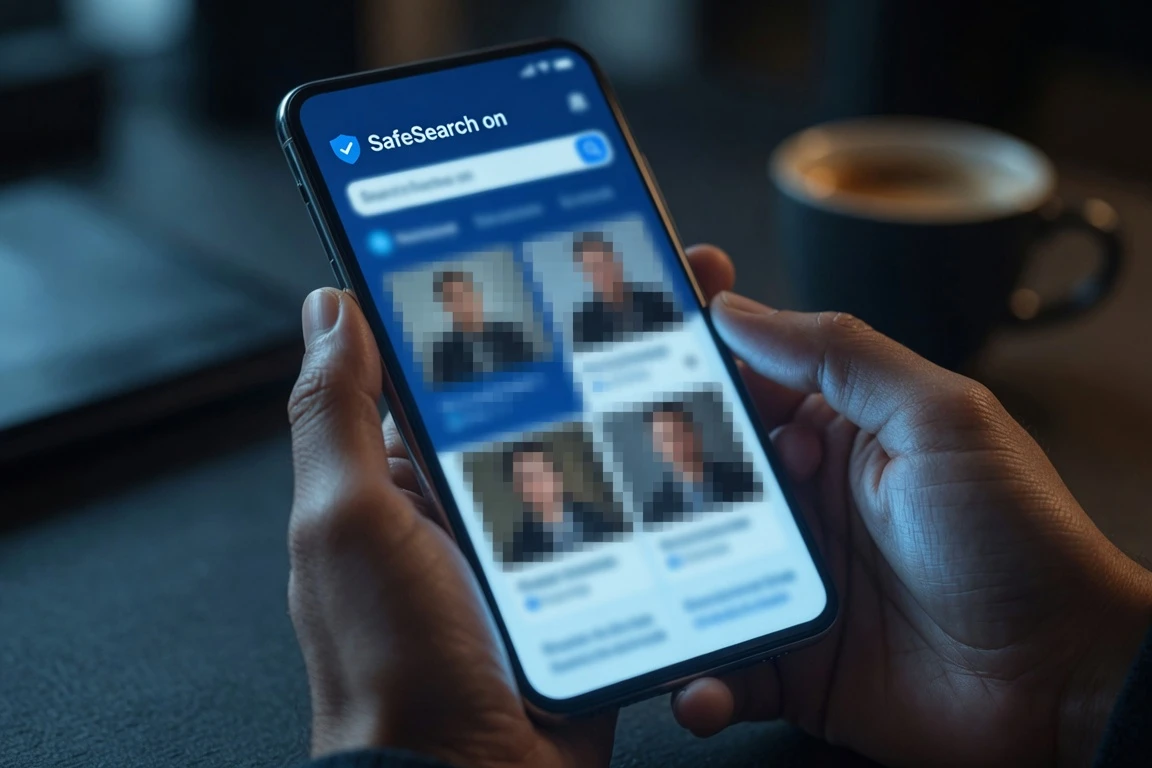
The rules bind Google, Bing, Yahoo and DuckDuckGo in three specific ways. Search providers must filter pornographic images and high-impact violence material out of results for any logged-in account flagged as under 18. They must also blur explicit thumbnails for logged-out users and place a crisis-support referral at the top of results for any query linked to self-harm or suicide.
The trigger is a risk signal of under-18 status. Providers must apply the strictest settings to accounts their systems decide are “likely to be Australian children,” a phrasing that lets them lean on age inference. SafeSearch defaults to its highest level, including in advertising, and the same filter applies to results generated by AI, since the code explicitly captures Google’s Gemini service alongside traditional blue-link search results. Adults can adjust their own preferences as they choose, and the rule is one-directional for minors.
The eSafety Commissioner, Julie Inman Grant, has called search engines the “primary gateway to harmful content,” and the new code is the regulator’s response. The Commissioner has framed the law as one that “mandates that platforms move beyond mere self-declaration, where a child simply types in a fake birthday,” and forces a shift to robust, auditable age assurance. The legal burden on providers is to take “reasonable steps,” and the same balance the prior social media ban has struggled with will be tested again in search.
The Staggered Rollout That Got Us Here
The new rules sit on top of the Online Safety Amendment (Social Media Minimum Age) Act 2024, which came into full force on 10 December 2025. That law bars anyone under 16 from holding an account on designated social platforms including TikTok, Instagram, Snapchat, Facebook, X and YouTube. Within weeks, age-restricted platforms removed access to roughly 4.7 million accounts believed to belong to under-16s, the largest single deplatforming of minors in internet history.
The search engine code is one slice of a nine-code package the register of online safety codes across two stages in 2025. Three codes covering hosting services, internet carriage services and search engine services were registered on 27 June 2025 and took effect on 27 December 2025. The remaining six codes, covering app distribution platforms, social media core features, messaging, relevant electronic services and designated internet services, were registered on 9 September 2025 and took effect on 9 March 2026. Adult and pornography sites were the last to fall under “hard” mandatory age verification in March, and app stores including Apple’s and Google’s are next on 9 September 2026.
- 10 December 2025: Social media minimum age ban takes effect, removing accounts for under-16s on TikTok, Instagram, Snapchat, Facebook, X, YouTube and others.
- 27 December 2025: Search engine code commences, with a six-month window to implement age assurance for logged-in users.
- 9 March 2026: Mandatory hard age verification begins on adult content sites accessible in Australia.
- 27 June 2026: Search engine age assurance fully operational for logged-in users, the deadline this article covers.
- 9 September 2026: Apple’s App Store and Google Play must enforce age ratings and block underage downloads of R18+ and X18+ apps.
How Search Engines Will Tell a Child From an Adult
The code does not mandate a single technology. Providers can pick from age inference, age estimation, age verification or the government’s Digital ID, so long as the outcome is robust and auditable. Google has signalled it will lean on inference from existing account signals and reserve heavier checks for edge cases. “We are rolling out age-assurance tools across our search and app services to comply with the new Australian codes, ensuring SafeSearch is the default for minors,” a Google spokesperson said in industry commentary published in January 2026.
| Method | How it works | Reported accuracy | Privacy footprint |
|---|---|---|---|
| Age inference | Deduced from account history and behaviour | Lowest, variable | No new data collected |
| Facial age estimation | AI predicts an age band from a selfie | roughly 92% near the under-18 boundary | Medium, image processed, ideally not stored |
| Document verification | Scans a passport or driver licence | about 99% | High, identity document exposed |
| Digital ID | Reusable government-backed credential | High | Lower, shares only an over/under flag |
| Hardware or OS signals | Device or app-store account age data | Medium | Medium, tied to platform account |
Age inference is the path of least friction, and the one most Australians will experience without noticing. The Australian government’s own Age Assurance Technology Trial, run by the Age Check Certification Scheme, found facial age-estimation methods correctly sorted users around the under-16 boundary roughly 92% of the time, while document-based verification sat at about 99%. The same trial flagged error rates as high as 30% for certain biometric estimation methods, a reminder that no single technique is a silver bullet.
“Age assurance can be done in Australia privately, efficiently and effectively,” trial chief executive Tony Allen concluded, but only with the right combination of methods behind it. Compliance teams have warned the six-month implementation window is tight for retrofitting age inference into a global product. The wildcard is Australia’s Digital ID Act 2024, in force since 1 December 2024, which gives platforms a government-backed credential to confirm age without storing biometrics themselves.
The Logged-Out Gap the Rules Don’t Close
Search engines are not required to run age assurance on anyone who is not logged in. The code’s drafters wrote it plainly: “Internet search engine services are designed for general public use, with or without an account.” That carve-out preserves anonymous search, and shows up in the one logged-out obligation that does exist: thumbnail images of pornography and high-impact violence must be blurred, but the underlying pages are still reachable with a single click.
In practice most Australians will not see the difference. Persistent logins for Gmail, Outlook, OneDrive, Microsoft 365 and Google Workspace mean age assurance will effectively cover nearly all Australian internet users. For those sessions, the new rule is real: account flagged as likely under-18, SafeSearch locked at its highest level, explicit results removed, advertising filtered to match. For an adult account, the system stays quiet unless age inference raises a flag.
The carve-out also gives children the simplest possible workaround. A determined minor can log out, switch to an incognito window, or borrow an adult’s already-signed-in device and see the unfiltered search results minus a few blurred thumbnails. Parents who want a hard block still need a network or device-level filter, since the search engine code does not give them one.
Even logged-out, the content is still one click away. The gap is not an oversight the eSafety Commissioner has hidden, since the logged-out browsing carve-out in the new code is treated as out of scope by design, balancing privacy against child safety.
What Changes for the Rest of Australia
For adults who sign in, nothing in their experience has to change. The code only requires providers to apply the strictest settings to accounts flagged as under-18, and over-18 users can keep their current preferences, including the choice to see unblurred explicit thumbnails in logged-out results. Search providers can still show explicit content to logged-out adults who click through, a deliberate decision that stops short of an Australian-style universal ID check.
The visible changes are concentrated in three areas. Search results about suicide, self-harm and eating disorders must downrank content that promotes those behaviours and surface crisis-prevention information, such as helplines, prominently at the top of the page. Autocomplete predictions that are sexually explicit or violent must be blocked before they appear in the suggestion bar. And AI-generated answers, including Google’s AI Overviews and Gemini responses, are subject to the same filtering rules as blue-link results.
Some of the filtering is blunt. Search providers know from the implementation of the under-16 social media ban that keyword bans can sweep up unrelated content, since a term like “breast” blocked as porn-adjacent can also exclude information on breast self-examinations or breast cancer. The code’s drafters accept this trade-off as the cost of running filters at the scale of Australian search traffic, and have left providers to add robust additional checks to keep exclusions narrow, a balance that has already proven hard to keep.
Where the Compliance Clock Goes Next
Search engines are the third milestone in a five-phase rollout that finishes on 9 September 2026, when Apple’s App Store and Google Play must enforce age ratings and block underage downloads of R18+ and X18+ apps. The six codes covering messaging, social media core features, relevant electronic services, equipment providers and designated internet services are already in force after their 9 March 2026 commencement. Adult-content sites have been under mandatory “hard” age verification since 9 March 2026. Australian parents trying to plan around the rollout can mark 9 September 2026 on the calendar now.
The loose end is generative AI. “We are already receiving anecdotal reports from school nurses, that kids as young as 10 are spending up to five hours a day with AI chatbots, at times engaging in sexualised conversations and being directed by the chatbots to engage in harmful sexual acts or behaviours,” Inman Grant said. The Commissioner has signalled that AI chatbots and similar services will need their own age checks, with the remaining codes to be settled by the end of July, and the regulator will move to mandatory standards if industry’s proposals fall short.
Frequently Asked Questions
When do Australia’s search engine age verification rules take effect?
The code takes full effect on Saturday 27 June 2026, after a six-month implementation window that began when the rules commenced on 27 December 2025.
Do Australians need to upload ID to use Google or Bing?
No. The code does not mandate a specific method, and providers such as Google have signalled they will lean on age inference from existing account signals first, reserving document checks and Digital ID for edge cases.
What content gets filtered for under-18 accounts?
Pornographic images and high-impact violence material are filtered from search results and advertising. Logged-out users of any age see explicit thumbnails blurred, and can still click through to the underlying pages.
What is the maximum penalty for failing to comply?
Civil penalties of up to A$49.5 million per breach, set at 150,000 penalty units. The figure matches the maximum under the social media minimum age law.


Google Opens Gmail to Voice and Gates Docs Live

Lenovo Prices the IdeaPad Vibe Against Apple’s $699 Neo

Xbox Caps Game Pass Cloud Gaming at 15 Hours

GTA 6 DualSense Controllers Follow Sony’s Usual $84.99 Script

South Korea Retail Investors Face Reckoning After KOSPI AI Rally Collapses

Surrey AI Maps Three Heart Attack Paths and Their Molecular Roots

Germany Locks Neutral Apple ATT Prompts Across Most of Europe

Apple’s 5% EU Fee Quietly Rewrites Alternative App Store Math

Apple’s EU Fee Truce Cuts Complexity but Leaves Rivals Fuming

Pixel 11 Pro Fold Trades Thinness for Durability and Seven-Year Stay

Oracle Cuts 21,000 Jobs in a Year, Cites AI in 10-K Filing

Fable 5 and Mythos 5 Return as US Lifts Anthropic Export Controls

SpaceX’s Google Deal Turns a Rocket Company Into a Cloud Landlord

CD Projekt Red Co-CEO: Redemption Arc Isn’t Done, Witcher 4 in 2027

XPL Rallies 30% Ahead of Plasma One Card Tier Launch

Google Search Profiles Build a Follow Graph Inside Discover

DGO App Brings Rs 549 Mobile Pass for FIFA World Cup 2026 in Nepal

Moonshot AI Targets $30 Billion in China’s Fastest AI Funding Sprint

Oppo’s ColorOS 17 Eligibility List Leaves A-Series Buyers Behind

Microsoft Xbox Layoffs Start in July as Sharma Slams 3% Margin
-
 AI2 months ago
Oracle Cuts 21,000 Jobs in a Year, Cites AI in 10-K Filing
-
 AI2 months ago
Fable 5 and Mythos 5 Return as US Lifts Anthropic Export Controls
-
 AI3 months ago
SpaceX’s Google Deal Turns a Rocket Company Into a Cloud Landlord
-
 GAMING2 months ago
CD Projekt Red Co-CEO: Redemption Arc Isn’t Done, Witcher 4 in 2027
-
 CRYPTO3 months ago
XPL Rallies 30% Ahead of Plasma One Card Tier Launch
-
 NEWS3 months ago
Google Search Profiles Build a Follow Graph Inside Discover
-
 APPS3 months ago
DGO App Brings Rs 549 Mobile Pass for FIFA World Cup 2026 in Nepal
-
 AI3 months ago
Moonshot AI Targets $30 Billion in China’s Fastest AI Funding Sprint