
AI
Canals Bets $35 Million on AI That Leaves ERP Intact
Canals raised $35 million to automate distributor quotes on Epicor and Infor. The overlay is easy to buy because the ERP, and the exit, stay in place.

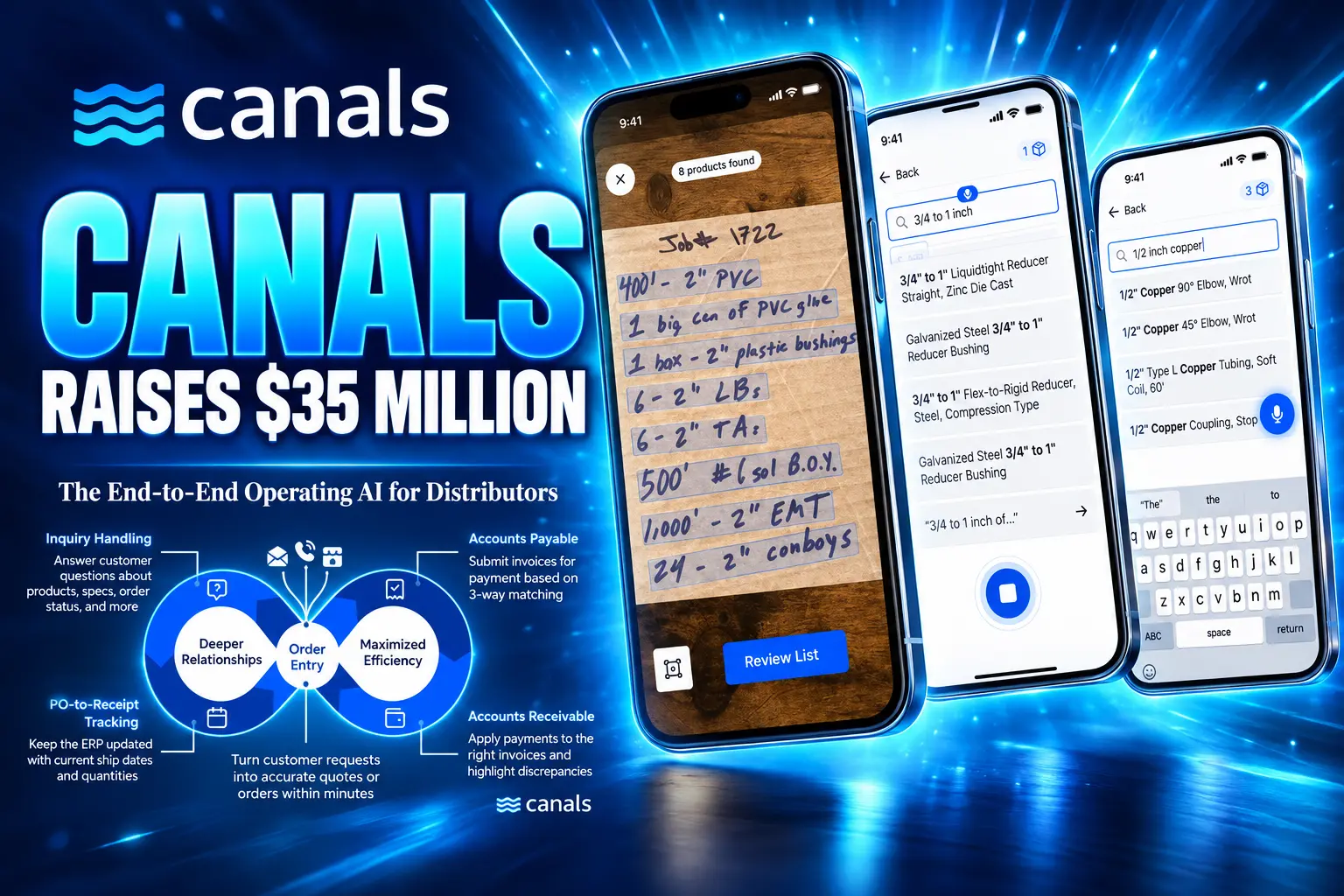
Canals raised $35 million in May to automate quotes, invoices, and orders for wholesale distributors without replacing the ERP those firms already run. Base10 Partners led the round for the Miami company, which had grown past 100 distributor accounts with no venture money. The software reads messy inbound work and posts clean records into systems of record such as Epicor, Infor, and SAP.
In June, CEO Michael Delgado still described Canals as a specialist for distributors only. The company’s current site also sells the same tools to manufacturers and contractors. That widening pitch is the easy part. The hard part is that the overlay is designed to be optional.
Canals Raised $35 Million to Stay Off the Ledger
Canals, founded in 2022, announced the financing on May 28, 2026. Jason Kong, a general partner at Base10, said customers kept repeating that the team was “customer-obsessed and delivers outstanding ROI,” and that the product was outperforming “others marketing similar solutions.” Delgado, the CEO and co-founder, put the job in plainer terms: distributors live with “messy inputs, imperfect data, and constant change.”
Named accounts in the announcement included DSG, The Kendall Group, and Locke Supply. Paul Kennedy, CEO of DSG and chair of the National Association of Electrical Distributors board, called Canals “our gold standard for how technology can continue driving the business forward.” Canals said the new money would push the product from sales-order entry into a wider suite across sales, customer service, accounting, purchasing, and receiving.
CANALS AT THE MAY ROUND
- The raise: $35 million, led by Base10 Partners, after years with no venture capital.
- The volume: The company said it had already processed over 8 million sales orders and $5 billion in payables.
- The accounts: More than 100 distributors, in a wholesale market Canals sized at $8.2 trillion.
- The hit rate: Customers, it said, had doubled quote conversion, with 96% touchless invoice processing.
Delgado told a later interview the firm had grown to about 100 employees. The public site now also claims 8,000-plus users, 90% time savings on the work it touches, and 99% cash-application match accuracy. Those are vendor figures. They are also the numbers a branch manager actually asks for: how fast a quote goes out, and how often an invoice posts without a clerk.
The Showroom Phone That Writes the Quote
The application Delgado likes to walk through is almost rude in its simplicity. A salesperson walks a customer through a showroom with a phone running, listening and transcribing the visit. At the end, the app, sitting on the quoting stack and the ERP, drafts the quote. The rep spends the visit selling. The re-keying that used to eat the afternoon is supposed to disappear.
The same pattern runs through the rest of the suite. Canals says it turns a customer ask into a quote or order “ready for your reps to approve and pass into your ERP in minutes,” with no templates and no customer-by-customer setup. Inside sales, counter sales, and outside sales are all in scope. As people use it, the company says, the models get better on that distributor’s customers and catalog.
WHAT THE SOFTWARE READS ON DAY ONE
- Inbound clutter: Handwritten notes, takeoffs, PDFs, emails, spreadsheets, and voicemail.
- Payables: Trade and expense invoices checked against records and business rules, then posted when they clear.
- Purchasing: Vendor acknowledgments, shipping notices, and packing slips matched to purchase orders, with ship-date changes written back to the ERP.
- Catalogs: Large part-number lists mapped across manufacturers and formats, including after an acquisition.
Go-live is sold as a two-week path. Canals says the ERP hookup takes about an hour or two of IT time, users can start before formal training, and the models usually show an effect within a day or two. The company also says it is SOC 2 Type 2 compliant. Vertical training listed on the site covers electrical, plumbing, HVAC, mechanical, industrial and MRO, lumber and framing, and building materials.
Delgado’s return metric is not a smaller payroll. “It’s sales first,” he said. “You get a sales lift due to speed and accuracy.” He pointed to one customer whose quote win rate tripled. That is a different claim from the May line that customers had doubled conversion, and it should be read that way: one account, not the base.
Software You Can Switch Off Still Has to Win
Delgado’s most revealing product decision is the one he offers as comfort. Canals is not the system of record. If the worst happens and the software dies, he said, a company can fall back to the world it already knows: people typing into Epicor, Infor, or SAP. The layer can be abandoned. The ledger cannot.
We’re an AI layer. ERP vendors serve as systems of record, where AI companies like ours can innovate much faster.
Michael Delgado, CEO and co-founder of Canals
He uses speed as the wedge. ERP vendors, he said, “release a bug patch in six months.” Canals “release[s] a bug patch in 30 minutes,” so a customer can take a new model as soon as it ships. That is a real advantage in a market where a packing slip, a voicemail, and a spreadsheet can all mean the same order. It is also a confession that the valuable object is still the ERP data model, the price file, and the item master. Canals reads them. It does not own them.
Founders who actually run established companies keep making the same point in public: you do not rip NetSuite or SAP because a demo looked clean. Fredrik Hjelm, who built Voi, put it without romance. “Critical systems like ERP and CRM are not getting ripped out in established companies. Forget it.” The overlay is what a risk committee will sign. The overlay is also what a successor product, including one shipped by the ERP vendor, can replace without a data migration.
Other teams chasing the same inbox already talk as if the ERP is sacred and the typing is the product. They want to catch a WhatsApp order, an emailed PDF, and a counter note before two clerks enter the same lines and a second shipment goes out. That failure is not a chatbot problem. It is a coordination tax on every branch that still lets people retype the day’s work.
Why Branches Sign Before the Veterans Leave
Delgado sells continuity as hard as he sells speed. Turnover, absences, and retirements empty the counter of the person who knew which fitting actually crosses, which customer pays in 30 days, and what to offer when a part is out. Canals, he said, captures that know-how so younger staff can be useful faster. “To our knowledge, no one has ever lost their job because of the automation we’ve provided, but definitely folks have not had to be replaced because of the automation we’ve provided.”
A December 2025 survey of distributors rhymes with that pitch more than with a headcount-cutting story. People, not leadership, were named the biggest barrier to AI, at 52%, split as a 33% skills gap and 19% change resistance. Sixty percent of respondents expected AI to raise the output of the people they keep. Email order automation was already the most common customer-facing AI use, at 62%. Sixty-five percent planned to increase AI spending over the next 24 months, and 88% named productivity as the top reason. Nearly two-thirds, 63%, were still exploring or piloting rather than scaling.
WHAT DISTRIBUTORS SAID ABOUT AI IN LATE 2025
- The stall: 52% said people were the barrier, not the executive suite.
- The first win: 62% had already put automation on inbound email orders.
- The budget: 65% planned to spend more on AI within 24 months.
- The goal: 88% said they wanted productivity, and 60% wanted more output from the staff they retain.
That is why “nobody got fired” is such an effective line, and why it is incomplete. The labor math in distribution is often about seats that will not be filled when a veteran leaves. The software is doing the work of a replacement hire that never arrives. Delgado is explicit that success “requires deep industry expertise,” which is another way of saying the model is only as good as the substitutions, exceptions, and customer habits it is taught while those people are still on the payroll.
SAP Wants Joule to Become the Only Screen
While Canals tells distributors it will never be the ERP, SAP is trying to make its copilot the place work happens. At Sapphire in May 2026, SAP said it would put more than 50 Joule Assistants across finance, supply chain, procurement, human capital, and customer experience, orchestrating over 200 specialized agents. Joule Work, in that telling, is the new front door. Users describe an outcome. Joule picks the workflows, data, and agents. People stop hunting through separate screens to type the same facts twice.
SAP CEO Christian Klein said in September that Joule Work had 150 customers. He also said the AI cases require a move to the cloud and S/4HANA. “There’s 60% of our installed base not yet in the cloud,” he said. “There’s work to be done.” He delayed general availability of the new agent platform, by his own account, because customers did not want to manage agent sprawl themselves and because he wanted lifecycle control, accuracy, and governance in SAP’s hands first.
OVERLAY VERSUS THE SYSTEM OF RECORD
| Point of comparison | Canals | SAP Joule |
|---|---|---|
| Where it lives | A layer on the ERP a distributor already runs | Inside SAP’s cloud applications and Joule Work |
| Who it is built for | Wholesale distribution, now also pitched to manufacturers and contractors | SAP process domains across finance, supply chain, procurement, HR, and customer experience |
| Cloud gate | Connects to on-prem and cloud ERPs the customer already has | Klein said the AI cases need cloud and S/4HANA |
| If it fails | Delgado says users can revert to manual entry | The records and the interface stay in SAP’s suite |
| Patch tempo | Delgado claims 30 minutes, against six months for ERP vendors | SAP held back GA to prove agent lifecycle and governance |
The 60% still off SAP’s cloud is not a footnote. It is Canals’ hunting ground by another name. A mid-market electrical or HVAC distributor on Epicor or Infor is not waiting for Joule Studio. It is waiting for someone to stop retyping packing slips. The same gap is why so many “AI employee” pitches now promise to leave the ERP untouched and run beside it, including on machines the customer already owns. The incumbents skipped those tenants. The overlays showed up with a quote bot and an AP reader instead.
Which ERPs the Overlay Already Speaks
Canals publishes a practical map of that hunting ground. The integrations page lists custom in-house systems, Epicor Prophet 21 and Infor CloudSuite, Epicor Eclipse, Infor CloudSuite Distribution Enterprise, Infor M3, Infor SX.e, Microsoft Dynamics 365, NetSuite, SAP S/4HANA, and SHIMS, plus third-party API layers for Eclipse and Prophet 21. That list is a picture of who still needs a translator between a PDF and a sales order.
ERPS CANALS LISTS AS READY TO CONNECT
- Epicor: Eclipse and Prophet 21, the pair most electrical, plumbing, and HVAC wholesalers already know.
- Infor: CloudSuite Distribution, CloudSuite Distribution Enterprise, M3, and SX.e, on-prem or in the cloud.
- Other ledgers: Microsoft Dynamics 365, NetSuite, SAP S/4HANA, SHIMS, and homegrown ERPs.
Notice what is missing: a requirement to move the general ledger. The sale is an hour or two of IT, a two-week rollout, and a promise that the item master stays where it is. Competitors in quoting, order entry, and invoice capture are making the same promise, some of them with a decade of document history and some of them trying to skip the ERP altogether with an AI-native stack. Canals’ $35 million is a bet that specialized models for messy distributor paper still beat both a generic copilot and a rip-and-replace.
Trust Outlasts a Fast Patch
Delgado knows the next few years will fill with firms that look like his. Smaller companies, he argued, will lean on specialists for a specific pain, and the buyer’s problem will be choosing a partner whose product still works after the demo. Canals has to scale quality as it hires. “In this industry, everybody knows what everybody’s doing and in the end it’s all about trusting the people that are delivering what they say they’re going to deliver,” he said. Feature races in enterprise AI compress quickly, which is why trust still standing after features cheapen is the part of the pitch a distributor can check with a peer, not a slide.
There’s a lot of hype when it comes to AI, but Canals is the real deal, the best-in-class product delivering real results that matter.
Paul Kennedy, CEO of DSG and NAED board chair, in Canals’ May 28 announcement
If the layer stops, Delgado told customers they can go back to typing. The ERP does not move. Someone still has to get the quote into it.

Instagram Plus Tests a Read-Only Mode That Cuts Stories

Altman Asks the Public to Accept Some AI Harm

Google Freezes OSS VRP Product Reports After AI Flood

AI Agents Make Payment Rails the Scarce Prize

Turkey’s Crypto Boom Now Runs Through Three Banks

Fable 5 Came Back Under a Commerce On-Off Switch

Google’s SpaceX GPU Lease Has a Sept. 30 Deadline

Plasma One’s XPL Locks Face a 1.81 Billion Cliff

DGO’s Rs 549 World Cup Pass Cost Fans Sleep and Data

Moonshot AI’s $30 Billion Ask Became a $35 Billion Close
-
 AI4 months ago
Fable 5 Came Back Under a Commerce On-Off Switch
-
 AI4 months ago
Google’s SpaceX GPU Lease Has a Sept. 30 Deadline
-
 CRYPTO4 months ago
Plasma One’s XPL Locks Face a 1.81 Billion Cliff
-
 APPS4 months ago
DGO’s Rs 549 World Cup Pass Cost Fans Sleep and Data
-
 AI4 months ago
Moonshot AI’s $30 Billion Ask Became a $35 Billion Close
-

 NEWS4 months ago
ColorOS 17 Device List Spans Oppo, OnePlus and Realme
-

 GAMING4 months ago
Xbox Cuts 3,200 Jobs After Five Years of Thin Returns
-

 GAMING4 months ago
The RTX 4050 Under Rs 70,000 Hides a Wattage Gap