
AI
From Point AI to Holistic Intelligence: Changan’s Factory Roadmap
Changan’s Tan Yingcong told an industry conference that point AI has hit a ceiling in factories and laid out a path through four specific gaps.

On July 3, Changan Automobile deputy chief engineer Tan Yingcong told an industry audience that more capability does not equal a smarter factory. “More capabilities don’t necessarily make a factory smarter,” he said at the 2026 Embodied Intelligence Industry Scenario Integration Conference, hosted by Gasgoo. AI is flooding auto plants, Tan argued, but most of it lands as scattered point solutions rather than anything that makes factory AI work end to end.
His diagnosis starts with the factory floor. Production is becoming increasingly flexible, with rapid switching between multi-model, small-batch runs the new normal, Tan said. System coupling inside the plant is intensifying. The speed at which decisions need to be made keeps rising. Point tools built for one scenario each cannot keep that pace, and plants that try end up with one model per scenario, one app per problem, and one project per plant.
Point AI Has Run Out of Road, Tan Argues
The remedy, in Tan’s framing, is a shift from isolated intelligence to holistic intelligence. Isolated intelligence is what you get when each tool solves one slice of the problem. Holistic intelligence is what you get when domains spanning quality, equipment, energy, processes, and logistics synchronize and feed decisions straight into business workflows.
His version of why this matters most now leans on three trends he named on stage. Production is becoming increasingly flexible, with rapid switching between multi-model, small-batch runs the new norm, Tan said. System coupling inside the same plant is intensifying. The speed at which decisions need to be made keeps rising. Each trend raises the cost of staying fragmented, which is the precise state Tan is trying to disrupt.
Point AI has not been a failure, Tan argued; it has been a phase. The next phase, holistic intelligence, is the one that takes on what automation, digitalization, and isolated AI deployments left unfinished. He built the rest of his talk around the architecture that operating mode would need.
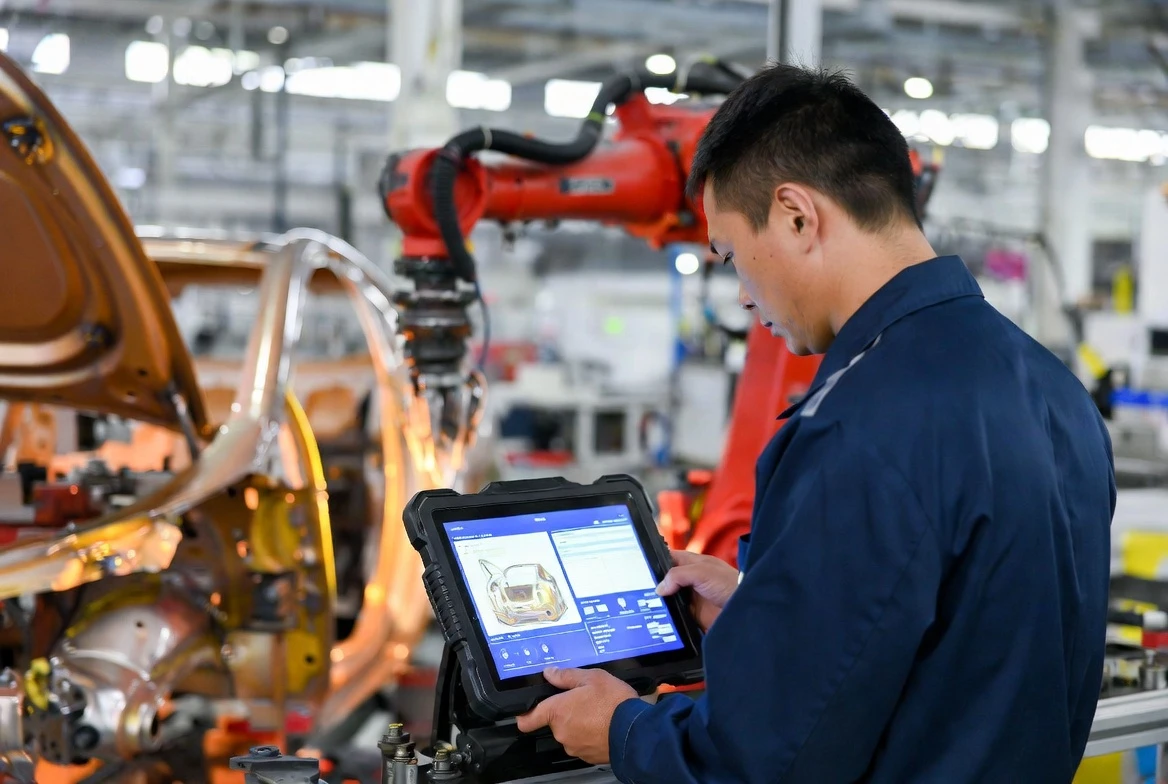
The Four Stages From Automation to Holistic Intelligence
Tan frames manufacturing’s past in four stages, each defined by what it primarily took on. Automation tackled efficiency, the mechanical floor that runs faster and steadier with every motor and PLC added. Digitalization handled connectivity, the wiring that links machines, lines, and back-office systems. AI addressed cognition, the pattern recognition and prediction that turn machine data into judgments. Each stage built on the one before and solved a real problem at the time.
| Stage | Tan’s framing |
|---|---|
| Automation | Tackled efficiency |
| Digitalization | Handled connectivity |
| AI | Addressed cognition |
| Holistic intelligence | Synchronizes quality, equipment, energy, processes, and logistics and embeds real-time value directly into business workflows |
The fourth stage is holistic intelligence, and it is the one that ties the previous three together. Domains spanning quality, equipment, energy, processes, and logistics must synchronize. Real-time value has to land inside business workflows, not in a dashboard someone checks once a day. Tan’s list of domains is the same taxonomy he uses later when describing where Changan is testing agent deployments.
The Four Gaps That Block Factory AI Today
Four named gaps hold the ceiling in place, in Tan’s taxonomy. They are not infrastructure bugs to be patched in a quarter. They are architectural problems that surface the moment a plant tries to scale one good AI application into ten.
Tan opens with the data gap: information on equipment, quality, processes, and production sits scattered across disconnected systems with no shared reference. The knowledge gap follows, with on-site experience, process rules, and judgment standards trapped in veteran workers’ minds or in physical documents. The process gap closes the loop on analysis, with AI results struggling to flow naturally into business judgment workflows. The execution gap closes the loop on action, with the physical mechanism for executing an AI’s call often never designed.
- Data gap: information on equipment, quality, processes, and production is scattered across disconnected systems
- Knowledge gap: on-site experience, process rules, and judgment standards remain trapped in the minds of veteran workers or in physical documents
- Process gap: AI analysis results struggle to flow naturally into business judgment workflows
- Execution gap: once an AI makes a call, determining the physical mechanism for execution remains a challenge
Tan names the gaps in a specific order, and the order is itself part of the argument. Each gap, on its own, can stop a deployment cold.
What a Factory Agent Is Not, and What It Must Be
The word “agent” does heavy lifting in 2026 manufacturing marketing. Tan drew a hard line at the conference between what vendors are calling agents and what he means by the word. His own talk led with a simple line that rejects the temptation to bolt more technology onto a factory.
More capabilities don’t necessarily make a factory smarter.
That line came from Tan Yingcong, Changan Automobile’s deputy chief engineer, on July 3 at the 2026 Embodied Intelligence Industry Scenario Integration Conference, hosted by Gasgoo. By his definition, a factory agent must understand objectives, organize cross-domain knowledge, sync with real-time data, and integrate with business workflows. Its job is to drive digital systems or physical equipment to turn decisions into action, end to end. A chatbot, a large language model, or an RPA process is none of those things. That is the bar Tan set for anyone who wants to call what they ship a factory agent.
Four Domains Where Changan Is Testing Agents
Changan is not waiting for the framework to be finished before testing it on its own lines. Tan broke out four domains where agents are already being explored: quality, equipment, energy, and production. Each one is wired to a class of decision that has long resisted full automation.
Quality is the hardest. Defect attribution involves process, equipment, materials, personnel, and history tangled together, and human inspectors have carried most of that reasoning for decades. Tan’s pitch for agents here is recommendation and tracking: let the agent suggest a likely root cause, then watch whether the fix holds in the data. The goal is to compress the gap between finding and fixing, not to retire the inspector.
Energy is a cleaner-data problem. Agents combine temperature, humidity, lighting, production load, and usage strategies to diagnose a plant’s energy profile end to end rather than per subsystem. Changan has prior deployments to build on here. Its Chongqing digital factory pairs 687 AMRs with AI visual inspection and runs an Industrial AI Joint Innovation Center co-built with Hikrobot inside its existing Digital Intelligence Factory deployment.
Production is where the framework meets the most moving parts. Agents coordinate bottlenecks, deviations, anomalies, and materials to enable real-time identification and dynamic adjustment, Tan said.
A Three-Phase Roadmap to a Decision Hub
Tan calls the rollout plan a platform-data-agent trinity. It is paced across three phases, each grounded in closing one more layer of the loop before unlocking the next. The first phase is foundation work, not headline-grabbing deployment. Skipping ahead is the failure mode Tan’s argument is built to discourage.
- Phase one: laying the foundation and closing the loop on single scenarios
- Phase two: expanding scenarios and optimizing models to scale from points to areas
- Phase three: establishing a decision hub for multi-directional autonomous decision-making
Phase one is where most Chinese smart factories already live, partly: single-scenario loops on top of digital infrastructure that varies wildly across plants. Phase two is where the framework tests whether the foundation can be widened without breaking what already works. Phase three is the destination Tan points to, one decision layer the whole plant can lean on.
“Agents will increasingly act like digital employees or experts in the factory,” Tan said. They will need to collaborate with humans but also judge independently, helping factories sense issues faster, decide quicker, and execute with greater stability.
Why China’s Smart-Factory Buildout Raises the Stakes
Changan’s framework lands inside a much larger national push. China runs a four-tier certification system for smart factories, and AI capability is now part of the criteria for the two top tiers. Thresholds for AI capability are scheduled to rise over time.
- 35,000 Basic-level smart factories
- 8,200+ Advanced-level smart factories
- 500+ Excellence-level smart factories
- 47% drop in average product defect rates at participating factories
- 38% shorter average product development cycles at participating factories
The participating factories’ headline numbers come from China’s four-tier smart factory framework statistics reported by MIIT in June. Industries named for the next cohort of Leading Smart Factory candidates include new energy vehicles, where Changan sits alongside Avatr and Xiaomi. Tan’s framework for “intelligent agents” reads as a candidate’s playbook for the Excellence and Leading tiers, not a side project. Each gap he names is, in effect, an item on the assessment rubric an automaker needs to clear.
Why Closing the Execution Gap Is the Hardest Part
The four gaps Tan names are not equally hard to close, and his ordering tells the reader where he expects the most resistance. Data can be consolidated with platform investment. Knowledge can be captured in industrial AI models and condition-monitoring logs. Process integration is solvable inside software. The execution gap, by contrast, lives in physical hardware, plant safety protocols, and the politics of who authorizes a machine to act, the same place where the workforce readiness gap is stalling agent rollouts across industries.
Tan’s “platform-data-agent trinity” roadmap tries to sequence around that bottleneck. Phase one closes the loop on a single scenario with a clean execution path. Phases two and three expand the loop, and each expansion depends on more physical machinery acting without a human in the immediate loop.
The closing test will be phase three. A decision hub for multi-directional autonomous decision-making is the end state of Tan’s roadmap, and it will sit or fall on whether anyone solves the execution gap first.
Frequently Asked Questions
What is a factory AI agent, and how is it different from a chatbot?
In Tan’s framing, a factory AI agent is an intelligent unit designed for manufacturing tasks rather than a chatbot or a generative AI tool. It has to understand objectives, organize cross-domain knowledge, sync with real-time data, and integrate with business workflows, and then it has to drive digital systems or physical equipment to turn decisions into action. That last clause is what Tan says distinguishes a factory agent from a chatbot, a large language model, or an RPA process.
What are the four gaps Changan says factory AI must bridge?
Changan names a data gap, a knowledge gap, a process gap, and an execution gap. Data sits scattered across equipment, quality, process, and production systems. Knowledge is trapped in veteran workers’ heads or on paper. AI analysis results do not flow naturally into business judgment workflows. Once an AI makes a call, the physical mechanism for executing it is rarely designed in. Point tools deployed without closing all four gaps will stall at scale.
Where is Changan already running factory agents on its production lines?
On four named domains: quality, equipment, energy, and production. In quality, agents help attribute and track defects across process, equipment, materials, personnel, and history. In energy, they combine temperature, humidity, lighting, production load, and usage strategies for whole-plant diagnostics. In production, they coordinate bottlenecks, deviations, anomalies, and materials for real-time adjustment. The Changan Digital Intelligence Factory in Chongqing, co-developed with Hikrobot, runs the prior generation of AI visual inspection, AMR logistics, and weld-spot analytics that the new agents are being layered on top of.
Why does Tan Yingcong say more AI capability does not equal a smarter factory?
Because the marginal capability lands in fragmented point solutions, Tan said. Auto model cycles have compressed from multi-year cadences to single-digit months on the leading Chinese brands, and point tools built for one scenario each cannot keep that rhythm. The result is one model per scenario, one app per problem, and one project per plant, a patchwork that looks like AI adoption but does not behave like intelligent operations.
What is the “platform-data-agent trinity” roadmap?
A three-phase rollout plan. Phase one is laying the foundation and closing the loop on single scenarios. Phase two is expanding scenarios and optimizing models to scale from points to areas. Phase three is establishing a decision hub for multi-directional autonomous decision-making across the plant. Each phase, in Tan’s framing, depends on the previous one being measured and closed before moving on.


Workers Still Trust Judgment Over the AI Tools They Use

DigitalOcean’s $894 Million Backlog Rewrites the Old Cloud

Companies Froze Job Design and Called AI a People Problem

AI Capex Looks Unique Because the Chips Wear Out

Samsung Medison’s HERA Z10 Aims at the Sonographer Shortage

GPT-6 Astra Ships as OpenAI’s First Critical Cyber Model

Palms Sells Clean Air Without Ending Casino Smoking

OnlyFans Promo Bots on X Now Pass the Humanity Tests

Datamaran Drops the ESG Label After Winning the Argument

Xiaomi’s Own Chip Lands While Apple Argues Over Color

Oracle Cuts 21,000 Jobs in a Year, Cites AI in 10-K Filing

Fable 5 and Mythos 5 Return as US Lifts Anthropic Export Controls

SpaceX’s Google Deal Turns a Rocket Company Into a Cloud Landlord

CD Projekt Red Co-CEO: Redemption Arc Isn’t Done, Witcher 4 in 2027

XPL Rallies 30% Ahead of Plasma One Card Tier Launch

Google Search Profiles Build a Follow Graph Inside Discover

DGO App Brings Rs 549 Mobile Pass for FIFA World Cup 2026 in Nepal

Moonshot AI Targets $30 Billion in China’s Fastest AI Funding Sprint

Oppo’s ColorOS 17 Eligibility List Leaves A-Series Buyers Behind

Microsoft Xbox Layoffs Start in July as Sharma Slams 3% Margin
-
 AI3 months ago
Oracle Cuts 21,000 Jobs in a Year, Cites AI in 10-K Filing
-
 AI2 months ago
Fable 5 and Mythos 5 Return as US Lifts Anthropic Export Controls
-
 AI3 months ago
SpaceX’s Google Deal Turns a Rocket Company Into a Cloud Landlord
-
 GAMING3 months ago
CD Projekt Red Co-CEO: Redemption Arc Isn’t Done, Witcher 4 in 2027
-
 CRYPTO3 months ago
XPL Rallies 30% Ahead of Plasma One Card Tier Launch
-
 NEWS3 months ago
Google Search Profiles Build a Follow Graph Inside Discover
-
 APPS3 months ago
DGO App Brings Rs 549 Mobile Pass for FIFA World Cup 2026 in Nepal
-
 AI3 months ago
Moonshot AI Targets $30 Billion in China’s Fastest AI Funding Sprint