
GAMING
Wolf Link Now Runs in the Twilight Princess 3DS Port
Tobias Friedly’s Twilight Princess 3DS port now runs Wolf Link and Midna, and he is aiming the original handheld Nintendo skipped.

Tobias Friedly’s Twilight Princess 3DS port now lets Link become a wolf, with Midna on screen, using the matching GameCube decomp. In a September 5, 2026 video on his Game of Tobi channel, he said the hookshot, the bow, sword swings, and enemy fights are in, and that more of the map loads than the glitchy July build. The game is still unfinished. He is aiming the original 3DS, not only the New model.
That is a strange place for this game to land. Nintendo already remade Ocarina of Time and Majora’s Mask for the 3DS, then sent Twilight Princess to Wii U, and left the handheld without the GameCube Zelda fans spent a decade asking for.
Wolf Link and Midna Are Finally In
Friedly first showed a native 3DS build in early July, after the GameCube decomp reached a usable state. Areas failed to load, geometry dropped out, and the picture was a mess. He called it an early pass and said he would ship July footage of the 3DS port “when it is ready and I feel like it.”
The September clip is the same project after those obvious breaks were attacked. Link walks. Combat is no longer a stub. Friedly was clear about the method: this is not a rewrite, it is the decompiled GameCube code running on the handheld.
WHAT WORKS IN THE SEPTEMBER BUILD
- Wolf Link: The transformation is in, so the dual-form campaign is no longer a missing mode.
- Midna: She appears with the wolf, which is the other half of that form.
- Items: The hookshot and the bow fire, and sword motion is in.
- Combat: Enemies exist and fighting them is implemented, not faked.
- Map: Many areas can be walked that failed to load in July.
He still needs graphics work, and the picture is not clean. The point of the September 5 progress video is that the build is now recognisable as Twilight Princess instead of a crash demo with a sword.
The full-game goal has not moved. Friedly wants every dungeon, every form, and a 3DS copy you could actually finish. He has not set a date.
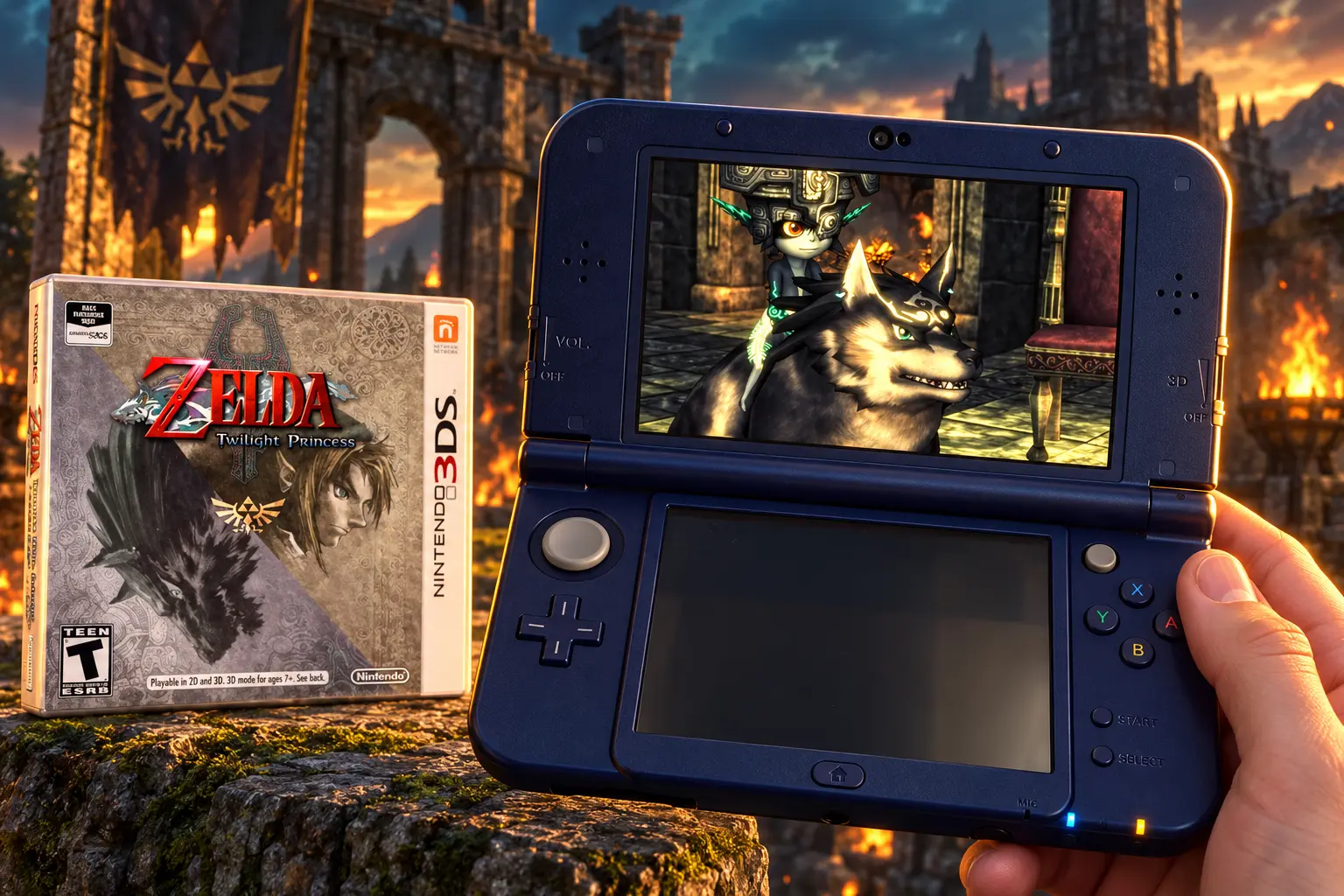
He Wants It on the Old 3DS
The first assumption this kind of port invites is that it only has a chance on a New 3DS. That later family has four ARM11 cores and 256 MB of FCRAM, double the original handheld, plus extra buttons that map closer to a Classic Controller. Nintendo itself used that extra CPU as the reason a huge Wii RPG could exist in your bag.
Friedly is aiming lower. Viewers asked, and he answered in the same September video: the original 3DS is part of the brief, even if he has to cut features to get there.
Yes, the goal is also to make this work on the old 3DS. There might be some sacrifices that I need to make to make it work on the old 3DS, but as always, my goal with these projects is to find the limit of what is possible and I definitely believe that putting this game on the old 3DS is part of something that is possible.
Tobias Friedly, Game of Tobi, September 5, 2026
That is the live argument of the project. A New 3DS-only build would still be a curiosity. A build that boots on the 2011 hardware is the one that collides with Nintendo’s own line, because the company already told the press that the original CPU was not enough for a flagship Wii port.
WHAT WE KNOW
- The code path: Friedly is running decompiled GameCube Twilight Princess, not an emulator wrapper.
- The wolf: Transformation and Midna are in the September 5 build.
- The target: He said the original 3DS is a goal, with possible cuts.
- The 3D pitch: Stereoscopic output is the reason he cares about this handheld.
WHAT IS UNCONFIRMED
- A date: There is no release window.
- Old 3DS performance: The sacrifices are unnamed, and the original model is not shown as a finished target.
- Stereoscopic 3D: It is a goal, not a feature in the current clips.
- The touch screen: He has not decided on a proper bottom-screen layout and may leave that to someone else if he opens the code.
A Switch remaster is still the version sitting in store daydreams. If this port becomes finishable first, it will be on a handheld Nintendo stopped selling, with a 3D slider the HD Wii U disc never had.
GameCube Releases Now Match in the Decomp
None of this starts with a 3DS kit. It starts with the Zelda Reverse Engineering Team’s Twilight Princess repository, which now states that matching GameCube decomp source is in place for the GameCube releases. Not every translation unit is linked yet. Work continues on the debug build and on Wii versions, all from one codebase with conditional compilation. Supported targets already include the North American, European, and Japanese GameCube discs, several Wii revisions, a kiosk demo, and the Nvidia Shield releases sold in China.
The README is blunt about what that repo is not. It ships no assets and no assembly. You need an existing copy of the game. The project “is not, and will not, produce a port” to PC or anywhere else. Friedly’s 3DS work sits beside that rule, as a separate native retarget of the recovered C++.
That split matters because decomp culture already produced other Twilight Princess binaries on modern machines. Friedly’s bet is the awkward one: take the same recovered game and hang it on a 2011 ARM handheld whose GPU, fill rate, and screen are nothing like Flipper. He said he is also writing GameCube shims so the next title is less of a from-scratch fight, once those decomps catch up.
He has done this kind of squeeze before. Super Mario 64 on Game Boy Advance is the clip that made the channel. Twilight Princess is the first of those stunts that looks like a game a 3DS owner might actually keep in the slot.
Why Twilight Princess Went to Wii U Instead
The 3DS already had the Zelda remake playbook. Ocarina of Time 3D and Majora’s Mask 3D used the upper screen’s parallax barrier, the same trick Friedly wants for Hyrule Field. Fans treated a GameCube follow-up as the next obvious cart. In April 2015, StreetPass data at a Zelda Symphony concert claimed someone was playing Twilight Princess 3D. It was a hoax on a hacked system. The rumor still described a product people were ready to believe in.
That same month, Nintendo did port a giant Wii game to the new handheld. Xenoblade Chronicles 3D launched in North America on April 10, 2015, as a New 3DS exclusive that would not boot on earlier models. Hiro Yamada, speaking for Nintendo on that port, said the extra CPU was the line: without the New 3DS processor, they could not have moved the game. Monster Games got a Wii world onto two small screens. Twilight Princess, a smaller and more famous first-party adventure, did not take that path.
THE 3DS ZELDA THAT NEVER SHIPPED
- April 2015: A StreetPass listing for Twilight Princess 3D is a hoax on a hacked system.
- April 10, 2015: Xenoblade Chronicles 3D ships in North America as a New 3DS exclusive.
- March 4, 2016: Twilight Princess HD ships on Wii U.
- March 24, 2016: Nintendo puts a Hyrule-branded New 3DS XL and Hyrule Warriors: Legends on 3DS family systems.
- July 2, 2026: Friedly shows an early native 3DS Twilight Princess build from the GameCube decomp.
- September 5, 2026: Wolf Link, Midna, combat, and more of the map run in that build.
Nintendo’s own January 2016 UK notice framed the HD remaster, the Hyrule 3DS, and the 3DS musou as one spring burst. Twilight Princess HD for Wii U was the actual Zelda in that bundle. The handheld got a branded lid and a spinoff. The HD disc has not been reissued on Switch or Switch 2. Friedly is now doing, as a hobby, the cart that window did not include.
128 MB Against the GameCube’s 24
The hardware argument was never “the 3DS has no memory.” Console researcher Rodrigo Copetti’s 3DS write-up gives developers 128 MB of Fast Cycle DRAM on the original machine, with the New family raising that to 256 MB. The original SoC is a two-core ARM11 MPCore; the New SoC is four cores. The upper LCD is 800 x 240 physical pixels, and in 3D mode it shows two 400 x 240 views through a parallax barrier. That is the feature Friedly keeps naming as the reason to care.
The GameCube, where Twilight Princess was built, uses 24 MB of 1T-SRAM as main Splash memory and 16 MB of ARAM on a third bus, 40 MB if you add the two pools. The 3DS has more raw RAM than the cube that shipped the game. The mismatch is architecture: PowerPC plus Flipper and a 480p TV path, versus ARM11 plus a PICA GPU and a 240-line stereoscopic panel, with a fill rate that does not love GameCube-sized scenes.
RAM ON THE MACHINES IN THIS FIGHT
| Machine | Main RAM | CPU notes |
|---|---|---|
| Original 3DS (2011) | 128 MB FCRAM | Two ARM11 cores |
| New 3DS family | 256 MB FCRAM | Four ARM11 cores |
| GameCube | 24 MB 1T-SRAM plus 16 MB ARAM | IBM Gekko, Flipper GPU |
July coverage treated 128 MB as “batting distance” from the original consoles. That was the wrong sport. The 3DS already had more general RAM than the GameCube. What Friedly still has to do is the unglamorous remap: GX calls onto PICA, Wii remote and nunchuk onto a circle pad, audio onto the handheld’s mixers, and a world built for 480p onto 240 lines, twice, if 3D stays on. He said in July that he had done almost none of that speed work. September’s clip is still, by his own account, the game before a real trim.
GameCube Shims Come After Twilight Princess
Friedly is not treating this as a one-off either. Since the July video he has heard from other people building their own 3DS Twilight Princess ports, which he called a good thing: more approaches make a finish more likely. He is writing GameCube shims so later ports reuse the glue. He named Super Mario Galaxy and Super Mario Sunshine decomps as the next obvious 3DS candidates once those matching efforts catch up. First, he said, finish Twilight Princess.
The 3D slider is still the prize he talks about in almost the same breath as the old 3DS. Official 3DS Zelda remakes already proved that parallax Hyrule works when a studio budgets for two projection matrices. Friedly has not shown that path yet, and he may skip a custom bottom screen so the vanilla game actually runs. If he opens the source near the end, he said someone else can do the touch layout.
What he will not do is promise a day. The September build has a wolf, a twilight imp, a bow, and a map that no longer collapses when you walk. The original 3DS is the machine he wants to humble. Nintendo already knew this hardware could swallow a Wii epic, then sold a Hyrule lid and kept the HD remaster on a home console it was about to abandon. The decomp did not wait.

Instagram Plus Tests a Read-Only Mode That Cuts Stories

Altman Asks the Public to Accept Some AI Harm

Google Freezes OSS VRP Product Reports After AI Flood

AI Agents Make Payment Rails the Scarce Prize

Turkey’s Crypto Boom Now Runs Through Three Banks

Fable 5 Came Back Under a Commerce On-Off Switch

Google’s SpaceX GPU Lease Has a Sept. 30 Deadline

Plasma One’s XPL Locks Face a 1.81 Billion Cliff

DGO’s Rs 549 World Cup Pass Cost Fans Sleep and Data

Moonshot AI’s $30 Billion Ask Became a $35 Billion Close
-
 AI4 months ago
Fable 5 Came Back Under a Commerce On-Off Switch
-
 AI5 months ago
Google’s SpaceX GPU Lease Has a Sept. 30 Deadline
-
 CRYPTO4 months ago
Plasma One’s XPL Locks Face a 1.81 Billion Cliff
-
 APPS5 months ago
DGO’s Rs 549 World Cup Pass Cost Fans Sleep and Data
-
 AI5 months ago
Moonshot AI’s $30 Billion Ask Became a $35 Billion Close
-
 NEWS5 months ago
ColorOS 17 Device List Spans Oppo, OnePlus and Realme
-
 GAMING4 months ago
The RTX 4050 Under Rs 70,000 Hides a Wattage Gap
-

 AI4 months ago
Boris Cherny’s Loops Still Demand a Higher Production Bar