
AI
China’s New AI Alliance Draws 29 Nations but Not One G7 Ally
China’s WAICO alliance signed 29 nations in Shanghai on July 16, echoing its 2015 AIIB blueprint, but no G7 economy has joined this time.

Twenty-nine countries signed the founding charter of a new artificial intelligence body in Shanghai on July 16, and the United States was not among them. The World Artificial Intelligence Cooperation Organization, or WAICO, is Beijing’s bid to write the rules for AI before Washington does, and Chinese President Xi Jinping used the following day’s opening of the World Artificial Intelligence Conference (WAIC) to make the pitch personal.
China has run something close to this play before. A decade ago, a China-led development bank picked off dozens of American allies over Washington’s objections. This time the guest list looks nothing like that one.
Beijing Signs 29 Countries Into a New AI Body
Chinese Foreign Minister Wang Yi signed the WAICO agreement on behalf of Beijing, with United Nations Secretary-General António Guterres among the officials present at the ceremony. The organization will sit as an independent intergovernmental body headquartered in Shanghai, built around what the founding text calls a “people-centered approach” to AI governance.
The founding roster leans heavily toward the Global South and China’s own diplomatic orbit:
- Russia, Belarus, Serbia, Cuba, Brazil and Venezuela
- Ten African nations, including South Africa and Senegal
- Twelve Asian nations, including Indonesia, Pakistan, Kazakhstan, Laos and Malaysia
The signing happened on the eve of WAIC, where Xi opened the conference in person for the first time since it launched in 2018. The show floor doubled as a showroom for the case Beijing is making: one booth displayed a humanoid robot that cooks, and Honor used the event for a robot phone that nods and dances as its answer to a rough run in premium handsets.
Xi’s Symphony Line Aims Straight at Washington
Xi did not name the United States. He did not need to.
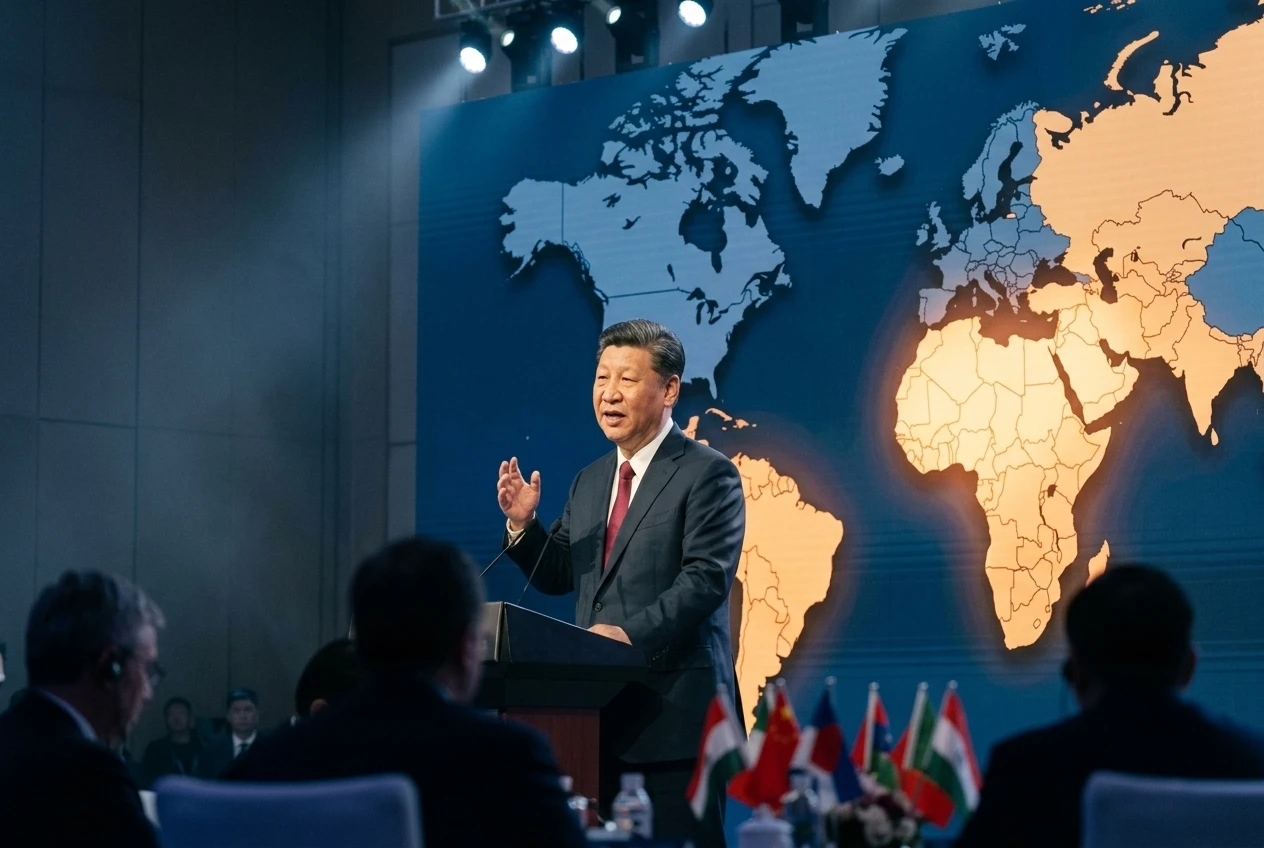
“AI development should not be a solo performance by a single country, but a symphony of international cooperation,” Xi told the conference. He added a warning aimed at export controls and security reviews: “We should jointly oppose overstretching the national security concept in the field of AI or placing one country’s security over that of others.”
With AI advancing at a staggering speed, we must ensure its development is for positive, for good, and for humanity.
Xi said that in his opening address to WAIC, according to CNN’s report from the conference. He framed China’s cheaper, open-source AI models as a public good for countries priced out of the frontier, a pitch Kazakhstan’s minister for AI and digital development, Zhaslan Madiyev, echoed after the signing, saying WAICO moves the conversation “from declarations to practical collaboration.”
China Ran This Play Once Before
The template is the Asian Infrastructure Investment Bank. Xi’s government proposed that China-led lender in 2014 as a rival to the World Bank, and Washington lobbied allies hard to stay out. The lobbying failed. Britain broke first, and Germany, France, Italy, South Korea and Australia followed within months, over open American objections. A peer-reviewed study of the episode found that 57 countries became founding members of the bank, turning a single Chinese initiative into a genuine crack in the US-led financial order.
| Measure | AIIB (2015) | WAICO (2026) |
|---|---|---|
| Founding members | 57 countries | 29 countries |
| Headquarters | Beijing | Shanghai |
| First major Western defector | United Kingdom, within months | None as of the signing |
| G7 participation | UK, Germany, France, Italy joined | Zero G7 economies |
The gap between those two rows is the story. WAICO has scale in numbers but not in the kind of defection that made the AIIB a threat Washington had to answer.
Zero G7 Economies on the Founding List
Paul Triolo, a partner at the DGA-Albright Stonebridge Group consultancy in Washington, told CNN he does not expect that to change. His read is that no major Western government will attach itself to an organization China controls and that carries a broad mandate over both AI promotion and AI safety. He does see Washington’s real move happening elsewhere: “For the US, the main action will be building a credible bilateral dialogue with Beijing around frontier AI model governance,” Triolo said.
George Chen, head of digital practice at The Asia Group consultancy, put the stakes in blunter terms, saying the new body lets Beijing “compete on standards,” not just chips or models.
Washington already has its own answer running. In June, undersecretary of state for economic affairs Jacob Helberg announced that 35 countries signed the Declaration on AI Opportunity under a US initiative called Pax Silica. Helberg used the moment to take a swing at the digital-sovereignty push that WAICO is built around, calling it “backward and counterproductive.”
- 29 nations signed WAICO’s founding charter in Shanghai on July 16.
- 35 countries back the rival US-led Pax Silica coalition unveiled weeks earlier.
- More than 1,000 enterprises and nine Nobel laureates attended the parallel WAIC conference, organizers told CNN.
The Chip War Sitting Underneath the Diplomacy
WAICO did not appear out of nowhere. AI has become a pillar of China’s industrial policy, and Beijing has poured money into building a domestic chip-to-consumer supply chain it does not have to ask Washington’s permission to use. China trails the US on the most advanced semiconductors but leads on the power-hungry data centers needed to run large models, generating more than twice as much electricity as the United States, a gap state-led grid investment is expected to widen.
Washington’s Commerce Department affirmed restrictions in May on chip shipments to Chinese-linked subsidiaries, and Beijing answered by curbing exports of dual-use technology and the rare earth minerals that chipmaking depends on, a supply chain China dominates outright. That standoff is the same one that produced the H200 chip arrangement that reshaped the AI world order earlier this year, and it is the backdrop against which China’s own AI-policy divide with Washington’s Asia-Pacific partners has already surfaced once, at an APEC digital ministerial meeting in Chengdu earlier this year.
What Happens After the Signing Ceremony
A linked High-Level Meeting on Global AI Governance is set to review WAICO’s progress, giving the new body its first formal checkpoint. China wants that conversation anchored at the United Nations, where it has pushed its Global AI Governance Initiative and argued that AI rules should rest on broad consensus rather than be set by “a small group of countries.”
Washington’s posture is less settled. Trump and Xi agreed in May, during their Beijing summit, to open a government-to-government AI dialogue, but the White House still has not formally announced it. Treasury Secretary Scott Bessent told CNBC afterward, “The two AI superpowers are going to start talking,” while cautioning that guardrails are hard to negotiate with a country the US is actively racing.
China’s foreign ministry spokesperson Guo Jiakun has said the two governments should work together so AI serves “the common well-being of the international community.” Both sides keep saying versions of that. What they have actually built, in the same month, are two separate coalitions that do not overlap by a single G7 economy.
Frequently Asked Questions
What does WAICO actually do, and who checks on it?
WAICO is an independent intergovernmental body headquartered in Shanghai, built to promote international cooperation and set governance standards for AI development and safety. Its progress is set to be reviewed at a linked High-Level Meeting on Global AI Governance, giving the young organization its first scheduled accountability checkpoint.
Has the United States ever joined a China-led body like this?
Washington never joined the Asian Infrastructure Investment Bank even after the United Kingdom, Germany, France and other allies signed on through 2015, and a decade later the US still is not a member. It has shown no indication it will join WAICO either.
What is Pax Silica, the US answer to WAICO?
Pax Silica is the Trump administration’s competing push, under which undersecretary of state Jacob Helberg says 35 countries have signed a Declaration on AI Opportunity. Helberg has framed the effort partly as a rebuke of digital sovereignty, calling that push “synchronized mediocrity.”
Why would a country like Kazakhstan actually sign on to WAICO?
Kazakhstan’s minister for AI and digital development, Zhaslan Madiyev, said joining lets his country move “from declarations to practical collaboration” and gives it a seat in writing international AI guidelines it would otherwise have no hand in shaping.


Workers Still Trust Judgment Over the AI Tools They Use

DigitalOcean’s $894 Million Backlog Rewrites the Old Cloud

Companies Froze Job Design and Called AI a People Problem

AI Capex Looks Unique Because the Chips Wear Out

Samsung Medison’s HERA Z10 Aims at the Sonographer Shortage

GPT-6 Astra Ships as OpenAI’s First Critical Cyber Model

Palms Sells Clean Air Without Ending Casino Smoking

OnlyFans Promo Bots on X Now Pass the Humanity Tests

Datamaran Drops the ESG Label After Winning the Argument

Xiaomi’s Own Chip Lands While Apple Argues Over Color

Oracle Cuts 21,000 Jobs in a Year, Cites AI in 10-K Filing

Fable 5 and Mythos 5 Return as US Lifts Anthropic Export Controls

SpaceX’s Google Deal Turns a Rocket Company Into a Cloud Landlord

CD Projekt Red Co-CEO: Redemption Arc Isn’t Done, Witcher 4 in 2027

XPL Rallies 30% Ahead of Plasma One Card Tier Launch

Google Search Profiles Build a Follow Graph Inside Discover

DGO App Brings Rs 549 Mobile Pass for FIFA World Cup 2026 in Nepal

Moonshot AI Targets $30 Billion in China’s Fastest AI Funding Sprint

Oppo’s ColorOS 17 Eligibility List Leaves A-Series Buyers Behind

Microsoft Xbox Layoffs Start in July as Sharma Slams 3% Margin
-
 AI3 months ago
Oracle Cuts 21,000 Jobs in a Year, Cites AI in 10-K Filing
-
 AI2 months ago
Fable 5 and Mythos 5 Return as US Lifts Anthropic Export Controls
-
 AI3 months ago
SpaceX’s Google Deal Turns a Rocket Company Into a Cloud Landlord
-
 GAMING3 months ago
CD Projekt Red Co-CEO: Redemption Arc Isn’t Done, Witcher 4 in 2027
-
 CRYPTO3 months ago
XPL Rallies 30% Ahead of Plasma One Card Tier Launch
-
 NEWS3 months ago
Google Search Profiles Build a Follow Graph Inside Discover
-
 APPS3 months ago
DGO App Brings Rs 549 Mobile Pass for FIFA World Cup 2026 in Nepal
-
 AI3 months ago
Moonshot AI Targets $30 Billion in China’s Fastest AI Funding Sprint