
AI
APEC’s Chengdu Statement Backs Open-Source AI for the First Time
APEC ministers in Chengdu backed open-source AI for the first time on July 23, while leaving chips and export controls out of the statement.

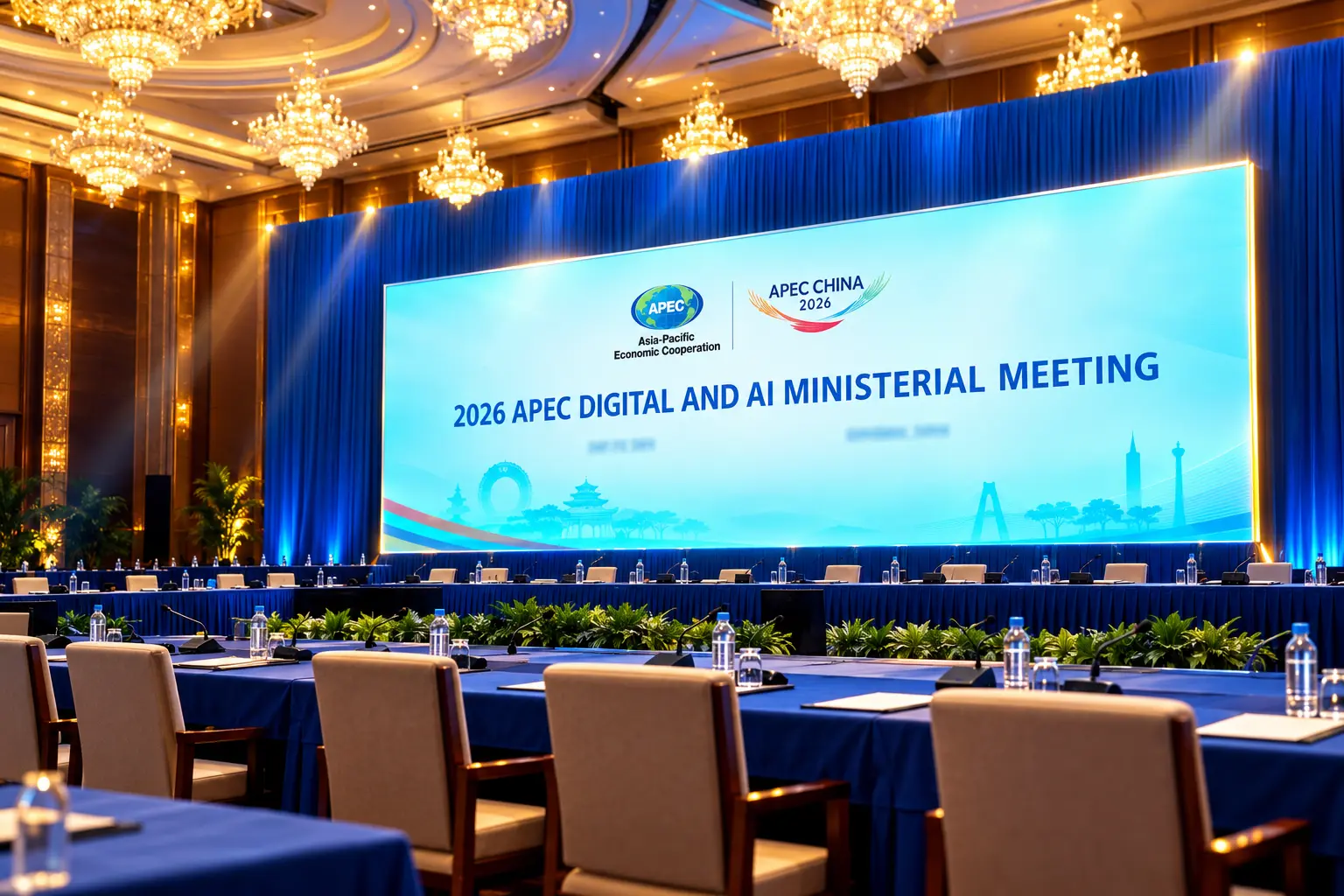
APEC ministers endorsed open-source AI for the first time on July 23 in Chengdu, in a statement that never mentions chips. Li Lecheng, China’s minister of industry and information technology, chaired the Digital and AI Ministerial Meeting of the 21-member forum and said the open-source line was new at this level.
The Chengdu Statement creates no treaty duties, and it is the text Viet Nam will inherit in 2027. China wanted that sentence in the regional record. The United States got language on intellectual property in the same paragraph.
Ministers Put Open Source Into an APEC Text
The host billed the day as digital inclusion and shared benefits. What the ministers actually added, and had not added before at this rank, was a dedicated open-source chapter.
Li told a Chengdu news conference that the meeting had raised open source to APEC’s ministerial level for the first time, while still stressing respect for intellectual property. He also said economies should speed up communications and computing-power networks, and help small firms use lighter digital tools.
We note the important role of trusted open-source approaches in unlocking the potential of digital technologies and fostering innovation in the digital economy. While respecting security, data protection and intellectual property rights, we encourage member economies to support open-source models and projects that employ strong security assurance through development and deployment. We also encourage member economies to engage in cooperation with open-source communities.
2026 APEC Digital and AI Ministerial Statement, Chengdu
That is the Chengdu Statement’s open-source clause, paragraph 15 of 18. Every verb around it is encourage, note, or support. The bargain is plain on the page: open models, if they come with security checks and IP respect.
George Chen, who chairs digital practice at The Asia Group, said open-source AI took center stage at Digital Week. Smaller governments in the forum will read the clause as permission to run weights on their own servers. If the competing offer is an interface they have to rent, they will keep shopping.
Five Chapters, Zero Hard Obligations
The APEC Secretariat listed five consensus areas after the session. The statement itself walks through them in order, and none of them binds a budget, a standard, or a chip licence.
THE CHENGDU STATEMENT’S FIVE CHAPTERS
| Chapter | What ministers asked economies to do |
|---|---|
| Universal and Meaningful Digital Connectivity | Build affordable, reliable access, with a focus on rural and remote networks, spectrum, satellites, and trusted data flows |
| Digital Technologies and AI for Economic Growth | Push AI into manufacturing, agriculture, and services, and give micro, small, and medium firms cheap tools that are easy to deploy |
| Digital Literacy and Skills Enhancement for All | Widen digital education and vocational training, and raise AI literacy for the public and for policymakers |
| Trusted Digital Environment | Treat online scams, data breaches, and AI misuse as shared risks, and swap practice on child protection and supply-chain resilience |
| Investment and Open Source for Digital Ecosystem | Bring in investors and venture funds, and back trusted open-source models while respecting security, data protection, and IP |
Vice Premier Zhang Guoqing opened the meeting and said AI is changing how people produce and live, and that China is ready to deepen practical cooperation. Thai Digital Economy and Society Minister Chaichanok Chidchob told the room the test is whether every economy can take part, not which one moves faster.
Paragraph 3 of the statement already admits the limit. Ministers said APEC is well placed to promote digital tools and AI, while acknowledging that member economies take different approaches to their own digital and AI policies.
The Compute Race Stays Off the Communique
Before the meeting, Zhang Xiaolei of MIIT’s international cooperation department said the host wanted to break down barriers to digital resources and narrow the AI divide. The adopted text never uses those phrases. It talks about last-mile networks, cheap software for small firms, and voluntary sharing “on mutually acceptable terms.”
It does not mention semiconductors, export licences, or frontier training runs. Li still put computing-power infrastructure on his oral list of results, which is as close as the chair came to naming the bottleneck the paper would not print. That silence is how APEC still works when Washington and Beijing cannot put the same sentence on chips.
Casey K. Mace, a senior U.S. official for APEC and economic policy, had previewed the American approach in May on the sidelines of trade ministers’ talks in Suzhou. He said Washington was active in promoting U.S. AI options and solutions, and that American firms would run workshops at the Chengdu digital week as a way to reach all 21 economies. Semiconductor export controls, he indicated then, were staying in place, which keeps official cooperation at the applications layer.
The ministerial paper therefore does useful work for ministries that need connectivity money and scam-fighting tips, and it leaves APEC’s unresolved intelligence divide where it was. Open source is the workaround written into paragraph 15 because the compute fight could not be.
An Exhibition Hall Shared by Rivals
MIIT said more than 30 companies had registered for the accompanying exhibitions and forums, among them Meta Platforms, Google, Microsoft, Panasonic, Tencent, ZTE, Baidu, and the Chinese robotics firm X Square Robot. Google’s consumer services stay blocked on the mainland. The company still put its name on a Chengdu APEC list, because the audience was the other 20 economies as much as the host.
FIRMS ON THE PRE-MEETING REGISTER
- U.S. platforms: Meta, Google, and Microsoft signed up for the exhibitions and forums around the ministerial.
- Japanese hardware: Panasonic was on the same register, a reminder that the floor was not a China-only showcase.
- Chinese platforms: Tencent, ZTE, and Baidu registered, alongside X Square Robot on the robotics side.
Liu Bochao, who heads MIIT’s international cooperation department, said the host had paired the closed ministerial with a high-level dialogue, project workshops, and a themed exhibition. He said more than 10 APEC economies and about 400 people would join the dialogue the next day, and that a casebook of 64 examples from 46 institutions would be released there, covering large models, intelligent manufacturing, green computing power, and cross-border digital trade.
Brunei’s communications ministry put attendance at the ministerial itself at more than 170 people from member economies, the Secretariat, and observers. Digital Week as a whole, running July 16 to 29, drew more than 500 people. Those are three different rooms, not one crowd counted three ways.
The Secretariat posted the outcome the same day.
APEC digital and AI ministers issued a joint statement after their meeting in Chengdu, China, chaired by China's Minister of Industry and Information Technology Li Lecheng. Consensus on connectivity, AI growth, skills and open source. Read full statement: https://t.co/9xakFN61KF pic.twitter.com/NPFOHErZrY
— APEC Secretariat (@APEC) July 23, 2026
What the Chengdu Statement Commits Economies To
The paper commits them to keep talking. It points back to the Putrajaya Vision 2040, the Internet and Digital Economy Roadmap, and the APEC AI Initiative for 2026 to 2030, which leaders adopted in Gyeongju in 2025. It points forward to Viet Nam in 2027. In between, it asks working groups to keep going.
China arrived with a domestic industry it could hold up as the supply behind that inclusion talk. Wei Wei, who heads MIIT’s science and technology department, gave the figures at the same Chengdu briefing.
CHINA’S AI BASE BEHIND THE PITCH
- Industry scale: Wei said China’s core AI industry passed 1.2 trillion yuan in 2025.
- Firm count: He put the number of AI companies at more than 6,200.
- Open weights: He said cumulative downloads of open-source models had passed 10 billion, which he called the most in the world.
- Training pledge: On July 17 in Shanghai, President Xi Jinping said China would provide developing countries with 5,000 AI training and seminar slots over five years, a World AI Conference promise, not a Chengdu deliverable.
Those download counts are why paragraph 15 is not an abstract courtesy. China can actually ship weights. The United States can ship frontier systems that many APEC ministries will not be able to train or host. The statement blesses the cheaper path without saying so.
On July 24, a separate High-Level Forum on AI, held under the theme “Promoting AI Development for Good and for All,” issued its own statement on secure deployment, responsible adoption, an enabling environment for innovation, and broader participation. That forum also told the Digital Economy Steering Group to keep AI on the plenary agenda. The ministerial and the forum are stacked paper, not one law.
Shenzhen in November Has to Carry the Rest
Chengdu was one stop in China’s third APEC host year, after 2001 and 2014, under the banner “Building an Asia-Pacific Community to Prosper Together.” Digital transformation and AI sit beside trade on that list. The leaders’ meeting is due in Shenzhen in November.
The APEC Policy Support Unit, in its February regional trends note, had already put numbers under the AI investment story ministers like to cite. It projected growth in the region at 3.2 percent in 2025 and 3.1 percent in 2026, easing to 2.9 percent in 2027. Carlos Kuriyama, who directs the unit, tied the near-term lift to demand, trade, and AI-related investment, and warned that trade curbs and policy uncertainty were weighing on the medium term. Merchandise trade volumes in the first three quarters of 2025 were up 8.0 percent for exports and 7.6 percent for imports from a year earlier.
FROM CHENGDU TO THE LEADERS’ MEETING
- July 16 to 22, 2026: The Telecommunications and Information Working Group holds its 73rd meeting as Digital Week opens in Chengdu.
- July 17, 2026: Xi Jinping, speaking at the World AI Conference in Shanghai, sets out four points on global AI governance and the 5,000 training slots.
- July 23, 2026: Ministers adopt the Chengdu Statement, with Li Lecheng in the chair.
- July 24, 2026: The High-Level Forum on AI issues a four-part statement, and the host holds the digital empowerment dialogue.
- July 29, 2026: Digital Week closes after 14 days.
- August 17 to 28, 2026: The Third Senior Officials’ Meeting in Dalian runs nearly 130 events for more than 3,000 people and, Guo Jiakun of the foreign ministry said, keeps the Chengdu digital and AI work moving toward Shenzhen.
- November 2026: APEC Economic Leaders meet in Shenzhen.
- 2027: Digital and AI ministers are due to meet again in Viet Nam.
On September 13 in New Delhi, Xi told the Brics summit that Beijing would help members develop and apply open-source large language models and build smart manufacturing plants. The Chengdu sentence is already travelling into other rooms. Shenzhen still has to decide how much of that line the leaders will pick up, and how much they will leave in the ministerial annex.
Frequently Asked Questions
Is the Chengdu Statement Legally Binding on APEC Economies?
No. APEC decides by consensus and its ministerial statements do not create treaty duties, court jurisdiction, or automatic changes to domestic law. Paragraph 3 of the Chengdu text even records that member economies keep different approaches to their own digital and AI policies, which is the forum’s usual way of parking a fight without a vote.
When Will APEC Digital and AI Ministers Meet Again?
They said they look forward to meeting again in Viet Nam in 2027, which is the next host year after China. Until then, the Digital Economy Steering Group is supposed to keep AI on its plenary agenda, which is a working-level track rather than another ministerial date.
What Does the APEC AI Initiative for 2026 to 2030 Set as Goals?
Leaders adopted the initiative in the 2025 Gyeongju Declaration with three stated aims: resilient growth through secure and accessible AI, broader participation through cooperation and capacity building, and more AI adoption by using energy-efficient technology and investment in resilient AI infrastructure. Chengdu’s ministerial paper treats that initiative as unfinished business, not as a completed programme.
How Did the July 24 High-Level Forum Differ From the July 23 Ministerial?
The July 23 meeting was the formal ministerial and produced the five-chapter Chengdu Statement. The July 24 High-Level Forum, themed “Promoting AI Development for Good and for All,” issued a shorter statement in four buckets: secure development and deployment, responsible adoption of applications, an enabling environment for innovation, and broader participation so more economies can take a share of the gains.
How Many Times Has China Hosted APEC?
2026 is China’s third host year, after 2001 and 2014, a 12-year gap. The current host year is built around the theme “Building an Asia-Pacific Community to Prosper Together,” with openness, innovation, and cooperation as the three published priorities, and with the leaders’ meeting still ahead in Shenzhen in November.
Li said China would keep using the APEC channel to put the Chengdu consensus into practice. The next ministerial reading of paragraph 15 is already booked in Viet Nam.

Instagram Plus Tests a Read-Only Mode That Cuts Stories

Altman Asks the Public to Accept Some AI Harm

Google Freezes OSS VRP Product Reports After AI Flood

AI Agents Make Payment Rails the Scarce Prize

Turkey’s Crypto Boom Now Runs Through Three Banks

Fable 5 Came Back Under a Commerce On-Off Switch

Google’s SpaceX GPU Lease Has a Sept. 30 Deadline

Plasma One’s XPL Locks Face a 1.81 Billion Cliff

DGO’s Rs 549 World Cup Pass Cost Fans Sleep and Data

Moonshot AI’s $30 Billion Ask Became a $35 Billion Close
-
 AI4 months ago
Fable 5 Came Back Under a Commerce On-Off Switch
-
 AI5 months ago
Google’s SpaceX GPU Lease Has a Sept. 30 Deadline
-
 CRYPTO4 months ago
Plasma One’s XPL Locks Face a 1.81 Billion Cliff
-
 APPS5 months ago
DGO’s Rs 549 World Cup Pass Cost Fans Sleep and Data
-
 AI5 months ago
Moonshot AI’s $30 Billion Ask Became a $35 Billion Close
-

 NEWS5 months ago
ColorOS 17 Device List Spans Oppo, OnePlus and Realme
-

 GAMING4 months ago
The RTX 4050 Under Rs 70,000 Hides a Wattage Gap
-

 AI4 months ago
Boris Cherny’s Loops Still Demand a Higher Production Bar