
GAMING
Immutable Outsources Its Games to Sell Steam Growth Tools
Immutable cut 29 studio jobs and is spending its 2022 crypto raise on Audience, an AI Steam growth tool sold to Web2 publishers.

Immutable cut 29 game-development jobs in 2026 and is handing most work on Gods Unchained and Guild of Guardians to unnamed outside studios. Co-founder James Ferguson called it a radical reshaping, aimed at selling Audience, the company’s AI growth software, to ordinary game publishers rather than blockchain titles alone.
The Sydney firm still sits on the US$200 million it raised in March 2022, when Temasek, Tencent and AirTree backed a US$2.5 billion bet that gaming would be the first consumer industry remade by crypto. Ferguson says that pile still covers 10 years of runway. The studio those cheques were meant to scale is the part being packed up.
Immutable Outsources the Games That Made It Famous
In early June 2026, Chief Studio Officer Justin Hulog told staff on Slack that Immutable would “outsource our Elderym operations” to a third-party provider. Elderym is the in-house banner over Gods Unchained, the company’s original hit, and Guild of Guardians, its second-biggest title. Immutable confirmed the note and would not name the buyer of the work.
In making this difficult but necessary decision, we will be saying farewell to most of our amazing Elderym colleagues by the end of July
Justin Hulog, Chief Studio Officer, Slack message to staff
Gods Unchained would “run as our core revenue-generating Studio product.” Guild of Guardians would “transition to Evergreen/ Maintenance Mode.” Hulog wrote that the Elderym franchise had been a core part of Immutable’s growth for 8 years, in “a challenging market, with a leaner squad, tighter budgets and sustained market headwinds.”
Ferguson said only a “very small” internal team would keep working on games. The rest of the company would point at Audience. “The major shift that we made last year was that we started opening up the platform from just Web3 games [blockchain games] to Web2 games as well, especially on the growth tools side,” he said. “How do we bring Immutable Audience, which is our AI growth platform for games, to the whole game market rather than just the subset of the market?”
A $200 Million Raise Built for a Studio
On March 7, 2022, Immutable closed a Series C led by Temasek, with Tencent, Animoca Brands and AirTree in the round, at a US$2.5 billion valuation. Australian filings and coverage of that raise put the haul at A$280 million. The company said at the time the money would go into Immutable X, the NFT scaling network, and into scaling the gaming studio, including Gods Unchained and Guild of Guardians. It also planned to hire 200 people.
The original commercial loop was on-chain. Immutable made money when tokens were minted and traded inside games running on its rails. IMX, the protocol token, still takes a cut: 20% of protocol fees must be paid in IMX, and holders can stake and vote. That design assumed a busy marketplace of player-owned items. The 2026 Slack note assumes something quieter: keep the one title that still pays, park the second, and rent the growth tooling out.
FROM STUDIO PROMISE TO OUTSOURCE NOTE
- March 7, 2022: Closes a US$200 million Series C at US$2.5 billion and says the capital will scale Immutable X and the in-house studio behind Gods Unchained and Guild of Guardians.
- December 4, 2025: Announces Immutable Audience as AI-powered growth software for acquisition, engagement and retention, built on zkEVM and Immutable Passport.
- Early June 2026: Hulog tells staff most Elderym colleagues will leave by the end of July as game operations move to a third party.
- End of July 2026: The studio cuts take effect. Gods Unchained stays as the core revenue product. Guild of Guardians moves to maintenance.
King River Capital, an existing backer, treated the shift as the plan it had always funded. Co-founder Chris Barter said the investment case “has always been about infrastructure, not a single game or product cycle,” and that Immutable is “building the platform that will help the next generation of games build and scale globally.” The platform in the 2026 sales deck is a Steam CRM. The platform in the 2022 deck was a chain for in-game assets.
Web3 Gaming’s Average Token Is Down 95%
The niche Ferguson wants to look past had a brutal four years. Crypto research firm Caladan, working from a ChainPlay pass over more than 3,200 GameFi projects, found 93 percent of GameFi projects dead. The average token in the sector is down 95% from its peak. Between 2020 and early 2026, Caladan estimates $12 billion to $15 billion in venture money, token sales and NFT proceeds went into blockchain games.
WEB3 GAMING AFTER THE 2022 PEAK
| Measure | Figure | Source window |
|---|---|---|
| Venture funding | $70 million | 2020 |
| Venture funding peak | $4 billion | 2022 |
| Venture funding | $360 million | 2025 |
| Single-month low | $9 million, one deal | May 2025 |
| Share of web3 venture | 62.5%, then single digits | 2022, then 2025 |
| Average token vs peak | Down 95% | Caladan sample |
| Projects effectively dead | 93% of 3,200+ | ChainPlay / Caladan |
Caladan’s post-mortem is blunt about why. Tokens and NFTs sold before playable builds existed. Play-to-earn needed a constant flow of new buyers to pay old players. Axie Infinity’s daily users fell from 2.8 million to 99,000. Capital that used to chase GameFi rotated into AI, real-world asset tokens and layer-2 infrastructure. Ferguson did not argue with the weather. “Volatility has always been part of that space,” he said. “The real thing is the opportunity here to build tools that help all games grow rather than just focusing on one niche, while still supporting that niche.”
Audience Chases Steam Wishlists With Passport Data
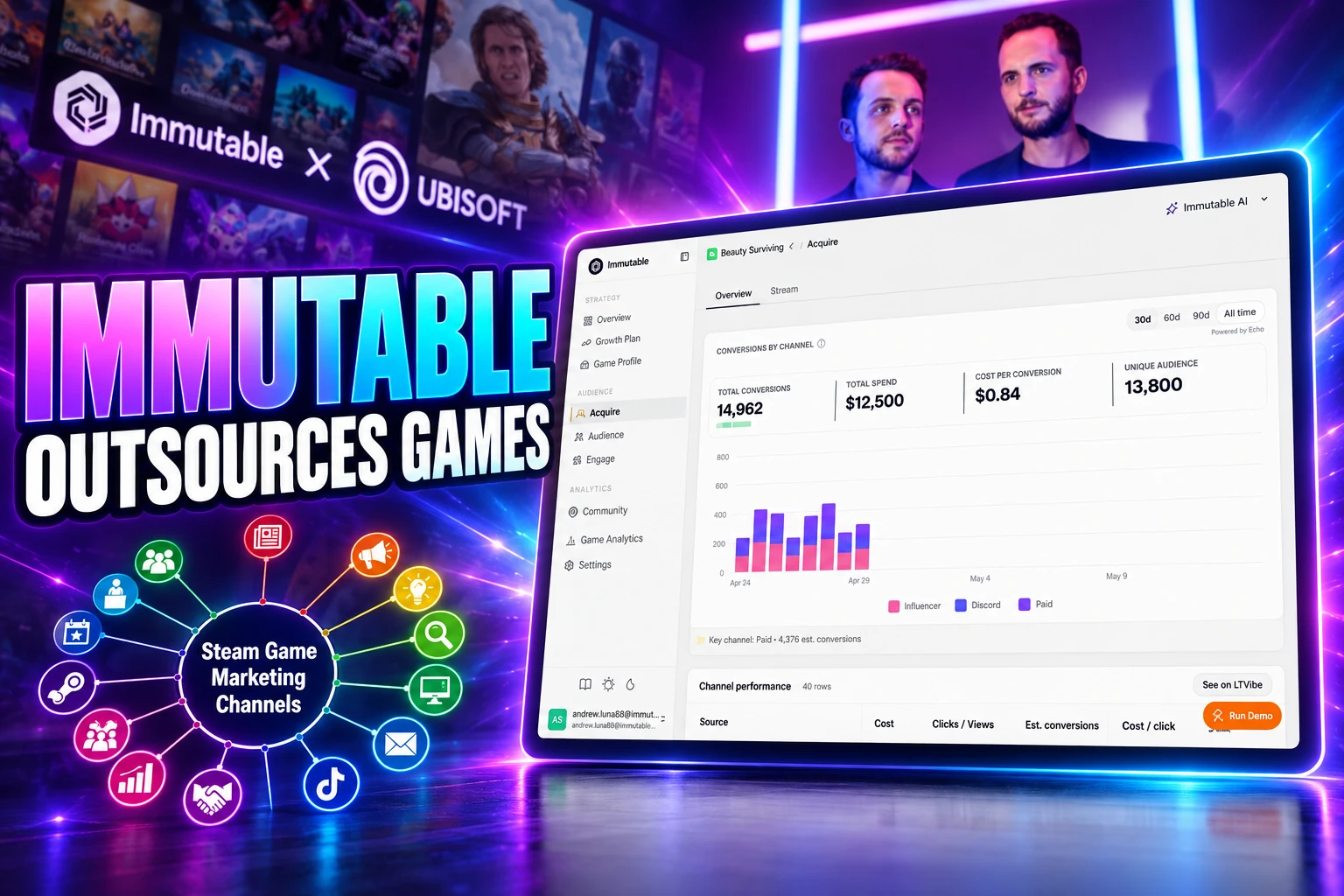
Immutable’s public site no longer leads with minting. It sells a growth engine for pre-launch Steam games, trusted by 700+ games, that promises weekly wishlist plans, identified player profiles and channel attribution. In August 2025 the company opened Audience to the wider games market, with Ubisoft’s Might & Magic: Fates as the marquee partner, and said the B2B tools would be available whether or not a title used web3.
Co-founder Robbie Ferguson put the pitch in the open on August 21, 2026. PC studios, he wrote, spend billions and still cannot see which channels create wishlists. After 8 years building games and working with over 700 studios, Immutable built Audience to pull Steam, social and ad data into a player CRM, then write a weekly growth plan.
Introducing Immutable Audience: the growth engine for pre-launch Steam games.
(btw we didn’t spend $50k on a viral launch agency – so if you think this is cool just share it for free i guess)
Game marketing is broken.
Every year PC studios spend billions to grow their games,… pic.twitter.com/uA9CEITyWG
— Robbie Ferguson | Immutable (@0xferg) August 21, 2026
“It’s become normal to accept that ~80% of your wishlists can’t be directly attributed to the marketing spend that caused them,” he wrote in a follow-up. When studios can see the missing slice, he argued, they will spend more, not less. The product still sits on Immutable’s chain and Passport wallet. The job those rails now do is stitch emails, Steam accounts and ad clicks into one profile a publisher can message.
WHAT AUDIENCE SELLS A STUDIO EACH WEEK
- Growth plan: A ranked list of wishlist actions, refreshed weekly, including Steam page fixes and content tests.
- Player identity: Landing pages that turn anonymous Steam, Discord and ad traffic into emails scored for likely spend, using data from 700+ games.
- Engage: Automated email, Telegram and in-app campaigns aimed at turning wishlists into buyers.
- Attribution: Channel credit for paying players, not just clicks, so budgets move toward traffic that actually spends.
- Owned list: The same contacts get reused for DLC, sequels and the next title, so the studio does not buy the same person twice.
One listed case, Empulse, went from 0 to 300,000 wishlists in 8 weeks. Ferguson said a beta title more than doubled wishlist-to-purchase conversion against Steam alone. He would not give Audience revenue. He said unit economics were strong and that the goal was more games on the platform. In the month before that June 2026 interview, he said Immutable had added 40 new games, a pace he put at about 500 extra games a year, “the fastest we’ve ever grown.”
By September 4, 2026, the public story had moved even further from the studio. Ferguson posted that Needle in a Haystack Simulator, an Audience customer, had drawn 40 million impressions in 48 hours, and that Immutable had a custom landing page live in under 48 hours. The company account did not post a farewell to Elderym. It posted growth software.
Ubisoft’s Conversion Table Is the Pitch Deck
Might & Magic: Fates, a free-to-play card game, launched on mobile and PC on February 4, 2026. Immutable’s own case study says the publisher, working with Audience, saw 2.8x higher launch-day player conversion than the default storefront flow of a Steam wishlist or mobile pre-registration. Nicolas Pouard, a Ubisoft vice president, is quoted saying audience “has become a core part of our go-to-market strategy.”
FATES PLAYER CONVERSION, STOREFRONT VS AUDIENCE
| Cohort | Day 1 | Day 14 | Day 14 lift |
|---|---|---|---|
| Standard storefront flow | 2.37% | 3.43% | – |
| Storefront plus Audience | 6.64% | 10.22% | 3.0x |
Player conversion here means the share of each cohort who became active players by that day. Email open rates in the treatment group hit 14.38%, against 6.55% for the storefront’s default launch notice, a 2.2x lift. Click-to-open rates were almost flat. The extra bodies came from getting the message opened, then from Telegram and Discord timed to the same countdown, after players had opted in on an Audience game page that captured email, Discord and Telegram.
That is a real publishing result, and it is also a web2 result. Fates still has a web3 trading layer in eligible regions. The number Immutable puts on the home page is a conversion rate into a free-to-play download, not a mint. Ferguson’s “whole game market” line is already how the product is sold.
IMX Trades 98.7% Below Its 2021 High
Holders of IMX did not get a new fee switch when the studio was cut. CoinMarketCap listed the token near $0.12, with a market cap of about $247 million, against an all-time high of $9.50 on November 26, 2021, a 98.7% drawdown. The full 2 billion supply is circulating. A token whose job is fees, staking and gas on a gaming chain gets quieter when the operator’s own games move to maintenance and the growth product is an email list.
The company still runs Immutable Play, Passport and the chain. Robbie Ferguson’s May 2026 shipping list for Audience included Passport identity stitching on login, Steam wishlist tracking, Meta, TikTok and Google ad dashboards, and conversion postbacks. The wallet is in the stack. It is in the stack as a login that lets a publisher keep the player after Valve’s one launch ping.
That is a hard trade for anyone who bought IMX as a claim on in-game minting. It is a cleaner trade for a publisher that wants first-party emails. The people on the losing side of Hulog’s Slack note are the Elderym staff and, on a longer fuse, token holders whose network activity now depends on other people’s Steam launches rather than Immutable’s own card economy.
Ten Years of Cash Buys a Different Company
Immutable’s 2024 accounts, the latest lodged with ASIC, show a loss of US$48 million. Comprehensive income, including gains on crypto holdings, was US$232 million. The firm had already cut roles across the business in 2025 and talked about using AI for work that used to be hired. The cash-flow breakeven target that sat on the 2025 plan did not survive contact with the Audience push.
Ferguson said Immutable will not break even by the end of 2026. He expects to burn “hundreds of thousands” of dollars a month to grow Audience. That is a small fire against a 2022 raise that he still rates at a decade of runway, which is the whole joke of the restructure. The war chest that was raised to put blockchain inside games is large enough, and the token market is weak enough, that the company can now pay to walk the studio down and hire the same balance sheet to a Steam wishlist machine.
Gods Unchained remains the studio’s core revenue product. Immutable has not named the firm now doing that work.
Disclaimer: This article is news reporting and analysis for information only. It is not investment advice, a solicitation to buy or sell IMX or any other token, or a recommendation about Immutable’s securities or products. Readers who are considering a financial decision involving crypto tokens, game publishers or related equities should speak with a licensed financial adviser who can review their own circumstances. Figures such as token prices, conversion rates, headcount and runway claims reflect the company statements, filings and market pages cited here and can change without notice.

Instagram Plus Tests a Read-Only Mode That Cuts Stories

Altman Asks the Public to Accept Some AI Harm

Google Freezes OSS VRP Product Reports After AI Flood

AI Agents Make Payment Rails the Scarce Prize

Turkey’s Crypto Boom Now Runs Through Three Banks

Fable 5 Came Back Under a Commerce On-Off Switch

Google’s SpaceX GPU Lease Has a Sept. 30 Deadline

Plasma One’s XPL Locks Face a 1.81 Billion Cliff

DGO’s Rs 549 World Cup Pass Cost Fans Sleep and Data

Moonshot AI’s $30 Billion Ask Became a $35 Billion Close
-
 AI4 months ago
Fable 5 Came Back Under a Commerce On-Off Switch
-
 AI4 months ago
Google’s SpaceX GPU Lease Has a Sept. 30 Deadline
-
 CRYPTO4 months ago
Plasma One’s XPL Locks Face a 1.81 Billion Cliff
-
 APPS4 months ago
DGO’s Rs 549 World Cup Pass Cost Fans Sleep and Data
-
 AI4 months ago
Moonshot AI’s $30 Billion Ask Became a $35 Billion Close
-

 NEWS4 months ago
ColorOS 17 Device List Spans Oppo, OnePlus and Realme
-

 GAMING4 months ago
Xbox Cuts 3,200 Jobs After Five Years of Thin Returns
-

 GAMING4 months ago
The RTX 4050 Under Rs 70,000 Hides a Wattage Gap