
AI
Panasonic’s AI Disassembly Robots Are Redesigning Home Appliances
Panasonic’s Osaka R&D lab uses AI robots to disassemble washing machines and air conditioners, feeding data back into product design for a circular economy.

Panasonic’s R&D facility in Osaka, Japan, is using AI disassembly robots to dismantle used air conditioners, washing machines, and microwave ovens, with cameras that read screws through dirt and rust. The work sits inside the company’s Green Impact initiative, and Andrea Murphy, director of environmental affairs and sustainability at Panasonic North America, frames it as a shift from a make-use-dispose model. The data path runs both ways: the same AI that drives the disassembly feeds the design of the next product.
Panasonic engineers describe the disassembly robots as a return loop in a manufacturing system that has long assumed a one-way trip from raw material to landfill. “We are looking at redesigning them to enable robots to carefully dismantle them in a way that allows valuable components to be harvested for recycling or possibly re-use,” Murphy told the Assembly Magazine feature on the Osaka disassembly line. The same robots that take a washing machine apart at the recycler can show engineers where the next washing machine needs to be easier to take apart. The factory floor at Osaka now treats the end of a product’s life as the start of the next one.
Where the Loop Closes Back on the Design Table
Every linear supply chain ends with disposal. Panasonic is using the disassembly line to push data back to the start. “By using AI to run extensive trial-and-error simulations, we can identify the most effective design configurations for both assembly and disassembly,” Murphy told Assembly Magazine. Each product torn down at Osaka is a rehearsal for the next product designed at the same company.
The closed loop is most visible in a small part of a washing machine. Panasonic pioneered the use of heat pump technology for drying efficiency, then moved the device from the bottom of the washer to the top. The heat pump can now be easily cleaned and maintained, Murphy said, and the design change also resulted in a 50 percent reduction in the amount of time it takes to repair a machine. The decision was informed by repair data and by what the disassembly robots revealed about access. Designers no longer guess at what blocks a screwdriver; the arm tells them.
CNET quoted Panasonic design engineer Michael Shadovitz on the same loop. “It’s hard for a designer to actually calculate all the different scenarios,” Shadovitz said. “So we’re trying to use this technology or language models in the future to help design with the design process for disassembly.” The implication is a slow narrowing of the gap between the assembly drawing and the disassembly sequence. Panasonic’s CES 2026 booth, which showcased the disassembly robots in action, was covered in the CES 2026 demonstrations of Panasonic’s disassembly robots, and framed the work as part of a redesign-and-disassembly process built into the product. The factory is starting to look like a round trip.
The Cyber-Physical Stack Behind the Robots
At the center of the system is a disassembly CPS, or cyber-physical system, that simulates and optimizes each teardown using 3D CAD tools. The data it produces flows into product design and into the automation of the next disassembly run. It is the same logic that runs a forward assembly line, run in reverse.
A disassembly CPS is a cross-industry technology solution that integrates advanced technologies such as generative AI, IoT and sensors to digitally reconstruct physical environments, thus enabling visualization, standardization and optimization.
That description came from Murphy in the Assembly Magazine feature. The phrase “cross-industry” matters: the system pulls from generative AI tools, sensor data, and 3D simulation at the same time, rather than treating each as a separate software layer.
Murphy also defined autonomous disassembly in her own words: “robotic or hybrid human-robot workcells that identify parts, choose tools and execute safe removal sequences without preprogramming for a single, fixed product state. They can adapt in real time with artificial intelligence and machine vision technology.” The cell does not need a new program per model. It reads the product in front of it, decides which tool to use, and removes the part without that preprogramming step.
Each teardown writes back into a dismantling database that stores data on each model. The data is used to improve equipment utilization rates and lay the foundation for automating the process further, according to Murphy. The more appliances that flow through the line, the denser the database becomes. New models arriving at the recycler meet a system that already knows what to look for on similar units. The cyber-physical stack is the place where disassembly stops being a one-off project and starts behaving like an industrial practice.
How Six-Axis Arms Learn to Read the Unit
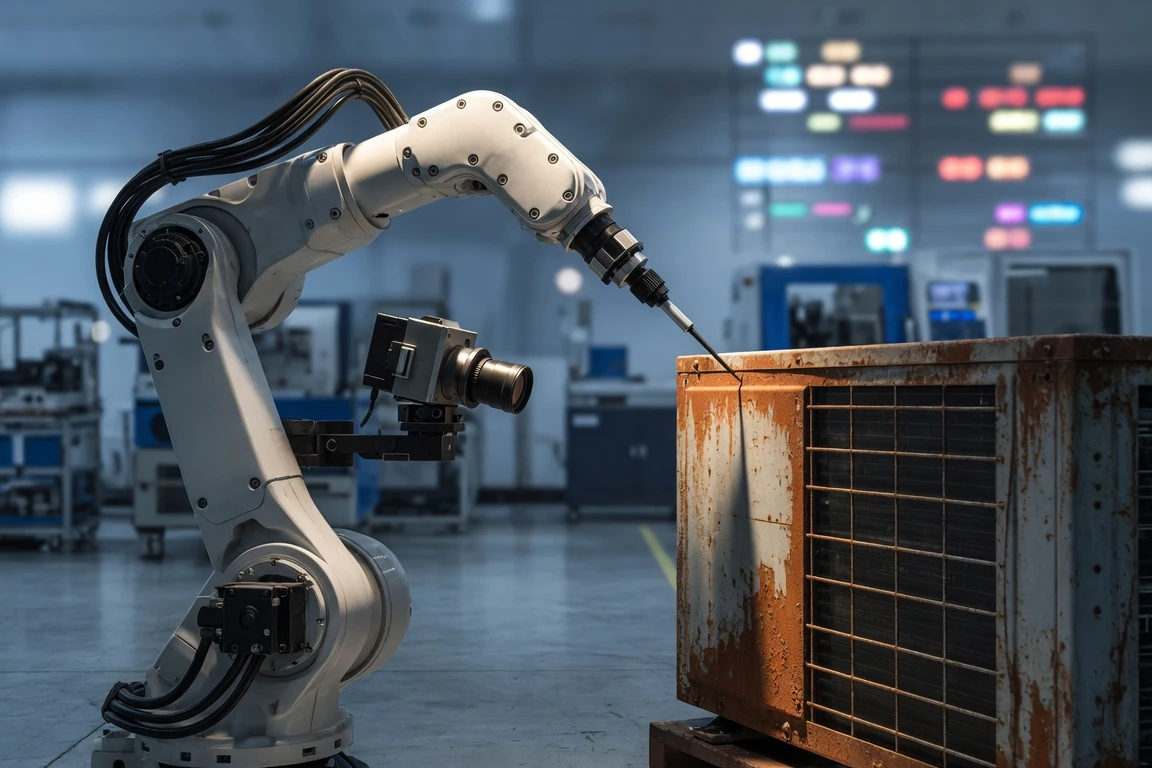
On the floor, six-axis robots do the physical work. Panasonic engineers are programming them to disassemble air conditioners, microwave ovens and washing machines, according to Assembly Magazine. Magnetic grippers lift the cover off appliances, screwdrivers remove fasteners, and end effectors equipped with other tools cut wires and carefully remove components. The robot’s toolset mirrors what a human technician would reach for, and the sequencing matters as much as the grip.
Vision is the part that lets the arm move without a fixed program. “The automatic dismantling equipment use machine vision technology to capture images,” Murphy said. “By using AI, the cameras accurately detect screws even with dirt or rust on the units. Then, it positions a robotic arm equipped with a screwdriver to remove the fasteners.” A rusted outdoor unit on a recycling line is not a clean CAD model; the AI has to find fasteners the way a person would, scanning past grime for the screw heads.
Robots also distance people from electrical, thermal and chemical risks during battery and capacitor removal, Murphy noted. The safety argument and the throughput argument land in the same cell.
- 3.69 million air conditioners sent annually to recycling plants in Japan as of 2022, per the Association for Electric Home Appliances.
- Four appliance categories covered by Japan’s Home Appliance Recycling Law since April 2001: air conditioners, TVs, refrigerators and freezers, and washing machines and clothes dryers.
- A pilot evaluation of the air conditioner outdoor unit dismantling system ran at PETEC Kanto in fiscal 2022 with a limited number of manufacturers and models.
The Heat Pump That Moved
Heat pumps were once buried at the bottom of Panasonic washing machines, a placement that made them hard to reach for cleaning and repair. Engineers at Panasonic redesigned the washer so the heat pump sits at the top, where a technician can get to it without dismantling the rest of the machine. The placement decision looks small on a parts diagram. The repair data shows otherwise.
The design change resulted in a 50 percent reduction in the amount of time it takes to repair a machine, Murphy told Assembly Magazine. The heat pump can now be easily cleaned and maintained, which extends the lifetime of the washing machine as a whole. Panasonic also used mechanical fasteners instead of adhesives in some areas, with features such as improved tool access, Murphy said. Each of those choices is the kind of detail a robotic screwdriver rewards, because fasteners and access are what an automated arm looks for.
The redesign fits a broader change at the company. “We strive to improve our design in providing easier access to components that require maintenance or replacement,” Murphy said. The same fix that speeds a human repair also speeds a robotic teardown, and the data from the teardown suggests where the next redesign should land.
The heat pump story shows the loop in operation. Repair data and current designs were analyzed, circular friendly improvements were developed, and the change shipped. The “design for repair” and “design for disassembly” tracks at Panasonic run on the same rails. The same AI that found screws on a dirty outdoor unit will, in time, suggest where to relocate the next vulnerable component.
The Three Pressures Behind the Push
Panasonic’s push into automated disassembly is being driven by three forces that converged over the past few years. Murphy named regulatory pressure, risk around critical materials, and customer convenience as the levers. Together they pulled disassembly from a back-room compliance task into a frontline engineering problem.
- Regulatory pressure. “Global regulatory pressure is increasing and there are market advantages to being an early adopter that can help lead thoughtful and actionable regulation,” Murphy told Assembly Magazine.
- Risk avoidance. “The availability and cost of critical materials is on the rise,” Murphy said, with recovery of copper, cobalt, nickel and rare earths cutting exposure to price volatility and supply shocks.
- Customer convenience. “Consumer convenience is core,” Murphy said. Circular programs that don’t add value at the household level won’t run.
The most concrete regulator on Panasonic’s doorstep is Japan’s Home Appliance Recycling Law, enforced since April 2001, which has driven Japanese recycling plants to handle a steady and growing stream of used appliances. The plants still do most of the work by hand today, which is why automation is moving up Panasonic’s priority list.
The push also reflects a longer-running materials math. Copper, cobalt, nickel and rare earths sit in compressors, motors, heat exchangers and control boards. Pulling them out of the appliance at the end of life puts them back into the supply chain. Murphy is blunt about the goal: “Recycling is not as good as reuse or remanufacture,” she told CNET. The disassembly line is meant to put reuse ahead of recycling whenever the part survives, and the company frames the work as part of a redesign-and-disassembly process on its Panasonic environment page on design for the circular economy.
Why Every Unit Arrives as a Different Puzzle
Disassembly would be straightforward if every appliance looked the same. They do not. Panasonic’s 2023 press release on the air conditioner outdoor unit dismantling system noted that “the units usually come in various size and designs depending on the manufacturer, and are usually installed outdoors, exposed to dirt and rust.” A robotic arm trained on a single model can run that model for years. Handling every model ever shipped means reading each unit first, which is why the system is built around model-by-model recognition rather than a single fixed script.
That is why Panasonic Holdings partnered with Panasonic Eco Technology Kanto (PETEC Kanto) and Mitsubishi Materials Corporation on a dismantling database that reads each unit’s label using AI-based OCR, per the Panasonic 2023 press release on the air conditioner dismantling system. The plan now is to expand the range of models covered and roll the system out to recycling plants inside and outside the Panasonic Group across Japan. Today’s system, in Panasonic’s own words from that release, “has enabled partial automation of the dismantling process.” The full automation arrives with each new model the database learns.
Frequently Asked Questions
What is Panasonic’s automated appliance disassembly system?
It’s a robotics line at the company’s R&D facility in Osaka, Japan, that uses six-axis robots, AI and machine vision to take apart used air conditioners, microwave ovens and washing machines so parts and materials can be reused or recycled. The work runs inside Panasonic’s Green Impact initiative.
Which appliances are being disassembled?
Air conditioners, microwave ovens and washing machines are the current targets at Panasonic’s Osaka R&D facility. The work aims to separate metals, plastics and other materials with high enough purity to feed back into new appliances.
How do the robots find the screws on a dirty or rusted appliance?
Cameras capture images of each unit, and AI-based recognition software detects fasteners even when they are covered in dirt or rust. A robotic arm equipped with a screwdriver is positioned to remove them, and a robotic grasping hand loosens and removes the cover.
What is the Panasonic Green Impact initiative?
It is Panasonic Group’s long-term environmental vision aimed at cutting CO2 emissions across its operations and value chain, including through circular-economy activities such as appliance recycling and design for disassembly. The disassembly robots at Osaka are one program within that broader framework.
Why did Panasonic move the heat pump to the top of its washing machines?
Placing the heat pump at the top made it easier to access for cleaning and maintenance, which extends the machine’s lifetime and reduced repair time by 50 percent. The new placement also gives a robotic screwdriver clearer access for future automated disassembly.


Google Opens Gmail to Voice and Gates Docs Live

Lenovo Prices the IdeaPad Vibe Against Apple’s $699 Neo

Xbox Caps Game Pass Cloud Gaming at 15 Hours

GTA 6 DualSense Controllers Follow Sony’s Usual $84.99 Script

South Korea Retail Investors Face Reckoning After KOSPI AI Rally Collapses

Surrey AI Maps Three Heart Attack Paths and Their Molecular Roots

Germany Locks Neutral Apple ATT Prompts Across Most of Europe

Apple’s 5% EU Fee Quietly Rewrites Alternative App Store Math

Apple’s EU Fee Truce Cuts Complexity but Leaves Rivals Fuming

Pixel 11 Pro Fold Trades Thinness for Durability and Seven-Year Stay

Oracle Cuts 21,000 Jobs in a Year, Cites AI in 10-K Filing

Fable 5 and Mythos 5 Return as US Lifts Anthropic Export Controls

SpaceX’s Google Deal Turns a Rocket Company Into a Cloud Landlord

CD Projekt Red Co-CEO: Redemption Arc Isn’t Done, Witcher 4 in 2027

XPL Rallies 30% Ahead of Plasma One Card Tier Launch

Google Search Profiles Build a Follow Graph Inside Discover

DGO App Brings Rs 549 Mobile Pass for FIFA World Cup 2026 in Nepal

Moonshot AI Targets $30 Billion in China’s Fastest AI Funding Sprint

Oppo’s ColorOS 17 Eligibility List Leaves A-Series Buyers Behind

Microsoft Xbox Layoffs Start in July as Sharma Slams 3% Margin
-
 AI2 months ago
Oracle Cuts 21,000 Jobs in a Year, Cites AI in 10-K Filing
-
 AI2 months ago
Fable 5 and Mythos 5 Return as US Lifts Anthropic Export Controls
-
 AI3 months ago
SpaceX’s Google Deal Turns a Rocket Company Into a Cloud Landlord
-
 GAMING2 months ago
CD Projekt Red Co-CEO: Redemption Arc Isn’t Done, Witcher 4 in 2027
-
 CRYPTO3 months ago
XPL Rallies 30% Ahead of Plasma One Card Tier Launch
-
 NEWS3 months ago
Google Search Profiles Build a Follow Graph Inside Discover
-
 APPS3 months ago
DGO App Brings Rs 549 Mobile Pass for FIFA World Cup 2026 in Nepal
-
 AI3 months ago
Moonshot AI Targets $30 Billion in China’s Fastest AI Funding Sprint