
AI
ForeFlight’s ChatGPT Pipe Is Not Cleared for Flight
Jeppesen ForeFlight’s ChatGPT connector reads live flight data, while its own terms bar that output from navigation, planning and any safety-of-flight use.

Jeppesen ForeFlight’s first live AI product is a ChatGPT connector its own terms bar from flight. The certified airline engine behind it is still a limited beta.
On July 1, 2026, the Austin company unveiled Jeppesen ForeFlight Airflow as an aviation-centric agentic engine, then pointed general aviation to a ChatGPT plug-in that reads a pilot’s own ForeFlight account. Commercial and business tools were promised later in 2026. Military work would follow. The preview is already in ChatGPT. The contract says do not fly on it.
Airflow’s Certified Seat Is Still Empty
Airflow is the company’s long bet, not the chat window. It mixes public aviation data, each customer’s isolated records, and Jeppesen ForeFlight’s own safety and certification knowledge, and it is built to work with more than one model. Operators can plug in their own agents, buy someone else’s, or run the company’s. CEO Brad Surak said customers can move on their own clocks, at lower IT cost than the last industry shift from paper to screens.
The Airflow site is blunter about generic models. It walks through a made-up miss in which a fuel figure of 1,200 lbs is off by 900 lbs, a NOTAM is skipped, and A320 tables are applied to a Boeing 737-800. Surak’s launch line was the same warning in plainer words.
General AI is confident, but often wrong. In our industry, these mistakes cascade into costly, dangerous, or catastrophic outcomes. Artificial intelligence is not enough for this industry, we need aviation intelligence: the assurance that the right data, right context, and right reasoning are applied every time, and always cross-checked and filtered through industry safety and governance protocols.
Brad Surak, CEO, Jeppesen ForeFlight, July 1, 2026 statement
The company lists five claims for responsible aviation AI: reason in context, reason from certified inputs, show a visible why-trail, run inside a patent-pending Aviation Intelligence SMS, and leave the last call with a human. Autonomy is drawn as four rungs, from L1 advisor up through L4, where software would act inside a certified frame. A limited beta for Airflow partners is open. The public airline product is not.
THE ENGINE IN NUMBERS
- Flights served: More than 60 million commercial, military, business and general aviation flights a year, the company says in its own description of the firm.
- People on the tools: The Airflow site says the company sits at decision points for more than a million pilots, cockpit to operations center.
- Certified base: An aviation context graph built on 90+ years of inputs, covering 200+ countries and air navigation service providers.
- Operator layer: A private Aviation Process Model the company describes as 7 areas, 65 groups, and thousands of processes, kept isolated per customer.
Those figures describe the data pile Airflow is supposed to reason on. They do not describe the ChatGPT preview, which is a thinner pipe into an individual account.
ChatGPT Can Already Read a ForeFlight Logbook
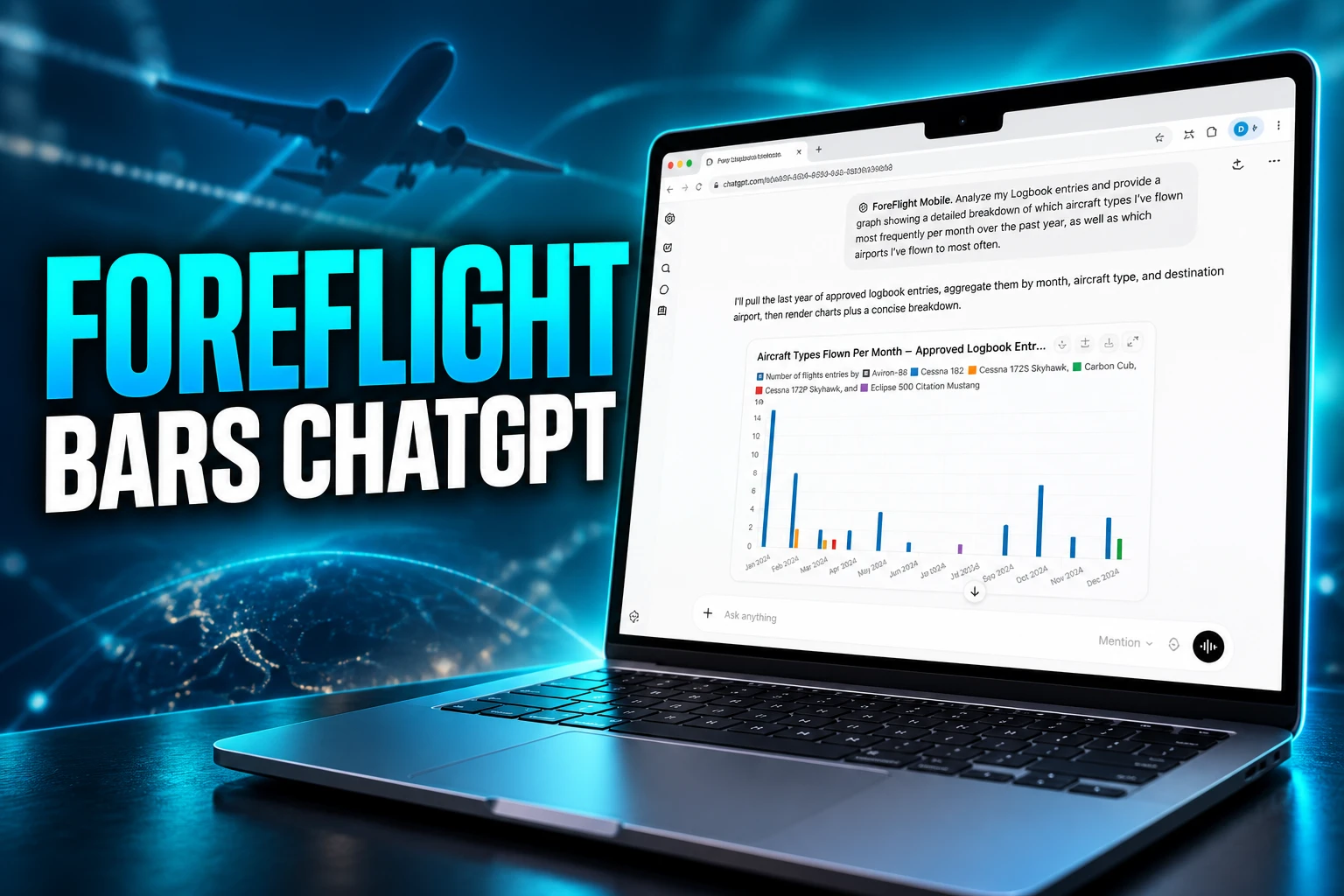
That design is the base of the Airflow aviation AI engine the company began pitching in July. The thing a private pilot can turn on now is the ForeFlight AI Connector, an official server on the open Model Context Protocol that ties ForeFlight Mobile to a user’s existing OpenAI ChatGPT account. ForeFlight’s own blog told pilots there is no new app and no new screen to learn. Search for ForeFlight Mobile in ChatGPT’s App Directory, connect, and log in.
Introducing Jeppesen ForeFlight Airflow™: aviation agentic AI engine built on decades of aviation data and experience.
Available now. Build on it. Explore it. Co-develop with us.https://t.co/L5HKDZsHWT#AviationAI #JeppesenForeFlight pic.twitter.com/yaTDIaxf7l
— Jeppesen ForeFlight (@JeppForeFlight) July 1, 2026
The company account called Airflow available to build on, explore and co-develop. Surak quoted that post and wrote that the five principles were requirements, not features. Gemini and Claude were named as later experience layers. ForeFlight’s connector page, still listing ChatGPT in September 2026, has not added them.
Access is a research preview for individual Starter, Essential, or Premium subscribers. Business and military flight bag accounts are out. Pricing, packaging and even whether the feature survives the preview are explicitly open. ForeFlight has been running the remote server through dedicated MCP test tooling across local, QA and production setups, which is the unglamorous work a lawyered preview still needs.
What the Connector Will Fetch From Your Account
Under the hood, ChatGPT issues Model Context Protocol tool calls against ForeFlight’s server. The model lists the tools, sends a call, and gets structured results back. Support copy says the connector can be asked to pull weather, forecasts, airport data and NOTAMs; suggest routes and score them; create and manage flights; read aircraft files; pull logbook and currency data; and draft logbook entries for review.
The worked examples are not shy. “What is the weather at KAUS right now?” is supposed to fetch current aviation weather. “Build a flight from KHOU to KDFW” is supposed to create a flight with ForeFlight tools. That is the same class of task the legal terms, a few clicks away, tell the user not to trust.
WHAT THE PREVIEW WILL TOUCH
| Ask in ChatGPT | Support page says it can | Connector terms say |
|---|---|---|
| Weather at KAUS | Retrieve aviation weather and forecasts | Do not rely on it for weather |
| Build KHOU to KDFW | Create and manage flights; suggest routes | Do not rely on it for flight planning or dispatch |
| Aircraft and performance | Access aircraft information and route performance | Do not rely on it for fuel, performance or navigation |
| Logbook and currency | Retrieve logbook data; create draft entries | Convenience only; not a certified EFB function |
| Business or MFB account | Not supported in the preview | The connector is an individual ChatGPT hook |
The support warning sits on the same page as those examples. Large language models can misread, omit or invent. Weather, NOTAMs, airports, routes and performance still have to be checked in official sources and in the ForeFlight app. The pilot in command stays solely responsible.
The Terms Say Do Not Use It for Flight
The supplemental terms, last updated June 24, 2026, go further than a help-center caution. Section 4 is labeled a critical safety notice. The connector and all AI output are for general information, convenience and situational awareness. They are not for navigation or operational flight.
THE CONNECTOR AND ALL AI OUTPUT ARE PROVIDED FOR GENERAL INFORMATION, CONVENIENCE, AND SITUATIONAL-AWARENESS PURPOSES ONLY. THEY ARE NOT FOR NAVIGATION AND ARE NOT TO BE USED AS A SOURCE OF REAL-TIME OR OPERATIONAL FLIGHT INFORMATION.
ForeFlight MCP Connector Terms, June 24, 2026
WHAT THE CONTRACT FORBIDS
- Safety of flight: Do not use the connector or AI output for flight planning, dispatch, in-flight decisions, navigation, weather, NOTAMs, fuel, performance or any other operational purpose.
- Certified bag: The connector is not a certified electronic flight bag function and is not a stand-in for the certified ForeFlight app or government sources.
- Stale or altered data: Data through the pipe may be delayed, cached, summarized, reformatted or changed, and is not promised current, complete or real-time.
- OpenAI’s hands: Flight, route, logbook, aircraft and location information you pull through the connector is sent to OpenAI to generate answers, under OpenAI’s terms, including any training settings.
- No model mining: Users may not train, fine-tune, distill or bulk-export ForeFlight data, and they must switch on ChatGPT controls so that connected data is not used to improve OpenAI’s models.
ForeFlight also says it does not create, control, review, endorse or guarantee ChatGPT’s wording. ChatGPT is a third-party service. The company is not affiliated with OpenAI. The pilot still has to verify every figure against official sources and the certified app. That split is the product: ForeFlight keeps the database and the certified app; the chat window is someone else’s model, running on a user’s own OpenAI bill.
$10.55 Billion Bought the Data Layer
The timing is a corporate one, not a lab one. Boeing agreed on April 22, 2025, to sell Jeppesen, ForeFlight, AerData and OzRunways to Thoma Bravo. The all-cash sale closed at $10.55 billion on November 3, 2025, and the units launched as a standalone company under Brad Surak, who had run Boeing’s digital aviation software.
FROM BOEING UNIT TO AI BET
- April 22, 2025: Boeing and Thoma Bravo announce an all-cash deal valued at $10.55 billion for Jeppesen, ForeFlight, AerData and OzRunways, with data-sharing terms meant to keep operations continuous.
- November 3, 2025: The carve-out closes. Surak, as CEO, says 90 years of Jeppesen data plus ForeFlight’s digital tools are back as an independent software company.
- July 1, 2026: Jeppesen ForeFlight unveils Airflow and previews the ChatGPT connector for individual subscribers, with airline and business offerings still dated later in 2026.
Scott Crabill, a Thoma Bravo managing partner, called the company a vertical software and data business and said the firm would put money into innovation and global expansion. For a buyer that paid $10.55 billion, the durable asset is not a ChatGPT skin. It is the context graph, the certified engines, and the right to sit between an operator’s private data and whatever model that operator already pays for. Model-agnostic, in that reading, means the model can churn. The data layer should not.
Garmin still sells the rival electronic flight bag that talks to Garmin panels. Honeywell and others still own glass in the front. Airflow does not have to win the PFD to win the prompt. If crew, dispatch and a private pilot all ask questions against Jeppesen ForeFlight data, the company remains in the loop even when the face of the answer is ChatGPT, Gemini or Claude.
Airlines Wait While GA Gets a Preview
The rollout order is the strategy in public. Individual GA subscribers get a research preview that costs ForeFlight almost nothing in new interface work, because ChatGPT is the interface. Flight departments and airlines, the accounts that would actually stress crew legalities, MEL items and slot times, are told to wait for native Airflow agents, co-development, or their own agents on the same MCP rails. Military-focused work is behind that.
September 2026 feature notes from ForeFlight still treat the connector as an open ChatGPT preview. They do not announce a commercial Airflow agent in service. The Airflow site still asks operators to request access and still says agents can stand up in weeks because the graph is already built. That is a sales clock, not a certification clock, and the company has not published an FAA or EASA approval for the ChatGPT path, because the terms say that path is not the certified one.
The open design is also a boundary. A carrier that wants Airflow later can keep its own model choice. A GA pilot who likes Gemini is told to wait. A business account that already lives in ForeFlight Dispatch cannot turn the preview on at all. The first customers are the ones whose flights are least bound by an airline’s ops spec, which is also the group most used to asking a chatbot when the handbook feels slow.
A Five-Knot Error Is the Easy Case
The habit is already here, with or without a ForeFlight button. In July 2026 a multi-engine instructor described a student who had a flap failure in a trainer and typed the question into ChatGPT instead of finding the speeds in the POH. The answer came back 5 knots too low. Asked why, the student said looking up the page would have taken longer. That is a single anecdote, not a study, and it did not involve ForeFlight’s connector. It is still the use case the connector makes faster: a confident paragraph where a table used to be.
Surak’s second line at launch was about trust earned one decision at a time, compounded across the 60 million flights the company serves a year. The preview does the opposite piece of work. It lets a subscriber ask for a route, a fuel stop, a weather brief or a logbook draft in the same window they use for everything else, then tells them in a separate contract that the answer is not operational. Individual subscribers can connect ChatGPT now. Business and military operators cannot. The terms already say the answers are not for flight.

Instagram Plus Tests a Read-Only Mode That Cuts Stories

Altman Asks the Public to Accept Some AI Harm

Google Freezes OSS VRP Product Reports After AI Flood

AI Agents Make Payment Rails the Scarce Prize

Turkey’s Crypto Boom Now Runs Through Three Banks

Fable 5 Came Back Under a Commerce On-Off Switch

Google’s SpaceX GPU Lease Has a Sept. 30 Deadline

Plasma One’s XPL Locks Face a 1.81 Billion Cliff

DGO’s Rs 549 World Cup Pass Cost Fans Sleep and Data

Moonshot AI’s $30 Billion Ask Became a $35 Billion Close
-
 AI4 months ago
Fable 5 Came Back Under a Commerce On-Off Switch
-
 AI4 months ago
Google’s SpaceX GPU Lease Has a Sept. 30 Deadline
-
 CRYPTO4 months ago
Plasma One’s XPL Locks Face a 1.81 Billion Cliff
-
 APPS4 months ago
DGO’s Rs 549 World Cup Pass Cost Fans Sleep and Data
-
 AI4 months ago
Moonshot AI’s $30 Billion Ask Became a $35 Billion Close
-

 NEWS4 months ago
ColorOS 17 Device List Spans Oppo, OnePlus and Realme
-

 GAMING4 months ago
Xbox Cuts 3,200 Jobs After Five Years of Thin Returns
-

 GAMING4 months ago
The RTX 4050 Under Rs 70,000 Hides a Wattage Gap