
NEWS
The Moto G77 Power Lasts Days on Last-Gen Silicon
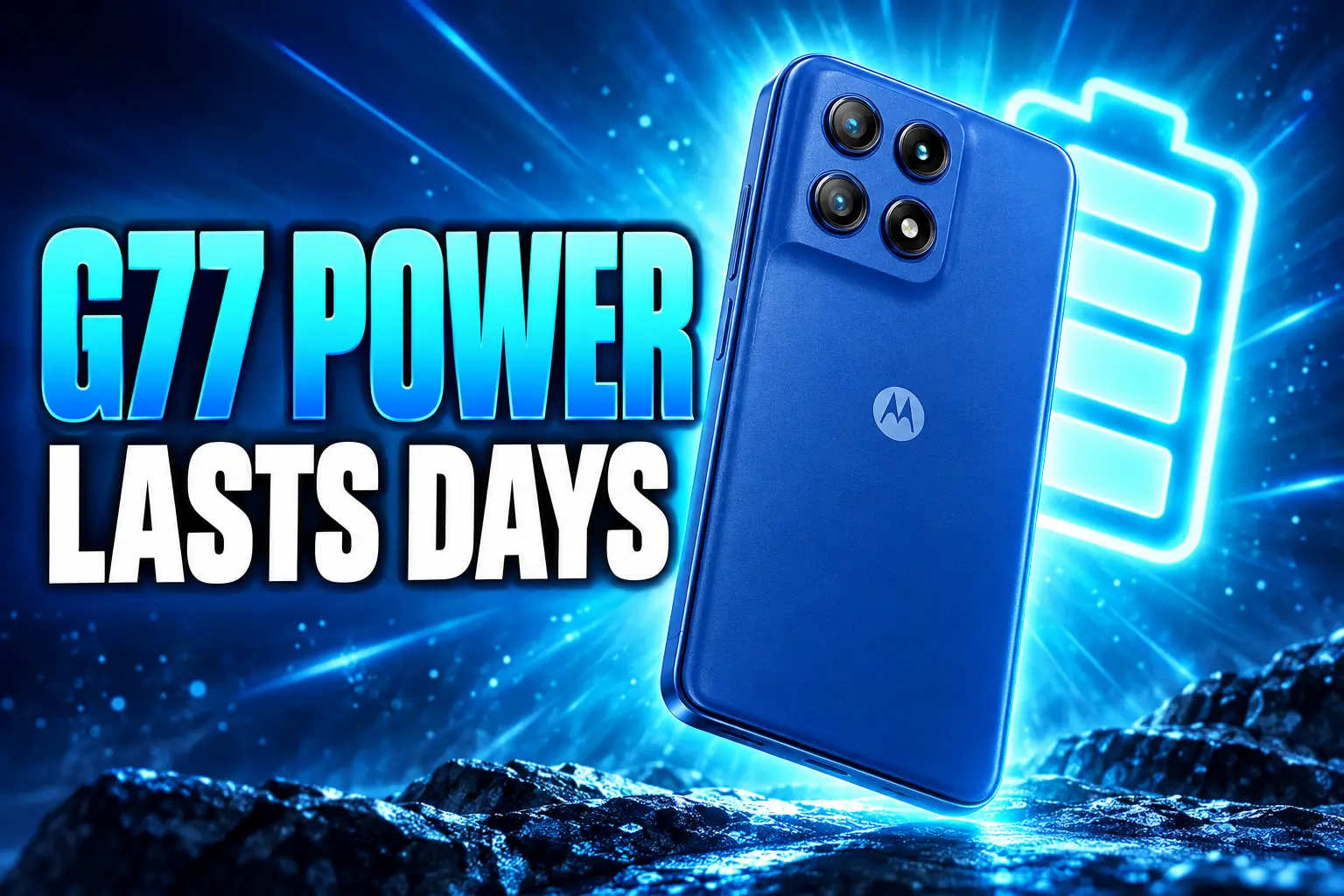
India’s Moto G77 Power is a 7,000mAh phone at Rs 25,999 whose Sony camera sits on a Dimensity 6400 and one Android update.

Motorola put the Moto G77 Power on Indian shelves on 13 July at Rs 25,999 for the only 8GB + 128GB model, five days after an 8 July launch, a cut that already undercut the under-Rs 30,000 teaser (~$270). Axis and HDFC card offers, or a matching exchange, trimmed the first bill to Rs 23,999.
The company still led on a Sony camera. Two months of hands-on tests have been kinder to the 7,000mAh cell than to that pitch, the Dimensity 6400 chip, or the 30W charger sitting under it.
The Opening Price Landed at Rs 25,999
Motorola had already confirmed the India launch for 8 July on Flipkart, motorola.in, and retail stores. Sale day was 13 July, a Monday, with one memory cut and three Pantone colours: Fuchsia Red, Nautical Blue, and Impenetrable.
THE LAUNCH CALENDAR
- 8 July 2026: Motorola India unveils the G77 Power and posts an opening figure of Rs 23,999 with offers.
- 13 July 2026: Units go on sale online and in stores at Rs 25,999 MRP.
- Late July 2026: First week-long tests start backing the cell and questioning the chip, the LCD, and the update window.
The brand account put the offer price in the launch post and asked why anyone would settle for ordinary.
Why settle for ordinary when you can wow all the way?
moto g77 POWER starting at 23,999*.
Sale starts 13th July on Flipkart, https://t.co/azcEfy2uaW and leading retail stores.#motorolaindia #motog77power #wowalltheway pic.twitter.com/0YRLjiBpIt
— Motorola India (@motorolaindia) July 8, 2026
Launch-day replies under that video skipped the battery almost entirely. They went after parts delays at service centres and the stock Google Dialer, which is a poor omen for a phone whose other headline features need years of software care.
Narasimhan Put Sony Ahead of the Cell
T.M. Narasimhan, managing director of Motorola India, did not open on milliamp-hours. He opened on photography.
Consumers today are placing greater importance on smartphone cameras, as they increasingly rely on them to capture, create, and share their everyday moments. With the moto g77 POWER, our focus was to deliver a more complete camera experience by combining the advanced Sony LYTIA camera system along with the highest UW and selfie camera, while complementing long-lasting battery life, immersive entertainment, and trusted durability.
T.M. Narasimhan, Managing Director, Motorola India
The hardware behind that line is a 50MP main camera using Sony’s 1/1.95-inch 50MP LYTIA 600 sensor, 0.8µm pixels, an f/1.8 lens, PDAF, and Quad Pixel binning, plus an 8MP ultrawide with a 120-degree view and a 32MP front camera. Both ends record 2K at 30fps. There is no 4K, and there is no OIS.
Daylight frames from a week-long Indian test were sharp enough at a glance, then warm, a little dim, and soft once you pinch in. Night shots held exposure when a light source was in the frame and went mushy when it was not. The ultrawide kept colour in step with the main lens and lost a lot of detail. The same LYTIA 600 looks cleaner on Motorola’s own G67 Power, which uses a Snapdragon 7s Gen 2 and a stronger ISP. The sensor is not the bottleneck. The processor behind it is.
The Global G77 Kept AMOLED and 108MP
A non-Power Moto G77 already exists outside India with a 6.78-inch Extreme AMOLED panel, 10-bit colour, a claimed 5,000-nit peak, and a 108MP main camera. India did not get that phone. It got the Power SKU: a 6.72-inch 8-bit LCD at 1080 x 2400, 120Hz, 1,050 nits, Gorilla Glass 7i, and the 50MP Sony module. Motorola still printed LYTIA on the camera island, which is how you tell this body from the cheaper G37 Power in the same blue leather.
Why the Dimensity 6400 Caps the Sony Sensor
The G77 Power uses MediaTek’s Dimensity 6400, the same 6nm chip as the G37 Power. MediaTek’s sheet lists two Cortex-A76 cores at 2.5GHz, six Cortex-A55 cores at 2.0GHz, LPDDR4x memory, and UFS 2.2 storage, which is the ceiling this silicon allows. The phone ships with 8GB of LPDDR4X, 128GB of UFS 2.2, a hybrid tray that takes a second nano-SIM or a microSD card up to 1TB, and RAM Boost advertised up to 24GB.
MediaTek built the part on a 6nm process and a Mali-G57 GPU and says it can draw up to 19% less power in games than rival chips in the class. That efficiency helps the cell. It does not close the gap to phones at the same rupees that use a Dimensity 7400 Apex or a Snapdragon 6 Gen 3.
LAB SCORES IN THE SAME TEST
| Phone | Chip | AnTuTu | Geekbench Multi |
|---|---|---|---|
| Moto G77 Power | Dimensity 6400 | 595,362 | 1,355 |
| OnePlus Nord CE 6 Lite | Dimensity 7400 Apex | 1,015,733 | 2,974 |
| Redmi Note 15 | Snapdragon 6 Gen 3 | 868,311 | 1,528 |
Geekbench single-core sat at 823 on the Motorola, 1,037 on the OnePlus, and 410 on the Redmi. In 30 minutes of Call of Duty: Mobile at Medium graphics and Max frame rate, the G77 Power averaged 55.4 fps. BGMI at HDR and Ultra averaged 38.5 fps. WhatsApp, Instagram, and YouTube stay smooth. Heavy games and stacked camera sessions do not.
Wi-Fi 5, USB 2.0 on the Type-C port, and the lack of NFC are the same generation as the chip. Motorola did not strip those features as a cost cut. The Dimensity 6400 does not offer a faster radio or a newer flash standard to turn on.
A 7,000mAh Cell on a 30W Charger
Motorola’s product page claims up to 59 hours on a single charge from the 7,000mAh pack, with 30W TurboPower in and 6W wired reverse out. That 59-hour figure is a lab claim, about two and a half days, not a three-day field result. Mixed-use tests tell a smaller, still strong story.
BATTERY ON THE CLOCK
- Official claim: Up to 59 hours from Motorola’s own listing.
- Screen-on time: About 9 hours on one charge, spread across three calendar days of light mixed use.
- PCMark drain: 16.3 hours from 100% to 20%, behind 17.1 hours on the Nord CE 6 Lite and 17.7 hours on a realme 16T with an 8,000mAh cell.
- Top-up: 20% to 100% in 84 minutes on 30W.
A full day of calls, social apps, YouTube, and messaging still left roughly 40% to 50% in more than one reviewer’s pocket. Lighter days stretch into a second evening. The cell is the reason the Power name still means something. The charger is why that name feels dated. Rivals at this money have moved to 45W on the same 7,000mAh size, or to 45W on a smaller silicon-carbon pack inside a lighter AMOLED body. Motorola kept 30W, the same TurboPower rating it already uses on cheaper G Power phones, so a dead 7,000mAh brick still asks for the better part of an afternoon if you miss the 84-minute window from 20%.
The louder gap after launch is that charger and the update window, not the battery life. Anyone who wanted two quiet days between wall sockets already has the part of the spec sheet that works.
One Android Update Against Longer Rival Pledges
The G77 Power ships with Android 16 and Hello UI, including Live Updates, a status-bar pill for timers and the torch, and the usual Moto gestures: karate-chop flashlight, twist for camera, Smart Connect to a PC. Bloat is light. The clock stops early.
Motorola promises one Android OS update, to Android 17, and three years of security patches. That is the whole software life of a phone that went on sale in mid-2026.
THE UPDATE PLEDGES
- Moto G77 Power: One OS upgrade and three years of security, with 41 apps in the box.
- OnePlus Nord CE 6 Lite: Two OS upgrades and four years of security, with 52 apps.
- Redmi Note 15: Four years of OS upgrades and six years of security, with 64 apps.
Hello UI is still the cleaner of those three skins. It is also the one that ends first. A buyer who keeps a midrange handset for three years will spend the last of those years on Android 17 while the Redmi is still picking up new platform drops. Clean software on day one does not fix a short fuse.
A Headphone Jack Comes With 215 Grams
The chassis measures 166.23 x 76.50 x 8.89 mm and weighs 215 grams, 37 grams more than the Redmi Note 15 at 178 grams and a shade over the Nord CE 6 Lite at 208 grams. Fuchsia Red and Nautical Blue use a vegan leather back. Impenetrable is acrylic. Motorola rates it IP64 and MIL-STD-810H, with SGS testing, and says Gorilla Glass 7i offers three times better drop performance than the glass it replaces. There is no factory screen protector, and one long test already picked up scuffs on the LCD.
Practical leftovers that cheaper AMOLED rivals often cut are still here: a 3.5mm jack with Hi-Res Audio, FM radio, stereo speakers with Dolby Atmos, a side fingerprint reader, and dual microphones. Those extras, plus the 7,000mAh cell, are the honest case for the Power badge. The LCD’s thick chin, the 8-bit panel, and the 215-gram mass are the bill for housing that cell in a body Motorola has now used on several G phones in a row.
At Rs 25,999, or Rs 23,999 with the launch bank cut, the G77 Power is a two-day battery with a Sony name on the lens, a 6nm chip shared with a cheaper sibling, an LCD next to AMOLED rivals, 30W on a 7,000mAh pack, and a software road that stops at Android 17. That is a coherent phone for someone who wants a jack, a huge cell, and a leather-ish back. It is also a camera pitch that the Dimensity 6400 cannot finish.

Instagram Plus Tests a Read-Only Mode That Cuts Stories

Altman Asks the Public to Accept Some AI Harm

Google Freezes OSS VRP Product Reports After AI Flood

AI Agents Make Payment Rails the Scarce Prize

Turkey’s Crypto Boom Now Runs Through Three Banks

Fable 5 Came Back Under a Commerce On-Off Switch

Google’s SpaceX GPU Lease Has a Sept. 30 Deadline

Plasma One’s XPL Locks Face a 1.81 Billion Cliff

DGO’s Rs 549 World Cup Pass Cost Fans Sleep and Data

Moonshot AI’s $30 Billion Ask Became a $35 Billion Close
-
 AI4 months ago
Fable 5 Came Back Under a Commerce On-Off Switch
-
 AI4 months ago
Google’s SpaceX GPU Lease Has a Sept. 30 Deadline
-
 CRYPTO4 months ago
Plasma One’s XPL Locks Face a 1.81 Billion Cliff
-
 APPS4 months ago
DGO’s Rs 549 World Cup Pass Cost Fans Sleep and Data
-
 AI4 months ago
Moonshot AI’s $30 Billion Ask Became a $35 Billion Close
-

 NEWS4 months ago
ColorOS 17 Device List Spans Oppo, OnePlus and Realme
-

 GAMING4 months ago
Xbox Cuts 3,200 Jobs After Five Years of Thin Returns
-
 GAMING4 months ago
The RTX 4050 Under Rs 70,000 Hides a Wattage Gap