
AI
NMIMS Makes Coursera AI a Required Layer of Every Degree
NMIMS Horizon folds Coursera AI courses into required degree work for about 40,000 students, years after the university first licensed the catalog.

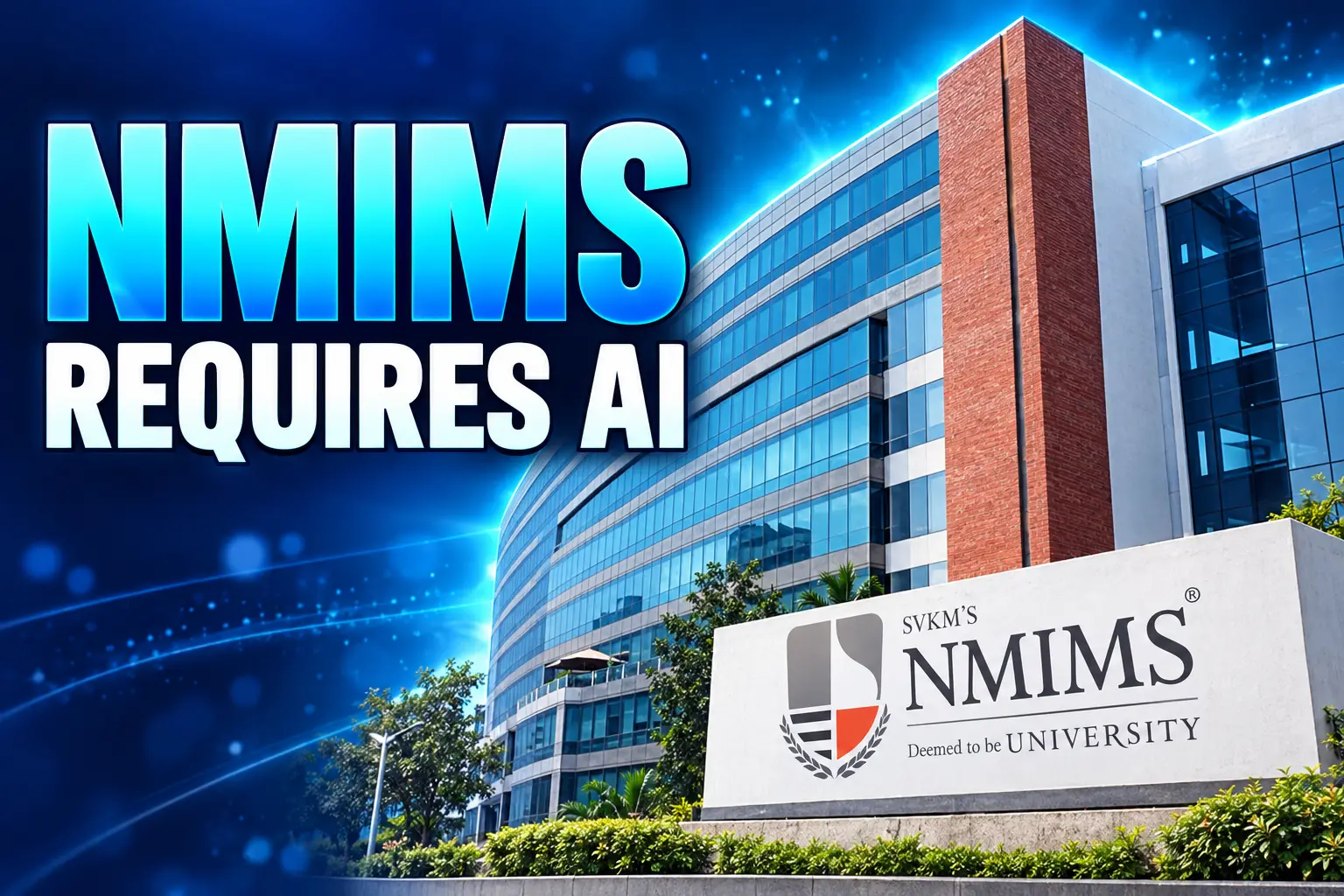
NMIMS has made Coursera AI courses a mandatory, assessed part of degree work for about 40,000 students. The program, named NMIMS Horizon, is paid for by the university and now sits inside management and undergraduate schools.
The June launch read like a new AI push. The catalog has been on campus since 2019. What changed is the status of that catalog: extra credit became required coursework.
Coursera Has Been Inside NMIMS Since 2019
In July 2019, SVKM’s Narsee Monjee Institute of Management Studies began using Coursera for Campus, according to Raghav Gupta, then the firm’s India and Asia-Pacific managing director. Engineering students could take 20 extra credits toward an AI honors degree, lifting a 160-credit load to 180, with add-on tracks in AI, IoT and cloud computing.
That was an opt-in honors path on a licensed catalog, not a requirement for every student. Gupta’s 2020 note already framed Indian campuses as buyers of ready-made courses rather than builders of every module in-house.
On 22 June 2026 the university’s own account introduced NMIMS Horizon with Coursera as AI-powered learning and global certificates built into the student experience. The Hindu later carried the same terms: pathways in artificial intelligence, machine learning, data analytics, digital transformation and emerging technologies, folded into the academic journey and funded so students pay no extra fee.
The future of learning begins here.
Introducing #NMIMSHorizon in collaboration with Coursera — empowering students with AI-powered learning, global certifications, and future-ready skills. @coursera #NMIMSxCoursera #FutureReadySkills pic.twitter.com/FfTKvUzdSy
— NMIMS (@nmims_india) June 22, 2026
Prof. Chandrima Sikdar, dean of academics and learning experience at the School of Business Management, said the job of a university now includes preparing students for a world where AI, technology and data will touch every profession. Dr. Sharad Mhaiskar, provost (administration), said graduates will be judged by how fast they can learn, adapt and work with new tools.
FROM OPTIONAL HONORS TO REQUIRED COURSEWORK
| Feature | July 2019 Coursera for Campus | 2026 NMIMS Horizon |
|---|---|---|
| Who it covers | Engineering students on an honors path | About 40,000 student users across campuses |
| How it counts | 20 extra credits, 180 total, for an AI honors add-on | A mandatory piece of the learning experience, then scored inside university assessment |
| Who pays | Not stated in the 2020 campus note | The university; students face no extra fee |
| Who teaches | Platform courses taken as extra work | Faculty complete the courses first, then run mentoring, assignments, projects and tests |
The 2019 design still left AI as a specialisation a student could chase. Horizon puts the same kind of catalog in the common path, then grades it.
Pharmacy and Commerce Join the Same Catalog
On 3 August 2026, NMIMS extended Horizon from management into undergraduate programmes. The university’s 5 August statement named four schools in the next phase and kept the same headcount of about 40,000 student users, still at no extra cost.
SCHOOLS NOW ON THE HORIZON PATHWAY
- Management: First wave, including the School of Business Management, where Sikdar and Mhaiskar framed the June launch.
- Engineering: Mukesh Patel School of Technology Management and Engineering, under Dean Dr. Koteswararao Anne.
- Science: Undergraduate science programmes across campuses, on the same Coursera pathways.
- Pharmacy: School of Pharmacy, pulled into a catalog that began as a management and engineering tool.
- Commerce: School of Commerce, with Dean Dr. Minu Mehta present at the undergraduate launch.
The August event also put a Coursera sales lead in the room. Honorary Secretary Dr. Jayant P. Gandhi and Mhaiskar appeared with Anne, Mehta and Prashasti Rastogi, director of India sales at Coursera, which is how a campus license gets presented as a joint academic project.
Anne’s public case is applied work, not a separate certificate pile. Students are meant to use AI inside civil, mechanical and other core fields they already study, then submit that work for university marks.
Faculty Take the Courses Before They Teach Them
Horizon is not a self-serve MOOC dump. NMIMS said faculty members are taking specialised training and finishing the relevant courses before they run student work. Mentoring, assignments, projects and assessments sit on top of the platform videos, and student results enter the university’s own assessment frame.
The real value of AI lies in its ability to solve practical problems across disciplines. Through NMIMS Horizon, students will apply AI concepts within their own domains through structured learning, faculty mentorship, projects and academic assessments. By integrating these courses into the curriculum, we are enabling students to develop practical competencies that complement their academic learning and prepare them to address real-world industry challenges.
Dr. Koteswararao Anne, Dean, SVKM’s NMIMS Mukesh Patel School of Technology Management and Engineering, 5 August 2026 statement
That model solves a staffing problem at the scale of about 40,000 users. A private university can assign global courseware faster than it can hire AI specialists for every campus and every non-CS degree. The trade is that faculty become facilitators of a catalog they did not write, after they first pass through it as learners.
Mhaiskar’s August line was that AI is changing the skills employers want, and that the university’s job is to put AI-focused learning inside the academic experience so students leave with domain knowledge plus “technological fluency.” The fluency, in practice, is a supervised pass through Coursera pathways, not a new NMIMS-authored AI department for pharmacy and commerce.
How India’s Credit Rules Opened a Catalog Market
Horizon sits on a policy floor that is older than the brand name. In 2021 the University Grants Commission told universities they could count up to 40% of courses through SWAYAM, double the earlier 20% cap. That gazette rule names the government platform, not Coursera.
Campus vendors still treat the wider online-credit window as the sales brief. Greg Hart, Coursera’s chief executive, said in September 2025 that Coursera for Campus is the firm’s academic push, that universities use the catalog for for-credit classes, and that in India “up to 40% of credits can be taken online.” Gupta, while still at Coursera, told a government forum in 2024 that campuses were already taking Coursera content as standalone for-credit work, and that students were earning up to 15-20% of credits that way, short of the 40% ceiling.
The online and blended learning as credit-bearing language in the National Credit Framework is what lets a university map platform hours onto a transcript. NCrF counts 30 notional learning hours as one credit and 1,200 hours as 40 credits in a year, including digital and blended modes, once the work is assessed.
THE POLICY STEPS BEHIND A CAMPUS CATALOG
- July 2019: NMIMS starts Coursera for Campus as extra credits for an AI honors path.
- 2021: UGC raises the SWAYAM share of a programme to 40% of courses, from 20%.
- August 7, 2024: Coursera and nasscom put ten Google and IBM professional certificates on NSQF levels 4.5 and 5, so universities can assign credit from notional hours.
- May 16, 2026: In-charge Vice Chancellor Meena Chintamaneni describes a Rs 9 crore tie-up with an unnamed online platform for more than 1,800 courses in marketing, finance, technology and pharmacy.
- June 22, 2026: NMIMS names the Coursera programme Horizon and calls the pathways a required part of student learning.
- August 3, 2026: Undergraduate engineering, science, pharmacy and commerce join the same assessed model.
Chintamaneni did not name Coursera in that May remark. She did describe a fully paid, domain-split AI catalog weeks before Horizon was branded, and she said those courses would be integrated into academics. Treat the Rs 9 crore figure as the university’s own price tag for a platform layer, not as a confirmed Coursera invoice.
Indian Campuses Supply Coursera’s Biggest Classroom
Hart, speaking in September 2025, put India at 31 million Coursera learners, about 20% annual growth, and second only to the United States. He counted more than 270 enterprise customers in the country and said Gen AI content was drawing 13 enrollments a minute worldwide, on a library of more than 1,000 Gen AI courses. Indian firms had built 1,900 of the 4,000 courses made with Coursera’s Course Builder since 2023, nearly half the total.
Gupta wrote in 2022 that 40% of all campus learners on Coursera already came from India. In 2024 he called India the largest adopter of Coursera for Campus worldwide and listed NMIMS with Manipal, Symbiosis and Acharya Institutes as campuses using partner content as standalone for-credit classes. Horizon is a deepening of that account, not a first handshake.
Credit transfer got an Indian hook in 2024, when Coursera aligned ten Google and IBM certificates to NSQF levels with nasscom. Google Data Analytics, Digital Marketing, UX Design and IBM Data Analyst sit at level 4.5; Google Project Management and the other IBM titles sit at level 5. Kirti Seth, then CEO of IT-ITeS Sector Skill Council nasscom, said learners could make those credits count toward degrees. The actual credit load, Coursera noted, is set by each university from notional hours.
THE SCALE BEHIND ONE CAMPUS LICENSE
- NMIMS seats: About 40,000 student users on Horizon, with the university paying the bill.
- India on Coursera: 31 million learners as of Hart’s September 2025 figures, growing about 20% a year.
- Credit-ready certificates: Ten Google and IBM professional certificates at NSQF 4.5 or 5.
- Local course building: 1,900 of 4,000 Course Builder titles came from Indian enterprises.
A license at this size is a distribution win for Coursera’s campus channel. For NMIMS it is a way to put the same AI pathway on every campus without waiting for each school to write its own.
The Same AI Layer Now Runs in Eight Cities
Orientation 2026 ran from 23 June to 18 August across Mumbai, Ahmedabad, Navi Mumbai, Bengaluru, Hyderabad, Indore, Shirpur and Chandigarh. Vice Chancellor Prof. Sougata Ray welcomed undergraduate, postgraduate and doctoral intake in that window, which is also when Horizon moved from a management launch into undergraduate schools.
Ahmedabad is the newest of those sites. Sessions there began on 1 July 2026 at the Sanand off-campus, NMIMS’s seventh off-campus centre and its first in Gujarat, with MBA, BBA, BCom (Hons) and two law degrees in the first year. Chintamaneni called the model “One NMIMS”: the same syllabus, delivery, evaluation and degree whether a student sits in Mumbai, Bangalore or Ahmedabad, with senior anchor faculty guiding teaching across sites. An annual review, she said, rewrites nearly 20% of course content.
Horizon fits that standardisation. A Coursera pathway that is mandatory and assessed is easier to copy across eight cities than a locally written AI lab course. The headcount is still moving. SVKM has taken a 40-acre, 90-year lease in Sector 18 of Nava Raipur, with a first academic batch expected in two to three years and a planned capacity of around 10,000 students once the campus is fully built over seven years. The 40,000-user license is a live figure on a university that is still adding cities.
What a Mandatory Pathway Looks Like on Campus
Students do not buy a Coursera subscription. NMIMS said it fully funded Horizon so the certificates carry no extra fee. They also cannot treat the courses as optional add-ons. The June description called the pathways a mandatory component of the student learning experience. The August description put outcomes inside university assessment, with faculty already enrolled as the first cohort.
The public trail of the launch is thin. NMIMS posted the brand, a dean video and a Coursera quiz at the management event; there was no open fight over workload, credit weight or who owns the syllabus. A funded mandate does that. Students are not asked to opt in, and faculty are told to clear the same courses before they assign them.
What remains unstated is the credit quantum per programme, the exact Coursera titles in each school, and how much of a pharmacy or commerce degree will be platform hours versus NMIMS-written work. Gupta’s 2024 range of 15-20% of credits from Coursera is the only named share from the vendor, and it was a cross-campus observation, not an NMIMS filing. UGC’s 40% SWAYAM cap is a different pipe. Hart’s “up to 40% of credits” line is the vendor reading the policy as addressable demand.
Faculty are still moving through the courses they will then mark. Undergraduate schools were added on 3 August 2026. Until NMIMS publishes a title list and a credit map, Horizon is a required pass through a global catalog, supervised by campus teachers, billed to the university and stamped on about 40,000 transcripts.

Instagram Plus Tests a Read-Only Mode That Cuts Stories

Altman Asks the Public to Accept Some AI Harm

Google Freezes OSS VRP Product Reports After AI Flood

AI Agents Make Payment Rails the Scarce Prize

Turkey’s Crypto Boom Now Runs Through Three Banks

Fable 5 Came Back Under a Commerce On-Off Switch

Google’s SpaceX GPU Lease Has a Sept. 30 Deadline

Plasma One’s XPL Locks Face a 1.81 Billion Cliff

DGO’s Rs 549 World Cup Pass Cost Fans Sleep and Data

Moonshot AI’s $30 Billion Ask Became a $35 Billion Close
-
 AI3 months ago
Fable 5 Came Back Under a Commerce On-Off Switch
-
 AI4 months ago
Google’s SpaceX GPU Lease Has a Sept. 30 Deadline
-
 CRYPTO4 months ago
Plasma One’s XPL Locks Face a 1.81 Billion Cliff
-
 APPS4 months ago
DGO’s Rs 549 World Cup Pass Cost Fans Sleep and Data
-
 AI4 months ago
Moonshot AI’s $30 Billion Ask Became a $35 Billion Close
-

 NEWS4 months ago
ColorOS 17 Device List Spans Oppo, OnePlus and Realme
-

 GAMING4 months ago
Xbox Cuts 3,200 Jobs After Five Years of Thin Returns
-
 GAMING4 months ago
The RTX 4050 Under Rs 70,000 Hides a Wattage Gap