
AI
Nvidia Stock Slides as China Chip Approvals Prove Just a Trickle
Nvidia stock dropped this week even as Washington approved fresh AI chip licenses for Alibaba, Tencent and ByteDance, with shipments still called minimal.

Nvidia shares fell this week even as Washington cleared fresh licenses letting Alibaba, Tencent and ByteDance buy its AI chips again. A senior Commerce Department official told Congress that almost none of those chips have actually shipped.
The stock is still the largest of any public company by market value. But the political fight over who gets Nvidia’s hardware, and how much of it, is nowhere close to settled.
Alibaba, Tencent and ByteDance Land on Washington’s Approved List
Reuters reported this week that roughly ten Chinese companies have won approval to buy advanced AI hardware from Nvidia and AMD. Applicants have to satisfy national security requirements and submit to inspections before any chips move.
The approved list includes some of China’s biggest tech names:
- Alibaba, one of China’s largest cloud computing and e-commerce operators
- Tencent, the gaming and social media company behind WeChat
- ByteDance, the parent company of TikTok
- A unit of ZTE, the Chinese telecommunications equipment maker
The list set off an immediate fight in Washington. Representative Gregory Meeks accused the administration of using the licenses as “a bargaining chip in broader negotiations with China.” Representative Bill Huizenga raised a different objection, warning that offshore subsidiaries of Chinese companies could exploit loopholes to keep hold of Nvidia’s more advanced Blackwell chips.
Both objections point at the same underlying tension over how far this reopening actually reaches.
Why Have So Few Chips Actually Shipped?
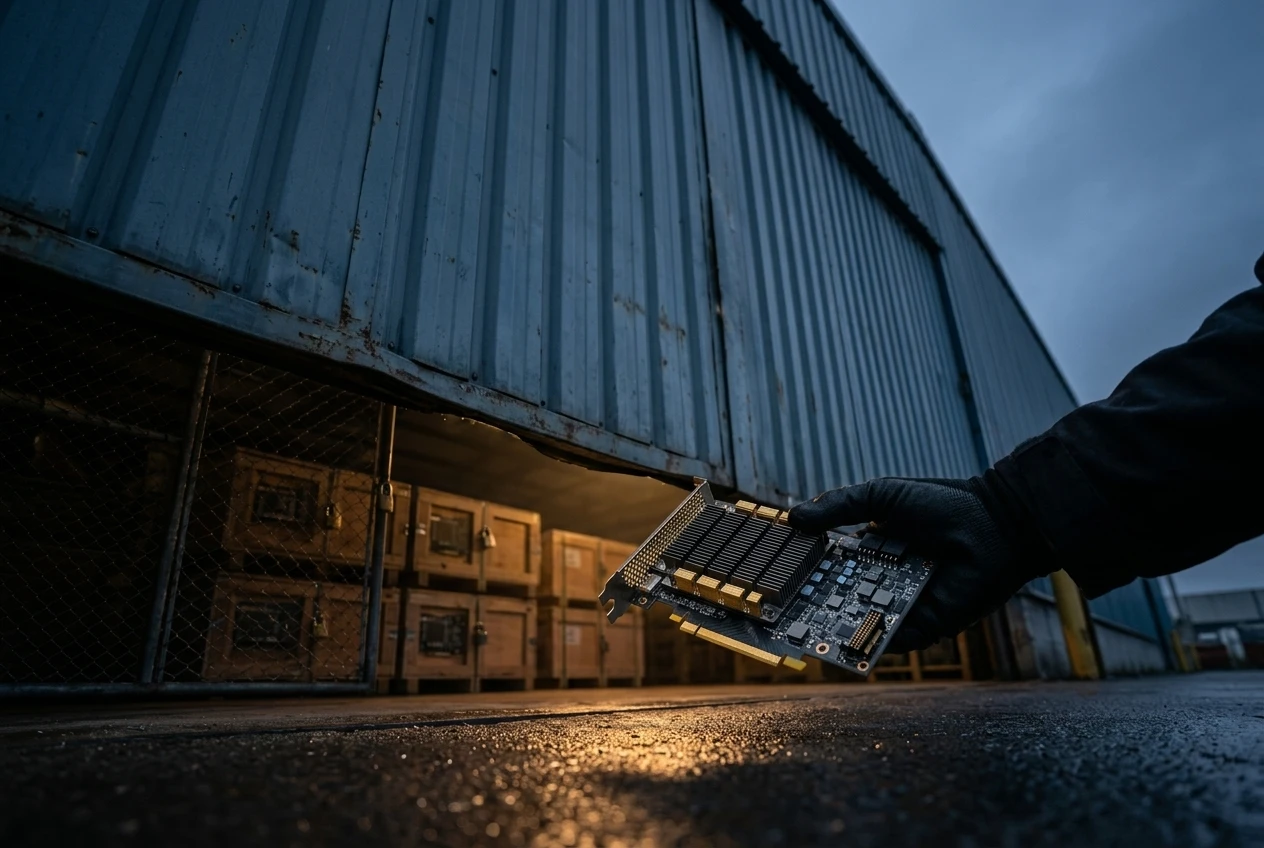
Nvidia’s new licenses cover only its H200 accelerator, a chip already a step behind the Blackwell and Vera Rubin hardware Nvidia sells everywhere else. A senior Commerce Department official told Congress this week, CNBC reported, that “very few” of those chips have actually reached Chinese buyers. Reuters separately quoted a top official calling shipment volumes “minimal.”
China and Hong Kong made up about 9% of Nvidia’s fiscal 2026 revenue, a shrinking share after years of export limits. Nvidia has pledged to return half its free cash flow to shareholders no matter how the China question resolves.
The company’s own guidance treats China as close to irrelevant already. When Nvidia last laid out detailed quarterly guidance, it told investors it is not assuming any Data Center compute revenue from China, continuing a pattern that has held for multiple quarters.
None of this is new to Nvidia. In securities filings, the company has warned for years that shifting rules could disrupt its supply chain and distribution channels even outside China, handing an opening to competitors facing fewer restrictions.
Four Years of Policy Whiplash
The current setup is the product of nearly four years of reversals.
- October 2022: The Biden administration imposes sweeping export controls on advanced AI chips headed to China, aiming to slow its military and surveillance buildout.
- December 2025: The Trump administration relaxes those controls for Nvidia’s H200 chip, and the Bureau of Industry and Security, the Commerce Department’s export-licensing arm known as BIS, begins approving China-bound shipments case by case instead of under a blanket ban.
- March 2026: Federal prosecutors allege a smuggling ring begins routing restricted Nvidia hardware toward China and Russia through shell companies.
- June 24, 2026: Jensen Huang tells Nvidia’s annual shareholder meeting the company will put US national security ahead of any single sale.
- July 14, 2026: A Commerce Department official’s testimony puts a number on the delay: just a trickle of licensed chips has shipped.
- July 15, 2026: Reuters reports the government has cleared Alibaba, Tencent, ByteDance and other firms to buy again, reigniting the fight in Congress.
Each reversal has moved the goalposts for Nvidia’s China business without ever fully reopening it.
Huang Draws a Line on Security and Smuggled Chips
Jensen Huang, Nvidia’s founder and chief executive, used the company’s June shareholder meeting to draw his own boundary. He told investors Nvidia would side with US national security if it ever conflicted with a commercial opportunity, and that smugglers trying to run Nvidia systems without official support would hit a wall.
Improvised systems built from smuggled chips are a “dead end,” Huang said, since they cannot get Nvidia’s software updates, networking gear or repairs.
Court filings unsealed in May show what that smuggling actually looks like. A Georgia-based ring, according to Fortune, began routing Nvidia hardware toward China and Russia in March 2026. One defendant, identified in filings as Zheng, wrote that mentions of China needed to be struck from messages because they “will draw attention from US government for embargo violation.” A co-conspirator identified as Kelly wrote back that the details had already been shared elsewhere. Zheng’s reply, according to the encrypted messages cited in court filings: “We just talk about it, no one can hold it as evidence against us.”
A third defendant named in the case, Tommy Shad English, 53, of Atlanta, faces the same allegations. As of Fortune’s report in May, federal prosecutors had until June to decide on formal charges.
Nvidia is not a party to that case. But it illustrates exactly the risk Huang describes: a black market Nvidia says it will not service and cannot fully stop.
The Rubin Rumor Meets a Flat Denial
Rumors of a delay in Nvidia’s next-generation Vera Rubin accelerator had circulated in trade press for weeks. Huang shut them down directly, telling investors the chip is already in production.
Nebius, a cloud provider backed by Nvidia, has also rolled out what it calls an “asset-light” model for building AI data centers, more evidence of how much infrastructure spending still runs through Nvidia hardware regardless of the China dispute.
Rivals see an opening anyway. Arm’s own push into full AI server processors, a $14 billion bet Wall Street has priced at $475 a share, adds one more competitor chasing the same data center budgets Nvidia has dominated for years. Some analysts also point to Google’s in-house AI chips as a longer-term threat to Nvidia’s grip on the market, even with the near-term fight centered on China.
Wall Street Still Bets Higher, Just Not This Week
None of that stopped most of Wall Street from staying bullish, even as the stock slipped.
| Metric | Figure | As Of |
|---|---|---|
| Share price | $209.44, down about 1% | Wednesday, July 15, 2026 |
| Market capitalization | $4.93 trillion | Mid-July 2026 |
| 52-week range | $164.07 to $236.54 | Trailing 12 months |
| Trailing P/E ratio | 32.44 | Mid-July 2026 |
| Fiscal 2026 revenue | $215.9 billion, up 65% year over year | Full fiscal year |
Bank of America called Nvidia a “unique, durable growth franchise” in a note this month. Thirty-seven analysts covering the stock still carry a Buy consensus with a $302 average price target, well above where shares actually trade.
Not everyone is convinced the rally has further to run right now. Stephanie Link of the investment firm Hightower called Nvidia and Broadcom “the anti-momentum trade right now” this month, a sign some money managers are rotating away from the biggest AI winners even while staying bullish on the longer arc.
Nvidia’s own guidance still assumes zero revenue from Chinese data centers, licenses or no licenses.
Frequently Asked Questions
Why Did Nvidia Stock Fall This Week?
Broader chip stocks actually helped push the S&P 500 and Nasdaq higher this week, according to Stocktwits market data, even as Nvidia specifically slipped about 1% on the day. The drop lined up with Commerce Department testimony that H200 shipments to China remain minimal and with renewed sniping in Congress over the new licenses. That points to worries specific to China’s chip fight, separate from the broader AI trade.
What’s the Difference Between Nvidia’s H200 and Blackwell Chips?
The H200 is an older Nvidia accelerator that Washington now allows onto a case-by-case export track for China. Blackwell, and the newer Vera Rubin architecture behind it, are Nvidia’s current top-tier chips and remain far more tightly restricted, which is exactly why Representative Huizenga warned about offshore subsidiaries using loopholes to hold onto Blackwell hardware already in their possession.
How Much of Nvidia’s Business Is Gaming Versus AI Data Centers?
Nvidia reports results in two segments. Compute & Networking covers data center AI accelerators, networking gear and software, and now drives the overwhelming majority of revenue growth. Graphics covers GeForce gaming GPUs and workstation cards, the business that built Nvidia’s brand long before the AI boom.
How Big Is the US Crackdown on Chip Smuggling?
Beyond the Georgia case detailed in court filings, the Bureau of Industry and Security has expanded enforcement broadly. Over the past year, regulators have announced nearly $420 million in combined penalties and forfeitures tied to technology smuggling cases.
What Did China’s Government Say About the Export Controls?
A Chinese Embassy spokesperson, Lu Pengyu, said China “has consistently opposed the U.S. practice of overstretching the concept of national security and abusing export control measures,” calling the approach a violation of market economy principles and fair competition.
Disclaimer: This article is for informational purposes only and does not constitute investment advice. Nvidia shares carry the volatility typical of AI infrastructure stocks, and export policy, earnings or chip production timelines can change quickly. Consult a licensed financial professional before making investment decisions. Figures are accurate as of publication on July 16, 2026.


Google Opens Gmail to Voice and Gates Docs Live

Lenovo Prices the IdeaPad Vibe Against Apple’s $699 Neo

Xbox Caps Game Pass Cloud Gaming at 15 Hours

GTA 6 DualSense Controllers Follow Sony’s Usual $84.99 Script

South Korea Retail Investors Face Reckoning After KOSPI AI Rally Collapses

Surrey AI Maps Three Heart Attack Paths and Their Molecular Roots

Germany Locks Neutral Apple ATT Prompts Across Most of Europe

Apple’s 5% EU Fee Quietly Rewrites Alternative App Store Math

Apple’s EU Fee Truce Cuts Complexity but Leaves Rivals Fuming

Pixel 11 Pro Fold Trades Thinness for Durability and Seven-Year Stay

Oracle Cuts 21,000 Jobs in a Year, Cites AI in 10-K Filing

Fable 5 and Mythos 5 Return as US Lifts Anthropic Export Controls

SpaceX’s Google Deal Turns a Rocket Company Into a Cloud Landlord

CD Projekt Red Co-CEO: Redemption Arc Isn’t Done, Witcher 4 in 2027

XPL Rallies 30% Ahead of Plasma One Card Tier Launch

Google Search Profiles Build a Follow Graph Inside Discover

DGO App Brings Rs 549 Mobile Pass for FIFA World Cup 2026 in Nepal

Moonshot AI Targets $30 Billion in China’s Fastest AI Funding Sprint

Oppo’s ColorOS 17 Eligibility List Leaves A-Series Buyers Behind

Microsoft Xbox Layoffs Start in July as Sharma Slams 3% Margin
-
 AI2 months ago
Oracle Cuts 21,000 Jobs in a Year, Cites AI in 10-K Filing
-
 AI2 months ago
Fable 5 and Mythos 5 Return as US Lifts Anthropic Export Controls
-
 AI3 months ago
SpaceX’s Google Deal Turns a Rocket Company Into a Cloud Landlord
-
 GAMING2 months ago
CD Projekt Red Co-CEO: Redemption Arc Isn’t Done, Witcher 4 in 2027
-
 CRYPTO3 months ago
XPL Rallies 30% Ahead of Plasma One Card Tier Launch
-
 NEWS3 months ago
Google Search Profiles Build a Follow Graph Inside Discover
-
 APPS3 months ago
DGO App Brings Rs 549 Mobile Pass for FIFA World Cup 2026 in Nepal
-
 AI3 months ago
Moonshot AI Targets $30 Billion in China’s Fastest AI Funding Sprint