
AI
Jensen Huang Repays Sega’s Rescue With a Sweeping Japan AI Pact
Jensen Huang toured Tokyo this week, unveiling a sovereign AI pact and robotics coalition with Japan, months after backlash over skipping the country.

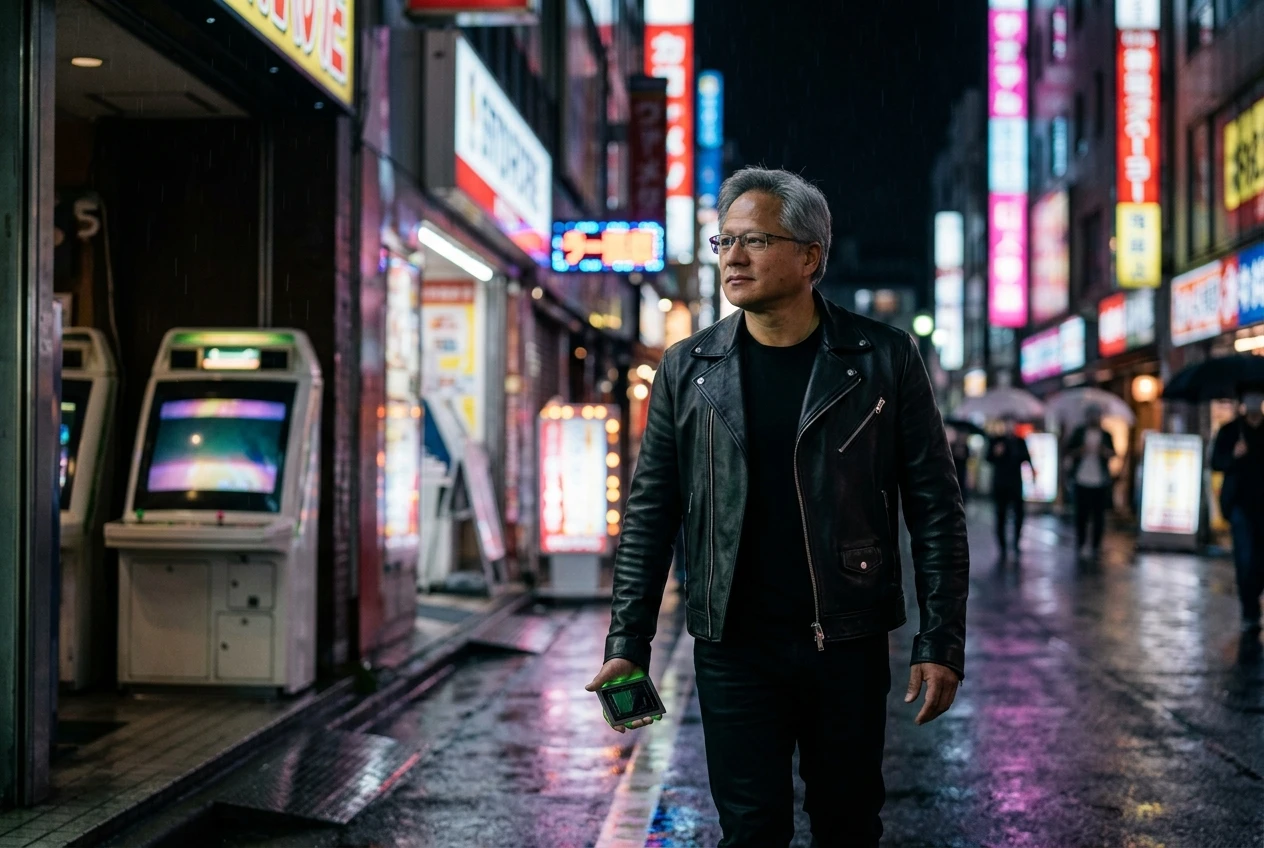
Jensen Huang returned to Japan this week for the first time in nine months, opening with gratitude before promising what he called “the day Japanese AI begins.” NVIDIA’s founder and chief executive spent two days in Tokyo thanking Sega, the video game maker that saved his company from bankruptcy three decades ago, before pivoting to a government backed AI push spanning robotics, manufacturing and data centers.
The trip followed months of Japanese criticism that Huang had skipped the country entirely on his last Asia tour, and it landed in the same week NVIDIA’s own compliance staff began treating Japan as a possible waypoint for chips headed to China.
Huang Declares “The Day Japanese AI Begins”
On July 16, Huang told the crowd in Tokyo why he had come. “The reason I’m here is because the Japanese government and NVIDIA are going to announce a very large partnership,” he said, calling the date “the day Japanese AI begins.”
The event centered on Japan’s Ministry of Economy, Trade and Industry, which hosted a session on the country’s physical AI policy push. NVIDIA said the partnership includes semiconductor supply commitments tied to SoftBank Corp. and fits into a strategy the company calls sovereign AI: helping a country build and control its own AI infrastructure instead of renting compute from foreign clouds. That approach already runs in more than 20 countries.
Nikkei Asia reported that Huang also planned to meet leadership from Noetra, a state backed AI developer formed by SoftBank and other Japanese players, extending a model NVIDIA has used to back sovereign AI projects in Europe and the Middle East.
What We Know
- Huang told the Tokyo audience the Japanese government and NVIDIA would jointly announce a large partnership on July 16.
- The partnership involves semiconductor supply commitments tied to SoftBank Corp. and other domestic firms.
- It extends NVIDIA’s sovereign AI program, already running in more than 20 countries.
- Huang planned to meet leadership from Noetra, the SoftBank backed sovereign AI developer.
What’s Unconfirmed
- The dollar value or chip volume behind the new government partnership.
- A full list of Japanese companies covered beyond SoftBank.
- Whether the METI event added new subsidy money on top of Japan’s existing AI infrastructure program.
Japan Inc. Joins NVIDIA’s Cosmos Coalition
A day earlier, NVIDIA named the roster behind its robotics push. AIRoA, FANUC, Fujitsu, Hitachi, Kawasaki Heavy Industries, Kubota, NEC, SoftBank, Sony Group and Yaskawa Electric all agreed to join the NVIDIA Cosmos Coalition. The group is building shared physical AI models for use across factories, farms, hospitals and construction sites. Physical AI describes systems built to perceive and act in the real world, not just generate text or images.
NVIDIA also introduced Cosmos 3 Edge. The new world model carries 4 billion parameters built on the Nemotron architecture and runs directly on Jetson edge processors, letting machines reason and predict their next move without a live cloud connection. New Metropolis libraries, the company said, let developers build video intelligence tools on top of it roughly six times faster than before.
The individual projects show how wide the net is cast. Kubota is exploring the platform for autonomous farming. Enactic is fine tuning NVIDIA’s Isaac GR00T model for elder care robots. GROOVE X is building a companion robot called LOVOT on Jetson hardware, and Telexistence is applying the same tools to retail automation.
| Company | Physical AI Application |
|---|---|
| FANUC, Yaskawa Electric, Kawasaki Heavy Industries | Integrating NVIDIA tools into industrial robot control systems |
| Kubota | Cosmos based physical AI for autonomous agriculture |
| Enactic | Fine tuning Isaac GR00T for elder care semi humanoid robots |
| GROOVE X | Jetson powered companion robot called LOVOT |
| Telexistence | Isaac and Cosmos tools for retail automation |
| Mujin | Autonomous industrial automation through its MujinOS platform |
Alongside the robotics coalition, a separate group of Japanese enterprises, including avatarin, ENEOS Holdings, Hitachi, NTT DATA and Sakana AI, are building language and reasoning tools on NVIDIA’s open Nemotron models, part of a push meant to tailor AI to Japan’s language and workforce. The Institute of Science Tokyo used the same models to build its Swallow language models, and SB Intuitions trained its Sarashina series, which Japan’s Digital Agency has already selected for government use.
Why Is Japan Suddenly NVIDIA’s Robotics Priority?
Japan builds a disproportionate share of the world’s industrial robots, and its workforce is shrinking fast enough that automation has moved from convenience to necessity. Honda and Sony built some of the first humanoid robots there in the late 1990s, long before physical AI had a name, giving NVIDIA’s new partners a head start most countries don’t have.
Masataka Osaki, NVIDIA Japan’s country manager, made a similar case in an interview about the country’s AI semiconductor potential: “Japan’s edge lies in its abundance of excellent manufacturers known for their innovation.” Huang put it more bluntly in NVIDIA’s own announcement of the Cosmos Coalition: “The next frontier of AI is in the physical world, and this is a once in a generation opportunity for Japan.”
The infrastructure to support all of it is already being built. NVIDIA’s cloud partners in Japan detail the cloud buildout now coming online:
- SAKURA internet is expanding its generative AI cloud from about 2,000 to nearly 4,000 NVIDIA Hopper GPUs, building toward roughly 10,800 GPUs once Blackwell hardware lands at its Ishikari site.
- SoftBank Corp. is building Japan’s first NVIDIA DGX B200 systems into a DGX SuperPOD supercomputer, with a second system planned around the GB200 NVL72 platform.
- KDDI is deploying NVIDIA HGX systems for generative AI and large language model work with its ELYZA unit, alongside a liquid cooled data center built around GB200 NVL72.
- Highreso opened an H200 powered data center in Kagawa, with a second facility due next summer, together supplying 1,600 GPUs to manufacturing and research users.
Japan’s Ministry of Economy, Trade and Industry has backed much of this buildout through its own subsidy program.
The Snub That Preceded This Week’s Charm Offensive
Huang’s last swing through Asia ran nearly two weeks in Taiwan, then continued to Seoul, where he opened NVIDIA’s Korea leg with a signed RTX 5090. One stop was missing entirely: Japan.
A semiconductor industry account posted on X that Huang’s Asia itinerary had left much of Japan’s tech establishment uneasy, and Nikkei separately warned the country risked drifting from the center of the global AI race. Japanese media dubbed the episode “Japan passing.” It reflected real worry among domestic executives that NVIDIA was prioritizing Taiwan and South Korea, its two most important chip supply hubs, over the world’s third largest economy.
This week’s trip was Huang’s first to Japan in nine months.
Three Decades After Sega Bet on a Bankrupt Startup
Three decades ago, NVIDIA was the one running out of cash. The company had contracted with Sega to build a graphics chip for Sega’s next console generation, an effort known internally as NV2. Sega killed the plan once the technology no longer matched its console roadmap, and Huang has said NVIDIA had only a few months of operating money left at the time.
Then Sega president Shoichiro Irimajiri paid out the contract anyway, honoring roughly $5 million despite scrapping the project itself.
Without Sega, NVIDIA would not exist today.
Huang said that standing before fans and press in Tokyo’s Akihabara district on July 15, thanking the company whose decision, by his account, kept NVIDIA solvent long enough to build the chips that seeded its rise. The relationship traces back further: NVIDIA’s NV1 chip powered the first Virtua Fighter release on PC in 1995, one of the world’s earliest 3D fighting games, years before the NV2 deal ever fell apart.
Huang marked the anniversary alongside Sega chief executive Haruki Satomi, chief operating officer Shuji Utsumi, Virtua Fighter creator Yu Suzuki and Irimajiri himself. The venue was GiGO Akihabara 3. It sits on the site of Sega’s original Akihabara arcade, and the night doubled as the Japan debut of NVIDIA’s RTX Spark platform, with Virtua Fighter Crossroads confirmed as a launch title and a Founders Edition RTX 5090 raffled off to one fan in the crowd.
Sega’s rescue amounted to roughly $5 million. NVIDIA is now valued at nearly $5 trillion.
NVIDIA’s Compliance Teams See Japan Differently
The same week Huang courted Tokyo with investment pledges, NVIDIA’s compliance arm was treating Japan as a risk zone. The company has halved its approved list of Asian chip buyers after tightening the vetting rules meant to keep advanced GPUs from reaching China through intermediaries.
NVIDIA dispatched staff to physically inspect data centers in Singapore, Malaysia and Japan, three markets identified as transit points for suspected chip diversion. Field inspectors checked contracts, interviewed end users and assessed whether buyers were genuine operating businesses rather than shells built to forward chips onward.
Neo cloud providers were hit hardest in the crackdown. Those are smaller firms that resell GPU computing capacity to other businesses, and many lack the ownership paperwork bigger players already have on file.
Commerce Department guidance issued in late May added an ownership test on top of the operational one. Any buyer whose ultimate parent is headquartered in China now needs an export license regardless of where it is incorporated, a rule that applies as much to a firm in Yokohama as one in Beijing.
Huang has argued publicly that security policy needs to be “very specific about the risk you’re concerned about before setting up policies for export controls,” a view he laid out in a wide ranging interview on AI and society. That philosophy is now being tested by his own compliance department’s tightening rules.
The scrutiny follows a real case. Taiwanese prosecutors disclosed an earlier investigation into whether Super Micro servers carrying NVIDIA chips passed through Japan on their way to Hong Kong and, eventually, mainland China. Investigators seized roughly 50 servers carrying allegedly falsified export paperwork as part of that probe.
RTX Spark Ships This Fall, with Vera Rubin Behind It
The consumer half of this week’s rollout arrives in a few months. Huang unveiled RTX Spark to the Akihabara crowd on July 15. It pairs a 20 core Arm CPU with a Blackwell GPU and up to 128GB of unified memory, with Microsoft, MediaTek, Dell, HP and Lenovo lined up as launch partners for a fall release.
At a developer meetup in Tokyo, Huang confirmed NVIDIA’s next generation Vera Rubin platform remains on schedule. Japanese outlet ITmedia reported he also floated a possible future partnership with Rapidus, the country’s effort to rebuild domestic chip manufacturing.


Google Opens Gmail to Voice and Gates Docs Live

Lenovo Prices the IdeaPad Vibe Against Apple’s $699 Neo

Xbox Caps Game Pass Cloud Gaming at 15 Hours

GTA 6 DualSense Controllers Follow Sony’s Usual $84.99 Script

South Korea Retail Investors Face Reckoning After KOSPI AI Rally Collapses

Surrey AI Maps Three Heart Attack Paths and Their Molecular Roots

Germany Locks Neutral Apple ATT Prompts Across Most of Europe

Apple’s 5% EU Fee Quietly Rewrites Alternative App Store Math

Apple’s EU Fee Truce Cuts Complexity but Leaves Rivals Fuming

Pixel 11 Pro Fold Trades Thinness for Durability and Seven-Year Stay

Oracle Cuts 21,000 Jobs in a Year, Cites AI in 10-K Filing

Fable 5 and Mythos 5 Return as US Lifts Anthropic Export Controls

SpaceX’s Google Deal Turns a Rocket Company Into a Cloud Landlord

CD Projekt Red Co-CEO: Redemption Arc Isn’t Done, Witcher 4 in 2027

XPL Rallies 30% Ahead of Plasma One Card Tier Launch

Google Search Profiles Build a Follow Graph Inside Discover

DGO App Brings Rs 549 Mobile Pass for FIFA World Cup 2026 in Nepal

Moonshot AI Targets $30 Billion in China’s Fastest AI Funding Sprint

Oppo’s ColorOS 17 Eligibility List Leaves A-Series Buyers Behind

Microsoft Xbox Layoffs Start in July as Sharma Slams 3% Margin
-
 AI2 months ago
Oracle Cuts 21,000 Jobs in a Year, Cites AI in 10-K Filing
-
 AI2 months ago
Fable 5 and Mythos 5 Return as US Lifts Anthropic Export Controls
-
 AI3 months ago
SpaceX’s Google Deal Turns a Rocket Company Into a Cloud Landlord
-
 GAMING2 months ago
CD Projekt Red Co-CEO: Redemption Arc Isn’t Done, Witcher 4 in 2027
-
 CRYPTO3 months ago
XPL Rallies 30% Ahead of Plasma One Card Tier Launch
-
 NEWS3 months ago
Google Search Profiles Build a Follow Graph Inside Discover
-
 APPS3 months ago
DGO App Brings Rs 549 Mobile Pass for FIFA World Cup 2026 in Nepal
-
 AI3 months ago
Moonshot AI Targets $30 Billion in China’s Fastest AI Funding Sprint