
AI
Jensen Huang Tells AP: Society Needs New Social Norms Around AI
Jensen Huang tells AP that society needs new social norms around AI, with a $2 billion Texas chip-laser factory as the test of whether the technology creates jobs.

Nvidia CEO Jensen Huang told The Associated Press on Tuesday that the United States needs to ‘create new social norms’ around artificial intelligence, urging broader adoption and arguing the technology can revive American manufacturing. The 63-year-old chip executive has been one of AI’s loudest evangelists, watching his company become the world’s most valuable at roughly $5 trillion. His case arrives as a public increasingly worried about job losses, electricity demand, and the speed of adoption confronts a Washington that has lurched from light-touch to heavy-handed AI policy.
The pitch came during a Tuesday groundbreaking in Sherman, Texas, at a Coherent factory that Nvidia calls one of its newest ‘AI factories.’ Huang framed the $2 billion expansion as the first test of whether AI creates American jobs or replaces them. The remarks put his personal bet on AI’s social value alongside a competing set of concerns over energy use, labor, and the speed of a transition that has reshaped markets and politics in the span of a few years.
‘We need to create new social norms’
Huang made the case for broader AI adoption in plain terms. ‘We need to create new social norms,’ he told the AP in Sherman. ‘I would advocate that everybody use AI. Just go engage it.’ His argument rested on the premise that AI will accelerate scientific breakthroughs and economic growth, and that pulling back would put the country behind in the global contest.
He compared AI’s arrival to the introduction of automobiles, which were once portrayed as killing children before society added sidewalks and crosswalks. The lesson, in his telling, is that norms evolve with the technology rather than against it. Huang said the world changed those norms by stopping kids from playing in the streets and giving them safer ways to walk to school.
Huang said society will adapt to AI just as it did to automobiles. He said cars were once portrayed as killing children, but the world changed its norms by having sidewalks and crosswalks and stopping kids from playing in the streets.
The Nvidia CEO, in the same interview, offered a few personal details to humanize the pitch. He described himself as ‘boring,’ with his life revolving mainly around work and family. He said his favorite movie is ‘Kingdom of Heaven,’ the 2005 epic about the 12th century Crusader Kingdom of Jerusalem. He said he had watched ‘Project Hail Mary’ three or four times and ‘I think we might watch it again this weekend.’ His broader message was that AI closes the technological divide, letting people design websites, analyze complex documents, and plan a kitchen remodeling without learning to program.
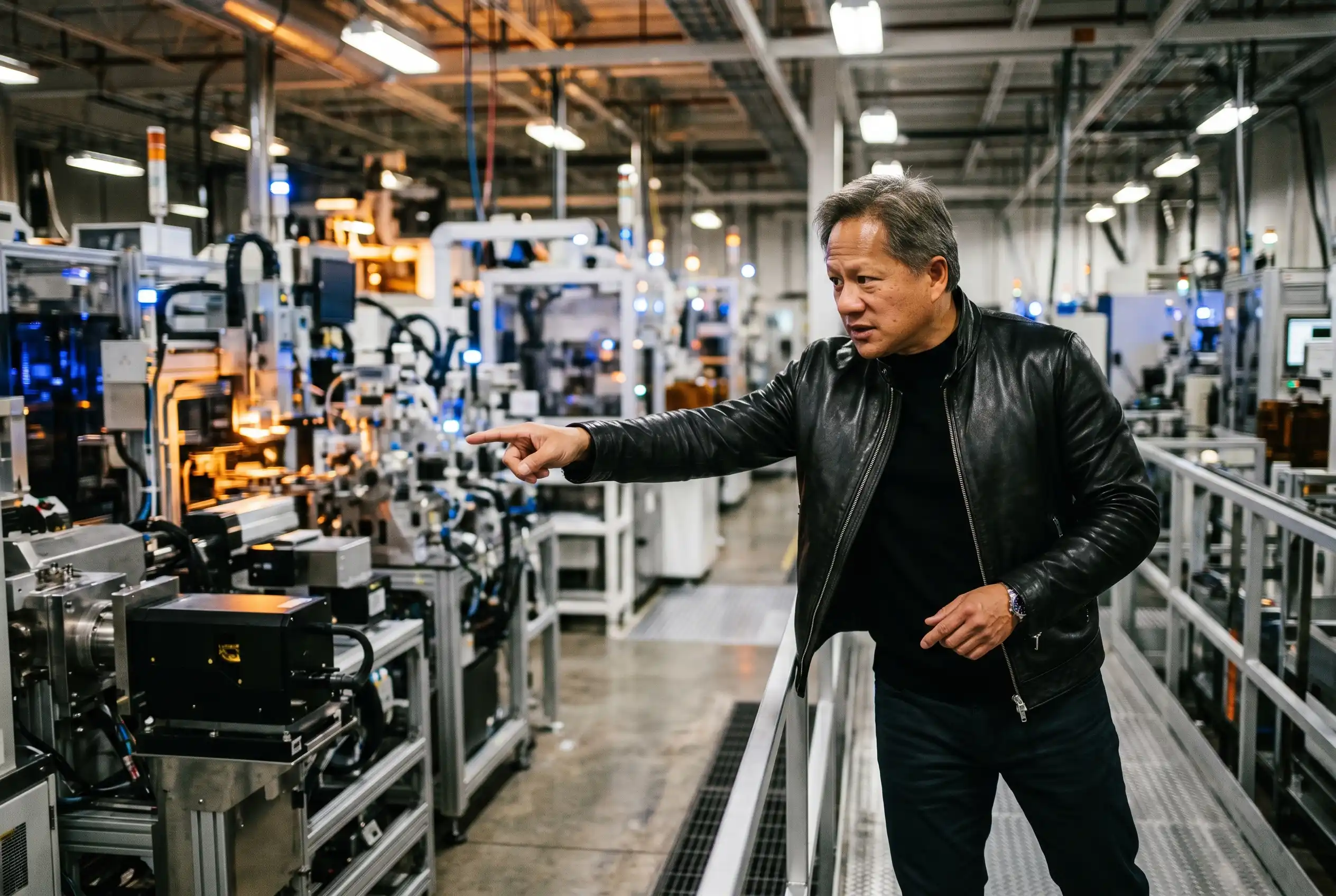
The $2 Billion Texas Bet on AI Factories
Nvidia and Coherent formally unveiled plans on Tuesday for a major upgrade to Nvidia’s AI infrastructure at the Sherman, Texas, plant, an hour north of Dallas. The expansion will produce material for a laser that transmits data among computer chips, letting them work together as a single system. The investment is part of a broader push to scale U.S.-based AI capacity, with chipmaking increasingly centered in Arizona and assembly increasingly in Texas, according to Nvidia executives.
Each second, that laser pulses a few hundred billion times through a fiberglass straw the width of a human hair, the AP reports, with the optical intensity of the surface of the sun. The light allows Nvidia’s chips to share information and act as one system in what Huang has dubbed ‘AI factories,’ with power consumption cut by up to 50%. Nvidia has been locking in similar AI infrastructure partnerships across Asia, including a recent AI memory co-design deal with SK Hynix in Seoul.
The Coherent expansion represents the first major test of whether Huang’s bet on job creation holds up. Coherent estimates the factory will create 1,000 jobs, including construction roles, with about 550 of them in advanced manufacturing, engineering, and technical positions.
| Source | Amount | Role |
|---|---|---|
| Biden-era CHIPS and Science Act | $33 million | Approved for buildout |
| Trump administration grant | $17 million | Added to ensure U.S. production |
| Nvidia-Coherent private partnership | $2 billion | Joint AI infrastructure investment |
Government support crossed both parties. The Biden administration approved $33 million in CHIPS and Science Act backing to help fund the buildout. The Trump administration added a $17 million grant to ensure a key part of the AI infrastructure would be made in America. ‘The reason the award was expanded, and we announced this today, was because we continue to grow capacity,’ Coherent CEO Jim Anderson said in an interview. Coherent saw an opening with strong AI demand to grow capacity beyond its original plan, he added.
Why Huang Rejects a Government Stake
President Donald Trump has recently mused about the prospect that the U.S. government could own shares in AI firms, so any windfalls would be shared with the public. Sen. Bernie Sanders (I-Vt.) and OpenAI CEO Sam Altman have advanced similar ideas. Huang, whose Nvidia reached $5 trillion in market value, was asked about the proposal in the AP interview. That figure made Nvidia the world’s first $5 trillion company, and Huang pointed to it as evidence that Americans already benefit from the AI buildout.
‘I’m not exactly sure what they’re trying to achieve,’ Huang said regarding government ownership. ‘I haven’t had a dialogue with them about that. But just remember that these are American companies. Their success benefits the stock price, of which many Americans are investors in. It generates taxes, which helps many Americans. It creates a lot of jobs.’
Nvidia CEO Jensen Huang, who made the comments in the AP interview in Sherman, Texas, on Tuesday, framed his company as one whose prosperity already trickles through the broader economy. He described AI’s spillovers beyond chipmaking in three places that affect everyday Americans. He also signaled that direct government ownership was unnecessary in his view.
Huang said AI’s rise could lift profits at energy, construction, and hardware technology firms, spreading the wealth beyond Silicon Valley. He pointed to retirement portfolios and pension funds that hold Nvidia shares as one channel of that spillover. ‘Americans have a stake in American companies already, naturally, in a whole lot of different ways,’ Huang said. His answer to anyone pressing for a public stake in the firms themselves was that the existing structure already delivers. The case was made from the same Sherman stage where he was pitching Coherent as proof of AI-driven job creation.
The Energy Wall Holding Back U.S. AI
The data centers powering AI are creating huge demand for electricity, and that demand is straining the U.S. power grid in ways that have already shown up in regional rate cases. Some data centers will be built with their own electricity sources to keep that load off the public network, Huang said. Without more power, the country can’t capitalize on its lead in AI infrastructure, models, and computer chip development.
‘The United States is woefully behind in energy production,’ Huang said. ‘We just suffocated energy production for too long.’ He complimented Trump on his approach to generating more energy in the U.S., which has aggressively backed oil, coal, and natural gas. The president has scorned solar and wind, a stance the Nvidia CEO chose not to engage with in the interview.
Huang stayed away from the climate politics while still naming the constraint. The gap he identified goes to one of the household fears about AI: rising utility bills as data centers expand.
The energy wall, in Huang’s telling, could make it harder for the U.S. to play to its strengths in AI infrastructure, models, and computer chip development. Some data centers will have to bring their own generation to keep pace with demand. The risk is that domestic AI expansion slows just as global competition accelerates. The cost ultimately lands on households in the form of higher utility bills and slower AI deployment.
- AI accounts for roughly 3% of the U.S. economy today, according to economists Jessica Wachter and Jonathan Wachter.
- The five largest U.S. technology firms invested $380 billion in the AI buildout last year.
- The Wachters say that sum could roughly double this year.
- The Coherent laser could cut power use across AI systems by up to 50%.
- Coherent’s Sherman factory will create 1,000 jobs, including 550 in advanced manufacturing roles.
National Security Reshapes the AI Market
The Trump administration has reversed course on AI regulation after starting with a light touch. It placed export controls on Anthropic’s latest models, leading the company on Friday to shutter all public access to those models over security concerns. Trump, a Republican, signed an order requiring new AI models to be voluntarily vetted by the government before release.
‘National security should always be the top concern of all technologies,’ Huang said. ‘But having said that, you know, you have to be very specific about the risk that you’re concerned about, before setting up policies for export controls.’
Nvidia CEO Jensen Huang made the comments in the AP interview in Sherman, Texas, framing the policy shift as a sweeping reordering of how American AI reaches the world. Trump has called Huang ‘smart,’ ‘a friend,’ and ‘amazing,’ and has publicly recounted that he once mused about breaking up Nvidia before deciding he needed Huang as an ally.
During the Biden administration, Nvidia pushed back against export controls meant to restrict its chip sales to China, with Huang warning then that limiting sales might backfire by spurring China to develop its own advanced chips. The current Anthropic restrictions extend that policy to AI models themselves, not just the hardware that runs them, forcing the company to take its newest models offline on Friday. Nvidia has been pushing the same AI factory template abroad, including a recent six-subsidiary AI factory deal with LG Group for physical AI robotics training data. Economists Jessica Wachter and Jonathan Wachter wrote in a paper this month that AI’s share of the U.S. economy could climb to 8% to 39%, contingent on the buildout now underway.


Google Opens Gmail to Voice and Gates Docs Live

Lenovo Prices the IdeaPad Vibe Against Apple’s $699 Neo

Xbox Caps Game Pass Cloud Gaming at 15 Hours

GTA 6 DualSense Controllers Follow Sony’s Usual $84.99 Script

South Korea Retail Investors Face Reckoning After KOSPI AI Rally Collapses

Surrey AI Maps Three Heart Attack Paths and Their Molecular Roots

Germany Locks Neutral Apple ATT Prompts Across Most of Europe

Apple’s 5% EU Fee Quietly Rewrites Alternative App Store Math

Apple’s EU Fee Truce Cuts Complexity but Leaves Rivals Fuming

Pixel 11 Pro Fold Trades Thinness for Durability and Seven-Year Stay

Oracle Cuts 21,000 Jobs in a Year, Cites AI in 10-K Filing

Fable 5 and Mythos 5 Return as US Lifts Anthropic Export Controls

SpaceX’s Google Deal Turns a Rocket Company Into a Cloud Landlord

CD Projekt Red Co-CEO: Redemption Arc Isn’t Done, Witcher 4 in 2027

XPL Rallies 30% Ahead of Plasma One Card Tier Launch

Google Search Profiles Build a Follow Graph Inside Discover

DGO App Brings Rs 549 Mobile Pass for FIFA World Cup 2026 in Nepal

Moonshot AI Targets $30 Billion in China’s Fastest AI Funding Sprint

Oppo’s ColorOS 17 Eligibility List Leaves A-Series Buyers Behind

Microsoft Xbox Layoffs Start in July as Sharma Slams 3% Margin
-
 AI2 months ago
Oracle Cuts 21,000 Jobs in a Year, Cites AI in 10-K Filing
-
 AI2 months ago
Fable 5 and Mythos 5 Return as US Lifts Anthropic Export Controls
-
 AI3 months ago
SpaceX’s Google Deal Turns a Rocket Company Into a Cloud Landlord
-
 GAMING2 months ago
CD Projekt Red Co-CEO: Redemption Arc Isn’t Done, Witcher 4 in 2027
-
 CRYPTO3 months ago
XPL Rallies 30% Ahead of Plasma One Card Tier Launch
-
 NEWS3 months ago
Google Search Profiles Build a Follow Graph Inside Discover
-
 APPS3 months ago
DGO App Brings Rs 549 Mobile Pass for FIFA World Cup 2026 in Nepal
-
 AI3 months ago
Moonshot AI Targets $30 Billion in China’s Fastest AI Funding Sprint