
AI
Palantir Folds Nebius Compute Into Its Commercial AI Stack
Palantir is routing commercial sovereign AI through Nebius, putting specialist GPU inference inside its perimeter for customers who want open models they.

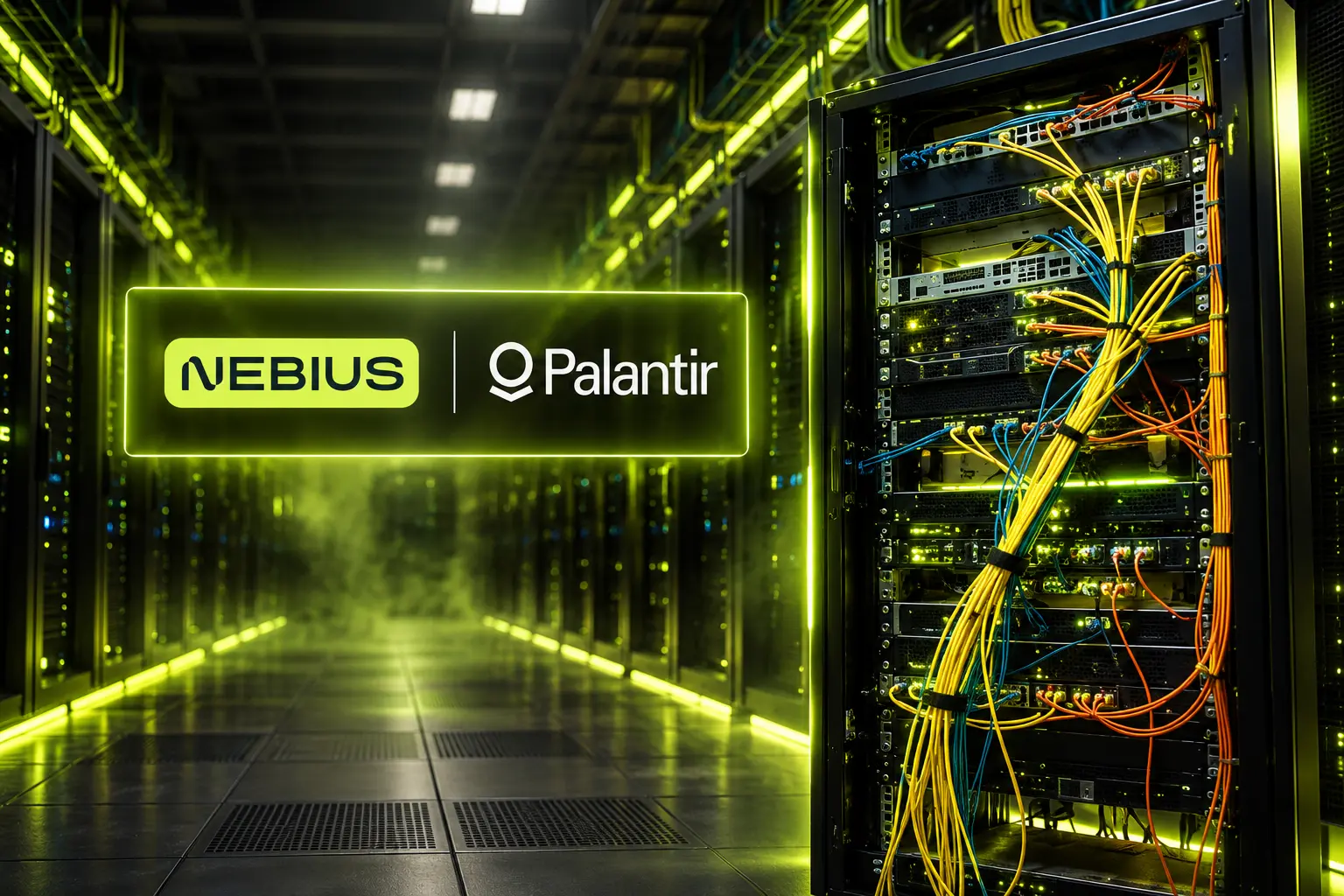
Palantir named Nebius its preferred sovereign AI infrastructure partner on September 8, 2026. The companies will put Nebius compute and inference inside the Palantir perimeter after they finish integrating. Eligible commercial customers can then run open models on that iron and keep the weights.
The move finishes a stack Palantir started with NVIDIA for U.S. agencies in June, this time for companies that rent GPUs instead of walling them off.
Palantir Puts Nebius Compute Inside Its Own Perimeter
Palantir Technologies Inc. (Nasdaq: PLTR) and Nebius Group N.V. (Nasdaq: NBIS) said they will bring Nebius’s AI-native cloud to Palantir’s commercial customers. After an integration period, Palantir will place Nebius compute and inference endpoints inside the Palantir enterprise perimeter, so eligible customers can reach that capacity without leaving Palantir’s access-control layer. Neither company disclosed a dollar figure, a term length, or a capacity commitment.
The companies also said they will stand up new capacity faster for those customers, including modular data-center halls at sites where power is already available. Palantir’s Sovereign AI Operating System, built on AIP, Ontology, Foundry, and Apollo, is the isolation layer. Palantir said that layer lets an organization train on its own data and keep the compute, the models, the data, and the advantage those models produce.
Alex Karp, Palantir’s co-founder and chief executive, tied the badge to a demand he has been selling all summer.
Nebius’ compute infrastructure powers your ability to run your own AI models under conditions you control. Our ontology and their infrastructure will undergird the sovereignty our partners are demanding.
Alex Karp, Co-Founder and CEO, Palantir, partnership announcement
Arkady Volozh, Nebius’s founder and chief executive, said organizations need large-scale AI infrastructure and control over data and models at the same time, and that the pair will let commercial clients run optimized open models on trusted iron. Palantir said it picked Nebius because the cloud was built for AI from the ground up rather than adapted from general-purpose computing, and because that stack can plug straight into Palantir’s operating system.
Nebius posted the same terms from its own account, naming itself Palantir’s preferred sovereign AI infrastructure partner and repeating that inference will run inside Palantir’s perimeter.
We are partnering with Palantir to bring trusted AI cloud infrastructure to Palantir’s commercial customers.
Palantir has named Nebius its preferred sovereign AI infrastructure partner.
Nebius compute and inference endpoints will run inside the Palantir enterprise perimeter –… pic.twitter.com/wTepmsat1O
— Nebius (@nebiusai) September 8, 2026
The first practical question around that post was the one the release does not answer: what the work is worth. Until endpoints are live, the preferred badge is a product promise, not a booked megawatt.
A Government Stack Built for Air-Gapped Rooms
On June 29, 2026, Palantir and NVIDIA launched an engine for running Nemotron open models in air-gapped environments, aimed at U.S. government agencies and critical infrastructure. Agencies can run customized Nemotron models on their own machines, train on their own data, and keep the resulting weights, including the operational knowledge encoded in them. Palantir’s operating system supplies authorization, isolation, portability, erasure, and audit trails. That government path already includes Maven AI as a Pentagon program.
Seventy-one days later the commercial version uses a rented specialist cloud instead of a classified hall. The software layer is the same. The iron is not. Palantir said bringing Nebius inside its perimeter opens a sovereign option to commercial organizations that had not previously had one to run their own models on trusted infrastructure.
THE TWO SOVEREIGN STACKS
| Layer | NVIDIA product, June 29, 2026 | Nebius product, September 8, 2026 |
|---|---|---|
| Buyer | U.S. agencies and critical infrastructure | Eligible Palantir commercial customers |
| Compute | Customer and NVIDIA machines, air-gapped | Nebius AI cloud, inside the Palantir perimeter |
| Models | NVIDIA Nemotron open models, customized on site | Open models on Nebius, adapted on the customer’s data |
| Control software | AIP, Ontology, Foundry, Apollo | AIP, Ontology, Foundry, Apollo |
| Claimed outcome | Own the weights; keep insights out of closed models | Domain models that can beat closed general models |
The government product assumes the customer already has, or will buy, isolated hardware. The September product assumes the customer will rent that hardware from Nebius and let Palantir wrap it. For a bank, a manufacturer, or a hospital that will never air-gap a Blackwell rack, that is the difference between a manifesto and a SKU.
653 U.S. Commercial Accounts Now Have a GPU Path
The channel Palantir is pointing at Nebius is no longer a side business. In the quarter ended June 30, 2026, Palantir said U.S. commercial revenue grew 149% year over year, and 28% from the prior quarter, to $764 million. Total revenue was $1.935 billion, up 93% year over year. U.S. revenue was $1.573 billion, 81% of the company.
Karp’s own line on that release was that demand for AI sovereignty had been unleashed, and that a customer’s competitive advantage should never become training data for someone else’s model. The company raised full-year U.S. commercial guidance to more than $3.424 billion, a rise of at least 134%.
PALANTIR’S U.S. COMMERCIAL RUN RATE
- $2.132 billion: U.S. commercial total contract value booked in the second quarter, up 153% from a year earlier.
- $6.238 billion: U.S. commercial remaining deal value at quarter end, up 124% year over year and 27% sequentially.
- 653 accounts: U.S. commercial customer count, up 35% year over year and 6% from the prior quarter.
- $912 million: GAAP operating income in the quarter, a 47% margin, with GAAP net income of $1.062 billion.
Customer count rose much more slowly than revenue, which means existing accounts are spending more. Those are the shops that already run Ontology against live operations. They are also the shops that, if they accept the new path, will send training and inference jobs to Nebius instead of to a hosted lab API or a hyperscaler GPU pool. Palantir did not say how many of the 653 are eligible, or what eligible means.
Why Palantir Named a Preferred Cloud After Years of Agnosticism
Palantir still lists Foundry on AWS, Google Cloud, Microsoft Azure, and Oracle Cloud. Apollo was sold as the layer that lets the same software run in almost any environment, including classified clouds and on-prem halls. AIP’s own capacity notes still treat Azure, OpenAI, AWS Bedrock, Google Vertex, and xAI as the pipes that feed token limits. The September badge does not delete those partners. It creates a new slot with a different job: a preferred place to train and serve the customer’s own open models under Palantir’s isolation rules.
That slot was previewed in Palantir’s own legal guidance. On July 27, 2026, the company published a long note on how hosted-model contracts can move a firm’s unique knowledge into someone else’s weights. Midway through, it said extra control might involve using neoclouds to host open-source models that the customer deploys and controls, because those specialist clouds may accept tighter data terms than labs or hyperscalers. Forty-three days later Palantir named one.
Preferred is a commercial word. It is not exclusive in the release, and Palantir did not say AWS or Azure GPU instances are barred. What it did say is that Nebius inference will sit inside Palantir’s perimeter, which is a stronger join than a marketplace listing. The software vendor becomes the place a customer clicks to get a GPU, and the specialist cloud becomes the default iron behind that click.
Modular Capacity at Sites That Already Have Power
The capacity clause is the part of the release that is not about branding. Palantir and Nebius said they will work together to bring new AI capacity online faster, including modular halls at sites where electricity is already available. That is a bet on interconnection queues, not on press copy. A hall that can be craned onto a powered plot is how a neocloud tries to beat a hyperscaler that is waiting on substations.
Nebius has been raising that bet in public all year. Second-quarter group revenue was $582.3 million, up 454% year over year, with the AI cloud about 98% of the total and annualized run-rate revenue at $3.0 billion. Volozh said production inference workloads more than tripled in the quarter. The company is targeting 5 gigawatts of contracted power by the end of 2026, with up to 1 gigawatt connected by year-end, and it plans to deploy more than 1 gigawatt of compute a year starting in 2027. Full-year 2026 revenue is guided at $3.0 billion to $3.4 billion against capital spending of $20 billion to $25 billion, with more than $9 billion of customer prepayments expected this year and more than $40 billion of customer commitments already on the books.
WHAT NEBIUS IS ACTUALLY BUILDING
- Contracted vs live: 5 gigawatts is power Nebius has secured, not racks that are already earning; connected power is still guided at up to 1 gigawatt by year-end 2026.
- Who already buys: Microsoft and Meta are named capacity customers; Palantir’s commercial base is a new enterprise channel, not a disclosed take-or-pay block.
- How it is funded: prepayments, debt, and a 2026 capex plan of $20 billion to $25 billion, the same prepaid growth in Nebius AI cloud the company has been converting into contracted megawatts.
- What Palantir adds: a software-tied path into 653 U.S. commercial accounts, plus a reason to drop modular halls next to power that is already in the ground.
A Palantir customer who wants a private model still needs a building, a substation, and a queue of GPUs. Nebius’s pitch is that it can supply those faster than a general-purpose cloud because the halls and the software were designed together. Palantir’s pitch is that the customer should not have to leave Ontology to use them. If the modular sites slip, the preferred badge is a slide.
The Token Bill Palantir Wants Customers to Stop Paying
The commercial argument underneath both the June and September products is the same. Karp has said customers want control over compute, models, the data stack, and their alpha, and that they want the means of production rather than a transfer of that value to a lab. In early July he called the token-metered way of selling AI completely wrong. Palantir’s July 27 note went further, warning that hosted labs and hyperscalers may extract unique tradecraft from prompts and outputs and sell it back as weights or services.
The proposed fix is an open model, looped on the customer’s own data, sitting behind Ontology so the model cannot cache the business or write it into public weights. Palantir says that combination can beat a general-purpose closed model on a specific domain. That claim is unproven in the September release. No customer, no benchmark, and no latency or dollar comparison with GPT-class APIs appears in the text.
What the release does change is the default path. A Palantir shop that accepts the new stack will train and serve on Nebius, under Palantir’s rules, instead of sending tokens to a lab. Palantir still sells software. If inference volume follows those jobs, Nebius collects the rent on the GPUs, and Palantir collects the rent on the control plane. Closed-model vendors keep the customers who want a frontier API and will live with the contract terms Palantir spent July attacking.
Still No Price on the Preferred Badge
The partnership is live as a statement and unfinished as a product. Palantir’s own forward-looking language in the release talks about expected benefits of the platforms, and Nebius lists the usual risks of a large collaboration, including whether preferred status actually expands its client base or revenue.
WHAT WE KNOW
- The badge: Palantir named Nebius its preferred sovereign AI infrastructure partner on September 8, 2026.
- The join: After an integration period, Nebius compute and inference endpoints are supposed to sit inside the Palantir perimeter for eligible commercial customers.
- The build: The companies said they will add capacity faster, including modular halls at powered sites.
- The thesis: Open models, adapted on the customer’s data, are meant to outperform closed general models while leaving data and weights with the customer.
WHAT IS UNCONFIRMED
- The money: No contract value, no take-or-pay, no GPU count, and no share of Palantir commercial spend was disclosed.
- The clock: The integration period has no published end date, and no customer was named as first to go live.
- The exclusivity: Palantir did not say AWS, Azure, Google Cloud, or Oracle are out of the sovereign path, only that Nebius is preferred.
- The performance claim: No domain benchmark was offered to show an adapted open model beating a closed frontier model on Palantir jobs.
Until those items land, the September deal is Palantir pointing its commercial base at a specialist cloud it already described, in July, as the kind of vendor that might take data-protective terms. Nebius gets a logo in front of 653 U.S. commercial accounts and a reason to drop modular halls where the grid is already live. The endpoints still have to light up.
Disclaimer: This article is news reporting and analysis of a corporate partnership and of figures those companies have already published. It is informational only and is not investment advice, a solicitation, or a recommendation to buy, sell, or hold Palantir Technologies or Nebius Group securities. Readers should consult a licensed financial adviser or securities professional before making any investment decision based on partnership news or capacity plans. Revenue, bookings, power targets, and product timelines are taken from company statements tied to the September 8, 2026 announcement and to each firm’s latest reported quarter, and those figures can change.

Instagram Plus Tests a Read-Only Mode That Cuts Stories

Altman Asks the Public to Accept Some AI Harm

Google Freezes OSS VRP Product Reports After AI Flood

AI Agents Make Payment Rails the Scarce Prize

Turkey’s Crypto Boom Now Runs Through Three Banks

Fable 5 Came Back Under a Commerce On-Off Switch

Google’s SpaceX GPU Lease Has a Sept. 30 Deadline

Plasma One’s XPL Locks Face a 1.81 Billion Cliff

DGO’s Rs 549 World Cup Pass Cost Fans Sleep and Data

Moonshot AI’s $30 Billion Ask Became a $35 Billion Close
-
 AI4 months ago
Fable 5 Came Back Under a Commerce On-Off Switch
-
 AI5 months ago
Google’s SpaceX GPU Lease Has a Sept. 30 Deadline
-
 CRYPTO4 months ago
Plasma One’s XPL Locks Face a 1.81 Billion Cliff
-
 APPS5 months ago
DGO’s Rs 549 World Cup Pass Cost Fans Sleep and Data
-
 AI5 months ago
Moonshot AI’s $30 Billion Ask Became a $35 Billion Close
-

 NEWS5 months ago
ColorOS 17 Device List Spans Oppo, OnePlus and Realme
-

 GAMING4 months ago
The RTX 4050 Under Rs 70,000 Hides a Wattage Gap
-

 AI4 months ago
Boris Cherny’s Loops Still Demand a Higher Production Bar