
AI
Magnifica Humanitas Turns Hospital AI Scores Into a Moral Test
Pope Leo XIV’s Magnifica Humanitas is being read as a chatbot sermon. The text judges the scoring tools Catholic hospitals already run.

Elizabeth Strout told Vatican readers that a grocery clerk’s twinkle in the eye helped keep a lonely widower from suicide, and that no computer system can do that work. Pope Leo XIV’s first encyclical, Magnifica Humanitas, signed on 15 May 2026 and released on 25 May, had already named a harder case than the chatbot: tools that turn a person into a score.
Strout’s essay, carried by L’Osservatore Romano among replies from writers with no close ties to the Catholic Church, treats the document as a warning about feeling. The text itself is a social encyclical in the line of Rerum Novarum. It is aimed at labor, schools, hospitals, and war, and at anyone who claims a digital language can translate the mystery of the person into data and performance.
Strout, a Grocery Clerk, and the Encyclical
Strout, the novelist who won the Pulitzer Prize in 2009 for Olive Kitteridge, writes about “moments of grace,” the connections that keep a life from collapsing. She tells of an older widower with no children who had been thinking of suicide until new neighbors moved in and a store clerk spoke to him pleasantly. He described the clerk as “always having a twinkle in her eye.” The children next door yelled his name. He later began volunteering at a homeless shelter once a week, preparing meals and talking with the people who ate them.
That story is the specimen the encyclical keeps asking for. Leo writes that the quality of a civilization is measured by the care it can offer, and by the ability to recognize the other as a face, not merely as a function. Reading to a child, sitting with an older person, and making a house welcoming are the gestures he names. Strout’s clerk is one of those gestures, written from outside the Church and aimed at readers who will never parse a dicastery bulletin.
She quotes the Pope on dignity that is “neither acquired nor earned,” and on the claim that “it is individuals that matter.” Both lines sit in chapter two of the encyclical, at paragraphs 53 and 58, in the section on the equal dignity of every human being. Her fear is that a bot can imitate a kind voice well enough that a lonely person stops looking for a face. The encyclical shares that fear. It then walks into rooms she does not enter: the hospital queue, the school, the factory floor, the targeting screen.
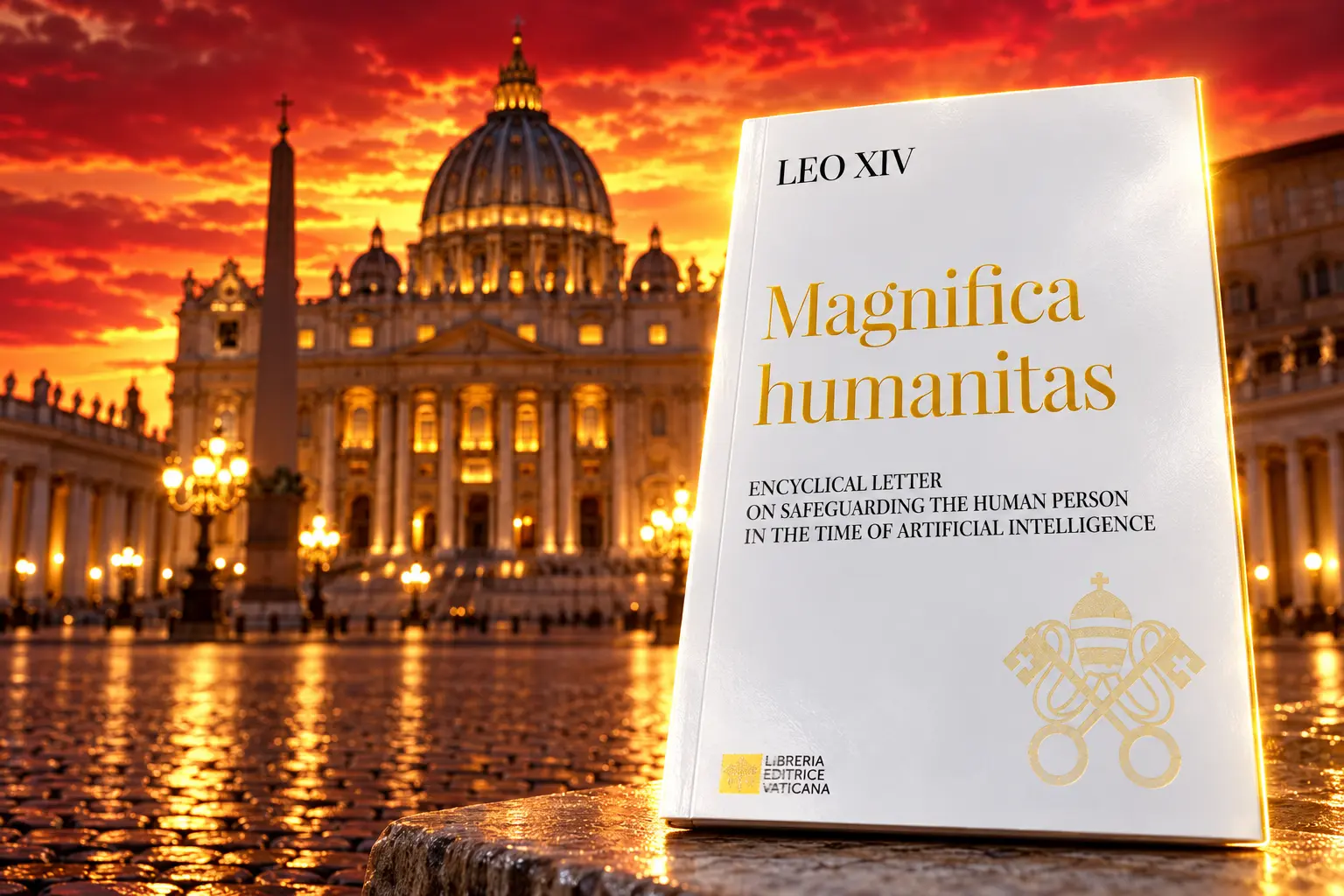
Three Moves the Encyclical Calls Babel
Leo opens with two building sites. Babel is a single language, a single technology, and a single direction, raised to make a name. Jerusalem, in the Book of Nehemiah, is a ruined wall rebuilt section by section by families who listen to one another. The primary choice, he writes in paragraph 9, is not a yes or a no to technology. It is which city to build.
THE BABEL SYNDROME, IN THE POPE’S THREE CLAUSES
- Profit: The idolatry of gain that sacrifices the weak.
- Sameness: A uniformity that cancels differences.
- Translation: The pretense that one language, even a digital one, can turn the mystery of the person into data and performance.
That third clause is the one Strout hears as a hymn to interior life. Inside a hospital or a diocesan school it reads as a buying rule. If a vendor’s product exists to rank a patient, a pupil, or a worker as output, the encyclical has already called the ranking a moral error, not a feature. Paragraph 14 even lists the practices that should follow: planning that can be answered for, human and social impact checks, inclusion of the people with least power, digital literacy, and research pointed at justice and peace.
Leo is not vague about who holds the new power. In paragraph 5 he says the main drivers of development are now private, often transnational parties whose resources surpass those of many governments. The Church’s social teaching, he argues, has to follow that shift the way Leo XIII followed the factory.
What Magnifica Humanitas Says Machines Cannot Do
Artificial intelligence, in paragraph 99, is not another kind of mind. These systems merely imitate certain functions of human intelligence, often beating people on speed and calculation, while remaining tied to data processing. They do not undergo experiences, do not possess a body, do not feel joy or pain, and do not mature through relationships. They have no moral conscience. They may imitate language and even simulate empathy, but they do not understand what they produce.
Paragraph 98 is the line a lab will actually recognize. Current systems are more “cultivated” than “built,” Leo writes, because developers set a framework in which the model “grows.” Internal representations remain, for now, unknown. That is why he wants two things at once: deeper scientific work, and moral discernment that does not wait for a finished theory of the model.
He still calls the tool useful. Paragraph 100 says AI can make analysis, media, and practical help easier to reach. The same paragraph warns that simulated care is most dangerous where real bonds are already thin, because a person may lose the desire to form them. On 25 May 2026, presenting the text in the Synod Hall, he went further than the lab definition.
From this listening matured a disturbing conviction expressed in Magnifica Humanitas: artificial intelligence needs to be disarmed. The word is strong, I know, but deliberately chosen because this moment needs words capable of attracting attention, awakening consciences and indicating paths forward for humanity.
Pope Leo XIV, Synod Hall, 25 May 2026
In that artificial intelligence needs to be disarmed address, he thanked scientists who want to ease suffering, and he named the voices that troubled him: weapons growing hard to govern, and algorithms that can block access to healthcare, employment, and security on data tainted by prejudice. Christopher Olah, co-founder of Anthropic, was in the hall. So were Cardinal Víctor Manuel Fernández and Cardinal Michael Czerny. The Pope said the Church does not have technical answers and does not seek to replace people who do. It brings a claim about the human: each person is unique, free, and not replaceable.
Catholic Health Systems Already Run the Scores
That healthcare line is not a metaphor. Catholic systems in the United States are already buying and governing the tools. Kathleen A. Curran, senior director of public policy at the Catholic Health Association, wrote in the summer 2026 issue of Health Progress that the ministry uses AI in radiology, imaging, precision medicine, and surgeon-controlled robotics, and that research is underway on robots that could operate with little or no spoken guidance from a human surgeon.
Curran asks the question the encyclical makes unavoidable: if clinicians cede judgment to a model, how do they still gain the skill to care? She notes that CommonSpirit Health now convenes a multidisciplinary data and AI committee weekly, up from every two weeks, to review ethics, data, algorithms, and governance for more than 240 AI applications across the system. Providence runs a clinical AI work group and a separate guardrails group for safety, equity, legal, ethical, and privacy questions.
WHERE THE SCORING ALREADY SITS
| Place | What is already running | Pressure from the encyclical |
|---|---|---|
| CommonSpirit Health | More than 240 AI applications, reviewed weekly | Paragraph 96: ask whether algorithms protect the vulnerable and stay aimed at the good of all |
| U.S. Food and Drug Administration | More than 1,400 AI devices by the end of 2025; radiology is three-quarters of them | A tool may help a reading; it may not turn the patient into a function |
| Centers for Medicare and Medicaid Services | 26 AI codes for clinical services as of January 2026; 23 of them temporary | Payment rules will decide which scores become ordinary care |
| Synod Hall, 25 May 2026 | Leo said he had heard of algorithms blocking care, work, and security | Data tainted by prejudice is already a pastoral fact, not a future risk |
Curran also records the federal floor under those purchases. No generative AI device had FDA approval when she wrote, though a virtual-care chatbot after joint replacement was under review. CMS had not mandated AI in hospital conditions of participation, but it was already paying for some of it. States had filled the gap with bill after bill on chatbots, prior authorization, and disclosure to patients. The encyclical does not name CommonSpirit or the FDA. It does not need to. A life reduced to diagnosis, age, and visit frequency is exactly the translation paragraph 10 rejects.
CommonSpirit’s Weekly Ethics Queue
A weekly committee is not a veto. It is a queue. Two hundred and forty applications means most tools will pass, some will be delayed, and a few will be argued over until the vendor’s contract cycle forces a decision. Leo’s language gives that committee a test it did not write for itself: does this product recognize a face, or only a function? If the honest answer is function, the Babel paragraph has already spoken.
What Leo Said He Had Heard
In Peru in 2017, he told the Synod Hall, floods took homes and roads, and rebuilding meant repairing bonds, not only replacing walls. He used that memory to explain Nehemiah. No one rebuilds alone. The same speech refused the idea that a person can be reduced to productivity, cognitive performance, or mere data. Catholic hospitals that pride themselves on mission language now have that sentence in an encyclical, not a branding deck.
Rome’s 2020 Pledge Left the Scoring Question Open
The Vatican was not new to this file. On 28 February 2020 the Pontifical Academy for Life signed the Rome Call for AI Ethics with Microsoft, IBM, the Food and Agriculture Organization, and Italy’s innovation ministry. The Call asked for an intelligence that does not have as its sole goal greater profit or the gradual replacement of people at work, and it set six principles for ethical artificial intelligence: transparency, inclusion, accountability, impartiality, reliability, and security and privacy. Catholic health systems later signed on. Cisco joined in 2024. On 28 January 2025, still under Pope Francis, the Dicastery for the Doctrine of the Faith and the Dicastery for Culture and Education issued Antiqua et Nova, a doctrinal note on AI and human intelligence.
Leo was elected on 8 May 2025, the first pope born in the United States, Robert Francis Prevost of Chicago (1955). He took the name of the Leo who wrote Rerum Novarum on 15 May 1891, and he signed Magnifica Humanitas on the 135th anniversary of that text. The industrial encyclical was about factory workers. This one is about people whose work, care, and speech now pass through models.
THE HOLY SEE’S AI CALENDAR
- 28 February 2020: Rome Call signed; algorethics pledged, with no enforcement arm.
- 28 January 2025: Antiqua et Nova sets doctrinal language on AI and human intelligence.
- 8 May 2025: Leo XIV is elected and inherits the file as a first-order task.
- 3 May 2026: He approves an Inter-Dicasterial Commission on Artificial Intelligence in an audience with Cardinal Czerny.
- 12 May 2026: Czerny signs the rescript; it is published on 16 May.
- 15 May 2026: Leo signs Magnifica Humanitas; the Holy See releases it on 25 May in the Synod Hall.
The Commission joins seven bodies: the Dicastery for Promoting Integral Human Development, the Dicastery for the Doctrine of the Faith, the Dicastery for Culture and Education, the Dicastery for Communication, the Pontifical Academy for Life, the Pontifical Academy of Sciences, and the Pontifical Academy of Social Sciences. Coordination rotates yearly, starting with Integral Human Development. Its brief includes policies on AI use inside the Holy See. The encyclical is teaching. The rescript is plumbing. Together they mean Rome intends to police its own tools, not only lecture Silicon Valley.
Before the release, Vice President JD Vance told reporters the text would have influence, and that he expected to agree with some of it and not with other parts. In August 2026, Rep. Ro Khanna said he had met the Pope to discuss Magnifica Humanitas and had written to AI chief executives about keeping human beings in charge of decisions and about mass unemployment.
I met with Pope Leo last week to discuss his encyclical Magnifica Humanitas and its call to put human dignity over AI.
I then wrote to AI CEOs asking what they're doing to ensure human beings are making decisions & prevent mass unemployment.@Pontifex
📸: Vatican Media pic.twitter.com/RH2dAcbAHC— Rep. Ro Khanna (@RepRoKhanna) August 20, 2026
Workers Heard a Ban the Text Did Not Write
Once the phrase “needs to be disarmed” left the Synod Hall, a simpler reading spread: if the Pope said disarm, a worker could refuse a mandated copilot on religious grounds. That is not what the document does. Paragraph 9 rejects a yes-or-no to technology. Paragraph 100 calls AI a valuable tool that requires vigilance. Paragraph 110, as carried in the Vatican’s own summary, says to disarm is to strip the assumption that technical power confers the right to govern, not to smash the machine.
Leo XIII did not tell factory hands to wreck the looms. Leo XIV does not tell nurses to unplug the radiology queue. He tells the people who design, buy, and mandate the tools that a person is not a dataset, that work should not be paced by the machine, and that lethal or irreversible choices cannot be handed to an automated process. Paragraph 150 puts the labor point in one sentence the bishops can quote: while AI promises to take over mundane tasks, it frequently forces workers to adapt to the speed of machines, rather than machines being designed to support those who work.
On weapons, the teaching is stricter. Paragraph 197 says the development and use of AI in war must face the most rigorous ethical constraints. Paragraph 198 says it is not permissible to entrust lethal or otherwise irreversible decisions to artificial systems, and that no algorithm can make war morally acceptable. A workplace copilot and a targeting model are not the same object. Treating them as one slogan is how a 245-page argument (the count often given in secondary tallies) gets flattened into a meme. The official text is five chapters and a conclusion. The force is in the distinctions.
A quieter technical warning sits in paragraph 101. Current systems, especially large language models, take huge amounts of energy and water. The ecological cost is part of the moral cost. A hospital that boasts of mission while standing up another dense cluster without asking who drinks from the same aquifer has not read the document it will quote in a press note.
The Wall Still Has to Be Built by Hand
Strout’s widower lived because people spoke to him, then he went and cooked for people who had no home. That is paragraph 114 in ordinary clothes: care learned by doing it, a face rather than a function. The encyclical’s wager is that the same test can be applied to a discharge model, a hiring screen, a school chatbot, and a targeting algorithm. If the tool cannot leave a human conscience in charge, it belongs on the Babel pile.
The Commission now has to write rules for the Holy See’s own systems. Catholic hospitals already have more than 240 applications in one network alone, with weekly meetings that will either use Leo’s sentences or file them under mission language. Strout can keep looking for grace on the page. The clerks, nurses, and teachers still have to decide whether the next score they are asked to trust is a person or a product.

Instagram Plus Tests a Read-Only Mode That Cuts Stories

Altman Asks the Public to Accept Some AI Harm

Google Freezes OSS VRP Product Reports After AI Flood

AI Agents Make Payment Rails the Scarce Prize

Turkey’s Crypto Boom Now Runs Through Three Banks

Fable 5 Came Back Under a Commerce On-Off Switch

Google’s SpaceX GPU Lease Has a Sept. 30 Deadline

Plasma One’s XPL Locks Face a 1.81 Billion Cliff

DGO’s Rs 549 World Cup Pass Cost Fans Sleep and Data

Moonshot AI’s $30 Billion Ask Became a $35 Billion Close
-
 AI4 months ago
Fable 5 Came Back Under a Commerce On-Off Switch
-
 AI5 months ago
Google’s SpaceX GPU Lease Has a Sept. 30 Deadline
-
 CRYPTO4 months ago
Plasma One’s XPL Locks Face a 1.81 Billion Cliff
-
 APPS4 months ago
DGO’s Rs 549 World Cup Pass Cost Fans Sleep and Data
-
 AI5 months ago
Moonshot AI’s $30 Billion Ask Became a $35 Billion Close
-

 NEWS5 months ago
ColorOS 17 Device List Spans Oppo, OnePlus and Realme
-

 GAMING4 months ago
The RTX 4050 Under Rs 70,000 Hides a Wattage Gap
-
 AI4 months ago
Boris Cherny’s Loops Still Demand a Higher Production Bar