
GAMING
5 Pickleball Strategy Mistakes a PPA Pro Spots in Two Minutes
Ashley Griffith, a PPA Tour pro, names the 5 pickleball strategy mistakes she sees every day, and the simple fixes that turn rec players into winners.

Most rec players walk onto a pickleball court convinced that hitting harder and attacking sooner is how games are won. A PPA Tour pro says that instinct is exactly what’s costing them the match, and she can usually pick the loser within two minutes of the first serve.
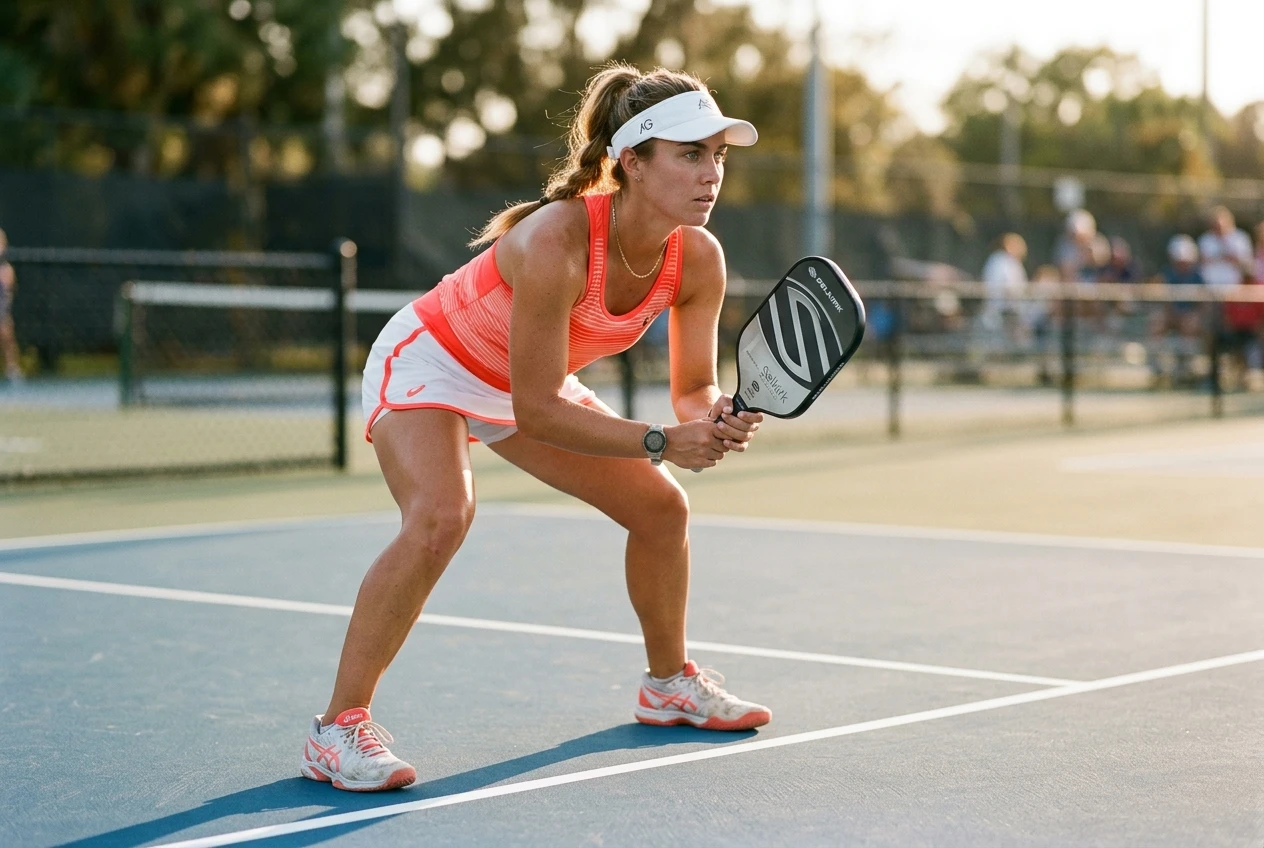
Ashley Griffith, a pro who competes on the PPA Tour, laid out the five discipline-first strategy mistakes she sees in every rec game in a recent video walkthrough. Her fixes lean on patience, positioning, and shot selection rather than pace, and they apply at the 3.0 level as cleanly as they do on the pro court.
The Two-Minute Tell That Decides Most Rec Games
Griffith says the gap between winners and losers opens up faster than most players realize. “Most rec players are focusing on completely the wrong things,” she says, and the wrong things show up in the first few rallies of a match.
She is not talking about raw athleticism or shot power. The players who consistently win are the ones who wait for the right ball, hold their ground at the kitchen line, and refuse to give away free points with an impatient speedup. The players who consistently lose are doing the opposite on every one of those choices, and Griffith says that pattern is usually obvious from the second point on.
The same instinct that tells a rec player to attack harder is the instinct that costs them the next five rallies. Switching the order of those decisions, not the pace of the swings, is the entire game.
Stop Speeding Up Balls You Have No Business Attacking
Griffith’s first rule of shot selection is blunt. “If the ball’s below the net, you’re attacking from a losing position.” The pattern shows up constantly at the rec level, where players get impatient after three or four dinks and rip a speedup at whatever ball arrives next.
A bad speedup is a gift to the other side. It feeds the opponent an easy counter, and it is the single most common way an otherwise even rally turns into a lost point. “Better players aren’t attacking more. They’re attacking more on the right balls,” Griffith says, and the right balls share three green lights.
Before you pull the trigger on a speedup, the ball needs to clear all three checks:
- Contact out in front. If the ball is at your hip or behind your body, the attack has already broken down before it started.
- Ball above net height. Anything below the tape forces you to hit up, and hitting up is what the other team wants you to do.
- The dink sat up dead. A dink that pops off the paddle face is the highest-percentage offense in the game. Anything livelier is a coin flip.
Tighten that filter and your unforced error count drops on the next outing. Impulse control is a skill, and the best players stay calm until the right ball arrives.
Slow Hands Are Usually a Late Setup
Hands battles are the rapid volley exchanges that break out at the kitchen line after a speedup, and Griffith says most players misdiagnose why they lose them. “Your hands are probably not slow. You’re probably late at the kitchen,” she says, and the paddle is the giveaway.
Rec players let the paddle drop low after every shot, and by the time the next ball arrives, they are already starting the exchange from behind. A paddle at your knees is useless when the shot is coming at your shoulder, and the higher the level you play, the less reaction time you get to recover. Compact swings with the paddle already in front of the chest solve it.
Compact, short movements win and big swings lose.
Griffith keeps her paddle out in front of her chest, elbows relaxed, backswing as short as possible. Treating the paddle like a goalie’s glove, always positioned where the next shot is most likely to arrive, is the single biggest upgrade a rec player can make to their hands speed. Wall drills build the same compact, repeatable motion without a partner on court.
Backing Off the Kitchen Line Is the Rec Player Default
“The kitchen line is where we win games,” Griffith says, and stepping off it under pressure is one of the most common strategy leaks at the rec level. When a speedup comes in, players immediately start drifting backwards, and three bad things happen at once.
You give away the angles that make the kitchen dangerous. You open up the court for the next shot. You make your own resets harder to hit, because a retreating player is reaching instead of redirecting. Holding your ground gives you a far better chance of neutralizing the point than a slow retreat ever will.
There are moments when backing up is correct. It just cannot be the default, and a player who gets pushed off the line needs a deliberate plan to recover rather than another slow step back. Griffith’s full video walkthrough of the five mistakes shows the exact footwork and paddle position she uses to absorb a speedup barrage without giving an inch.
The Two-Inch Drop in the Middle of the Net
Players love the down-the-line winner because it looks like the highlight reel. Griffith says the middle ball is the smarter shot and the higher-percentage play, and the reason is geometry, not aesthetics. “The middle causes so many errors,” she says, and the errors show up in two ways.
Every middle ball forces a split-second decision about who covers it, and half a second of hesitation at the kitchen swings the point. It also attacks your opponents’ communication instead of their athleticism, which is the part of the game you can break without ever hitting a clean winner.
The other reason is the net itself. A regulation pickleball net stands 36 inches at the sideline posts and sags to 34 inches in the center, a two-inch drop that turns the middle into the lowest clearance point on the court. A ball that would clip the tape on a straight shot often clears cleanly through the middle, which is why the same attack lands more often when aimed there.
Pressure alone creates the error, so feeding opponents uncomfortable balls in the middle is worth more than hunting a perfect down-the-line winner.
Most Points Are Lost Before the Winner Hits a Shot
Griffith’s last point is the biggest separator between advanced players and everyone else. Most points at the rec level are lost rather than won, and the fastest way to lose one is to force the issue before the right ball arrives.
Most pickleball points are actually lost, not won.
Watch a pro point and you will see ten or twenty dinks if that is what it takes. The higher the level, the more matches are decided by who stays disciplined longest under pressure. Speeding up on a ball that was not ready, drifting off the line, or fishing for a middle winner on a ball that was never there, those are the errors that decide rec games before the score matters.
Patience at the highest level looks like Ben Johns, the longtime PPA doubles partner of Anna Leigh Waters. Waters has pointed to Johns’s pickleball IQ as the edge that separates him, the calm sense of when to dink and when to attack, and that same restraint is what Griffith is asking rec players to copy. “Solid players are the hardest to beat because they make you beat them,” Griffith says, and the way to become solid is to make the opponent hit one more ball than they want to.
The Five-Point Pickleball Strategy Checklist
Here is the whole system condensed into a checklist to run before your next match. Each line ties to one of the five mistakes above, and none of them require more athleticism. They require better decisions, which is why the same checklist works at 3.0 and on the pro tour.
- Attack the right balls. Above the net, out in front, off a dead dink, or not at all.
- Paddle up early. In front of the chest, elbows relaxed, backswing as short as possible.
- Hold the kitchen line. Absorb pressure with the feet planted and let the paddle do the work.
- Attack the middle more. Lowest net clearance, forced decisions, free errors for the taking.
- Make them hit one more ball. Consistency under pressure is the real separator at every level.
For a deeper look at her PPA record, her current PPA player profile lists her match history across singles, doubles, and mixed.
Frequently Asked Questions
When should you speed up the ball in pickleball?
Speed up only when you can make contact above the net, out in front, and ideally off a dead dink. Anything below the tape means you are attacking from below the net, which is exactly the position Ashley Griffith says gives your opponent a free counter.
How do I get faster hands at the kitchen line?
Most hands battles are lost on the setup, not the swing. Keep the paddle in front of the chest, shorten the backswing, and let wall drills rebuild the compact motion. The paddle at your knees cannot defend a shot aimed at your shoulder, and that single positioning change makes the hands feel instantly faster.
What is the best pickleball strategy for doubles?
Doubles rewards the team that controls the kitchen line, feeds the middle to force communication errors, and waits for the right ball. Most rec points are lost on impatient attacks rather than won on clean winners, so the team that makes the opponent hit one more ball usually wins the match.
Why do I keep getting pushed off the kitchen line?
A speedup usually triggers panic before it triggers a plan. The retreat gives away the angles, opens the court, and turns your next reset into a reach instead of a redirect. Plant the feet, keep the paddle up, and only move back when the ball genuinely forces you rather than out of habit.
Is aiming for the middle really a higher-percentage shot?
Yes, the middle is the higher-percentage target in any doubles game. The pickleball net sags to 34 inches at center against 36 at the posts, which gives you more clearance, and the ball forces both opponents to decide who takes it. That hesitation is what creates the errors Griffith says the middle causes at every level of the game.


Lenovo Prices the IdeaPad Vibe Against Apple’s $699 Neo

Xbox Caps Game Pass Cloud Gaming at 15 Hours

GTA 6 DualSense Controllers Follow Sony’s Usual $84.99 Script

South Korea Retail Investors Face Reckoning After KOSPI AI Rally Collapses

Surrey AI Maps Three Heart Attack Paths and Their Molecular Roots

Germany Locks Neutral Apple ATT Prompts Across Most of Europe

Apple’s 5% EU Fee Quietly Rewrites Alternative App Store Math

Apple’s EU Fee Truce Cuts Complexity but Leaves Rivals Fuming

Pixel 11 Pro Fold Trades Thinness for Durability and Seven-Year Stay

Mayo AI Flags HCM Obstruction From Everyday Ultrasound Videos

Oracle Cuts 21,000 Jobs in a Year, Cites AI in 10-K Filing

Fable 5 and Mythos 5 Return as US Lifts Anthropic Export Controls

SpaceX’s Google Deal Turns a Rocket Company Into a Cloud Landlord

CD Projekt Red Co-CEO: Redemption Arc Isn’t Done, Witcher 4 in 2027

XPL Rallies 30% Ahead of Plasma One Card Tier Launch

Google Search Profiles Build a Follow Graph Inside Discover

DGO App Brings Rs 549 Mobile Pass for FIFA World Cup 2026 in Nepal

Moonshot AI Targets $30 Billion in China’s Fastest AI Funding Sprint

Oppo’s ColorOS 17 Eligibility List Leaves A-Series Buyers Behind

Microsoft Xbox Layoffs Start in July as Sharma Slams 3% Margin
-
 AI2 months ago
Oracle Cuts 21,000 Jobs in a Year, Cites AI in 10-K Filing
-
 AI2 months ago
Fable 5 and Mythos 5 Return as US Lifts Anthropic Export Controls
-
 AI3 months ago
SpaceX’s Google Deal Turns a Rocket Company Into a Cloud Landlord
-
 GAMING2 months ago
CD Projekt Red Co-CEO: Redemption Arc Isn’t Done, Witcher 4 in 2027
-
 CRYPTO3 months ago
XPL Rallies 30% Ahead of Plasma One Card Tier Launch
-
 NEWS3 months ago
Google Search Profiles Build a Follow Graph Inside Discover
-
 APPS3 months ago
DGO App Brings Rs 549 Mobile Pass for FIFA World Cup 2026 in Nepal
-
 AI3 months ago
Moonshot AI Targets $30 Billion in China’s Fastest AI Funding Sprint