
GAMING
PlayStation Ends Discs in 2028 and the Bill That Comes Due
Sony ends PlayStation physical disc production in January 2028. The 85% digital sales stat hides what players, museums, and indie publishers lose.

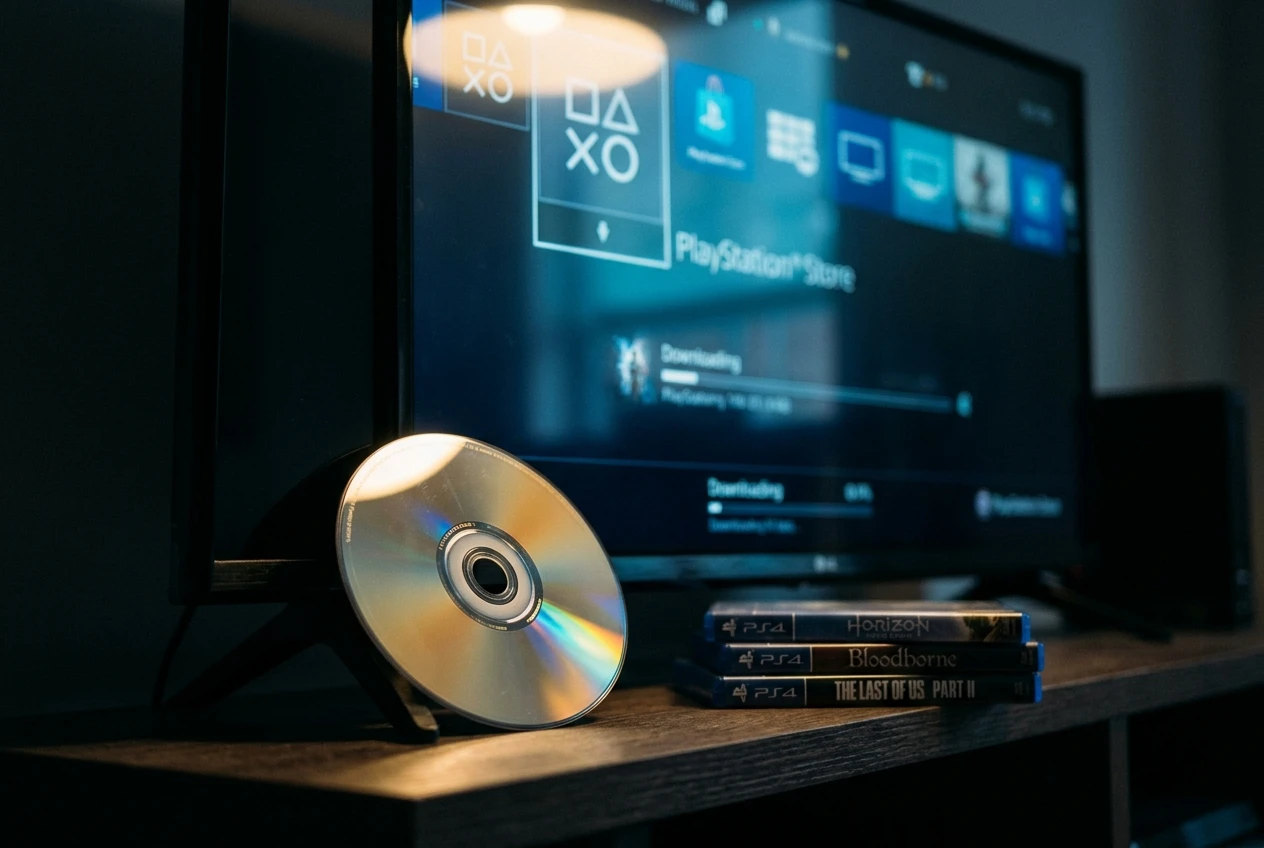
PlayStation will end physical disc production for new games in January 2028, Sony said on July 1, 2026, handing the console industry’s last mass-market physical format to the digital storefronts that already sell 85% of PlayStation software. The announcement, made on the PlayStation Blog and confirmed the same morning, frames the cut as a natural response to how players already buy games. The losses it carries, from collector libraries to museum archives, are nowhere in the framing.
Behind the company’s argument sits the kind of number that ends arguments inside boardrooms. Sony’s FY2025 results, published May 8, 2026, recorded 85% of all PS5 and PS4 full game sales as digital in the final quarter of the fiscal year. The full-year average sat at 78%. Spending on new physical video games in the United States fell to $1.5 billion in 2025, the lowest total in any year since tracking began in 1995. That figure is now the size of the U.S. disc market Sony has decided to step away from.
Sony Sets a January 2028 Deadline
Sony confirmed the cutoff on the morning of July 1, 2026, writing in a PlayStation Blog post that the change applies to new games only. Anything released on disc before January 2028 keeps shipping and keeps working. After that date, new PlayStation titles will reach shelves only through the PlayStation Store or as digital codes at retail.
“This transition will enable us to align more closely with how most of our community prefers to access and play games today,” Sony wrote in the post, according to a CNBC report on the same announcement. The company called the move a “natural direction” given that digital game preference “significantly outpaces physical discs.” For Sony, that language is the closing argument. For the people whose shelves, archives, and reference libraries depend on discs existing as objects, the deadline has already arrived.
The 85% Number and What It Leaves Out
Set that 85% against the rest of the market and a familiar pattern shows up fast. The 78% full-year average sat two points above the previous year. In the United Kingdom, almost 90% of game sales were digital by 2022, and Ubisoft reported a 35% drop in UK physical game sales during FY25. Germany was at 70% digital in 2025. Even Nintendo, the industry’s physical-media holdout, hit 67% digital in its most recent reported quarter.
Some of the loudest pushback followed one specific game, Grand Theft Auto VI. Rockstar has confirmed there are no plans to press GTA VI discs at launch, per a BBC News report on the no-disc decision. The size of the title has already pushed independent retailers, including Canada’s VGP, to publicly refuse to carry the code-in-a-box version. A corporate decision became a flashpoint because it landed on the biggest release of the decade.
The numbers behind Sony’s call:
- 85% of all PS5 and PS4 full game sales digital in Q4 FY2025 (Sony)
- $1.5 billion: U.S. spending on new physical games in 2025, the lowest since 1995
- 87% of U.S. games released before 2010 no longer commercially available
- $11.6 billion: peak U.S. physical game spending in 2008
- Just 13% of classic game history represented on the current market
Why Sony Says Players Want This
The PlayStation Blog frames the cut as a response to behavior, not a strategy imposed on players. That framing holds. Games industry consultant Jon Cartwright treats it as the second half of a longer commercial argument. “Ultimately, it’s about revenue and profit,” Cartwright said. “Doing retail, doing physical, there are a lot of costs involved in terms of the manufacturing, the distribution, retail; everybody’s taking a cut.”
The pressure on physical formats compounds from three directions at once. Subscription services such as Xbox Game Pass and PS Plus remove the rationale for individual purchases. Hardware has moved with the shift: the PS5 launched with a disc-less SKU and the PS5 Pro shipped without any built-in optical drive. Rising memory prices pushed Sony to raise PS5 console prices in April 2026, with the disc edition climbing from $549.99 to $649.99. Cutting the disc is also a way to lower the next console’s bill of materials, an argument Cartwright’s margin logic makes hard to dismiss.
What Disappears Has No Disc to Hold
The line Sony draws between disc and digital understates a more uncomfortable reality that hit PlayStation owners in late June 2026. From September 1, 2026, the company is removing 551 purchased StudioCanal films and TV titles from the libraries of customers who paid for them, citing “content licensing arrangements.” Sony’s email to affected customers does not include a refund or compensation, according to GamesIndustry.biz reporting on the removal notice. The same licensing logic sits at the base of every digital game purchase.
For games, the loss wears a different label but lands the same way. Older Forza Horizon titles, including the Australia-set Forza Horizon 3, are no longer available to buy digitally. Players who already own them can still download and play them, but anyone joining today would have to find a pre-owned disc. Digital-only delistings work the same way under licensing rules. The PlayStation End User Licence Agreement spells out the position plainly: game software, disc or not, is “licensed to you, not sold.”
Concord, the PlayStation hero shooter that Sony pulled from sale and took offline in 2024, has become the warning. The disc exists only as evidence the game shipped at all. Sealed copies trade at premium prices on secondary markets and no longer load.
“Though those discs no longer work now that Sony has pulled it from sale and shut its servers off, they are the only evidence the game ever existed at all, for those who bought it to hold onto it, and the only way anyone can preserve its game files for posterity,” said David Smith, former managing editor of Kotaku Australia. “Ironically, Sony’s most public embarrassment and its scramble to erase a PR own goal became a symbol of how physical media helps a work endure.” The format did not save Concord. It documented the cancellation.
A short list of recent digital removals gives the warning some scale:
- 551 StudioCanal films and TV titles removed from purchased PlayStation libraries on September 1, 2026
- Forza Horizon 3 and earlier Forza Horizon entries unavailable digitally under expired licensing
- Concord pulled from sale and taken offline after two weeks
- Anthem and other live-service titles delisted as publishers withdraw support
The 87% Problem and the Archives Racing It
PlayStation’s decision lands inside a preservation crisis that was already quantified. A 2023 study by the Video Game History Foundation found that 87% of classic video games released in the United States are critically endangered. “Just 13% of video game history is being represented in the current marketplace,” the foundation wrote on its study page documenting the disappearance. The research is one of the first to put a number on what curators have watched happen in slow motion.
Without a physical copy, an ‘original’, museums and archives have next to no options for preservation but to either breach DRM or negotiate directly with games companies who may no longer exist, in order to legally collect a ‘copy’ of a game for preservation purposes.
That quote is from Seb Chan, ACMI CEO and Director. The licensing structure that makes Sony’s digital library profitable is the same structure that makes its history uncollectable. Frank Cifaldi, director of the Video Game History Foundation, made the case publicly on the foundation’s social channels after the announcement: “The industry needs to meaningfully come to the table on this issue, because asking museums to download a copy of Grand Theft Auto VI and hope it’ll run in 50 years is not a preservation solution.” The studio closure that would follow a 50-year wait is the implicit punchline.
Where the Disc Era Goes From Here
Sony is not alone. Microsoft employees are testing a disc-to-digital feature that would convert existing Xbox One and Series X/S collections into download licenses, with Microsoft’s next Xbox reportedly dropping the disc drive. Nintendo remains the swing case: 54.6% of its full-year software sales were digital in its last annual report, with the most recent quarter at 67.2%, yet the company’s hybrid Switch line still leans more on physical than its competitors.
It is more than a product for many, it is a memory.
That line is from Chloe Appleby, Program Curator at Powerhouse, on the relationship players form with their collections. Cartwright, watching the same backlash, sees it as something closer to a negotiating position. “We have to speak up and talk about the fact that we’re not happy about it,” he said. Sony’s end of disc production arrived inside a fan response that did not change the date but did change the conversation, and the next console cycle will tell whether that conversation stalls at nostalgia or finds its way into a disc-shaped premium product that companies can still ship at a margin.
Frequently Asked Questions
When does PlayStation stop making game discs?
Sony will end physical disc production for new PlayStation games in January 2028, the company said in a PlayStation Blog post on July 1, 2026. Games already on disc continue to ship and work as normal; the cutoff applies to new titles only.
Will my existing disc games still work?
Yes. Sony’s announcement says existing physical libraries remain unaffected. Any disc sold before January 2028 continues to work on compatible hardware. The cut is on production of new discs, not on access to discs already in players’ hands.
Why is Sony stopping disc production now?
Sony points to player behavior. In its FY2025 results, published May 8, 2026, the company said 85% of PS5 and PS4 game sales were digital in the final quarter of the year. The full-year average was 78%. Games industry consultant Jon Cartwright adds the cost side: manufacturing, distribution, and retail margins each take a cut a digital sale does not, making physical a worse unit economics story every quarter.
What happens to games I bought digitally if Sony pulls them?
It has already happened once. On September 1, 2026, Sony is removing 551 purchased StudioCanal films from players’ video libraries with no refund offered. Game removals work the same way under the PlayStation End User Licence Agreement, which says game software is “licensed to you, not sold.” For online multiplayer, the company can also take the servers offline entirely, as it did with Concord in 2024.


OpenAI Ultrafast Puts GPT-5.6 Sol on Live Workloads

Apple’s 15% External Fee Bid Admits Its Own Zero Floor

JBL Beats Bose and Sony on Value for 2026 Soundbars

iPhone Users Pull 40 Percent More From Microdrama Apps

Nebius Q2 Turns AI Cloud Demand Into Prepaid Growth Machine

One UI 9.5 App Lock Ends Years of Samsung Delays

Shiprocket IPO Premium Hides ESOP Costs and Flat Merchant Base

Google Halves Gemini 3.7 Flash Price to Fuel Agent Swarms

Dawnwalker Time Clock Cracks Open-World RPG Habits

Gemini 3.7 Flash Cuts Agent Costs While Pro Stays Delayed

Fable 5 and Mythos 5 Return as US Lifts Anthropic Export Controls

Oracle Cuts 21,000 Jobs in a Year, Cites AI in 10-K Filing

SpaceX’s Google Deal Turns a Rocket Company Into a Cloud Landlord

CD Projekt Red Co-CEO: Redemption Arc Isn’t Done, Witcher 4 in 2027

XPL Rallies 30% Ahead of Plasma One Card Tier Launch

Google Search Profiles Build a Follow Graph Inside Discover

DGO App Brings Rs 549 Mobile Pass for FIFA World Cup 2026 in Nepal

Moonshot AI Targets $30 Billion in China’s Fastest AI Funding Sprint

Microsoft Xbox Layoffs Start in July as Sharma Slams 3% Margin

Oppo’s ColorOS 17 Eligibility List Leaves A-Series Buyers Behind
-
 AI1 month ago
Fable 5 and Mythos 5 Return as US Lifts Anthropic Export Controls
-
 AI2 months ago
Oracle Cuts 21,000 Jobs in a Year, Cites AI in 10-K Filing
-
 AI2 months ago
SpaceX’s Google Deal Turns a Rocket Company Into a Cloud Landlord
-
 GAMING2 months ago
CD Projekt Red Co-CEO: Redemption Arc Isn’t Done, Witcher 4 in 2027
-
 CRYPTO2 months ago
XPL Rallies 30% Ahead of Plasma One Card Tier Launch
-
 NEWS2 months ago
Google Search Profiles Build a Follow Graph Inside Discover
-
 APPS2 months ago
DGO App Brings Rs 549 Mobile Pass for FIFA World Cup 2026 in Nepal
-
 AI2 months ago
Moonshot AI Targets $30 Billion in China’s Fastest AI Funding Sprint