
AI
Shifters Puts One Operator in Charge of Robot Teams
Shifters used Eurosatory to sell one-operator robot teams, not another chassis, while TRUST is still in field tests and headed to AUSA.

Shifters spent Eurosatory 2026 selling a ground autonomy stack that lets one operator supervise a robotic team. The Washington company occupied Booth C213 in Hall 5A at Paris Nord Villepinte from June 15-19, showing RITA, ARENA and TRUST as a single product set.
Unmanned vehicles already filled that hall. The scarce input was the person who still has to drive them.
One Operator Was the Pitch in Hall 5A
On June 15 the company put out its public case for an AI-native ground autonomy product ecosystem, built so a human sets mission intent, permissions and intervention thresholds, then several robots share the movement and the sensing. The live demo was framed around search and rescue, site security, remote inspection and entry work in places people should not walk first.
Ofer Ballin, chief executive and co-founder, put the claim in one line on the show floor and in the release.
The next leap in ground robotics is not a better remote-controlled machine. It is the ability for one operator to supervise coordinated robotic teams that can enter, sense and operate in dangerous environments before people are exposed.
Ofer Ballin, CEO and co-founder, Shifters, Eurosatory 2026
Assaf Chaprak, president, chief technology officer and co-founder, called ground autonomy a systems problem in the same release, listing terrain, perception, communications, power, payloads and decision-making as things that have to work at the same time. The company’s slogan is “Robots Go First.” Ballin told a floor interviewer he wants, five years on, platoons that send multiple robots ahead to clear the way so soldiers move in behind them.
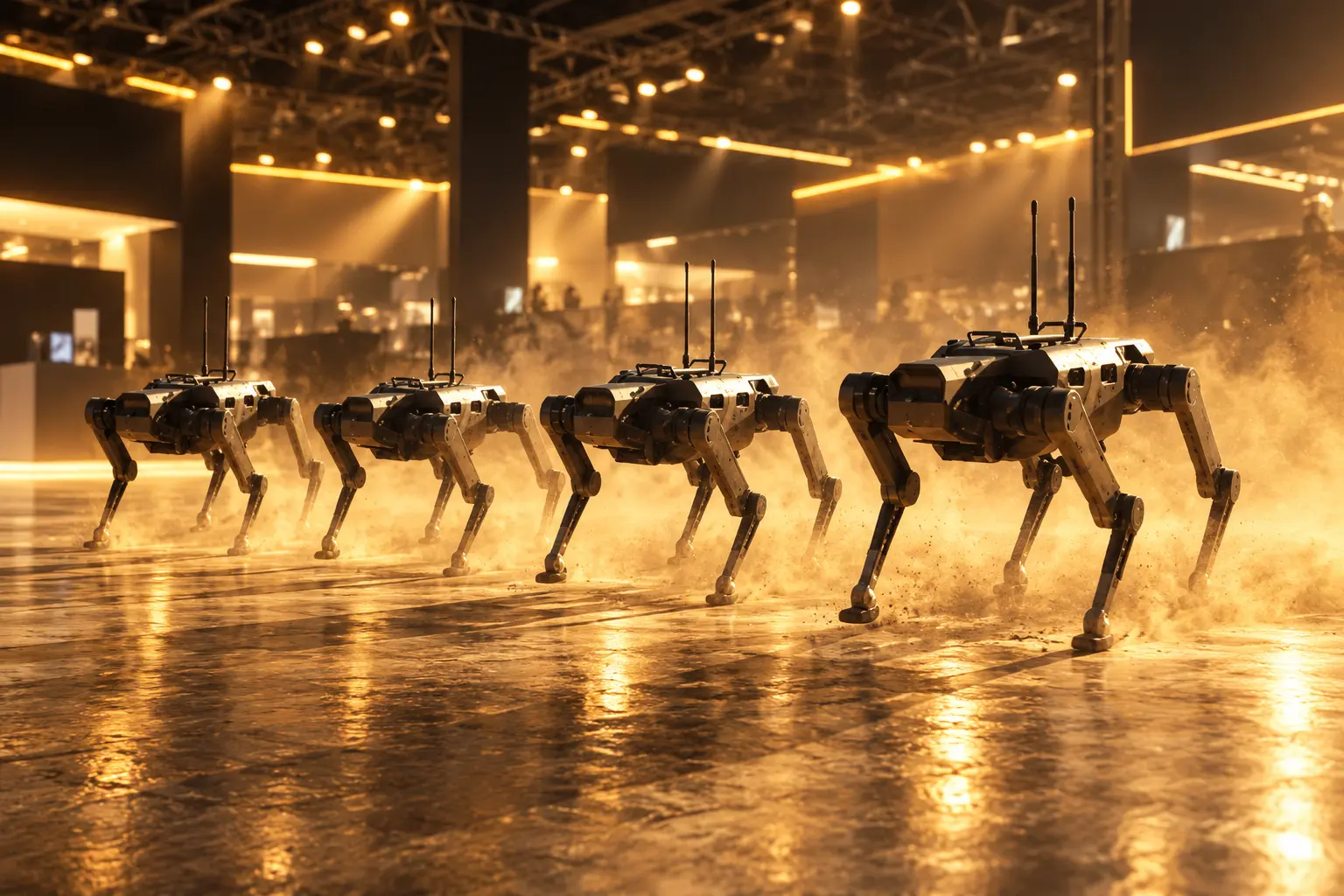
Fifty Ground Vehicles and One Scarce Resource
Eurosatory had dozens of uncrewed ground vehicles on display, from backpack robots to uncrewed trucks. Show counts put at least 50 unmanned ground vehicle makers on the floor, and Ukraine brought over 40 manufacturers, several showing combat robots in public for the first time.
Federico Borsari, a fellow at the Center for European Policy Analysis, said Ukraine leads because it has three years of combat testing and new units built around those machines. He also said formal adoption in meaningful numbers is still missing in other armies. That gap is the opening Shifters is trying to occupy. A teleoperated vehicle still burns one trained person per hull. A supervised team is the way a small unit fields more hulls without hiring a matching set of drivers.
Shifters was not the only firm talking about one-to-many control. Estonian company Ark Robotics used the show to task a robot in Tallinn from Paris. Italy’s IDV, now part of Leonardo, talked about a crewed command vehicle coordinating several uncrewed units. The crowded floor is why a 20-person shop cannot win by bringing a prettier dog. It has to win on the load it takes off the operator.
Inspection and rescue quadrupeds are already a product class of their own, with wheel-leg machines aimed at substations, tunnels and fire grounds. A new chassis in that shape is easy to ignore. A command layer that turns “secure this perimeter” into coordinated motion is harder to copy, if it actually works when the radio drops.
TRUST 50 and TRUST 70 Fit in a Pack
The hardware on the stand was a family of four-legged robots, not a tracked mule. Chaprak described two models on June 17, both built so one person can carry them, and called the base platform a tray with legs when he spoke after the June 3 funding round. Ballin said the robot can lift or carry 15 pounds, 18 pounds, even more within certain parameters, and that it runs about 3.5 meters per second (7.83 mph) on flat ground.
TRUST 50 AND TRUST 70
| Model | Stated weight | How it is carried |
|---|---|---|
| TRUST 50 | just under 40 pounds | backpackable by one person |
| TRUST 70 | just under 50 pounds | backpackable by one person |
Ballin said any payload can be plugged in, and that the company is open on energy, mechanics and software. Chaprak said the robots use Western-made parts, including chips from NVIDIA, with printed circuit boards designed in-house and no Chinese modules. Affordability was a design rule, he said, because a specialized machine a customer can buy five, 10 or 50 of would miss the point. The aim is hundreds or thousands in the field.
On July 3, two weeks after the Paris booth closed, the company posted one of the first clips of its locomotion models running on TRUST itself, with the team audible off-camera.
You can hear our team shouting "Wow!" in the background. For a while now we've had teams advancing two independent efforts:
• Designing and training AI models for stability and maneuverability.
• Designing and building TRUST, our first ruggedized tactical robot.This clip is… pic.twitter.com/FzuVHE1MxL
— Shifters (@shiftersai) July 3, 2026
“Recovery isn’t the story,” the company wrote. “What’s exciting is that our AI is now beginning to live on our own hardware.” That clip is gait and balance, not a finished multi-robot mission. It does show the software and the hull meeting after being built on separate tracks.
The Command Layer Does the Heavy Lifting
Chaprak has said most of the heavy lifting sits in software, with the robots built from simple, available parts so they stay cheap to source and to make. The public stack has three named layers, and the company now lists them on its site in the same order it used in Paris.
THE THREE LAYERS ON THE STAND
- RITA: Robotic Intent To Action, the operator-command layer that turns a human goal into robotic tasking, including point-to-point travel and jobs such as scanning a room, looking for survivors, or searching an underground tunnel.
- ARENA: Autonomous Robotic Execution and Nexus Architecture, the multi-agent layer that coordinates navigation, sensing and execution so several robots act as one unit.
- TRUST: Tactical Robot for Unmanned Safety & Security Tasks, the rugged quadruped family that carries sensors or other payloads into rough ground.
The live script in Paris asked attendees to watch a single operator define boundaries, then supervise several robots as they moved and gathered information. Named settings included collapsed or subterranean search, perimeter security at ports, energy sites, data centers and campuses, remote sensing in degraded sites, and dangerous-entry checks before workers or first responders go in.
The company says the platform follows Modular Open Systems Approach rules, so cameras, scanners and, later, armed kits can ride the same hull. ISR has been the cleanest fit so far, Chaprak said, with perimeter patrol and hazardous-material scans in the same “robots go first” set. He also said the machines can ride other unmanned ground vehicles to the line, then walk from there.
Seed Funding Reaches $15 Million
On June 3, twelve days before the booth opened, Shifters said it had raised a $10.2 million seed round led by Ace Capital Partners, bringing total funding to $15 million. Participating investors were Aurelius Capital Management, Corner Ventures, Arkin Capital, STEP World and Fresh Fund. The money, the company said, is for AI work, manufacturing readiness and a wider footprint in the United States, Europe and the Middle East.
THE MONEY AND THE FOOTPRINT
- Latest seed: $10.2 million, led by Ace Capital Partners, announced June 3, 2026.
- Total raised: $15 million from U.S., European and Israeli investors.
- Headcount: 20 people across Israel, the United States and Europe, with hiring in AI, mechatronics and software.
- Home base: Washington, D.C. headquarters, with operations in the U.S., the Middle East and Europe.
Shimon Tsentsiper, co-founder and managing partner at Ace Capital Partners, backed the motion-control software rather than the silhouette. “Shifters is exactly that kind of company, and the AI motion control layer it is building is exactly the kind of capability we believe will define the next era of ground robotics,” he said. Alon Lifshitz, founding partner at Aurelius Capital, called Shifters a rare mix of operational understanding, technical depth and market timing, and said the hard companies in defense are the ones that have to turn a breakthrough into a field product.
Ballin’s line on the raise was the same thesis he later took to Paris: the first asset into a dangerous place should be a robot, and the funding is meant to make coordinated teams that one operator can direct. Chaprak, who served as a major in the Israeli Air Force before working in video and computer vision in the United States, said the job is a dual hardware and software problem, keeping supervision simple while the machines run in hard terrain.
Contracts, Field Tests, and a Copilot Path
The June 15 release said the stack was already being field-tested on the way to operational deployment. That is not the same as a finished, hands-off team. In a June 3 interview, Chaprak said the product was still under development and would soon reach operational maturity. He said the company already had commercial contracts in defense and national security, and that it worked with the Ministry of Defense, the Israel Defense Forces and foreign entities, with a large share of the work still in development and field trials.
“The robot is remotely controlled, and we are adding advanced autonomous capabilities,” he said. “Ultimately, the goal is full autonomous operation, so the systems can navigate obstacles independently and reach their intended destinations.” He has described that path as a copilot, with more autonomy added in steps. He also said TRUST would be at “TRL eight…if not nine” by the end of the year, and that the firm had already tested the stack with security and national security clients, including units in the U.S. Army.
WHAT WE KNOW
- Public debut: RITA, ARENA and TRUST were shown together at Eurosatory 2026, June 15-19, Booth C213 in Hall 5A.
- Hardware class: two backpackable quadrupeds, TRUST 50 at just under 40 pounds and TRUST 70 at just under 50 pounds.
- Capital: $10.2 million seed on June 3, $15 million total, 20 people on the payroll.
WHAT IS UNCONFIRMED
- Full team autonomy: Chaprak still described the robot as remotely controlled in early June, with autonomy being added.
- Year-end TRL: TRL eight or nine by the end of 2026 is the company’s target, not a scored result.
- Contract scale: IDF, Ministry of Defense, foreign and U.S. Army-unit work is the company’s account; values and unit counts have not been published.
The co-founders Ofer Ballin and Assaf Chaprak started the company in 2023. Ballin is a former IDF colonel who later worked in business development at Kaltura in Boston. Chaprak is listed as a serial entrepreneur in robotics and manufacturing. The wider bench named on the company site includes Eyal Barnea, chief product officer, formerly vice president of product at Hailo and a robotics lead at Intel, and Guy Ostfeld, vice president of software and systems integration, a former 8200 cyber team lead.
Washington Gets the Next Public Look in October
FROM SEED TO AUSA
- 2023: Ballin and Chaprak found Shifters to put robots into dangerous ground before people.
- June 3, 2026: The company raises a $10.2 million seed led by Ace Capital Partners, taking total funding to $15 million.
- June 15-19, 2026: RITA, ARENA and TRUST debut together at Eurosatory, Booth C213, Hall 5A.
- July 3, 2026: Shifters posts the first clip of its locomotion AI running on TRUST hardware.
- October 12-14, 2026: The Association of the United States Army holds its annual meeting in Washington, and Shifters asks visitors to meet the team at AUSA.
AUSA runs October 12-14 at the Walter E. Washington Convention Center, a short walk from the company’s stated home city. That is the next dated public stop after Paris, and it sits in front of the U.S. Army audience Chaprak already says has been in the trial loop. The stack that left Hall 5A is still a copilot on a quadruped that a soldier can carry. The bet Ace Capital wrote the check for is that one operator, not one driver per hull, is what those buyers will pay to own.

Instagram Plus Tests a Read-Only Mode That Cuts Stories

Altman Asks the Public to Accept Some AI Harm

Google Freezes OSS VRP Product Reports After AI Flood

AI Agents Make Payment Rails the Scarce Prize

Turkey’s Crypto Boom Now Runs Through Three Banks

Fable 5 Came Back Under a Commerce On-Off Switch

Google’s SpaceX GPU Lease Has a Sept. 30 Deadline

Plasma One’s XPL Locks Face a 1.81 Billion Cliff

DGO’s Rs 549 World Cup Pass Cost Fans Sleep and Data

Moonshot AI’s $30 Billion Ask Became a $35 Billion Close
-
 AI4 months ago
Fable 5 Came Back Under a Commerce On-Off Switch
-
 AI5 months ago
Google’s SpaceX GPU Lease Has a Sept. 30 Deadline
-
 CRYPTO4 months ago
Plasma One’s XPL Locks Face a 1.81 Billion Cliff
-
 APPS4 months ago
DGO’s Rs 549 World Cup Pass Cost Fans Sleep and Data
-
 AI5 months ago
Moonshot AI’s $30 Billion Ask Became a $35 Billion Close
-

 NEWS5 months ago
ColorOS 17 Device List Spans Oppo, OnePlus and Realme
-
 GAMING4 months ago
The RTX 4050 Under Rs 70,000 Hides a Wattage Gap
-
 AI4 months ago
Boris Cherny’s Loops Still Demand a Higher Production Bar