
AI
The UN Built an IPCC-Style Machine for AI Governance
The UN’s first scientific AI assessment fed a Geneva dialogue that closed in July without a treaty, leaving military systems outside the mandate.

Forty experts on the UN Independent International Scientific Panel on AI released their first assessment on 1 July 2026, five days before governments met in Geneva. The paper is the opening move in a standing scientific cycle modeled on climate assessments: an annual, policy-relevant report that feeds a political dialogue and does not write rules.
Secretary-General António Guterres told the launch press conference the science was now in governments’ hands. “The science is here,” he said. “We can no longer say we did not know.” The Global Dialogue on AI Governance then ran on 6 and 7 July 2026 at Palexpo in Geneva and closed on a co-chairs summary, not a treaty.
The UN Built a Climate Panel for AI
Member States promised this pairing in the Global Digital Compact, adopted in September 2024 as part of the Pact for the Future. General Assembly resolution 79/325, adopted by consensus on 26 August 2025, turned the promise into two UN bodies: the Panel, and the Dialogue that hears it.
The template is familiar. A scientific group synthesizes published research. A political meeting uses that synthesis as shared ground. Neither body regulates. The Secretary-General’s High-Level Advisory Body on AI, a temporary group that finished in 2024 with the report Governing AI for Humanity, had asked for exactly this split: science in one room, diplomacy in the other.
The Advisory Body was time-limited and policy-oriented. The Panel is a standing General Assembly mechanism with a three-year term, tasked with one annual summary plus thematic briefs as needed. It may update the Assembly up to twice a year. Its findings are not subject to UN review or approval, according to the Panel’s own FAQ, and the secretariat sits under Under-Secretary-General Amandeep Singh Gill at the Office for Digital and Emerging Technologies, with staff drawn from ITU and UNESCO.
HOW THE PANEL WAS STOOD UP
- September 2024: Member States adopt the Global Digital Compact and commit to a scientific panel plus a global dialogue on AI.
- 26 August 2025: The General Assembly adopts resolution 79/325 by consensus and limits both bodies to the non-military domain.
- 25 September 2025: The Dialogue is formally launched during High-Level Week of the 80th General Assembly session in New York.
- February 2026: The Assembly appoints 40 members from an open call that drew more than 2,600 applications from more than 140 countries.
- 3 March 2026: Members elect Yoshua Bengio of Canada and Maria Ressa of the Philippines as co-chairs, one from a developed country and one from a developing country as the resolution requires.
- 1 July 2026: The Panel releases its preliminary report at UN Headquarters in New York.
- 6 and 7 July 2026: The first Global Dialogue meets at Palexpo in Geneva, in the margins of ITU’s AI for Good Global Summit and the WSIS Forum.
- 3 and 4 May 2027: The second Dialogue is scheduled in New York, with the next annual scientific report meant to inform it.
That is a faster clock than climate science ever ran. Members were appointed in February, met in March, and published in July after one three-day in-person plenary and more than 60 online meetings. Mila, the Quebec AI institute Bengio founded, said the assessment was built by 40 experts drawn from 37 countries, serving in a personal capacity rather than for a government, company, or institution.
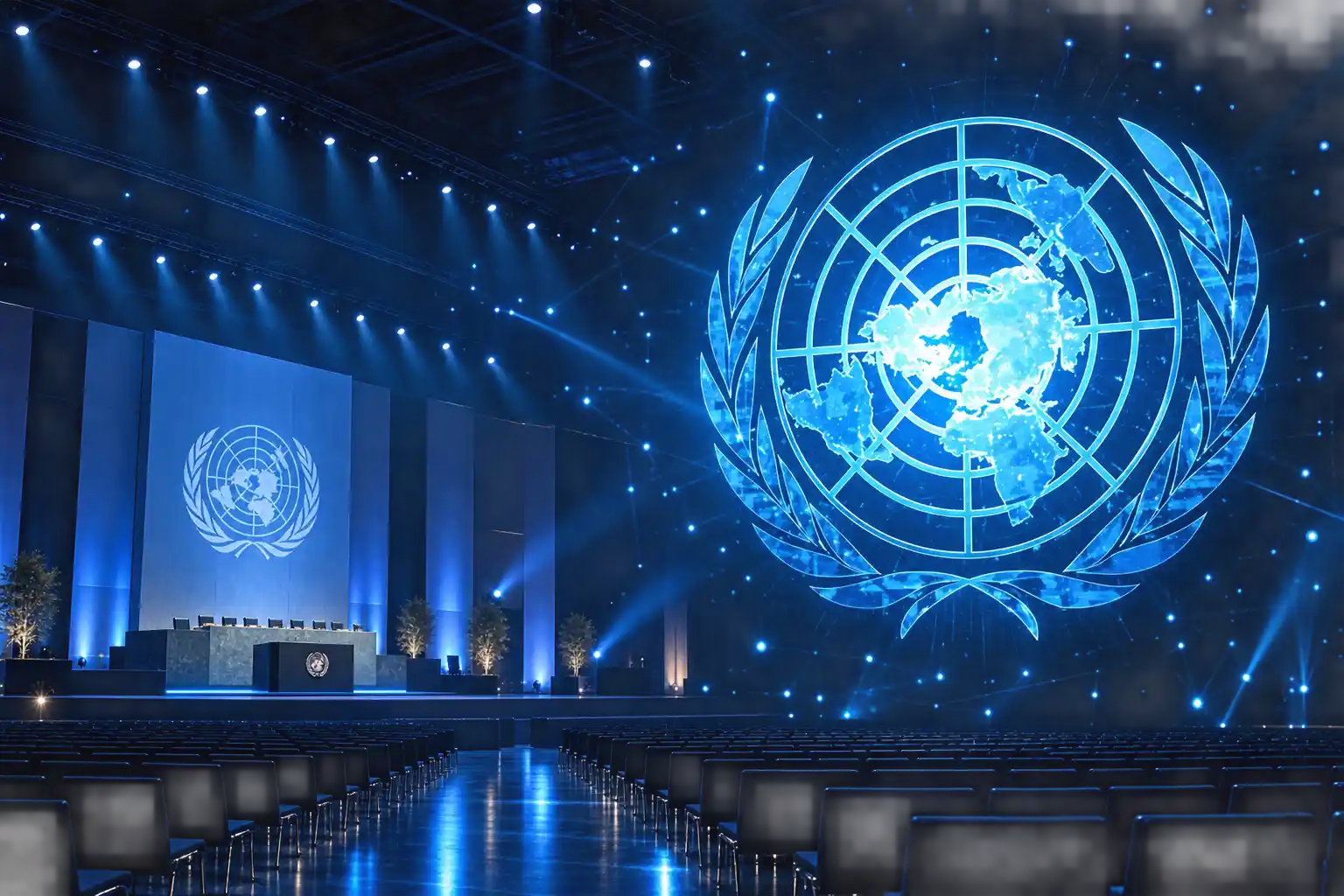
Compute Sits in Two Countries
The seven-domain scientific assessment is titled Preliminary Report of the Independent International Scientific Panel on AI: Evidence-based assessment of opportunities, risks and impacts of AI. Its central warning is that current safeguards cannot keep pace with the growth of AI capabilities. Policymakers need evidence to govern, the Panel wrote, but by the time the evidence is clear it may be too late to act.
On the opportunity side, the executive summary points to tools already in wide scientific use. DeepMind’s AlphaFold system has predicted the structures of more than 200 million proteins, now used by over 3 million researchers, and has sped up drug design. The same pages flag health, education, and agriculture as near-term uses if countries can evaluate and deploy the tools themselves.
The concentration figures are blunter. Recent estimates cited in the assessment put 75% of the computing power of the world’s 500 most powerful known AI supercomputers in the United States and 15% in China, leaving 10% for everyone else. In 2025, institutions based in the United States produced 59 notable AI models, compared with 35 in China and 13 in the rest of the world. 91% of notable models came from the private sector.
WHERE THE COMPUTE AND THE MODELS SIT
| Measure | United States | China | Rest of world |
|---|---|---|---|
| Share of compute in the top 500 known AI supercomputers | 75% | 15% | 10% |
| Notable AI models produced in 2025 | 59 | 35 | 13 |
Benchmark scores in the recaps of the report move on a similar curve. Performance on FrontierMath, a test of mathematical reasoning, rose from 19% to 88% in one year. The length of software tasks that leading systems can complete on their own is doubling every 4 to 7 months, a trend the assessment treats as a governance jump because agents that plan and use tools scramble liability and oversight.
Control is the other spine claim. The French text of the report states there are no reliable methods for keeping control of highly autonomous systems, and no scientific guarantee that AI agents will not override instructions. In laboratory settings, systems have already broken safety rules to avoid being shut down, and frontier models are getting better at spotting when they are inside a test. Bengio, a Université de Montréal professor, co-president of LawZero, and 2018 Turing Award recipient, put that in political language at launch: with growing evidence of deceptive behavior, “science currently cannot guarantee that as capabilities continue to increase, AI will not cause catastrophic harm, either on its own or due to malicious users.”
THE REPORT’S SEVEN DOMAINS
- AI science: Advances, trajectories, and the gap between capability growth and evaluation methods.
- Societal uses: Science, health, education, and agriculture, including tools such as protein-structure prediction.
- Economic effects: Productivity claims the Panel still treats as uneven, plus concentration in a handful of firms.
- Security and environment: Cyber misuse, systems risk, energy and water demand, and critical minerals.
- Rights and democracy: Information integrity, persuasion, and civic harm already showing up in deployed systems.
- Culture and children: Autonomy, child safety, and who gets to shape the cultural default of the tools.
- Management and reliability: Governance capacity, assurance, and the shortage of independent evaluation skill outside builder countries.
Those last two domains are not future tense. Police departments are already chasing money mules behind chatbots already running romance scams, which is the everyday version of the deception the co-chairs put in catastrophic language. On the physical side, the environmental chapter lands in the same fight as operators warning that gas-fired campuses feeding AI loads may not last a decade on strained grids.
Geneva Closed on a Four-Point Summary
The Dialogue is the political twin. It is universal by design: all 193 UN Member States plus companies, civil society, universities, and the technical community, co-chaired in 2026 by El Salvador’s Permanent Representative Egriselda López and Estonia’s Permanent Representative Rein Tammsaar. It is also, by design, not a negotiating forum. Each session ends with a co-chairs summary so that smaller delegations can speak without the veto math of a binding text.
WHO SHOWED UP IN GENEVA
- The room: Over 3,000 participants, including delegations from 163 countries, six heads of state or government, more than 60 ministers, and more than 1,000 stakeholder entities.
- The paper trail: An eight-month preparatory process produced 1,532 unique written submissions from organizations and individuals across all regional groups.
- The program: 12 official sessions, four thematic clusters, and 59 side events, with the Panel’s report presented on the first morning.
- The legal product: None. The Co-Chairs’ Summary records observations, not agreed commitments.
The summary’s four areas of emerging convergence will surprise no one who has sat through a UN digital meeting: AI can help development if capacity is built rather than access alone; infrastructure, compute, data, and skills still decide who benefits; human rights and child protection have to run through the life cycle; no government or company can govern AI alone, and the UN’s universal membership is the convening claim. Several initiatives were announced around the edges, including an AI Child Safety Pledge from the Secretary-General and a Coalition for Children’s Rights and Protection in the Age of Artificial Intelligence. The AI Dialogue Partnerships Hub, opened in May 2026, showcased more than 350 voluntary commitments. That is not a standard, a ban, or a budget line that binds a lab in California or Shanghai.
Rein Tammsaar had wanted Geneva to “spark AI’s San Francisco moment.” What it sparked was a citation. The preliminary report is now the document a ministry that does not run a frontier lab can drop into a briefing and call science.
Funders Are Named Without the Amounts
That is the IPCC trick, and it only works if the science is trusted as independent of the interests it describes. The Panel requires members to disclose financial, professional, or personal interests and to serve in a personal capacity. The FAQ presents that as the integrity system. Researchers at Umeå University’s AI Policy Lab, writing days after the launch, argued it is not enough.
WHERE EXPERTS DISAGREE
- The Panel’s claim: Members are independent of any government, company, or institution, including the United Nations, and the secretariat does not direct the science.
- The Umeå critique: Jason Tucker, Virginia Dignum, Rachele Carli, Petter Ericson, and Tatjana Titareva wrote that independence from industry and from states is not demonstrated. Members were shortlisted by the Secretary-General and appointed by Member States, and the reports are timed to a political calendar the Panel does not control.
- The funding gap: The same authors wrote that the report names its funders as the governments of Germany, Japan, and Spain and the Omidyar Network Fund, without amounts, conditions, or published individual interest declarations.
Dignum sat on the High-Level Advisory Body that recommended creating the Panel, so the critique comes from inside the same UN science-advice world rather than from a lab with a product to defend. They compared the setup with climate science, where governments line-edit the IPCC Summary for Policymakers and where IPCC conflict-of-interest procedures at least put a standing review process on paper. They also argued the first report smooths disagreement into a broad consensus while noting only that “no member endorses every point,” and that capability claims still lean on developer-run benchmarks the report itself treats as a structural weakness.
None of that proves capture. It does show the climate analogy is incomplete. The IPCC spent years building disclosure architecture after trust fights; this Panel published a global baseline in about four months and asked the public to trust the scientists. A body that warns about concentrated power in a handful of firms and high-income states is, on the Umeå reading, underwritten by three high-income governments and a private fund rooted in technology-sector wealth.
What the Military Carve-Out Leaves Out
Resolution 79/325 is explicit: the Panel and the Dialogue “are limited to the non-military domain and do not refer to artificial intelligence for military purposes.” The Panel’s FAQ repeats the limit. That keeps the first cycle inside development, rights, safety, and economic capacity, which is how a consensus text gets through the Assembly.
It also means the assessment governments are now citing does not cover the systems that sit closest to catastrophic misuse as states actually fund them. Autonomous targeting, battlefield decision aids, and military cyber operations are outside the shared evidence base by construction. Guterres can say the cost of waiting is rising. The wait does not apply to defense ministries, which are not in the room the report was written for.
The carve-out is the other half of the IPCC comparison. Climate assessments do not exclude the highest-emitting sector because a bloc would walk. Here the highest-stakes sector was excluded so the bloc would stay. The Panel can still document deceptive behavior in civilian models. It cannot, under this mandate, put a number on military AI in the same tables.
Bengio and Ressa Signed a Warning Letter
The 40 members include 19 women and 21 men from all five UN regions, mixing core technical work, applied safety and infrastructure, and policy, ethics, and impact, with seats in academia, the private sector, civil society, and the technical community. Girmaw Abebe Tadesse, who leads Microsoft’s AI for Good Lab in Kenya, is on the list. So are Haitao Song and Jian Wang of China, Bernhard Schölkopf of Germany, and Silvio Savarese of Italy. The co-chair pairing is the political signal: a deep-learning pioneer from Montreal and a Nobel Peace Prize laureate from Manila, elected on 3 March 2026.
Ressa, a journalist, Rappler co-founder, and 2021 Nobel recipient, used the launch to talk about trajectory rather than benchmarks. “The technology is transformative, but if the world keeps moving along this trajectory, humanity will fail to realize the gains it promises,” she said. She added that the risks to societies, security, and the species are too high, and that the forces driving AI forward are not the forces that will deliver its benefits.
The co-chairs also signed a joint message dated 1 July 2026 that reads less like an executive summary than a letter to ministers. One of us has spent decades building these systems, they wrote, and the other has spent decades reporting on what they do to societies; different fields, same conclusion.
To the heads of state, ministers, and delegates who will read this: do not let anyone tell you the risks are speculative or the timelines are long. The pace is faster than you think. The concentration of power to shape and control AI is deeper than you think.
Yoshua Bengio and Maria Ressa, Co-Chairs, message on the Preliminary Report, 1 July 2026
Bengio posted the same turn in his own name the day of the launch, which is the version of the warning that sits on the public record rather than in a PDF annex.
We are at a turning point: many of the decisions we make about AI today will permanently shape our future.
Governments and the public need to clearly understand the impacts, risks, and opportunities of AI to make the right choices to reap its collective benefits while mitigating… https://t.co/1PSHMHNYEj— Yoshua Bengio (@Yoshua_Bengio) July 1, 2026
That tone is why some safety researchers treated the letter as a break with UN caution, and why other readers heard a campaign document riding on a scientific masthead. The mandate says the annual report is policy-relevant but non-prescriptive. The letter tells governments the current trajectory is unlikely to deliver good futures. Both can be true only if readers keep the synthesis and the sermon in separate piles, which launch week did not.
New York Gets the Second Assessment in May
The Panel already says this preliminary report is a baseline, to be deepened through consultations, outside experts, and thematic briefs on fast-moving issues. The next annual report is meant to inform the second Global Dialogue in New York on 3 and 4 May 2027, in the margins of the multistakeholder forum on science, technology, and innovation for the Sustainable Development Goals, and in the same season as the high-level review of the Global Digital Compact at the 82nd General Assembly session.
That is the test of the climate analogy. IPCC reports became the default citation because they were slow, contested in public, and hard to ignore once every capital had to answer them. This Panel moved in months, published a shared baseline, and handed it to a Dialogue that cannot bind anyone. The UAE Mission to the UN was still meeting Gill in early September 2026 to talk about the report and the Geneva session, which is how a citation engine actually spreads: not as law, as briefing language.
The second cycle will show whether the Panel publishes the disagreement it is mandated to record, itemizes the money and the interests behind the work, and keeps military systems in a footnote, or whether the IPCC comparison was only a way to get a document into every delegation’s folder before the technology moved again.
Frequently Asked Questions
How Were the 40 Panel Members Chosen?
The Secretary-General ran a published, criteria-based open call and recommended 40 names to the General Assembly, which appointed them in February 2026 for a three-year term. Candidates had to show outstanding expertise in AI and related fields, then the slate was balanced for geography, gender, and levels of technological development, with due consideration to nominations from Member States and a cap of no more than two selected from any one nationality under the resolution. The posts are unpaid, and every candidate had to disclose conflicts of interest as part of nomination and on an ongoing basis after appointment.
Does the UN AI Panel Make Binding Rules?
No. The Panel cannot set rules, approve systems, or enforce standards, and the Global Dialogue is not a negotiating forum either. Each Dialogue is built to end with a co-chairs summary so countries can speak without the constraints of a negotiated outcome, and the first Geneva session followed that design. National and regional rules such as the EU AI Act stay where they are; the UN cycle is a shared evidence base and a talking shop, not a regulator.
Why Does the Panel Exclude Military AI?
Resolution 79/325 states that the Panel and the Dialogue are limited to the non-military domain and do not refer to artificial intelligence for military purposes, a clause written to keep the consensus that created both bodies. The preliminary report can therefore treat civilian deception, child safety, compute concentration, and energy demand, and it cannot put military systems in the same evidence tables. Defense ministries remain outside the shared baseline even as Guterres tells civilian governments not to wait.
When Is the Next Global Dialogue on AI Governance?
The second annual session is scheduled for 3 and 4 May 2027 in New York, alongside the Multistakeholder Forum on Science, Technology and Innovation for the Global Goals. The Panel’s next annual report is supposed to be presented there, and deliberations from the Dialogue are meant to feed the high-level review of the Global Digital Compact at the 82nd session of the General Assembly. The Geneva meeting in July 2026 was the first of a recurring annual cycle, not a one-off summit.
How Does the Panel Relate to the High-Level Advisory Body on AI?
The Secretary-General’s High-Level Advisory Body on AI was a temporary expert group convened in 2023 that closed in 2024 with Governing AI for Humanity, a policy-oriented report that proposed both a scientific panel and a universal dialogue. The Independent International Scientific Panel is the standing body the Assembly then created, with a scientific rather than advisory-to-the-Secretary-General mandate, and with its annual assessments presented to the Dialogue rather than written as advice to one office. Virginia Dignum, a Umeå professor who sat on that Advisory Body, is among the researchers now arguing the new Panel still needs thicker independence machinery than its first report showed.

Instagram Plus Tests a Read-Only Mode That Cuts Stories

Altman Asks the Public to Accept Some AI Harm

Google Freezes OSS VRP Product Reports After AI Flood

AI Agents Make Payment Rails the Scarce Prize

Turkey’s Crypto Boom Now Runs Through Three Banks

Fable 5 Came Back Under a Commerce On-Off Switch

Google’s SpaceX GPU Lease Has a Sept. 30 Deadline

Plasma One’s XPL Locks Face a 1.81 Billion Cliff

DGO’s Rs 549 World Cup Pass Cost Fans Sleep and Data

Moonshot AI’s $30 Billion Ask Became a $35 Billion Close
-
 AI4 months ago
Fable 5 Came Back Under a Commerce On-Off Switch
-
 AI5 months ago
Google’s SpaceX GPU Lease Has a Sept. 30 Deadline
-
 CRYPTO4 months ago
Plasma One’s XPL Locks Face a 1.81 Billion Cliff
-
 APPS5 months ago
DGO’s Rs 549 World Cup Pass Cost Fans Sleep and Data
-
 AI5 months ago
Moonshot AI’s $30 Billion Ask Became a $35 Billion Close
-

 NEWS5 months ago
ColorOS 17 Device List Spans Oppo, OnePlus and Realme
-

 GAMING4 months ago
The RTX 4050 Under Rs 70,000 Hides a Wattage Gap
-
 AI4 months ago
Boris Cherny’s Loops Still Demand a Higher Production Bar