
AI
India May Need a New AI Law, IT Minister Vaishnaw Tells PTI
IT Minister Vaishnaw says a new AI law is likely needed in India because the 2000 IT Act predates AI. India is in industry talks on a dedicated framework for synthetic media.

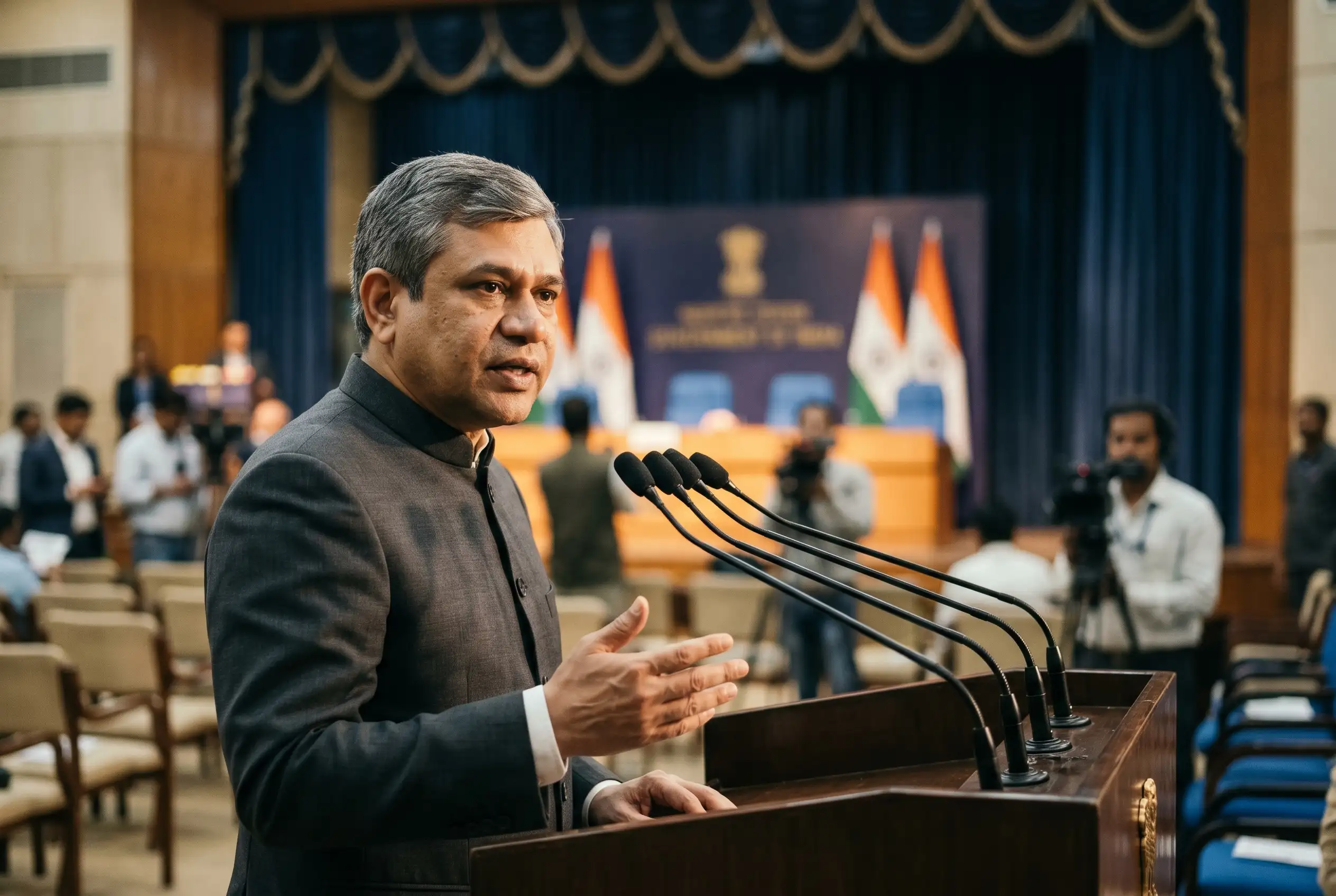
India may get a new AI law. IT Minister Ashwini Vaishnaw told news agency PTI on Tuesday that the 2000 IT Act predates AI and a dedicated statute is likely needed. The government is in talks with industry on a framework that would govern deepfakes, synthetic media, and emerging AI risks.
Vaishnaw stopped short of committing to a timeline. The February 2026 amendments to the IT Rules already brought synthetically generated information under the existing framework and cut takedown windows to three hours. Those amendments haven’t, in the minister’s view, closed the case for fresh legislation. The current architecture is a 2000 statute plus 2021 rules plus 2026 amendments, patched repeatedly to handle a category of technology that didn’t exist when any of them were written. India, the minister said, wants to keep innovation moving while citizens stay safe.
Vaishnaw Tells PTI a New AI Law Is Likely Needed
The Union Minister for Electronics and Information Technology has publicly opened the door to a new AI law for India. Ashwini Vaishnaw told news agency PTI on 9 June 2026 that the IT Act was framed before AI emerged, and that its limits on the technology have grown too wide to close through amendments alone. The minister stopped short of naming a draft, a date, or a sponsoring ministry.
It’s a very complex topic. Certain things have been done under the IT Act framework, but I do think that there is a requirement for a new law because the world of AI is very different from the world when the IT Act was enacted in 2000.
The Union Minister for Electronics and Information Technology, Ashwini Vaishnaw, gave the interview to PTI on 9 June 2026, the same day he told Parliament that existing safeguards were holding up. Read together, the two statements aren’t contradictory: Vaishnaw is saying the rules already in place are working as far as they go, and that they don’t yet go far enough. The goal he stated, the line Indian policy makers return to on this subject, is to balance innovation and regulation in a manner that lets innovation keep happening while citizens stay safe. What shape any future statute would take, whether it would be tabled in Parliament or layered as a delegated regime under the existing IT Act, he didn’t say. The industry consultations he referenced are, for now, the only process he put on the record.
The 2000 IT Act Was Enacted Before AI Reached the Mainstream
The Information Technology Act, 2000 was framed in an era when Indian internet users numbered in the low millions, and the law’s preoccupations were electronic records, digital signatures, and the first wave of cyber offences. The law was notified on 17 October 2000, more than a decade before the deep learning wave that produced today’s generative systems, and more than two decades before ChatGPT. Twenty-six years on, the text has been amended several times, but the architecture is the same. The minister who oversees it now says, in a 9 June 2026 interview with PTI, that the existing framework can’t keep absorbing AI through amendments.
The mismatch shows up most visibly around synthetic media, which has been handled, so far, only through subordinate rules. The February 2026 amendment to the IT Rules is the most recent example.
The fix so far has been to layer obligations on intermediaries under the IT Rules, 2021, not to rewrite the parent law. That is what the 10 February 2026 amendment does, in granular detail. It is also what the 2011 reasonable-security rules do for personal data, and what the Digital Personal Data Protection Act, 2023 does for data processed through AI systems. Vaishnaw’s signal on Tuesday was that this stack of statutes and rules needs a fresh statute on top.
What the February 2026 IT Rules Amendment Changed
On 10 February 2026, the Ministry of Electronics and Information Technology notified amendments to the IT Rules, 2021, effective 20 February 2026. The amendments define “synthetically generated information,” or SGI, and pull it into the existing due-diligence framework for intermediaries. The category covers audio, visual, and audio-visual content that is algorithmically created or modified in a way that makes it appear real or authentic, and indistinguishable from a natural person or real-world event.
Routine editing, accessibility tools, and good-faith educational or template-based content are excluded from the definition. Permitted SGI must carry visible labels and permanent metadata or provenance markers, and platforms are barred from offering tools that strip those markers out. Significant social media intermediaries (SSMIs), defined as platforms with more than 5 million registered users in India, must require users to declare whether content is SGI, deploy technical measures to verify the declaration, and ensure confirmed SGI is clearly labelled. Violations strip an intermediary of safe-harbour protection under Indian law.
- 10 February 2026: MeitY notified the IT Rules amendment.
- 20 February 2026: Effective date for in-scope platforms.
- 3 hours: New takedown window for flagged unlawful AI content, down from 36 hours.
- 2 hours: Takedown window for non-consensual intimate imagery.
- 5 million registered users: Threshold for Significant Social Media Intermediary (SSMI) status.
The Techno-Legal Framework India Has Built So Far
Vaishnaw has been pressing the same case in different settings for months, including a five-layer AI strategy he outlined at Davos 2026. At the World Economic Forum Annual Meeting on 21 January 2026, he argued that AI governance can’t rely on legislation alone and that India would pair policy with technical safeguards. The phrase he used, and the one the government has run with since, is techno-legal, and the goal is to build obligations that can be enforced through code, not just through courts.
The Davos speech made the technical side concrete. India is developing bias-mitigation tools, deepfake detection systems calibrated to be court-admissible, and mechanisms for “unlearning” inside models before enterprise deployment. None of this is in force as binding regulation; all of it is under construction.
The compute side is the most concrete piece. India has built a public-private partnership of 38,000 GPUs as a common facility, accessible to students, researchers, and startups at roughly one-third prevailing global cost. The government is also training 10 million people in AI skills and has overseen $70 billion of data-centre investment from global players including Google, Microsoft, and Amazon. The five-layer stack Vaishnaw described in Davos runs from the application layer down through models, compute, data centres, and energy.
The model layer is the part most often misread. Vaishnaw told Davos that “nearly 95% of AI work can be done using the 20-50 billion parameter models,” a position that fits India’s bet on smaller, localised systems over frontier-scale ones. Stanford’s AI Index, he said at the time, ranks India third globally on AI penetration, preparedness, and talent. The techno-legal framing doubles as the law’s working theory while a new AI statute is being written.
Open Questions for an India AI Law
A new law wouldn’t arrive in a vacuum. India’s current AI-adjacent rules already touch content moderation, intermediary liability, child safety, data protection, and platform-level labelling for synthetic media. The question Vaishnaw hasn’t answered is which of those would move into a new statute, which would stay where they are, and which would be created from scratch.
What is plausible, based on the consultation he has signalled, is a hybrid: an overarching AI statute that sets definitions, risk categories, and obligations for the largest systems, with sectoral rules kept in place underneath. That is the structure the EU AI Act uses, with a horizontal framework and sectoral overlays. India hasn’t announced that it will follow that template, but the contour is what most of Vaishnaw’s 2026 remarks point to.
The list of items the new framework would have to settle is short and politically heavy. None is on the minister’s desk in draft form, and none is more than a year old in the public conversation, which is part of the reason Vaishnaw framed the call as a “requirement” rather than a plan. Each item is a question that any future statute will have to answer, and the government’s posture in the meantime is to keep consulting.
- A statutory definition of AI, distinct from the SGI category in the February 2026 amendment, that covers foundation models and generative systems.
- Risk-based obligations, including a parallel to the EU AI Act’s high-risk category, for AI used in employment, credit, education, and government services.
- Liability rules for harms caused by AI systems, including deepfake fraud, where the current stack offers only sectoral remedies.
- Mandatory transparency and provenance requirements for synthetic media, extending the labelling rules already in force.
- Governance: which body certifies, audits, and enforces the new rules, and how it relates to MeitY, the industry ministry, and the courts.
Frequently Asked Questions
Why is India considering a new AI law?
IT Minister Ashwini Vaishnaw told news agency PTI on 9 June 2026 that the IT Act, 2000 was enacted before AI emerged, and that the limits of the existing framework are now too wide to close through amendments alone. The minister said the government is engaging with industry on what a dedicated statute could look like.
What did the February 2026 amendment to India’s IT Rules change?
The Ministry of Electronics and Information Technology notified the amendments on 10 February 2026, effective 20 February, bringing synthetically generated information into the IT Rules framework. The amendments cut the takedown window for flagged unlawful content to three hours from 36 hours, with a two-hour window for non-consensual intimate imagery, and required labels and permanent provenance markers for permitted synthetic content.
What is “synthetically generated information” under Indian law?
The 2026 amendment defines it as audio, visual, or audio-visual information artificially or algorithmically created, generated, modified, or altered using a computer resource, in a manner that appears real and authentic, depicting or portraying any individual or event as indistinguishable from a natural person or real-world event. Routine editing, accessibility tools, and good-faith educational or template-based content are excluded.
What is India’s “techno-legal” approach to AI regulation?
The term was set out by Ashwini Vaishnaw at the World Economic Forum in Davos on 21 January 2026. It pairs policy with technical safeguards such as bias-mitigation tools, deepfake detection systems calibrated to be court-admissible, and model unlearning mechanisms before enterprise deployment. The framing is that statutory rules alone can’t govern AI; the rules must run partly through code.
How does India’s approach compare with the EU AI Act?
The EU AI Act entered into force on 1 August 2024 and will be fully applicable on 2 August 2026, with risk-based categories ranging from prohibited uses to high-risk systems to transparency obligations. India has so far taken a sectoral approach under the IT Act and the IT Rules, layering obligations on intermediaries, and is now publicly floating a dedicated statute to govern AI more directly.
When could a new AI law be introduced in India?
Vaishnaw didn’t give a timeline. He told PTI the government is in industry consultations, with the stated goal of balancing innovation and regulation, and that a new law is required because the 2000 IT Act predates AI. The consultations, he said, are the next concrete step.


South Korea Retail Investors Face Reckoning After KOSPI AI Rally Collapses

Surrey AI Maps Three Heart Attack Paths and Their Molecular Roots

Germany Locks Neutral Apple ATT Prompts Across Most of Europe

Apple’s 5% EU Fee Quietly Rewrites Alternative App Store Math

Apple’s EU Fee Truce Cuts Complexity but Leaves Rivals Fuming

Pixel 11 Pro Fold Trades Thinness for Durability and Seven-Year Stay

Mayo AI Flags HCM Obstruction From Everyday Ultrasound Videos

Indian Brands Quietly Scale Landmark Screens and Home Tech

Navin Vatsa Turns Grief Into a Lifetime of Quiet Seeing

Google Bets Pixel 11 Agentic AI Will Redefine Phones

Oracle Cuts 21,000 Jobs in a Year, Cites AI in 10-K Filing

Fable 5 and Mythos 5 Return as US Lifts Anthropic Export Controls

SpaceX’s Google Deal Turns a Rocket Company Into a Cloud Landlord

CD Projekt Red Co-CEO: Redemption Arc Isn’t Done, Witcher 4 in 2027

XPL Rallies 30% Ahead of Plasma One Card Tier Launch

Google Search Profiles Build a Follow Graph Inside Discover

DGO App Brings Rs 549 Mobile Pass for FIFA World Cup 2026 in Nepal

Moonshot AI Targets $30 Billion in China’s Fastest AI Funding Sprint

Oppo’s ColorOS 17 Eligibility List Leaves A-Series Buyers Behind

Microsoft Xbox Layoffs Start in July as Sharma Slams 3% Margin
-
 AI2 months ago
Oracle Cuts 21,000 Jobs in a Year, Cites AI in 10-K Filing
-
 AI2 months ago
Fable 5 and Mythos 5 Return as US Lifts Anthropic Export Controls
-
 AI3 months ago
SpaceX’s Google Deal Turns a Rocket Company Into a Cloud Landlord
-
 GAMING2 months ago
CD Projekt Red Co-CEO: Redemption Arc Isn’t Done, Witcher 4 in 2027
-
 CRYPTO3 months ago
XPL Rallies 30% Ahead of Plasma One Card Tier Launch
-
 NEWS3 months ago
Google Search Profiles Build a Follow Graph Inside Discover
-
 APPS3 months ago
DGO App Brings Rs 549 Mobile Pass for FIFA World Cup 2026 in Nepal
-
 AI3 months ago
Moonshot AI Targets $30 Billion in China’s Fastest AI Funding Sprint