
NEWS
Oukitel’s New WP68 Air Rugged Phone Loses to Its Own WP210
Oukitel’s WP68 Air rugged phone runs a 2022-era chipset, and its own WP210 beats it on nearly every benchmark at a similar price.

Oukitel’s WP68 Air packs a 6.88-inch screen, 12GB of RAM and an 8,000mAh battery into a rugged phone that lists for $419.99 direct from the maker, £268.99 in the UK and €359.99 across the EU. TechRadar put it through full benchmark testing and came away unconvinced.
Android 16 and Gemini AI on the spec sheet read like current-generation credentials. The MediaTek Dimensity 7025 chip running underneath first shipped inside 2022’s Dimensity 930, and testing shows it drags the whole phone down, especially next to a cheaper sibling from the same company.
The Dimensity 7025 Is Doing Its Seventh Tour of Duty
Oukitel’s own store lists a 6.88-inch HD+ display and 8,000mAh battery as the WP68 Air’s headline features, alongside 12GB of RAM and 512GB of storage. What the listing does not advertise is the age of the silicon inside.
The Dimensity 7025 is a 6nm chip built on a design that debuted three years ago. TechRadar’s testing found the same processor already running in at least six other devices, including the Oukitel WP300, WP66, WP61 Plus, WP60 and WP55 Pro, plus a rival brand’s RugOne Xever 7 Pro.
The bigger problem sits in the graphics side. The integrated IMG BXM-8-256 GPU cannot fully handle OpenGL or Vulkan, the graphics standards most games and benchmarking tools rely on, which rules the WP68 Air out for serious gaming or VR use.
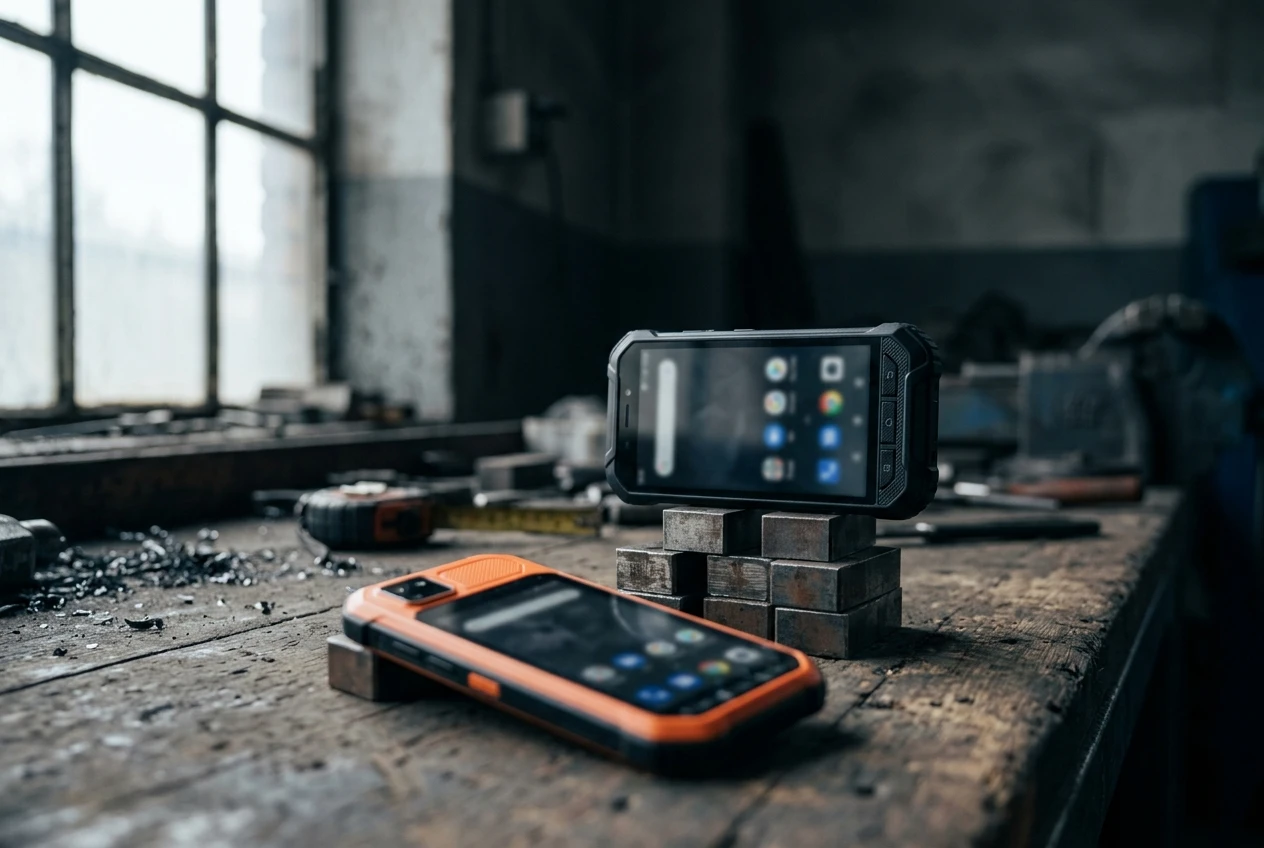
Numbers That Undercut the Marketing
Beyond the chip, several individual specs land below what buyers might expect from a 2026 rugged phone at this price. TechRadar’s review flagged the same pattern across the screen, the battery and the video capture ceiling.
- 8,000mAh battery capacity, modest against rugged rivals that commonly run 10,000mAh to 20,000mAh
- 720 x 1640 resolution stretched across a 6.88-inch panel, softer than rival FHD+ screens of similar size
- 1440p at 30fps video ceiling, with no 4K despite a main sensor rated for it
- 450 nits of screen brightness, dim for reading outdoors in direct sun
The phone also skips wireless charging entirely, even though its flat rear panel and raised camera cluster look built for a charging coil. Instead it relies on a 45W wired charger. Streaming quality takes a hit too, since the phone lacks Widevine L1 certification, capping services like Netflix at 480p regardless of the screen’s own resolution.
Oukitel also fitted a hard plastic bumper rather than the soft TPU case common on rugged phones. TechRadar’s reviewer noted it is difficult to remove without risking damage, and removal is required just to reach the SIM tray underneath.
The WP210 Wins Every Benchmark That Counts
Oukitel already sells a phone built for the same job, and it beats the WP68 Air almost everywhere it matters. TechRadar ran both through identical benchmark suites.
| Spec | Oukitel WP68 Air | Oukitel WP210 |
|---|---|---|
| Chipset | Dimensity 7025 (6nm) | Dimensity 8200 (4nm) |
| GPU | IMG BXM-8-256 | Mali-G610 MC6 |
| Memory | 12GB / 512GB | 12GB / 512GB |
| Battery capacity | 8,000mAh | 8,800mAh |
| Geekbench multi-core | 2,173 | 3,968 |
| PCMark 3.0 score | 12,111 | 13,970 |
| 3DMark Wildlife | 1,373 | 6,023 |
| Battery rundown test | 19h 58m | 22h 44m |
Both phones ship with identical memory and storage, yet the WP210’s 3DMark Wildlife score comes in more than four times higher. The gap narrows only on the PCMark test and the battery rundown, where the WP68 Air holds closer to parity thanks to its lighter overall power draw.
Separate launch coverage from a Russian tech outlet clocked the Dimensity 7025 at roughly 650,000 points in AnTuTu, a figure consistent with a chip built for efficiency rather than raw speed. That tracks with a phone tuned to sip power rather than chase frame rates.
Why Does Oukitel Charge More for the Weaker Phone?
In the US, Oukitel’s own store prices the WP210 about $30 above the WP68 Air, despite giving buyers a faster chip, a sharper screen and a much stronger camera for the extra cost. That math flips entirely in Germany.
On Oukitel’s German storefront, the WP210 runs €319.99, a full forty euros below the WP68 Air’s €359.99 price tag. In the UK, the WP68 Air undercuts the WP210 by about £16, though it was out of stock on the UK site at the time TechRadar tested it.
GSMArena’s coverage of the WP210’s original reveal described a phone built around an 8,800mAh battery with 45W charging and a 108MP main camera, specs that make the pricing gap in Germany especially hard to justify for anyone choosing the newer WP68 Air instead.
Same Company, Two Very Different Phones
Strip away the branding and the WP210 reads like the phone the WP68 Air should have been. TechRadar’s dedicated WP210 review points to a screen upgrade as the clearest difference.
That review describes an AMOLED panel rated at 500 nits, protected by Gorilla Glass 5 and running at 120Hz, against the WP68 Air’s dimmer 450-nit IPS screen. The WP210 also carries a 108MP main camera versus the WP68 Air’s 64MP sensor, plus 10W reverse charging that lets it top up other devices.
The WP210 is not flawless either. Notebookcheck’s independent review found PWM flickering despite its OLED panel, along with colour accuracy that fell short of expectations for the display technology involved.
Even with that caveat, the WP210 still out-benchmarks the WP68 Air by a wide margin, and for buyers weighing both, that trade-off looks easy to accept.
This Same Chip Turns Up Six More Times
The WP68 Air is not an isolated misstep. It is one entry in a much longer list of Oukitel and rival devices built around the same aging processor.
- Oukitel WP300, the larger flagship-tier rugged phone Oukitel sells alongside the WP210
- Oukitel WP66, the heavier, thicker design the WP68 Air was built to replace
- Oukitel WP61 Plus, a walkie-talkie rugged phone with a 20,000mAh battery
- Oukitel WP60, a 10,000mAh rugged phone built around a 108MP camera
- Oukitel WP55 Pro, an 11,000mAh rugged phone in the same mid-range tier
- RugOne Xever 7 Pro, a rival brand’s rugged phone running the identical chip
That kind of overlap points to a wider habit in the budget rugged phone market: launch enough SKUs and eventually two of them compete for the same buyer. When the cheaper option shares a warehouse with a stronger one at a similar price, the newer phone is the one left holding the weaker hand.
For now, the WP68 Air remains available in orange, black and green, priced at $419.99 direct from Oukitel, with the WP210 sitting right beside it in the same catalogue.
Frequently Asked Questions
How Much Does the Oukitel WP68 Air Cost?
Oukitel sells the WP68 Air direct for $419.99 in the US, £268.99 in the UK and €359.99 across the EU, though UK stock was unavailable at the time of testing.
Does the Oukitel WP68 Air Record 4K Video?
No. The 64MP main sensor supports 4K recording, but the Dimensity 7025 chip only processes video up to 1440p at 30 frames per second, so the phone caps out well below its camera’s actual capability.
Is the Oukitel WP210 Better Than the WP68 Air?
Yes, on nearly every measurable spec. The WP210 runs a faster Dimensity 8200 chip, an AMOLED screen and a 108MP camera with reverse charging, and it costs about the same or less depending on the region.
Does the Oukitel WP68 Air Have Wireless Charging?
No. The phone’s flat rear panel looks built for a charging coil, but Oukitel left wireless charging out entirely, relying on a 45W wired charger instead.
What IP Rating Does the Oukitel WP68 Air Carry?
It carries IP68 and IP69K certification alongside MIL-STD-810H, meaning it withstands submersion up to 1.5 meters for 30 minutes and passes military-grade drop and temperature testing.
What Colors Does the Oukitel WP68 Air Come In?
Oukitel offers the WP68 Air in orange, black and green, with the hard plastic bumper adding extra weight over the bare 314-gram body.


South Korea Retail Investors Face Reckoning After KOSPI AI Rally Collapses

Surrey AI Maps Three Heart Attack Paths and Their Molecular Roots

Germany Locks Neutral Apple ATT Prompts Across Most of Europe

Apple’s 5% EU Fee Quietly Rewrites Alternative App Store Math

Apple’s EU Fee Truce Cuts Complexity but Leaves Rivals Fuming

Pixel 11 Pro Fold Trades Thinness for Durability and Seven-Year Stay

Mayo AI Flags HCM Obstruction From Everyday Ultrasound Videos

Indian Brands Quietly Scale Landmark Screens and Home Tech

Navin Vatsa Turns Grief Into a Lifetime of Quiet Seeing

Google Bets Pixel 11 Agentic AI Will Redefine Phones

Oracle Cuts 21,000 Jobs in a Year, Cites AI in 10-K Filing

Fable 5 and Mythos 5 Return as US Lifts Anthropic Export Controls

SpaceX’s Google Deal Turns a Rocket Company Into a Cloud Landlord

CD Projekt Red Co-CEO: Redemption Arc Isn’t Done, Witcher 4 in 2027

XPL Rallies 30% Ahead of Plasma One Card Tier Launch

Google Search Profiles Build a Follow Graph Inside Discover

DGO App Brings Rs 549 Mobile Pass for FIFA World Cup 2026 in Nepal

Moonshot AI Targets $30 Billion in China’s Fastest AI Funding Sprint

Oppo’s ColorOS 17 Eligibility List Leaves A-Series Buyers Behind

Microsoft Xbox Layoffs Start in July as Sharma Slams 3% Margin
-
 AI2 months ago
Oracle Cuts 21,000 Jobs in a Year, Cites AI in 10-K Filing
-
 AI2 months ago
Fable 5 and Mythos 5 Return as US Lifts Anthropic Export Controls
-
 AI3 months ago
SpaceX’s Google Deal Turns a Rocket Company Into a Cloud Landlord
-
 GAMING2 months ago
CD Projekt Red Co-CEO: Redemption Arc Isn’t Done, Witcher 4 in 2027
-
 CRYPTO2 months ago
XPL Rallies 30% Ahead of Plasma One Card Tier Launch
-
 NEWS3 months ago
Google Search Profiles Build a Follow Graph Inside Discover
-
 APPS2 months ago
DGO App Brings Rs 549 Mobile Pass for FIFA World Cup 2026 in Nepal
-
 AI3 months ago
Moonshot AI Targets $30 Billion in China’s Fastest AI Funding Sprint