
NEWS
Generation Z’s Digital Detox Demands Are Rewiring Europe’s Campsites
Generation Z’s demand for phone-free camping is pushing European campsites to add booking apps, contactless check-in and zoned Wi-Fi.

European campsites are spending on booking apps, contactless check-in and zoned Wi-Fi this year to sell Generation Z something it already found on a screen: a weekend without one. Digital natives born between 1995 and 2010, plus the oldest members of Generation Alpha, are pushing new demands onto the continent’s outdoor accommodation sector, and operators who ignore the shift are losing bookings to the ones who don’t.
The twist sits in the middle of the trend. Campers find the glamping tent on TikTok, book it through an app, and post proof of their digital detox before the signal fades. The industry built to sell disconnection runs almost entirely on connection.
The Five-Point Checklist Rewriting Europe’s Campsites
Generation Z, defined in the research as travelers born between 1995 and 2010, is joined by the earliest members of Generation Alpha in reshaping what a European campsite has to offer. The analysis, first published by the trade outlet Tourism Review and echoed almost word for word days later by the Greek outlet Tornos News, narrows the shift down to five habits that decide who gets booked.
- Digital convenience – Online booking, contactless check-in and mobile access to information are now expected from the moment a trip is planned to the moment it ends.
- Unique, shareable stays – Domes, treehouses and other one-off setups beat a standard pitch and a picnic table.
- Visible sustainability – Renewable power, less single-use plastic and a clear waste routine are expected up front, not buried in a brochure.
- An honest option to disconnect – Marked zones with no signal sit next to zones with strong Wi-Fi, so guests choose when to go dark.
- Built-in social interaction – An active social media presence and on-site community moments give guests something to tag.
Combined, the five habits describe one buyer: someone who wants a phone-first booking process and a phone-free option once they arrive, on their own schedule.
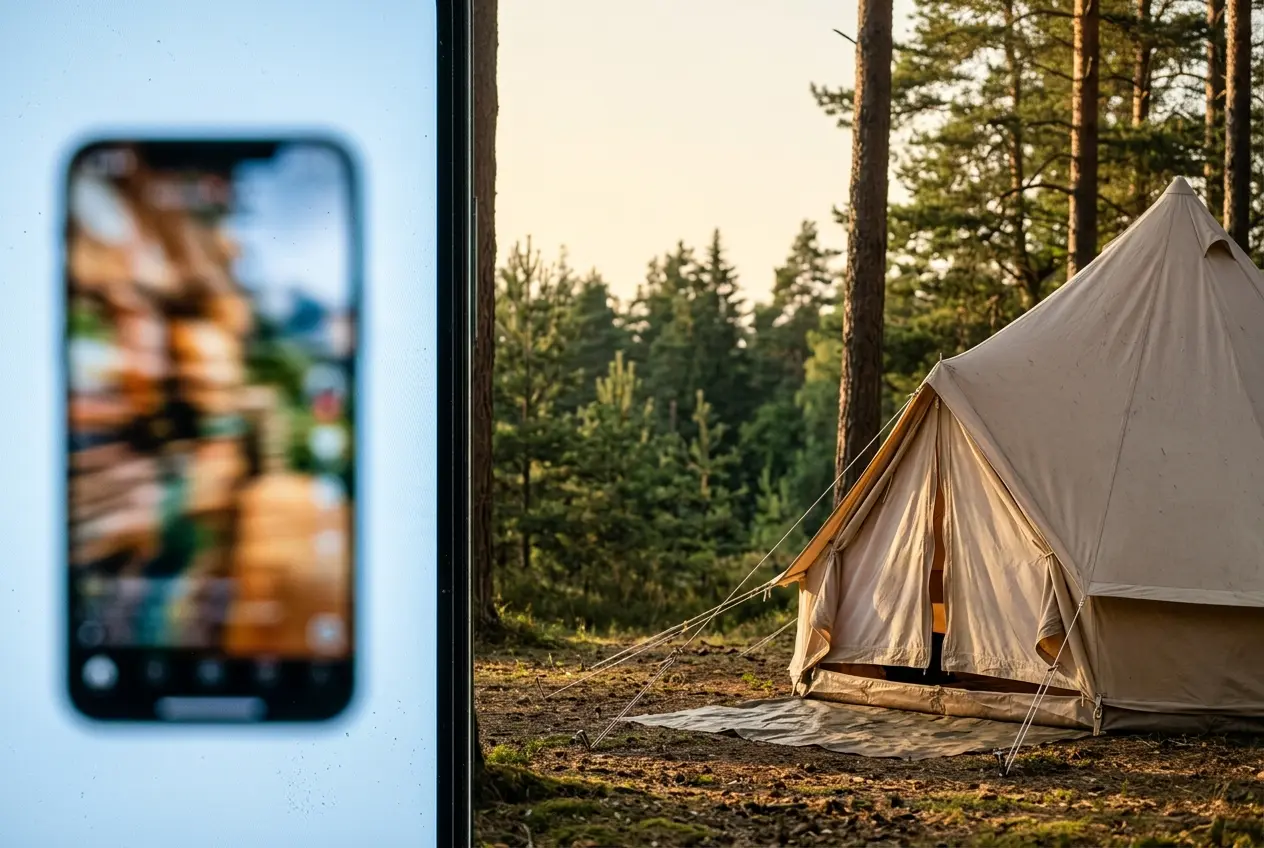
Campsites Chase Contactless Check-In To Sell A Phone-Free Weekend
Outdoor hospitality has changed more in the last five years than in the twenty before it, largely because pandemic-era contactless rules and rising labor costs turned automation into a necessity rather than a luxury. Online booking, digital check-in, mobile-friendly site maps and automated payments are no longer selling points. They are the baseline.
Campground consultancy Firefly Reservations found that parks see a 15-25% jump in reservations within a year of adding online booking, largely from bookings made outside office hours.
Parks that still make guests call during business hours are losing that business to competitors offering booking around the clock. Text messaging has also overtaken email as the preferred channel for younger guests, with confirmations and arrival instructions now running on autopilot once a park sets up the triggers.
How TikTok Turned Off-Grid Into An On-Screen Obsession
Glamping, camping with hotel-grade comforts layered on top, is no longer a niche curiosity. The 2025 State of Outdoor Hospitality Report found that yurts and treehouses now make up 29% of U.S. camping stays, a five-point jump from the year before, and pins the shift on Gen Z travelers booking directly from their phones and skipping traditional travel agencies.
These travelers choose a destination based on the creators they already trust, value experience over possessions, and expect a property to be camera-ready before they arrive. User-generated content does the rest of the marketing. Roughly half of U.S. social media users say they now watch more of it than they did six months earlier.
Outdoor brands have leaned hard into small creators over big names because of it. Micro-influencers with between 10,000 and 50,000 followers accounted for 91% of sponsored glamping collaborations tracked in the report, since their smaller, trusting audiences convert into actual bookings.
In the U.S., Kampgrounds of America (KOA) has watched a similar pattern play out on the ground. Toby O’Rourke, the company’s president and chief executive, says today’s campers want sites “with quality Wi-Fi so they can share their experiences and opportunities to socialize.”
Glamping Aficionados, Tent Traditionalists And RV Loyalists
Industry researchers have started sorting campers into personas rather than age brackets, and the differences show up in what each group books and why.
| Generation | Camping Persona | What They Book | Standout Behavior |
|---|---|---|---|
| Generation Z | Glamping Aficionados | Domes, treehouses and other unique lodging | Expect mobile booking, instant messaging and Instagram or TikTok-ready spaces |
| Millennials | Tent Traditionalists | Traditional tent sites picked for landscape and location | Research trips on social media but value authenticity; open to van life and hybrid stays |
| Gen X and Boomers | RV Comfort Seekers | RVs and cabin-style glamping | Prioritize reliability and on-site services like utility hookups |
The personas come from the American Glamping Association’s read on 2025 booking data. Each group is chasing a different kind of proof: Gen Z wants a photo, millennials want a story, and older campers want a working hookup.
What Happens When The Disconnect Goes Too Far?
Going fully off-grid on a trip can turn a quiet weekend into a real emergency, safety researchers and insurance specialists warn, because a phone doubles as a map, a rescue line and proof for a claim. Wellness marketing has sold total disconnection as the ultimate escape, but for travelers without backup support, it can be the riskier choice.
Michelle Girasole found that out directly. She left her phone in the car for what she expected to be a few quiet minutes chasing sunrise with her dog at a Rhode Island state park.
I ended up being stranded with no water, sunscreen, or way to call for help.
Girasole, a software developer from North Kingstown, Rhode Island, told Forbes she spent the next nine hours lost before a fisherman spotted her on the shoreline.
A survey cited in the same report found that 98% of travelers say they want to disconnect on vacation, and 85% hope to unplug from their phones entirely. “Why anyone would travel, especially internationally, without their cell phone is beyond me,” says John Gobbels, a travel-safety industry executive quoted in Forbes’ reporting on the safety risks of digital detox travel.
The Money Behind The Shift
Follow the numbers and the scale of the shift gets clearer.
- $29.89 billion: the size Mordor Intelligence puts on the U.S. camping and caravanning market in 2026, up from $27.87 billion the year before and on pace to reach $42.35 billion by 2031.
- $6,434: what Gen Z travelers are projected to spend on international trips over the next 12 months, more than any other generation, according to MMGY Travel Intelligence’s Portrait of European Travellers survey.
- 88%: the share of Millennials and Gen Z worldwide keeping or raising their travel budgets in 2026, per Klook’s Travel Pulse study, which also found social content actively shapes booking decisions for 80% of global travelers.
- 72%: the share of campers who call camping a cost-effective way to travel, according to Kampgrounds of America’s 2025 report, even as more of that spending shifts toward glamping upgrades.
Almost none of that money is chasing a low-tech product anymore. It is chasing a curated one.
Wi-Fi Zoning Becomes The New Amenity Line
Connection itself has become a selling point, even at sites built around disconnecting. Campground software firm Campspot found that 82% of travelers say a desire for connection will shape their 2026 travel plans, and campgrounds are positioning themselves as the place that happens face to face rather than through a screen.
The practical answer many European sites have landed on is zoning. Full Wi-Fi coverage runs near reception, the restaurant and family pitches. Certain corners of the property carry no signal at all, marked and left that way on purpose, so guests choose the moment they go quiet instead of having it forced on them by a dead zone in the trees.
That single design choice, cheap to build and easy to market, is quietly becoming as standard a line on a campsite’s amenities page as a swimming pool or a laundry room.
Frequently Asked Questions
How Many Campers Today Are Gen Z Or Millennials?
In the United States, Gen Z and Millennial campers make up 61% of all new campers, according to Kampgrounds of America’s 2025 Camping and Outdoor Hospitality Report. The same report found that over half of new campers now prefer sites with a full range of on-site amenities rather than a bare patch of ground.
Is Going Phone-Free On A Camping Trip Actually Safe?
Not always, according to travel-safety reporting. A phone works as navigation, emergency contact and proof for an insurance claim, and Squaremouth spokeswoman Lauren McCormick says keeping it on hand “allows you to quickly submit insurance documents, photos, and receipts in real time” if a trip goes wrong. Safety experts recommend app-based screen limits over surrendering the device entirely.
Does Generation Alpha Actually Choose Where The Family Camps?
Increasingly, yes. Mastercard’s Travel Trendline report, conducted with The Harris Poll, found that 76% of parents say their child’s interests are the primary factor in choosing a destination, and 85% of parents traveling with Generation Alpha kids say their child has effective veto power over a destination they find boring.
Will AI Replace Social Media As The Main Trip-Planning Tool?
Not yet. Social media still starts the search, but AI now filters it. In the UK, 58% of Gen Z travelers say they feel confident using AI to plan and book trips, up from 38% a year earlier, and 91% of travelers in Klook’s global survey now use AI somewhere in their planning, mostly for research, translation and budget management.
Do Sustainability Claims Actually Change Where Gen Z Books?
They shift the shortlist more than the final decision. Around three-quarters of British holidaymakers already see camping as more environmentally friendly than other kinds of trips, according to Mintel, which means sustainability messaging works best as a tiebreaker between two similar sites rather than the reason someone chooses camping in the first place.
What Happens To Campsites That Skip The Digital Upgrade?
They lose bookings around the clock, according to Firefly Reservations. Parks that still require a phone call during office hours are losing reservations to competitors offering booking at any hour, and the gap tends to show up first in last-minute weekend trade, a segment that increasingly belongs to younger travelers booking on impulse.


South Korea Retail Investors Face Reckoning After KOSPI AI Rally Collapses

Surrey AI Maps Three Heart Attack Paths and Their Molecular Roots

Germany Locks Neutral Apple ATT Prompts Across Most of Europe

Apple’s 5% EU Fee Quietly Rewrites Alternative App Store Math

Apple’s EU Fee Truce Cuts Complexity but Leaves Rivals Fuming

Pixel 11 Pro Fold Trades Thinness for Durability and Seven-Year Stay

Mayo AI Flags HCM Obstruction From Everyday Ultrasound Videos

Indian Brands Quietly Scale Landmark Screens and Home Tech

Navin Vatsa Turns Grief Into a Lifetime of Quiet Seeing

Google Bets Pixel 11 Agentic AI Will Redefine Phones

Oracle Cuts 21,000 Jobs in a Year, Cites AI in 10-K Filing

Fable 5 and Mythos 5 Return as US Lifts Anthropic Export Controls

SpaceX’s Google Deal Turns a Rocket Company Into a Cloud Landlord

CD Projekt Red Co-CEO: Redemption Arc Isn’t Done, Witcher 4 in 2027

XPL Rallies 30% Ahead of Plasma One Card Tier Launch

Google Search Profiles Build a Follow Graph Inside Discover

DGO App Brings Rs 549 Mobile Pass for FIFA World Cup 2026 in Nepal

Moonshot AI Targets $30 Billion in China’s Fastest AI Funding Sprint

Oppo’s ColorOS 17 Eligibility List Leaves A-Series Buyers Behind

Microsoft Xbox Layoffs Start in July as Sharma Slams 3% Margin
-
 AI2 months ago
Oracle Cuts 21,000 Jobs in a Year, Cites AI in 10-K Filing
-
 AI2 months ago
Fable 5 and Mythos 5 Return as US Lifts Anthropic Export Controls
-
 AI3 months ago
SpaceX’s Google Deal Turns a Rocket Company Into a Cloud Landlord
-
 GAMING2 months ago
CD Projekt Red Co-CEO: Redemption Arc Isn’t Done, Witcher 4 in 2027
-
 CRYPTO3 months ago
XPL Rallies 30% Ahead of Plasma One Card Tier Launch
-
 NEWS3 months ago
Google Search Profiles Build a Follow Graph Inside Discover
-
 APPS3 months ago
DGO App Brings Rs 549 Mobile Pass for FIFA World Cup 2026 in Nepal
-
 AI3 months ago
Moonshot AI Targets $30 Billion in China’s Fastest AI Funding Sprint