
AI
Music Industry Launches AI Song Labels as Platforms Stay on the Fence
IFPI, RIAA and six other music groups unveiled voluntary AI-Generated and AI-Assisted labels Friday, though no streaming platform has confirmed adoption yet.

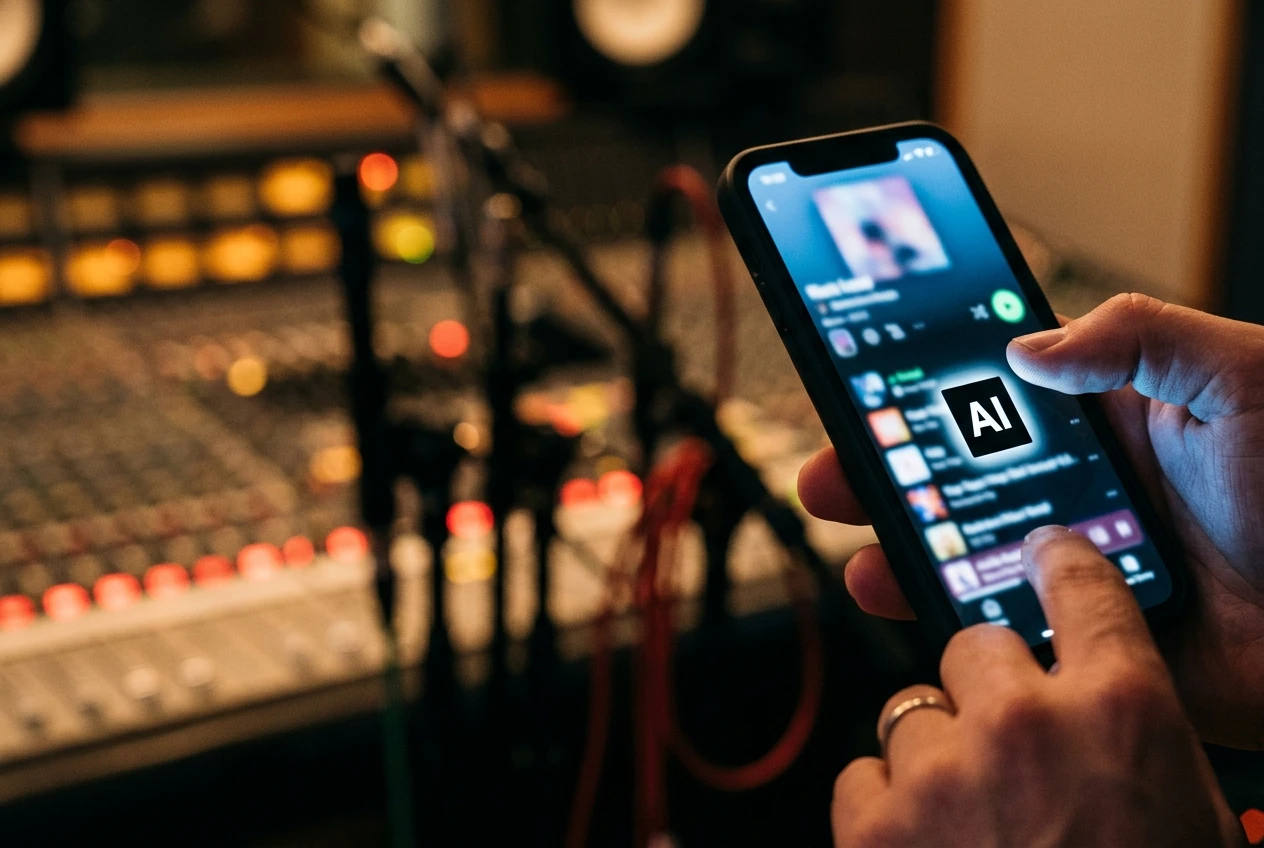
Eight of music’s biggest trade groups agreed Friday on two small icons meant to answer one question for streaming listeners: was a person or a machine behind this song. The Recording Industry Association of America (RIAA) and the International Federation of the Phonographic Industry (IFPI) led the coalition. Grammy Awards organizers, SAG-AFTRA and four other industry groups signed on too.
The labels are voluntary. None of the streaming services that would actually display them, Spotify, Apple Music and Amazon Music among them, have confirmed they will use the exact badges. And the coalition’s own numbers point to a deeper problem the tags do not touch. Bot fraud is pulling royalty money away from working musicians right now, far more than any missing disclosure label.
AI-Generated Tags Borrow a Trick from the Parental Advisory Sticker
The system works like the small explicit warning that has marked recordings for decades. Two icons, both voluntary, are meant to sit next to a track’s title on a streaming service.
One reads AI-Generated, rendered as bold white capital letters on a black square. It applies when generative AI produced the entirety or the primary portion of a recording’s creative elements, according to the criteria defining AI-Generated versus AI-Assisted tracks released Friday.
- An entire song produced from a text prompt, with no human recording session involved
- A lead vocal performance generated by AI, even when the instruments are human played
- A key instrumental performance generated by AI, even when the vocals are human sung
The second label, AI-Assisted, uses lowercase black letters on a white square. It applies when humans performed the lead vocal and primary instruments but used AI for some other expressive element of the recording.
“Fans want to know whether and how generative AI has been used in the music to which they listen,” IFPI chief executive Vikki Oakley and RIAA chairman and chief executive Mitch Glazier said in a joint statement.
The system does not yet cover AI used in lyrics, composition, music videos or cover art. It applies only to the sound recording itself, at least for now.
Deezer’s Uploads Are Now Almost Half Synthetic
The push did not emerge from a vacuum. Deezer’s own upload numbers have climbed steadily since the French streaming service switched on AI detection in January 2025, growing from a few thousand tracks a day to a flood the company itself calls impossible to ignore. Apple Music has separately said a similar share of what lands on its platform never involved a human performer at all.
- 75,000 AI-generated tracks now arrive on Deezer daily, representing 44% of uploads
- 97% of respondents in a Deezer-commissioned Ipsos survey of 9,000 listeners could not tell AI music from human-made music in a blind test
- 80% of the same respondents said fully AI-generated songs should carry a clear label
- 52% said AI-generated songs should not sit alongside human-made tracks on the main charts
Listener enthusiasm has not kept pace with supply. A Luminate study tracking listener sentiment toward AI music found attitudes turned more negative between May and November 2025.
“Across the board, what we found is that consumers are net negative,” said Audrey Schomer, a media analyst and research editor at Luminate who authored the report.
Where the Royalty Money Disappears
Fully AI-generated tracks still account for a small slice of what people actually stream, between 1% and 3% of total plays on Deezer. But 85% of those streams are flagged as fraudulent, likely driven by bots rather than real listeners, and stripped of royalties before payment.
The stakes reach beyond any single platform. A study projecting 25% of creator revenue at risk by 2028, conducted by CISAC, the international confederation of authors’ and composers’ societies, with PMP Strategy, put the potential loss at close to €4 billion (about $4.3 billion).
Independent trackers are trying to put a number on the damage in real time. A site called Slop Tracker estimated fifty AI acts earned $2.7 million on Spotify, pulled from the same royalty pool human musicians depend on.
Some artists say the harm is not evenly spread. R&B singer SZA has said publicly she feels at odds with AI-generated music that mimics the sound of Black artists, arguing the originators of that style cannot collect the streams. Forbes reported in June that the American Federation of Musicians sued Warner Music Group and Universal Music Group, alleging the labels licensed members’ recordings to AI companies without paying the performers who played on them.
How Spotify, Apple, Tidal and Deezer Already Diverge
Streaming platforms did not wait for Friday’s announcement. Each built its own answer to the same question, with different consequences for royalties.
| Platform | Detection Method | Royalty Treatment | Latest Disclosed Figure |
|---|---|---|---|
| Deezer | In-house detection tool running since January 2025 | Demonetizes fraudulent AI streams; excludes AI tracks from recommendations and editorial playlists | 44% of daily uploads, or 75,000 tracks a day |
| Apple Music | Self-reported Transparency Tags from labels and distributors, launched March 2026 | No public royalty penalty; tagging only | More than a third of new uploads flagged as fully AI |
| Spotify | Artist-submitted credits under the DDEX metadata standard, in beta since April 2026 | Verification badge withheld from AI-persona profiles | Tens of thousands of AI credits submitted daily |
| Tidal | Own detection tool identifying wholly AI-generated content | Withholds royalties from tracks it identifies as wholly AI-generated, with stricter enforcement starting soon | Currently applies to 100% AI content, with plans to expand |
None of the four platforms uses the same criteria or icon set the coalition proposed Friday.
Why No Streaming Service Has Signed On Yet
No streaming service, including Spotify, Apple Music or Amazon Music, has publicly committed to using the coalition’s exact AI-Generated and AI-Assisted icons. Their lobbying group, the Digital Media Association (DiMA), offered what amounted to a cautious welcome on Friday, saying it wants more reliable metadata attached to tracks before any rollout.
DiMA chief executive Graham Davies said the group wants labels and distributors to “provide accurate and timely metadata on all music released and distributed.”
Not every stakeholder likes the shape of the plan. A spokesperson for Suno, one of the AI generators facing copyright suits from the major labels, said transparency matters but argued “it should be up to artists and platforms to decide how to treat these complex issues.” Suno chief executive Mikey Shulman has separately described AI music generation as the “Ozempic of the music industry.”
- Suno says labeling choices should stay with artists and platforms rather than one mandated standard, a company spokesperson said
- SAG-AFTRA executive Duncan Crabtree-Ireland calls transparency “only the beginning” of protecting performers from unauthorized AI use
- DiMA wants firmer, more consistent metadata attached to tracks before platforms commit to any rollout
Tidal’s Royalty Ban Arrives Before the New Tags Do
The clearest test of what voluntary will mean in practice starts next week. Tidal, which already writes its own rules on AI music, begins enforcing a policy on July 15: no royalties for tracks it identifies as wholly AI-generated.
Tidal’s policy statement on wholly AI-generated tracks says its priority is “ensuring royalties go to original works directly produced, written, and performed by people.”
The company says it will expand the tag to content it judges substantially AI-generated as detection technology improves. It is also urging AI music creators to disclose AI use before uploading rather than after a listener complaint.
The coalition’s own labels remain a proposal without a single confirmed streaming partner. Whether that changes depends on distributors, aggregators and services agreeing to share the same metadata trail from studio to stream. The coalition said Friday it will keep working with “digital music services, distributors, aggregators and standard-setting bodies” to get there.
Frequently Asked Questions
What is the difference between the AI-Generated and AI-Assisted music labels?
AI-Generated applies when artificial intelligence produced all or most of a track’s core creative work, including a fully prompt-written song or an AI lead vocal or key instrumental. AI-Assisted applies when humans performed the lead vocal and main instruments but used AI for some other creative element. Industry groups say the tags will rely on the DDEX metadata standard already used to route credit information between labels and streaming services.
Does the label system cover AI-written lyrics or AI-made cover art?
Not yet. The current system applies only to sound recordings and excludes lyrics, composition, music videos and cover art. That is narrower than the European Union’s AI Act, which already requires certain AI-generated content sold in Europe to be detectable, unlike the voluntary approach the coalition is proposing.
How many record labels does the coalition behind these labels represent?
IFPI alone represents more than 8,000 record companies worldwide, while A2IM, the trade group for independent labels, represents more than 600 independently owned labels in the United States. Both are among the eight organizations that built Friday’s labeling framework.
Has a fully AI-generated song ever topped a music chart?
Yes. An AI-generated country track called Walk My Walk, credited to the artist Breaking Rust, topped Billboard’s Country Digital Sales chart, according to music industry researchers at Ohio University who tracked the release.
Will artists lose royalties if they do not use the new AI labels?
Not under this specific framework, since disclosure is voluntary and unenforced. Individual platforms already go further on their own. Spotify removed more than 75 million spammy AI-linked tracks in a fraud crackdown last year, separate from any labeling requirement.
What is the Human Artistry Campaign?
It is a global coalition, one of the eight groups behind Friday’s announcement, describing itself as working for responsible AI development across 34 countries and more than 180 member organizations, including recording artists, actors, journalists and athletes.


Pixel 11 Trails Galaxy Phones That Last as Long

OpenAI’s Research Intern Arrives With a Warning Attached

Robinhood Prices XRP Into a Two-Cent 9 a.m. Bet

Sony’s 10 Percent Disc Drop Leaves the 2028 Cutoff Intact

Chip Allocation Sidelines the Base iPhone 18 This Fall

Miami-Dade Fights the Vice City Brand It Already Wears

IFA 2026 Awards Put Tecno Ahead of Flagship Phones

USB-C Gadgets Made the Junk Drawer Rechargeable

Pixel 11 Pro Asks $1,099 for a Light Google Locked

The iPhone Ultra Sells Two Retired Minis as One Foldable

Oracle Cuts 21,000 Jobs in a Year, Cites AI in 10-K Filing

Fable 5 and Mythos 5 Return as US Lifts Anthropic Export Controls

SpaceX’s Google Deal Turns a Rocket Company Into a Cloud Landlord

CD Projekt Red Co-CEO: Redemption Arc Isn’t Done, Witcher 4 in 2027

XPL Rallies 30% Ahead of Plasma One Card Tier Launch

Google Search Profiles Build a Follow Graph Inside Discover

DGO App Brings Rs 549 Mobile Pass for FIFA World Cup 2026 in Nepal

Moonshot AI Targets $30 Billion in China’s Fastest AI Funding Sprint

Oppo’s ColorOS 17 Eligibility List Leaves A-Series Buyers Behind

Microsoft Xbox Layoffs Start in July as Sharma Slams 3% Margin
-
 AI3 months ago
Oracle Cuts 21,000 Jobs in a Year, Cites AI in 10-K Filing
-
 AI2 months ago
Fable 5 and Mythos 5 Return as US Lifts Anthropic Export Controls
-
 AI3 months ago
SpaceX’s Google Deal Turns a Rocket Company Into a Cloud Landlord
-
 GAMING3 months ago
CD Projekt Red Co-CEO: Redemption Arc Isn’t Done, Witcher 4 in 2027
-
 CRYPTO3 months ago
XPL Rallies 30% Ahead of Plasma One Card Tier Launch
-
 NEWS3 months ago
Google Search Profiles Build a Follow Graph Inside Discover
-
 APPS3 months ago
DGO App Brings Rs 549 Mobile Pass for FIFA World Cup 2026 in Nepal
-
 AI3 months ago
Moonshot AI Targets $30 Billion in China’s Fastest AI Funding Sprint