
AI
Webyne Bets a Small Hosting Firm Can Scale to 100 Megawatts
Webyne Data Centre owns just 1 MW of its 10 MW Delhi-NCR footprint but is targeting 100 MW within a year, riding India’s booming AI infrastructure market.

Webyne Data Centre Pvt. Ltd. says it now operates 10 megawatts of Tier III data center capacity across Delhi-NCR. It owns exactly one of those ten.
The Noida-based hosting company wants to reach 100 megawatts within 12 months, a target that would put its claimed footprint within shouting distance of some of India’s biggest AI infrastructure projects. It plans to get there mostly through leased and partnered Tier III facilities rather than buildings it owns outright, a distinction the company’s own July 11 announcement makes plain but does not dwell on.
Only 1 of the 10 Megawatts Is Actually Webyne’s
The announcement, distributed as an advertorial through India PR Distribution, lays out the numbers cleanly. Webyne currently owns and operates 1 MW of this infrastructure, while the remaining capacity is delivered through strategically located Tier III data center facilities, according to the release. That means 9 of the 10 megawatts run on someone else’s floor space, someone else’s cooling systems, someone else’s certification.
Webyne has been in business since 2012, when it launched as a budget VPS provider, according to a company profile from hosting comparison site VPSBenchmarks. Its own website still advertises GPU cloud plans built on Nvidia hardware starting at a few thousand rupees a month, alongside forex trading VPS and gaming server packages. The company’s marketing also separately claims a private Tier III facility in Noida with a second in Mumbai, though the new announcement covers only the Delhi-NCR cluster.
The press release describes a company portfolio that spans several service lines at once. Webyne’s stated offerings include the following:
- GPU cloud – Nvidia-powered instances marketed for machine learning and inference workloads
- Dedicated servers – AMD EPYC and Intel-based bare metal hosting
- Enterprise cloud – managed hosting for business-critical applications
- Storage and networking – backup, S3-style storage, and connectivity services
- AI infrastructure – the newly emphasized category tying the rest together
That range is typical of a mid-size Indian hosting reseller. What is new is the vocabulary. A company that markets ₹4,999-a-month VPS plans is now describing itself as building toward the scale of the country’s hyperscale operators.
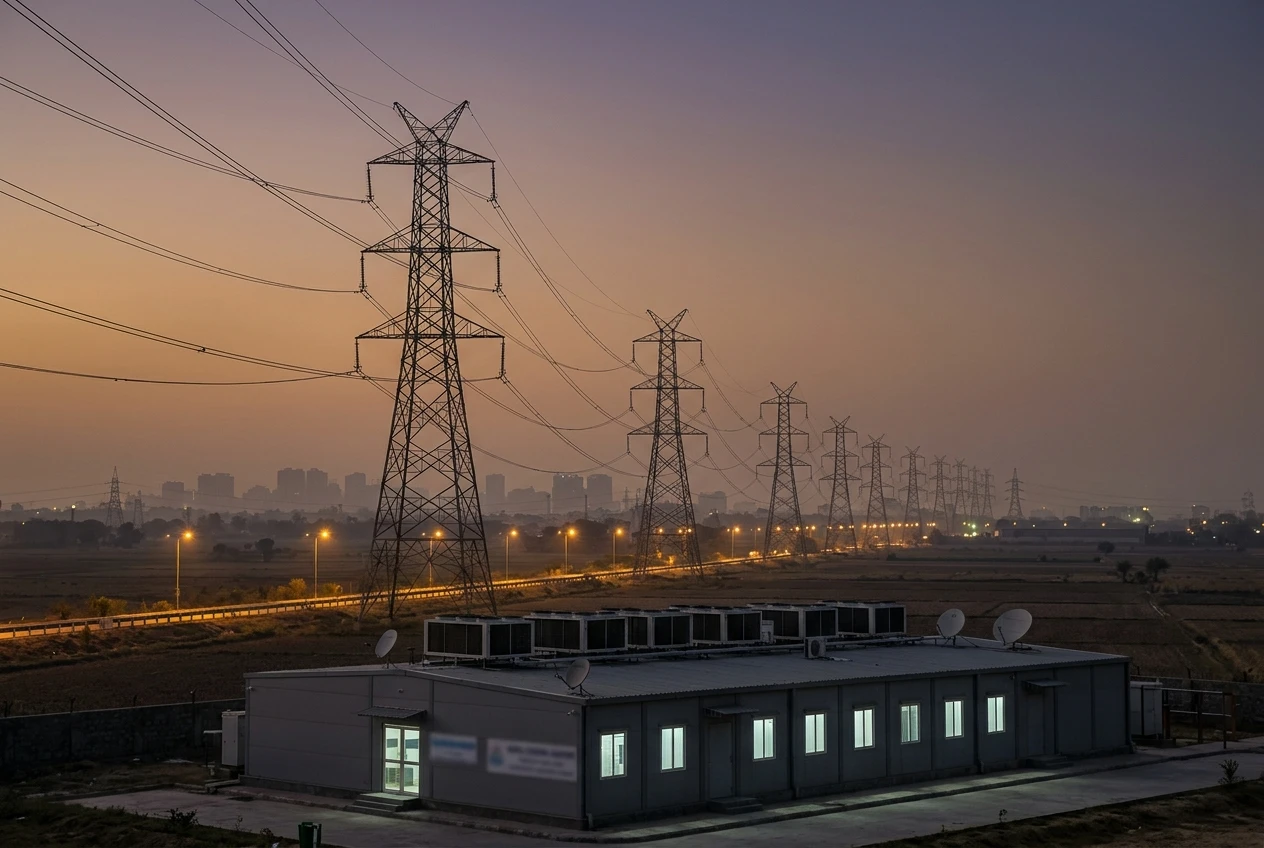
India Added 440 Megawatts of Capacity Last Year Alone
Webyne’s timing is not random. India’s data center sector closed 2025 with roughly 1,700 megawatts of total capacity nationwide, driven by a record 440 MW of new supply, according to CBRE’s India Alternate Sectors Outlook 2026 report, a jump of 160% over the prior year. CBRE expects the country to add roughly 500 more megawatts in 2026, a 30% year-on-year climb.
Investment has kept pace. Cumulative commitments into Indian data centers reached $126 billion by the end of 2025, with $56.4 billion of that arriving in 2025 alone. CBRE projects the total could cross $180 billion in 2026. Real estate consultancy JLL separately put India’s operational IT load at about 1,123 MW by the middle of 2025, with 387 MW added that year, more than double what went in during 2024.
The same boom that gives Webyne room to rebrand is pulling in far bigger checks elsewhere in Asia. In Thailand, energy group Gulf Development has pledged $4.3 billion toward its own AI infrastructure buildout, led by chairman Sarath Ratanavadi, underlining that the region-wide AI infrastructure race now runs on sums well beyond what most colocation resellers can raise.
Webyne’s Bet Looks Tiny Next to Its Named Comparables
Placing Webyne’s numbers next to other recent Indian data center announcements shows the gap in scale, and in disclosed capital.
| Company | Announced Capacity | Disclosed Investment | Location and Timing |
|---|---|---|---|
| Webyne Data Centre | 10 MW now, targeting 100 MW | Not disclosed | Delhi-NCR, 12-month target set July 2026 |
| RackBank | 80 MW, scaling toward 100,000 GPUs | $120 million initial, up to $360 million total | Raipur, Chhattisgarh, announced May 2025 |
| NTT DATA and Neysa Networks | 400 MW AI cluster, 25,000 GPUs | $1.18 billion | Hyderabad, MoU signed April 2025 |
| AdaniConneX | 400 MW campus, 200 MW renewables | Not disclosed in this release | Chennai, commissioned December 2025 |
| Yotta Data Services | 250 MW project with battery storage | $200 million debt raise | Greater Noida, announced November 2025 |
| Microsoft | Regional load lifted to 150 MW | Part of a broader multi-billion-dollar India pledge | Hyderabad, expansion completed January 2026 |
Every other name on that list has either disclosed a dollar figure behind its megawatts or belongs to a company whose balance sheet is public. Webyne has done neither. Startup-tracking platform Tracxn lists the company at 11 to 50 employees with no external funding rounds on record, a profile that looks more like a regional hosting shop than an infrastructure developer chasing nine-figure builds.
Longer term, the entire market Webyne is trying to join keeps expanding. India’s installed data center base is projected to climb from 5.45 gigawatts in 2026 to 15.21 gigawatts by 2031, industry research firm Mordor Intelligence forecasts, a 22.79% compound annual growth rate pushed by AI workloads, cloud localization rules, and hyperscale commitments north of $30 billion from Microsoft and Google combined.
How Much Power Would 100 Megawatts Actually Draw?
A 100 MW facility is not a rounding error. Sustainability researchers studying India’s data center sector note that a hyperscale facility of that size draws electricity on the order of a large village, a comparison that becomes more pointed once a company sets it as a one-year target rather than a hypothetical.
Reaching that figure would put Webyne’s claimed footprint at close to 6% of the roughly 1,700 MW CBRE says the entire country held at the end of 2025. Whether that power gets sourced from owned infrastructure, leased Tier III halls, or some new mix of both is not specified in the July 11 release, which only says the 100 MW target will combine owned infrastructure with strategic expansion across multiple Tier III facilities.
Grid Planners Already Have a Data Center Problem
India’s data center capacity could grow from roughly 1.4 gigawatts today to 9 gigawatts by 2030, according to the Institute for Energy Economics and Financial Analysis, with data centers rising from under 1% of national electricity consumption to about 3% over that span. The country’s grid is already straining to keep up. In the first quarter of 2026 alone, India lost 300 gigawatt hours of already-generated renewable power because transmission lines could not carry it to where it was needed, per energy think tank Ember.
Rapidly scaling AI and cloud infrastructure is placing unprecedented strain on power grids in high-density DC hubs. Consequently, renewable energy procurement has become a structural pillar of supply-side strategy, balancing sustainability with long-term power security.
Ram Chandnani, managing director of leasing at CBRE India, made that comment as part of the same CBRE outlook that tracked the country’s 2025 capacity numbers. Separate reporting has found that data centers draw power equal to a large village once they scale past 100 megawatts, and that more than half of India’s existing facilities sit in water-stressed regions, adding a second resource constraint on top of electricity.
Physical space is tightening too. Rack-mount mainframes and other new hardware are landing in Indian and global markets at the same time that usable data center floor space itself is becoming scarce, a squeeze that hits smaller operators leasing capacity from third parties hardest, since they compete with everyone else for the same limited halls.
Webyne’s Own Deadline Arrives in Early 2027
The company has given itself a public schedule to hit, laid out in its own words rather than an analyst’s model.
- July 2026: Webyne announces 10 MW of Tier III capacity across Delhi-NCR, with 1 MW owned outright and the rest delivered through partner facilities.
- Six to eight months out (roughly early 2027): additional infrastructure is expected to become operational, per the company.
- Twelve months out (roughly mid-2027): Webyne’s stated target of 100 MW total capacity, combining owned and partnered sites.
A company spokesperson framed the push as a response to market conditions rather than a fixed capital plan.
The demand for AI-ready infrastructure is accelerating rapidly. Our focus is on building a resilient, high-performance cloud platform that enables enterprises, startups, and AI innovators to scale with confidence.
That statement, attributed only to a Webyne spokesperson rather than a named executive, is the entirety of the company’s public commentary on how a firm with a few dozen employees intends to fund a hundred-fold jump in scale. Nothing in the release addresses financing, land acquisition, or power purchase agreements, the three items that other companies on the comparison table above disclosed as a matter of course.
The 12-month clock the company itself set runs out around mid-2027. That is when the 100-megawatt number stops being a plan and starts being a fact someone can check.
Frequently Asked Questions
What does Tier III certification actually mean for a data center?
Tier III, a classification from the Uptime Institute, generally requires concurrent maintainability, meaning a facility can take individual power or cooling components offline for maintenance without shutting down customer systems. It sits below Tier IV, which adds full fault tolerance, and is the most common standard cited by Indian colocation providers, including several of the facilities Webyne leases rather than owns.
How much of Webyne’s data center capacity does it actually own?
Just 1 of its stated 10 megawatts. The remaining 9 MW runs through Tier III facilities the company does not own, based on its own July 11 announcement, meaning most of its current footprint depends on continued arrangements with third-party operators rather than assets on its own balance sheet.
How does Webyne’s 100 MW target compare to India’s biggest data center projects?
It is small by comparison. At typical Indian build costs of roughly $4 million to $5 million per megawatt, cited in energy-sector analysis of the country’s data center capex wave, reaching 100 MW would likely require somewhere in the range of $400 million to $500 million, a sum Webyne has not disclosed raising or securing.
Is Webyne backed by outside investors?
Public startup data shows no external funding rounds on record for the company, which is listed with 11 to 50 employees. That contrasts with named rivals in the same capacity range, several of which disclosed specific investment figures or debt raises alongside their expansion announcements.
What is driving India’s broader data center boom right now?
AI workloads, cloud localization rules under the Digital Personal Data Protection Act, and new government incentives are the main drivers. The Union Budget for 2026-27 included a 20-year tax holiday, running until 2047, for foreign cloud providers using Indian infrastructure through domestic resellers, on top of existing tax breaks for data center operators.


South Korea Retail Investors Face Reckoning After KOSPI AI Rally Collapses

Surrey AI Maps Three Heart Attack Paths and Their Molecular Roots

Germany Locks Neutral Apple ATT Prompts Across Most of Europe

Apple’s 5% EU Fee Quietly Rewrites Alternative App Store Math

Apple’s EU Fee Truce Cuts Complexity but Leaves Rivals Fuming

Pixel 11 Pro Fold Trades Thinness for Durability and Seven-Year Stay

Mayo AI Flags HCM Obstruction From Everyday Ultrasound Videos

Indian Brands Quietly Scale Landmark Screens and Home Tech

Navin Vatsa Turns Grief Into a Lifetime of Quiet Seeing

Google Bets Pixel 11 Agentic AI Will Redefine Phones

Oracle Cuts 21,000 Jobs in a Year, Cites AI in 10-K Filing

Fable 5 and Mythos 5 Return as US Lifts Anthropic Export Controls

SpaceX’s Google Deal Turns a Rocket Company Into a Cloud Landlord

CD Projekt Red Co-CEO: Redemption Arc Isn’t Done, Witcher 4 in 2027

XPL Rallies 30% Ahead of Plasma One Card Tier Launch

Google Search Profiles Build a Follow Graph Inside Discover

DGO App Brings Rs 549 Mobile Pass for FIFA World Cup 2026 in Nepal

Moonshot AI Targets $30 Billion in China’s Fastest AI Funding Sprint

Oppo’s ColorOS 17 Eligibility List Leaves A-Series Buyers Behind

Microsoft Xbox Layoffs Start in July as Sharma Slams 3% Margin
-
 AI2 months ago
Oracle Cuts 21,000 Jobs in a Year, Cites AI in 10-K Filing
-
 AI2 months ago
Fable 5 and Mythos 5 Return as US Lifts Anthropic Export Controls
-
 AI3 months ago
SpaceX’s Google Deal Turns a Rocket Company Into a Cloud Landlord
-
 GAMING2 months ago
CD Projekt Red Co-CEO: Redemption Arc Isn’t Done, Witcher 4 in 2027
-
 CRYPTO2 months ago
XPL Rallies 30% Ahead of Plasma One Card Tier Launch
-
 NEWS3 months ago
Google Search Profiles Build a Follow Graph Inside Discover
-
 APPS2 months ago
DGO App Brings Rs 549 Mobile Pass for FIFA World Cup 2026 in Nepal
-
 AI3 months ago
Moonshot AI Targets $30 Billion in China’s Fastest AI Funding Sprint