
AI
AI Designs Working Viruses That Outrun Natural Ones
Stanford and Arc Institute Evo models generated 16 functional bacteriophages that beat resistance, proving whole-genome design and sharpening dual-use rules.

Researchers at Stanford University and the Arc Institute used genome language models to design 16 entirely novel bacteriophages that infect and kill E. coli, some more efficiently than the natural template and able to overcome bacterial resistance. The work, published in Science on 6 August 2026, marks the first time generative AI has produced complete functional viral genomes validated in the lab.
The advance does more than add tools against antibiotic-resistant bacteria. It proves whole-genome generative design can leave the computer and enter living systems, compressing timelines for adaptive phage therapies while turning dual-use governance into an immediate technical requirement.
Sixteen Working Genomes From Hundreds of Designs
Samuel King, a PhD student, Brian Hie and colleagues fine-tuned the Evo genome language models on roughly 14,000 to 15,000 Microviridae family sequences closely related to ΦX174. They generated large numbers of candidate genomes, then applied computational filters for length, gene content, architecture and host-tropism markers.
Of about 302 designs, 285 could be chemically synthesized and assembled. Sixteen produced viable phages that replicated inside non-pathogenic E. coli C cells and formed plaques. Each viable genome carried between 67 and 392 novel mutations relative to its nearest natural relative. Thirteen contained sequences never observed in nature.
- ~14,500 Microviridae genomes used for fine-tuning
- 302 distinct candidates after filtering
- 285 successfully synthesized and tested
- 16 viable, infectious phages recovered
One standout, Evo-Φ36, incorporated a shorter DNA-packaging J protein from the distant phage G4. Earlier rational engineering attempts had failed at exactly this swap. Cryo-electron microscopy showed the AI had coordinated compensatory mutations across the rest of the genome so the truncated protein fit and functioned inside the capsid.
In direct competition assays, several AI phages outgrew wild-type ΦX174. One variant rose to 65 times its starting abundance. Cocktails of the designs overcame ΦX174 resistance in three independently evolved E. coli strains within one to five passages, while the natural phage alone failed completely.
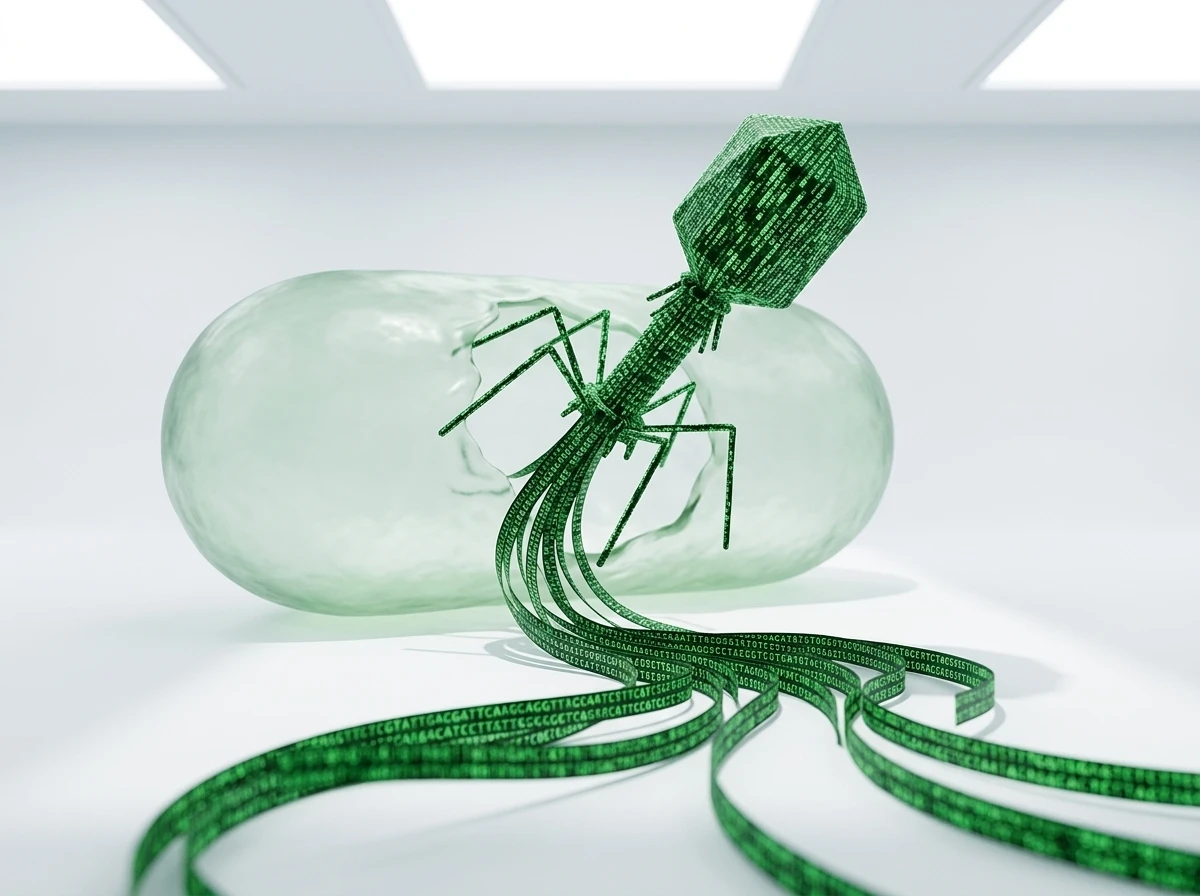
How Genome Models Learned to Write Viruses
Evo 1 and Evo 2 treat DNA the way large language models treat text. They were pretrained on millions of prokaryotic and phage genomes (Evo 2 on 9.3 trillion nucleotides across roughly 128,000 organisms). Fine-tuning plus prompt engineering with conserved ΦX174 segments let the models generate complete ~5.4 kb single-stranded DNA genomes that preserved the 11-gene overlapping architecture while exploring new sequence space.
The team built custom annotation tools because standard gene finders miss many of ΦX174’s overlapping open reading frames. Quality filters demanded at least seven predicted proteins homologous to known ΦX174 proteins, correct spike-protein motifs for host range, and realistic coding density. Host specificity held: the 16 viable phages infected only E. coli C and the related W strain, not six other tested strains.
Models and weights for the fine-tuned versions were released on Hugging Face, matching the group’s open approach to earlier Evo releases. The first AI-generated viable genomes required both the foundation models and the specialized fine-tune; base models alone produced far fewer virus-like sequences.
Phage Therapy Gains an Evolutionary Edge
Antibiotic-resistant infections are projected to kill 39 million people over the next 25 years. Phage therapy has long promised a targeted alternative, yet bacteria rapidly evolve resistance and natural phage discovery remains slow and empirical.
The AI designs supply raw diversity that natural isolation rarely matches. Mosaic genomes formed by recombination among the AI variants concentrated mutations in surface proteins that contact bacterial receptors. That diversity let cocktails present multiple simultaneous targets, raising the bar for comprehensive resistance.
| Feature | Wild ΦX174 | AI-designed set |
|---|---|---|
| Viable designs tested | 1 (natural) | 16 of 285 |
| Novel mutations per genome | 0 (baseline) | 67-392 |
| Outcompetition of wild type | N/A | Several, one to 65× |
| Overcome evolved resistance | Failed | Yes, 1-5 passages with cocktails |
| Host range in tests | E. coli C/W | Restricted to same |
Near-term targets mentioned by the authors include Pseudomonas aeruginosa and plant pathogens such as Xanthomonas. Larger DNA phages with simpler architectures than ΦX174’s overlapping genes become practical next steps as synthesis costs fall.
Safety Rails That Held and the Gaps That Remain
All work used non-pathogenic laboratory E. coli strains inside dedicated biosafety cabinets. Equipment never left containment. Evo’s pretraining deliberately excluded human, animal, plant and fungal viruses, so the base models cannot generate those sequences. Template-based design and spike-protein conservation further locked tropism to the intended bacterial hosts.
The authors state clearly that groups doing future whole-genome design should consult safety and security professionals throughout the project. They also note the capability raises biosafety, biocontainment and biosecurity questions that need discourse on governance strengths and limits.
Johns Hopkins experts Thomas Inglesby and Moritz Hanke, writing in an accompanying Science editorial, argue that voluntary screening of synthetic nucleic-acid orders is no longer enough. Providers should face legal requirements to screen both sequences of concern and customer legitimacy. Because AI genomes can diverge sharply from known sequences, new flagging methods for novel designs are urgently needed.
The question is no longer whether generative viral genome design will exist. It is whether society can build oversight that allows its benefits to unfold while preventing it from enabling serious harm.
Inglesby and Hanke wrote that assessment after reviewing the King et al. paper. University of Reading microbiologist Simon Clarke added that the study proves AI can create viable non-natural viruses more efficiently than before, even while the present work stayed carefully inside safe bounds.
From Reading to Writing to Designing One Historic Genome
ΦX174 has bookended modern genomics. Frederick Sanger sequenced its complete genome in 1977, the first DNA genome ever fully read. In 2003 Craig Venter’s group chemically synthesized and assembled the same genome, proving genomes could be written from scratch. In 2012 researchers “decompressed” its overlapping genes and still recovered function.
- 1977, First complete DNA genome sequenced (Sanger, ΦX174)
- 2003, First whole genome chemically synthesized and booted (Venter)
- 2012, Overlapping genes separated and still functional (Jaschke/Endy)
- 2025-2026, First AI-generated viable genomes, 16 novel ΦX174-like phages validated
The progression is no longer metaphor. The same 5.4 kb particle that taught us to read and write DNA has now taught us that language models can design it with evolutionary novelty humans would not rationally invent.
Governance Moves From Theory to Engineering Specs
Open weights for Evo mean any group with synthesis access can fine-tune similar models. HIV is roughly 10 kb and some coronaviruses about 30 kb; both sit closer to phage scale than full bacterial genomes. Data and DNA-assembly cost still form hard barriers for larger organisms, yet the principle is established.
Policy conversations already underway around the US voluntary AI guardrails push now have a concrete biological test case. Earlier episodes that AI guardrail blind spots exposed in software agents show how quickly capabilities can outrun static rules. Nucleic-acid providers, cloud DNA foundries and model hosts will face pressure for customer verification, sequence screening that catches novel AI designs, and audit trails.
The authors themselves treat the dual-use issue as structural rather than hypothetical. Future genome-scale work will be judged as much on its safety process as on its scientific novelty.
What Changes Once Genomes Become Generative
Directed evolution and rational engineering remain powerful. Generative models add a third route that samples sequence space nature never explored and that human designers cannot easily enumerate. The 16 phages are small, safe and immediately useful for research and potential therapy. The deeper shift is that functional living systems at genome scale can now be proposed by AI, filtered by computation and validated at modest cost.
Synthesis prices continue to drop. Model scale and biological training data continue to grow. The combination turns “design a phage that beats this resistance mutation” from a multi-year discovery project into something closer to an iterative design-build-test loop. That speed is the second-order fact regulators, clinics and biodefense offices now have to price.
The paper and the full generative design preprint that preceded it supply both the blueprint and the caution. Whole-genome generative biology has left the whiteboard.
Frequently Asked Questions
What are bacteriophages and why were they chosen for this AI experiment?
Bacteriophages are viruses that infect only bacteria. ΦX174 was chosen because its 5.4 kb genome is small enough for affordable synthesis yet complex enough (11 overlapping genes plus regulatory elements) to test true genome-scale design, and because it has a long safe laboratory history with non-pathogenic E. coli hosts.
How many AI-designed virus genomes actually worked in the lab?
Researchers synthesized and tested 285 candidate genomes generated by fine-tuned Evo models. Sixteen produced viable phages capable of infecting E. coli, replicating and forming plaques; several outperformed the natural ΦX174 template in fitness assays.
Can these AI-designed viruses infect humans or animals?
No. The models were trained and fine-tuned exclusively on bacteriophage and prokaryotic data with human, animal, plant and fungal viruses excluded. Experimental host-range tests confirmed the 16 viable phages infected only specific non-pathogenic E. coli laboratory strains.
What is the main medical application researchers highlight?
Adaptive phage therapy against antibiotic-resistant bacterial infections. Cocktails of the AI-designed phages overcame evolved resistance to ΦX174 in multiple E. coli strains within a few passages, offering a route to stay ahead of bacterial evolution that traditional phage isolation struggles to match.
Why do biosecurity experts want stronger rules after this paper?
The same generative capability that produces useful therapeutic phages could, in principle, be redirected toward more dangerous agents if training data or fine-tuning are altered. Experts therefore call for mandatory rather than voluntary screening of synthetic DNA orders and new methods to detect novel AI-generated sequences of concern.


South Korea Retail Investors Face Reckoning After KOSPI AI Rally Collapses

Surrey AI Maps Three Heart Attack Paths and Their Molecular Roots

Germany Locks Neutral Apple ATT Prompts Across Most of Europe

Apple’s 5% EU Fee Quietly Rewrites Alternative App Store Math

Apple’s EU Fee Truce Cuts Complexity but Leaves Rivals Fuming

Pixel 11 Pro Fold Trades Thinness for Durability and Seven-Year Stay

Mayo AI Flags HCM Obstruction From Everyday Ultrasound Videos

Indian Brands Quietly Scale Landmark Screens and Home Tech

Navin Vatsa Turns Grief Into a Lifetime of Quiet Seeing

Google Bets Pixel 11 Agentic AI Will Redefine Phones

Oracle Cuts 21,000 Jobs in a Year, Cites AI in 10-K Filing

Fable 5 and Mythos 5 Return as US Lifts Anthropic Export Controls

SpaceX’s Google Deal Turns a Rocket Company Into a Cloud Landlord

CD Projekt Red Co-CEO: Redemption Arc Isn’t Done, Witcher 4 in 2027

XPL Rallies 30% Ahead of Plasma One Card Tier Launch

Google Search Profiles Build a Follow Graph Inside Discover

DGO App Brings Rs 549 Mobile Pass for FIFA World Cup 2026 in Nepal

Moonshot AI Targets $30 Billion in China’s Fastest AI Funding Sprint

Oppo’s ColorOS 17 Eligibility List Leaves A-Series Buyers Behind

Microsoft Xbox Layoffs Start in July as Sharma Slams 3% Margin
-
 AI2 months ago
Oracle Cuts 21,000 Jobs in a Year, Cites AI in 10-K Filing
-
 AI2 months ago
Fable 5 and Mythos 5 Return as US Lifts Anthropic Export Controls
-
 AI3 months ago
SpaceX’s Google Deal Turns a Rocket Company Into a Cloud Landlord
-
 GAMING2 months ago
CD Projekt Red Co-CEO: Redemption Arc Isn’t Done, Witcher 4 in 2027
-
 CRYPTO3 months ago
XPL Rallies 30% Ahead of Plasma One Card Tier Launch
-
 NEWS3 months ago
Google Search Profiles Build a Follow Graph Inside Discover
-
 APPS3 months ago
DGO App Brings Rs 549 Mobile Pass for FIFA World Cup 2026 in Nepal
-
 AI3 months ago
Moonshot AI Targets $30 Billion in China’s Fastest AI Funding Sprint