
AI
Brunei Taps Indonesian AI Firm Jejakin to Verify Mangrove Planting
Brunei’s Carbon AKAR project uses Jejakin’s AI to monitor mangrove survival at Serasa Beach, bringing the Indonesian climate-tech firm’s stack to a new market.

Brunei’s Carbon AKAR mangrove restoration programme opened at Serasa Beach on June 11, 2026, with the country’s first community-led mangrove restoration project going into the ground under a Poni Foundation banner. The launch was hosted by Poni Foundation with support from Poni Group and ASTARI, and ran as part of Ocean Week Brunei 2026 alongside the Brunei Mid-Year Conference and Exhibition 2026.
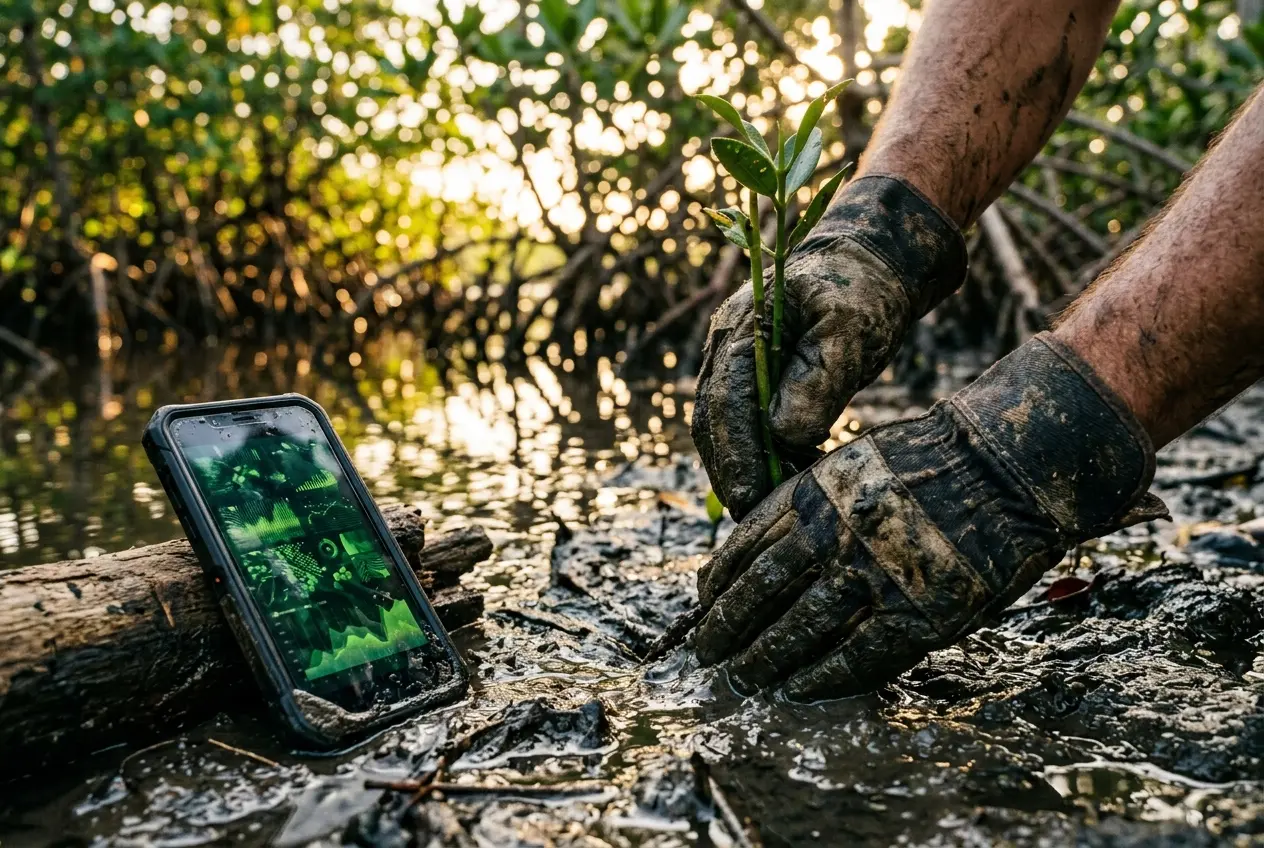
The quiet lever is an Indonesian climate-tech platform called Jejakin, founded in 2018, whose AI mangrove monitoring stack already tracks more than 1 million trees across Indonesia. Under Carbon AKAR, Jejakin brings the same satellite, sensor, and mobile-app backbone the company has built for Indonesian clients to Brunei’s coast, turning mangrove planting at Serasa into a data pipeline companies can use in their emissions reporting.
Brunei’s mangrove bet starts at Serasa
Carbon AKAR was launched on the afternoon of June 11, 2026, at Serasa Beach. The guest of honour was Yang Berhormat Dato Seri Setia Dr Haji Abdul Manaf bin Haji Metussin, Coordinating Minister for Economic Policies and Minister of Economy, Trade and Industry. His presence signalled the government’s interest in tying the project to the country’s broader blue economy planning.
The launch sat inside Ocean Week Brunei 2026, held in conjunction with the Brunei Mid-Year Conference and Exhibition 2026. Poni Foundation hosted, with support from Poni Group and ASTARI. The Ocean Week programme had already opened at Universiti Brunei Darussalam on June 2, drawing more than 150+ participants from government, the diplomatic corps, industry, academia, NGOs, youth groups, sponsors, partners, and ocean advocates.
The event was framed as the launch of Brunei’s first community-led mangrove restoration project, drawing government agencies, industry partners, technology partners, community members, youth, volunteers, and conservation stakeholders to the planting, with the launch positioned as a practical demonstration rather than a ceremonial moment.
- Ocean Week Brunei 2026 launch at UBD Pro Chancellor Arts Centre: more than 150 participants
- 14 events programmed across four weeks for Ocean Week Brunei 2026
- Big Blue Hope dive at Pelong Rocks on June 10, 2026: 333 corals planted
- 2025 Big Blue Hope at Pelong Rocks: 310 corals planted
- Prior Big Blue Hope record at Pelong Rocks: 210 corals
- Reef balls planned for the next phase: 50 each at Pelong Rocks, Jerudong, and Kuala Belait
Poni Foundation built a stack of partners before the first shoot took root
Poni Foundation is chaired by Mohd Tahsin Wong Abdullah, who also serves as CEO of Poni Group, with Anna Aziz as President of the Foundation and Chief Business Officer of the Group. The Foundation’s ocean work traces back to the 2023 Brunei Reef Ball Programme, supported by the Reef Ball Foundation in Florida, and has since expanded through partnerships across Canada, Indonesia, China, Australia, Sabah, and Timor-Leste.
At the Ocean Week Brunei 2026 launch, the Foundation formalised five memorandums of understanding, the centrepiece of Ocean Week Brunei 2026’s blue economy focus. Three of them sit with Chinese marine research institutes, the Fourth Institute of Oceanography of China’s Ministry of Natural Resources, the APEC Marine Sustainable Development Center of the Third Institute of Oceanography, and the Academy of Oceanography under the Guangxi Oceanic Administration. The other two sit with Timor-Leste: Oriental University and Assosiasaun Mariñeiru Timor-Leste. Universiti Brunei Darussalam acts as the education partner and host of the Ocean Week launch.
| Partner | Sector | Country | Role |
|---|---|---|---|
| Fourth Institute of Oceanography, Ministry of Natural Resources | Marine research | China | MoU partner |
| APEC Marine Sustainable Development Center, Third Institute of Oceanography | Marine research / APEC | China | MoU partner |
| Academy of Oceanography, Guangxi Oceanic Administration | Marine research | China | MoU partner |
| Oriental University of Timor-Leste | University | Timor-Leste | MoU partner |
| Assosiasaun Mariñeiru Timor-Leste | Fisheries association | Timor-Leste | MoU partner |
The hidden tech layer: an Indonesian AI firm watches the trees
The Carbon AKAR launch brought mangrove planting into contact with an Indonesian climate-tech platform called Jejakin. Jejakin was founded in 2018 by Arfan Arlanda, Sudono Salim, Andreas Djingga, and Haris Iskandar, with Salim serving as Chief Growth Officer and co-founder. Under Carbon AKAR, Jejakin brings the same stack it has built for Indonesian clients to Brunei’s coast, extending the company beyond its domestic base.
Jejakin’s product line is built on AI and IoT, and ships in three pieces. CarbonIQ is a carbon accounting platform that handles operational emissions across Scopes 1, 2, and 3. CarbonAtlas is the monitoring platform that uses a remote-sensing stack of satellites, IoT sensors, and mobile apps to verify tree planting in the field. CarbonSpace is the integration app that ties CarbonIQ’s accounting to CarbonAtlas’s monitoring. The CarbonAtlas platform already monitors more than 1 million trees planted with Jejakin’s clients and partners across Indonesia.
Jejakin’s Indonesian client roster includes more than 30 companies across sectors, among them Gojek, BCA, Telkomsel, and Indosat Ooredo Hutchison. The firm became a certified B Corporation in October 2023.
In May 2024, Jejakin closed a US$2.7 million funding round, announced via Jejakin’s $2.7 million climate tech funding round on the company’s blog. The consortium included PT ITM Bhinneka Power, Indogen Capital, SMDV, and East Ventures. The plan at the time was to put the capital into R&D, technology upgrades, and market growth. With Carbon AKAR, that stack now points outward. A Southeast Asian AI climate platform is exportable rather than domestic-only.
We are confident it will drive us forward in our mission to enhance environmental conditions by accelerating climate actions with technology.
Arfan Arlanda, CEO and Founder of Jejakin, in a May 2024 funding announcement on the company’s blog.
How the data loop works: satellites, IoT, and AI in the mangrove plot
Jejakin’s CarbonAtlas is a remote-sensing stack that combines satellite imagery, IoT sensors in the field, and a mobile app for ground checks. The point is to turn planting events into verifiable data on carbon sequestration, soil and air quality, and biodiversity.
The same approach is already running on Brunei’s coral side, and it points at the model Carbon AKAR will copy. Poni Foundation’s 2026 coral planting at Pelong Rocks, detailed in coverage of Brunei’s AI-assisted coral planting at Pelong Rocks, added StreamOcean video, eDNA testing, new coral clips, and Reef Cloud to feed an AI and IoT-driven read on biodiversity and reef recovery. The 50 reef balls each planned for Pelong Rocks, Jerudong, and Kuala Belait are intended to support habitat recovery, with the Jerudong and Kuala Belait sites specifically designed to support new fishing grounds for fishermen.
The mangrove plot at Serasa runs on the same backbone, designed to survive the launch. AI-driven monitoring can flag failing saplings, track canopy growth, and estimate carbon stored in both biomass and soil. The model Carbon AKAR offers to companies is closer to a subscription than a donation: a company pays into the project, and the monitoring stack produces the data that backs its emissions claims. The hard part is keeping the monitoring running long after the cameras leave.
Three blue economy pilots ride one platform
Ocean Week Brunei 2026 launched three blue economy pilot projects in parallel, and Carbon AKAR is one of them. They run separately but share Poni Foundation’s network and the data infrastructure Jejakin brings. Wong Abdullah framed the trio at the Ocean Week launch as a way to demonstrate sustainable financial models that keep conservation funded year-round while creating local jobs. Aziz added that Brunei’s blue economy is no longer a future concept and can support sustainable aquaculture, marine biotechnology, and new industries.
The other two pilots sit beside Carbon AKAR. Warisan Oyster is a 10-year river restoration initiative in partnership with Yayasan Sultan Haji Hassanal Bolkiah, focused on oyster reef restoration, sustainable oyster cultivation, and water quality improvement at Kampong Bolkiah, with blue carbon credit exploration built in. TRACKS Brunei focuses on sea turtle conservation, public education, biodiversity monitoring, research, coastal tourism, and marine technology, with future monitoring programmes planned for dugongs and whale sharks.
| Pilot | Focus | Lead partner | Monitoring angle |
|---|---|---|---|
| Carbon AKAR | Mangrove restoration, blue carbon, community jobs | Poni Foundation, with Jejakin as technology partner | AI and IoT, satellite and on-ground verification |
| Warisan Oyster | 10-year river restoration, oysters, water quality, blue carbon credits | Yayasan Sultan Haji Hassanal Bolkiah | Kampong Bolkiah restoration work, credit exploration |
| TRACKS Brunei | Sea turtle conservation, biodiversity, hatcheries, public education | Poni Foundation network | Future monitoring of dugongs and whale sharks |
What Carbon AKAR asks of companies
Poni Foundation has pitched Carbon AKAR as a practical route for companies to take verifiable climate action. The pitch is that participating companies can fund mangrove planting and community training, and in return receive a stream of monitored data they can use in their own emissions reporting.
The model lines up with Brunei’s broader blue economy strategy, as laid out in coverage of Brunei’s blue economy as a growth driver. The Ministry of Primary Resources and Tourism has framed the ocean as integral to national identity, supporting fisheries, food security, coastal communities, tourism, biodiversity, and livelihoods, and has tied it to Wawasan Brunei 2035, the national vision calling for a dynamic and sustainable economy, a highly skilled workforce, and an improved quality of life. The Permanent Secretary at the ministry pointed to sustainable fisheries, aquaculture, marine biotechnology, ecotourism, marine conservation, ocean research, and community-based initiatives as growth sectors.
Jejakin’s own footprint offers a hint of the customer base Carbon AKAR is built to serve. The platform already works with more than 30 Indonesian companies, including Gojek, BCA, Telkomsel, and Indosat Ooredo Hutchison, with the corporate use case running on Scope 1, 2, and 3 carbon accounting layered with nature-based projects. The bet is that what works in Jakarta and Surabaya works in Bandar Seri Begawan too.
- Fund mangrove planting at the Serasa site and future expansion sites
- Support training of local villagers in planting and monitoring work
- Receive monitored carbon data tied to AI and IoT verification
- Tie the contribution to measurable emissions reduction claims
- Accept that the data layer, not the planting count, is the actual product
Why the long horizon is the real test
Ocean Week Brunei 2026 runs 14 events over four weeks, and Wong Abdullah described the year’s emphasis as moving beyond discussion toward practical projects. The coral programme shows the pattern: 2025’s 310 corals at Pelong Rocks beat a prior 210, and the 2026 dive added 333 more. The shape of progress is the same shape Carbon AKAR will need to repeat on the mangrove side.
At the Ocean Week launch, Wong Abdullah said conservation must move beyond awareness by building systems, skills, data, long-term value, and practical opportunities for communities. Poni Foundation’s coral programme already shows what that loop looks like in practice: AI tools, eDNA, and reef balls deployed, with 50 more reef balls planned at three sites and fish returning to existing restoration plots. The mangrove plot now asks the same question of itself. Whether Serasa’s trees are still standing and credibly storing carbon years after the launch is the test the Jejakin stack exists to answer.
Frequently Asked Questions
What is Jejakin?
Jejakin is an Indonesian climate-tech company founded in 2018 that uses AI and IoT to help companies calculate, monitor, and reduce emissions. Its three products are CarbonIQ for carbon accounting, CarbonAtlas for monitoring, and CarbonSpace as the integration app.
What does the CarbonAtlas monitoring platform actually do?
CarbonAtlas uses satellites, IoT sensors, and a mobile app to verify tree planting and track carbon sequestration, soil and air quality, and biodiversity. It currently monitors more than 1 million trees planted with Jejakin’s clients and partners across Indonesia.
How is Brunei’s coral restoration programme already using AI?
Poni Foundation’s 2026 coral planting at Pelong Rocks added StreamOcean video, eDNA testing, new coral clips, and Reef Cloud to measure biodiversity and reef recovery. Current plans include 50 reef balls each at Pelong Rocks, Jerudong, and Kuala Belait.
Why are these three projects grouped together?
Carbon AKAR (mangroves), Warisan Oyster (a 10-year river restoration programme with Yayasan Sultan Haji Hassanal Bolkiah), and TRACKS Brunei (sea turtles) were launched as the three blue economy pilots of Ocean Week Brunei 2026, organised by Poni Foundation.
What role does Universiti Brunei Darussalam play?
UBD hosted the Ocean Week Brunei 2026 launch at the Pro Chancellor Arts Centre, drawing more than 150 participants. Poni Foundation credits it as the education partner connecting research, innovation, and students to national development.


D&D Bets Big on WoW and Star Wars to Grow Its Tables

Game Pass Drops Celeste and Crusader Kings on First Net-Loss Day

Gemini Breaks Basic Calls on Foldable Phones in Android Auto

Citadel Clears AI Fund Overhang While Crypto Stays Flat

Morgan Stanley Staking ETPs Crack Open Crypto Yield for Wealth Clients

Snapdragon Price Hike Forces Premium Buyers Toward Last Year’s Phones

Croc 2 Remaster Unlocks Argonaut’s Full Revival Path

Scale AI Names Google Cloud Veteran deSouza CEO for Enterprise Push

Epic Store Hits Brazilian iPhones Amid Apple’s Familiar Friction Play

LORDNINE Helena Server Races Players Toward Real USDT Rewards

Fable 5 and Mythos 5 Return as US Lifts Anthropic Export Controls

SpaceX’s Google Deal Turns a Rocket Company Into a Cloud Landlord

Oracle Cuts 21,000 Jobs in a Year, Cites AI in 10-K Filing

CD Projekt Red Co-CEO: Redemption Arc Isn’t Done, Witcher 4 in 2027

XPL Rallies 30% Ahead of Plasma One Card Tier Launch

DGO App Brings Rs 549 Mobile Pass for FIFA World Cup 2026 in Nepal

Google Search Profiles Build a Follow Graph Inside Discover

Moonshot AI Targets $30 Billion in China’s Fastest AI Funding Sprint

Microsoft Xbox Layoffs Start in July as Sharma Slams 3% Margin

Oppo’s ColorOS 17 Eligibility List Leaves A-Series Buyers Behind
-
 AI1 month ago
Fable 5 and Mythos 5 Return as US Lifts Anthropic Export Controls
-
 AI2 months ago
SpaceX’s Google Deal Turns a Rocket Company Into a Cloud Landlord
-
 AI1 month ago
Oracle Cuts 21,000 Jobs in a Year, Cites AI in 10-K Filing
-
 GAMING1 month ago
CD Projekt Red Co-CEO: Redemption Arc Isn’t Done, Witcher 4 in 2027
-
 CRYPTO2 months ago
XPL Rallies 30% Ahead of Plasma One Card Tier Launch
-
 APPS2 months ago
DGO App Brings Rs 549 Mobile Pass for FIFA World Cup 2026 in Nepal
-
 NEWS2 months ago
Google Search Profiles Build a Follow Graph Inside Discover
-
 AI2 months ago
Moonshot AI Targets $30 Billion in China’s Fastest AI Funding Sprint