
NEWS
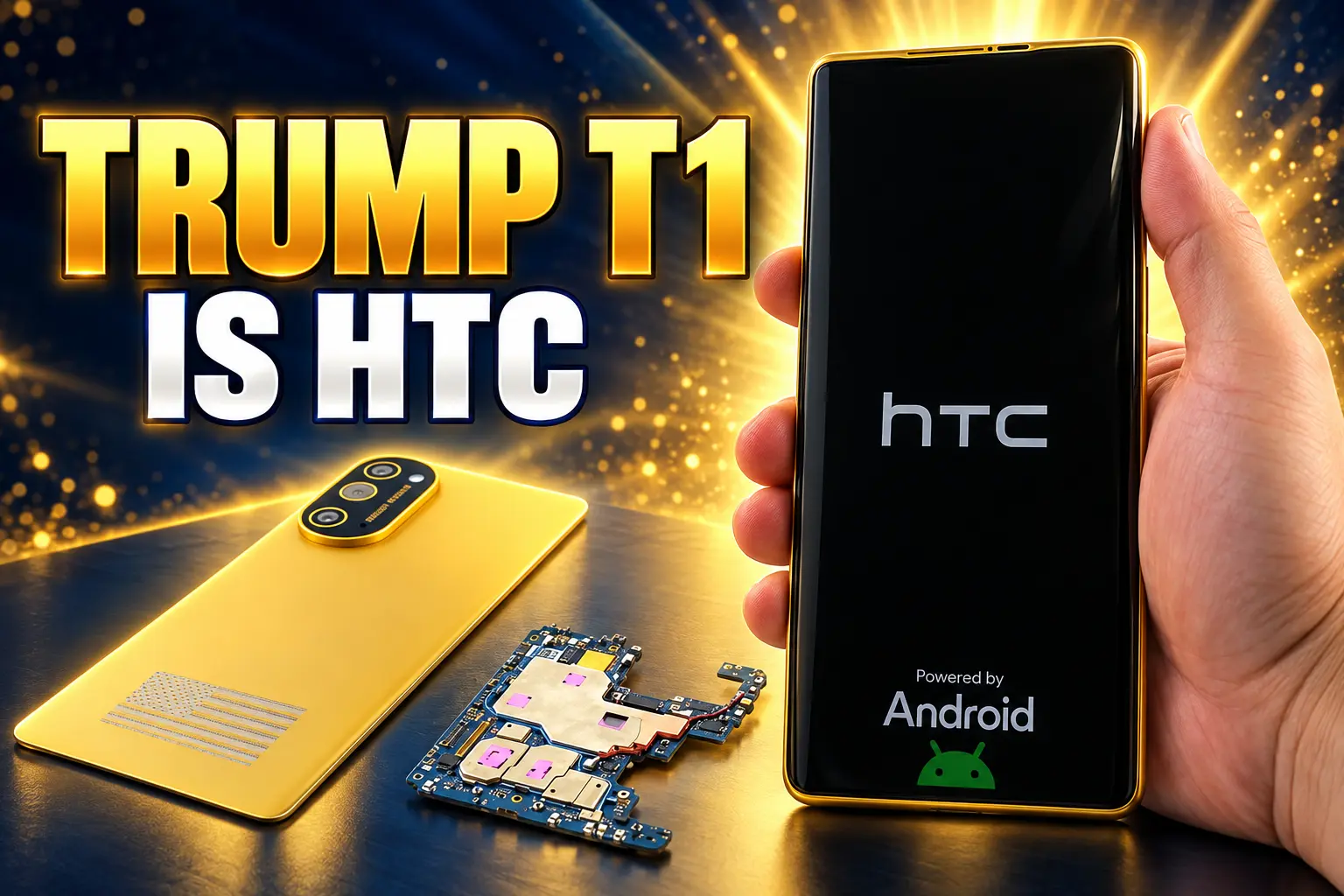
iFixit Confirms the Trump T1 Phone Is an HTC
iFixit’s CT scan and board swap show the $499 Trump T1 is a gold HTC U24 Pro, built for a tiny order with a Philippine battery and a 3/10 repair score.

iFixit technician Shahram Mokhtari ran a gold Trump T1 phone through a Lumafield CT scanner on June 10, 2026, in San Luis Obispo. The radiographs matched 2024’s HTC U24 Pro before a single screw came out. He then seated the HTC board in the Trump shell, and the hybrid booted.
Trump Mobile had sold the $499 handset as an American product. What the scan showed was a small-run ODM phone with a longer flash cable, a new cell, and almost no time for a new design.
A CT Scanner Settled the Gold Phone in Minutes
Mokhtari had already seen the T1 on a video call with a television network that sent its media sample to iFixit’s lab. The camera island and flash looked slightly off from the U24 Pro, so the team scanned both phones, opened the backs, and compared boards side by side. CT scans and a full teardown left little to argue about.
Even from the initial radiographs, the answer was clear: the internals are nearly an exact match for the HTC U24 Pro.
Shahram Mokhtari, iFixit teardown technician, iFixit
The flash contacts on the board had not moved. The flex cable was simply longer, a cosmetic shift. The aluminum chassis is almost the same; only the speaker hole pattern is different, over drivers that sit in the same place. Screw holes and anti-tamper stickers line up. Both listed screens, 6.78 inches on the T1 and 6.8 inches on the U24 Pro, use Samsung’s Diamond Pixel layout at the same density under an industrial microscope, and Mokhtari could not measure a real gap.
On June 11, iFixit posted the scan photos from that session.
First The Verge spotted the resemblance. Then NBC brought the Trump Phone to our San Luis Obispo office so we could get past the gold paint.
CT scans and a full teardown confirmed it: the T1 is nearly identical to the HTC U24 Pro. Same internals. Same layout. Same story, just… pic.twitter.com/lM0mEviXX4
— iFixit (@iFixit) June 11, 2026
Both boards carry Qualcomm’s SM7550, the Snapdragon 7 Gen 3 platform, with 12GB of LPDDR5 and 512GB of storage. The T1’s memory package is from Micron. The U24 Pro unit iFixit opened used SK Hynix. Swapping storage vendors between runs is ordinary, and the HTC board running in the gold body closed the case. The only hardware change that matters sits in the battery bay.
T1 VERSUS THE HTC U24 PRO
| Item | Trump T1 | HTC U24 Pro |
|---|---|---|
| Chip | Snapdragon 7 Gen 3 (SM7550) | Snapdragon 7 Gen 3 (SM7550) |
| Memory package | Micron, 12GB + 512GB | SK Hynix, 12GB + 512GB |
| Battery energy | 19.35 Wh, 30W charge | 17.23 Wh, 60W charge |
| Marketed cell rating | 5,000 mAh | 4,600 mAh |
| Repair score | 3/10, provisional | 3/10 |
| Price | $499 | about $490 to $525 on import |
Mokhtari put it bluntly: against the 512GB U24 Pro, the T1 is not a gouge. You lose 60W charging, and you get a gold shell. People who followed the teardown already treated a secret American phone lab as a fantasy. The surprise was that the bill of materials still lands near a midrange Android, not that the board matched.
The Philippine Cell Plant Registered in 2025
The T1 cell is listed at 19.35 Wh against 17.23 Wh in the U24 Pro, in a pack of almost the same size. Trump Mobile rates it at 5,000 mAh; HTC rated the older phone at 4,600 mAh. Charge power falls from 60W to 30W, and the in-box brick drops with it.
The cell comes from Newlix Mfg Inc, a Philippine company with no public website that iFixit found, registered in 2025, around the T1 announcement. Most consumer-electronics cells still come from mainland China, where the raw materials, the lines, and the prices sit. A Philippine pack on a $499 phone is a volume tell: the run was not large enough to interest a major cell maker.
THE ORDER BOOK IN PLAIN FIGURES
- Viral preorders: A round figure of 600,000 T1 preorders spread online and was never backed by the company or by a primary filing.
- Leak scale: iFixit pointed to a customer-data leak putting combined phone and plan sales in the region of 30,000.
- Deposit: Buyers put down $100, and CEO Pat O’Brien would not give a preorder count, citing competition.
- Plan: The companion Trump Mobile service is $47.45 a month on a T-Mobile MVNO, with or without the gold handset.
Phone factories plan in the millions. An order near 30,000 does not open a new line, and it does not get you a custom battery from a first-tier Chinese pack plant. It gets you whoever still has the U24 Pro molds warm, plus a new cell shop willing to take a small book. That is the joke inside the patriotic supply chain: the least Chinese-looking part exists because the Chinese majors had no reason to bid.
Executives Don Hendrickson and Eric Thomas have said final assembly happens in Miami from about 10 pieces, and Thomas called it more than slapping a cover on. Mokhtari’s working guess is that the cell, cameras, USB-C module, speakers, haptic engine, and board could be among those pieces, while the chassis and curved glass likely arrive already joined, because curved displays are ugly to seat in a small US shop.
Three Slogans and an 11-Stripe Flag
The origin line moved faster than the phone. On June 16, 2025, at Trump Tower, the Trump Organization press release called the T1 a gold smartphone “proudly designed and built in the United States.” Partner Pat O’Brien said they were going to build phones in America. Eric Trump, in a later clip, said “eventually” the phones can be built in the United States, which is a different promise.
HOW THE ORIGIN LINE SHRANK
- June 16, 2025: Launch copy says designed and built in the United States, at $499, with an August 2025 target.
- Late June 2025: Within two weeks the site drops Made in USA. Later public language includes “designed with American values in mind,” “proudly American,” and “shaped by American innovation.”
- January 2026: Sen. Elizabeth Warren and 10 other Democratic lawmakers ask the FTC to look at the origin ads and the $100 deposits that had not produced phones.
- May 13, 2026: O’Brien says preordered units are going out and that early T1 phones are assembled in the US. The box reads “Proudly Assembled in the USA.”
- June 10, 2026: iFixit publishes the scan and the board swap.
Spokesperson Chris Walker still told a newspaper after the site change that the phones “are proudly being made in America” and that contrary talk was “simply inaccurate.” Hendrickson later called US manufacturing a goal and said there are rules you have to meet to say made in America. Those rules are not vague. The FTC’s all or virtually all standard requires final assembly in the United States, all significant processing here, and no more than negligible foreign content. Unqualified Made in USA labels, including in online catalogs, also sit under the Made in USA Labeling Rule finalized in August 2021, with civil penalties. Assembled in the USA is a lower bar, principal and substantial assembly, and the agency has been less crisp about the cutoff.
The back of the T1 carries an American flag with 11 stripes. The US flag has 13. Trump Mobile and the White House have not explained the missing pair. For a device sold as patriotic hardware, that is a lot of silence over two lines of ink.
Yuanchang Electronics Already Had the Tooling
HTC sold a large share of its smartphone talent to Google in 2017 and stepped back from first-party manufacturing. Phones such as the U24 Pro, announced June 12, 2024 and released July 1, 2024, depend on Chinese original design manufacturers. HTC said it “does not design or manufacture phones for third parties” and would not confirm who built the U24 Pro.
Mokhtari’s read is that HTC likely never owned the design rights, which is common when an ODM keeps the molds. Taiwan’s NCC records, as cited in the iFixit report, list Guangdong Yuanchang Electronics Co., Ltd. as the U24 Pro’s manufacturer. Retail listings for that HTC still carry NCC ID CCAK245G0050T7. The T1 arrived on a short calendar, at the U24 Pro’s price, in limited quantity. The only shops that can do that already have this phone’s tooling. That trail runs to Guangdong, not to a new American line.
Trump Mobile has talked about preferred or friendly countries and about moving the chain out of China as much as possible. A Guangdong ODM for the donor phone, a Snapdragon, and a 2025 Philippine cell shop is not that move. If Yuanchang built the U24 Pro as a white-label platform, taking a second gold-shell order is a normal ODM day, not a knockoff in the alley sense. It is two badges on one set of molds.
What Breaks If This Phone Fails?
iFixit scored the U24 Pro 3/10 for repair and gave the T1 a provisional 3/10. The architecture is the same, and the after-sales path is the part that turns a fair midranger into a disposable one. Two years after the HTC launched, there is still no public service manual and no official spare-parts channel. White-label ODM phones also tend to get short software and security support. Trump Mobile has not published independent manuals or a parts catalog. Until it does, the T1 inherits that dead end.
WHY THE T1 IS HARD TO FIX
- No manuals: iFixit found no public repair documentation for the U24 Pro platform the T1 copies.
- No parts desk: Trump Mobile has no official spare-parts channel, so a cracked screen or a swollen cell is a full-unit problem.
- Glue and glass: Entry is through the back, and the curved display is the kind of assembly Mokhtari doubts a small Miami shop is seating from scratch.
- Short software life: ODM Android devices in this class usually get a brief patch window, and Trump Mobile has not posted a longer one.
Buyers who paid for the flag still get a working Snapdragon 7 Gen 3 phone with a headphone jack and a microSD slot, traits the 2024 HTC kept and most new flagships dropped. They also get a device that, once the hardware fails, is unlikely to be fixed. iFixit said it will raise the provisional score if Trump Mobile issues manuals and a parts list. That offer is still open.
The California Phone That Lists Every Part’s Origin
Mokhtari’s close was that bringing even simple pieces such as a chassis or a back cover to the United States would push the price up, and that a trade fight plus a slogan will not rebuild the missing plants or the missing skills. If you want electronics actually made here, the comparison on the table is Purism’s Liberty Phone, listed at $1,999.
Purism says all electronics fabrication happens in its US facility and that the whole phone is assembled in the United States. Its public Made in USA electronics table is blunt in a way the T1 box is not: mainboard and USB-C boards in the USA, packaging and assembly in the USA, chassis from China, modem module from China unless you ask for another source, Wi-Fi module from India. The Liberty is a 5.7-inch IPS phone with 4GB of RAM, 128GB of storage, an NXP i.MX 8M chip, PureOS, hardware kill switches, and a user-replaceable 4,500 mAh battery. It is slower and much more expensive than the gold T1, and it still cannot claim every screw is American. It does claim the boards, and it prints the rest.
The T1 proves a narrower point. You can get a $499 Android that looks like a campaign souvenir, assemble about 10 pieces in Miami, and still ship a phone whose board will boot last year’s HTC. You cannot, on a 30,000-unit order and a missed August 2025 date, conjure a US phone industry. iFixit’s provisional 3/10 stays until someone publishes the parts list. The molds, for now, stay where they were.
Frequently Asked Questions
Is the Trump T1 the same phone as the HTC U24 Pro?
iFixit treated them as the same platform after the HTC mainboard booted inside the T1 and drew an HTC interface on the gold phone’s display. Both keep a 3.5 mm headphone jack and a microSD slot, details HTC’s 2024 midranger retained and most 2026 flagships dropped, and those traits travel with the shared chassis rather than with the gold paint.
Who is listed as the maker of the HTC U24 Pro?
Taiwan’s NCC file, as cited by iFixit, names Guangdong Yuanchang Electronics Co., Ltd. as the U24 Pro manufacturer, and current HTC retail listings still print NCC ID CCAK245G0050T7. HTC has said it does not design or make phones for third parties and has not named the factory, which is why the T1 is best read as a second badge on existing ODM tooling rather than as a proven HTC contract phone.
Can a phone assembled in Miami be labeled Made in USA?
Not under an unqualified claim. The FTC requires all or virtually all US content for Made in USA, and the August 2021 Labeling Rule added civil penalties for those labels on products and in online catalogs. Assembled in the USA only needs principal, substantial assembly, a fuzzier test that still does not cover a Guangdong-designed board with Asian silicon and a Philippine cell.
What is the Trump T1 repairability score?
iFixit gave the T1 a provisional 3/10 and the U24 Pro a 3/10, and it said it will revise the T1 score if Trump Mobile releases service manuals and a dedicated parts catalog. Two years after the U24 Pro went on sale, that HTC still has no public manuals or official spares, which is the baseline the gold phone inherits.
Is there a smartphone with electronics made in the United States?
Purism’s Liberty Phone is the one iFixit pointed to, at $1,999, with US board fabrication and US assembly, a user-replaceable 4,500 mAh battery, and a published origin list that still marks the chassis as Chinese. It runs PureOS on an NXP i.MX 8M with 4GB of RAM and 128GB of storage, so it is a privacy appliance, not a Snapdragon 7 Gen 3 camera phone in gold.

Lunit Turns Routine H&E Slides Into a Lung Pre-Screen

Meta’s Muse Agent Wants Your Inbox and Your Card

Police Chase Mules as AI Chatbots Run Romance Scams

ChatGPT Mil and Grok Take the Desk Anthropic Lost

Chewy Turns Vet Clinics Into the New Pet Aisle

Fable 5 Came Back Under a Commerce On-Off Switch

Google’s SpaceX GPU Lease Has a Sept. 30 Deadline

Plasma One’s XPL Locks Face a 1.81 Billion Cliff

DGO’s Rs 549 World Cup Pass Cost Fans Sleep and Data

Moonshot AI’s $30 Billion Ask Became a $35 Billion Close
-
 AI3 months ago
Fable 5 Came Back Under a Commerce On-Off Switch
-
 AI3 months ago
Google’s SpaceX GPU Lease Has a Sept. 30 Deadline
-
 CRYPTO3 months ago
Plasma One’s XPL Locks Face a 1.81 Billion Cliff
-
 APPS3 months ago
DGO’s Rs 549 World Cup Pass Cost Fans Sleep and Data
-
 AI3 months ago
Moonshot AI’s $30 Billion Ask Became a $35 Billion Close
-
 NEWS3 months ago
ColorOS 17 Device List Spans Oppo, OnePlus and Realme
-

 GAMING3 months ago
Xbox Cuts 3,200 Jobs After Five Years of Thin Returns
-
 GAMING3 months ago
The RTX 4050 Under Rs 70,000 Hides a Wattage Gap