
CRYPTO
Powell’s Last Stock Warning Lands as Warsh Takes the Fed
Powell’s ‘fairly highly valued’ warning meets a Fed in transition. The April 29 hold, four dissents, and what it means for stocks and crypto.

Federal Reserve Chair Jerome Powell spent his final weeks in office repeating a single warning to the stock market: by many measures, equity prices are fairly highly valued. The S&P 500 has since traded at around 22 times forward earnings, the central bank kept its policy rate at 3.50% to 3.75% on April 29, 2026, and the institution that issued the warning has changed hands.
That sequence is what most coverage of Powell’s farewell blurs. The warning, the policy hold, and the leadership swap happened close enough together that the late-cycle valuation call landed on a market already pricing in a different kind of Fed. Kevin Warsh was sworn in as the 17th chair of the Federal Reserve on May 22, 2026, after a 55-45 Senate vote. For anyone holding stocks or crypto, the more useful question is not whether Powell predicted a 2026 crash. It is what a market this priced has to gain from a positive surprise, and what it has to lose from a negative one.
What Powell Actually Said, and When
The line that traveled furthest came on September 23, 2025 in Providence, Rhode Island, where Powell was asked how much weight the Fed puts on elevated asset prices when it sets policy. The full text of Powell’s September 2025 speech is captured in this write-up of the Providence remarks, where he answered: “We do look at overall financial conditions, and we ask ourselves whether our policies are affecting financial conditions in a way that is what we’re trying to achieve. But you’re right, by many measures, for example, equity prices are fairly highly valued.”
That framing did two things at once. It acknowledged the concern, then softened it. Powell added that the moment is “not a time of elevated financial stability risks,” a qualifier that helped stocks digest the comment with a small pullback and little follow-through. The session ended with major averages in the red, but the warning did not reset positioning.
Powell stuck to the same structure six months later. The April 29, 2026 FOMC statement held the target range for the federal funds rate at 3.50% to 3.75%, flagged Middle East developments as a source of uncertainty, and noted that “inflation is elevated, in part reflecting the recent increase in global energy prices.” That language is the closest Powell’s Fed came on paper to acknowledging the stagflation debate markets had been pricing for months.
The Valuation Evidence Behind the Warning
Powell’s “fairly highly valued” line was not a gut feeling. The S&P 500 entered 2026 trading at around 22 times forward earnings, while European stocks traded at 14 times forward earnings, per Alhambra Partners’ cross-market comparison.
The US premium is the real read. A 22x multiple for the S&P 500 sits well above mid-cycle norms and well above comparable international benchmarks. That is the figure Powell was pointing at, and it is what determines how much cushion the market has if earnings or rates move the wrong way. It is also what frames the rest of the Fed’s caution.
The implication shows up in the table traders actually use. High starting valuations do not trigger selloffs on their own. They compress the reward for risk and widen the asymmetry if earnings or rates break.
| Signal | What it shows | Why it matters |
|---|---|---|
| S&P 500 ~22x forward earnings | Valuations well above the long-run average | Smaller cushion against negative earnings or rate surprises |
| 14x European forward P/E | US multiple is the rich one, not the global one | Less room for multiple expansion to do the work |
| FOMC rate held at 3.50% to 3.75% | Policy is still restrictive | Liquidity is not expanding to support multiples |
| Cook warns of asset price declines | Concern is shared inside the Fed | Lower odds of a pre-emptive cut to support markets |
The honest read is that valuation is a condition, not a catalyst. It tells you the market is priced for things to go right. It does not tell you when, or whether, they go wrong. The same math applied to bitcoin and ether, where the value sits furthest in the future, gives an even tighter cushion to a hawkish surprise. The S&P 500 still has earnings to lean on. The most speculative assets do not.
Why the April 29 Vote Was the Most Divided Since 1992
The April 29 decision was not unanimous. The full FOMC statement and the dissent breakdown show the vote to hold at 3-1/2 to 3-3/4 percent drew four dissents, the highest level of internal disagreement at a single FOMC meeting since 1992, per this reproduction of the Federal Reserve’s April 29 statement.
The split ran in two directions at once. Stephen Miran, the Trump appointee who had been voting with the majority, broke ranks to argue for a 25 basis point cut. Beth Hammack, Neel Kashkari, and Lorie Logan supported the hold but opposed including an “easing bias” in the statement, language that would have pre-shadowed a cut at the next meeting.
That second camp is the cleaner read of Powell’s warning in institutional form. Rate cuts were not on the table until inflation came down further. The market reaction stayed orderly. The dissent pattern, more than the rate decision itself, told traders what to expect at the June 16-17 meeting and beyond. The market is now pricing zero rate movements for 2026 and a single 25 basis point cut in December 2027, per the CME FedWatch tool.
What the Warning Means for Crypto
Crypto is the part of the risk market that feels the asymmetry first. The asset class tends to perform best when liquidity is expanding and policy is loosening. When the Fed signals it will not ease just because risk assets want cheaper money, leveraged and forward-looking positions become more fragile. The price tape confirms the channel is open. Bitcoin opened at $73,568.40 on Monday, June 1, 2026, per Yahoo Finance, and Ethereum opened the same day at $2,004.03, both well below the late-2025 highs that crypto traders had been using as their reference.
The exit has been orderly but persistent. US spot Bitcoin ETFs shed $4.33 billion across a record 13-day net outflow streak from May 15 to June 3, 2026, a reversal of approximately 59,351 BTC, per Galaxy Research via The Defiant. The Bitcoin ETF outflow record confirms the same pattern in a different window.
Powell’s Exit and Warsh’s First Weeks
Powell’s term as chair ended on May 15, 2026. The Federal Reserve Board formally named him chair pro tempore that day, a procedural step to bridge the gap until his successor was confirmed and sworn in.
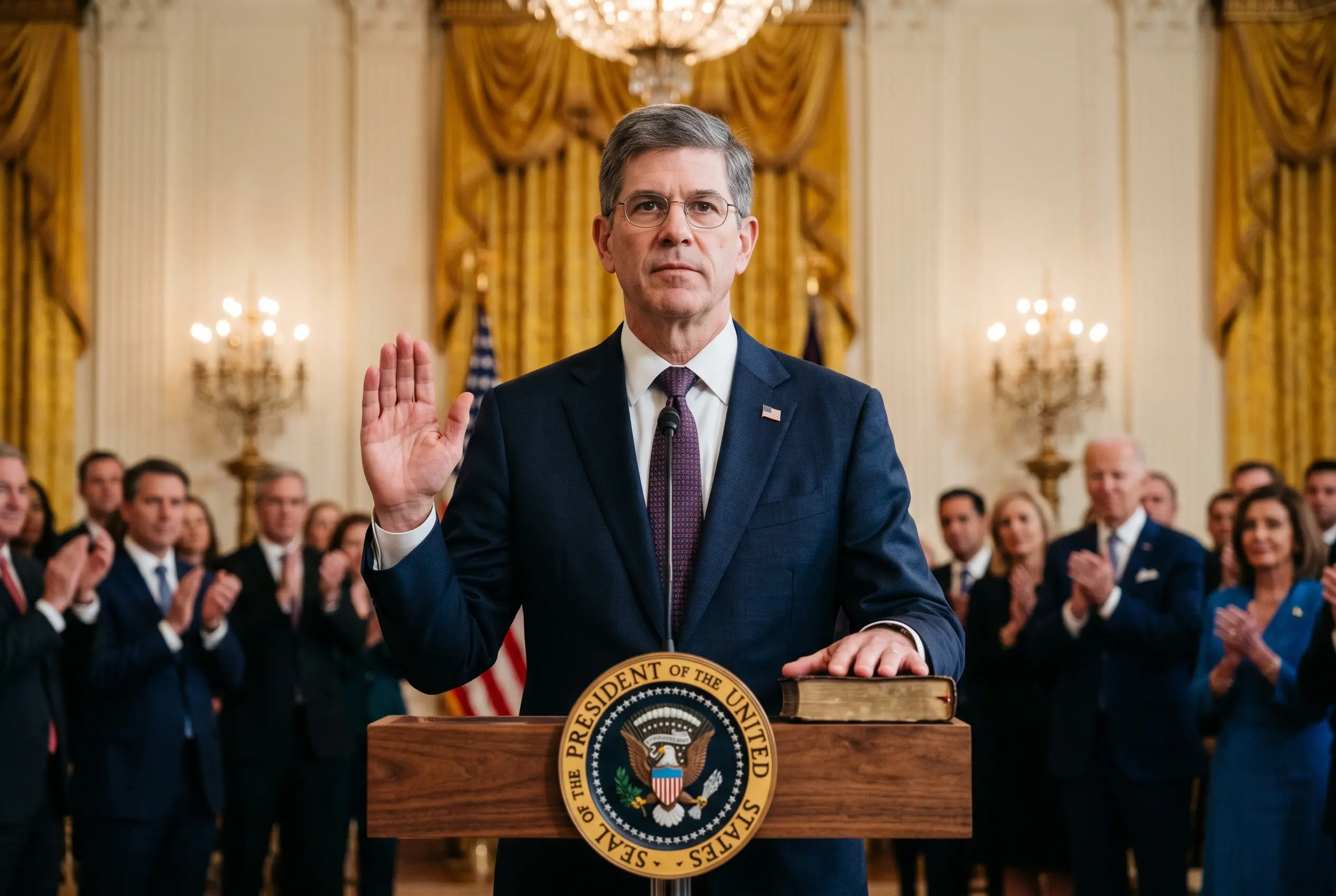
Kevin Warsh cleared the Senate on a 55-45 roll call vote on May 13, 2026, with one Democrat, John Fetterman of Pennsylvania, crossing party lines. Warsh was sworn in one week later, on May 22, 2026, by Supreme Court Justice Clarence Thomas in the East Room of the White House. The Warsh swearing-in ceremony and his first remarks drew Supreme Court Justices Samuel Alito and Brett Kavanaugh, former Vice President Dan Quayle, and former Secretary of State Condoleezza Rice, per coverage of the East Room event.
- May 13, 2026: Senate confirms Warsh on a 55-45 roll call vote
- May 15, 2026: Powell’s term as chair ends, and the Federal Reserve names him chair pro tempore
- May 22, 2026: Warsh is sworn in by Justice Clarence Thomas in the East Room of the White House
Warsh, 56, becomes the 11th Fed chair of the modern banking era. In his first remarks, he framed the job as a reset rather than a continuation. “To fulfill this mission, I will lead a reform-oriented Federal Reserve,” he said at the ceremony, promising to escape “static frameworks and models” while upholding “clear standards of integrity and performance.” For markets, the open question is whether Warsh leans more hawkish or dovish than Powell on the timing of cuts.
How Traders Are Positioning Around the Warning
The Federal Reserve’s own voice on the riskier end of the warning was blunter than Powell’s. Governor Lisa Cook said in Cook’s prepared remarks on financial stability risks at a Georgetown University event on November 20, 2025 that elevated prices across equities, corporate bonds, housing, and leveraged loans may portend a large pullback, as carried in the Reuters dispatch on the speech.
She paired that with the same caveat Powell has used. Cook argued the financial system is more resilient than it was before the 2008 crisis, and she does not see asset price declines themselves as risks to financial stability. In her framing, the conditions are stretched, the mechanism for a sharp move is in place, and the system that absorbs the move is stronger than it used to be.
Currently, my impression is that there is an increased likelihood of outsized asset price declines.
That line is the most pointed warning to come from a sitting Fed governor in this cycle. The qualifier that follows it is also instructive: she does not see the financial system itself at risk, only the prices of the assets inside it.
The seasoned approach to a moment like this is to respect the asymmetry Powell described, not to predict the crash he did not call. The three positioning rules that follow that read are simple, and they apply as much to a leveraged Bitcoin perpetual as to a richly valued tech stock.
- Trim leverage ahead of major Fed dates, not after. The repricing that follows a hawkish surprise happens faster than the average retail stop can react.
- Size positions to survive a deep drawdown. The goal is to be wrong about the Fed and still be in the position.
- Keep dry powder for the forced-selling moments when leverage unwinds across both stocks and crypto at once. That is when the asymmetry Powell described flips into a buyer, not a seller.
The better framing of Powell’s warning is neither bullish nor bearish. It is a reminder that the cushion under both stocks and crypto is thinner than the calm tone suggests, and that a new Fed chair inherits a market that has already absorbed the warning once without doing much about it.
Frequently Asked Questions
What did Jerome Powell actually warn about?
Powell said in a speech in Providence, Rhode Island on September 23, 2025 that by many measures, for example, equity prices are fairly highly valued. He paired that with a qualifier that the moment is not a time of elevated financial stability risks. The warning was about fragility and stretched valuations, not a specific crash call.
Why did the April 29, 2026 Fed meeting matter?
The Federal Open Market Committee held the federal funds rate at 3.50% to 3.75% on April 29, 2026. The vote drew four dissents, the most since 1992. One member wanted a 25 basis point cut, and three supported the hold but opposed an easing bias in the statement. The committee also flagged Middle East developments and elevated energy prices as risks to the outlook.
Is the Fed likely to cut rates in 2026?
Markets are betting the Fed will stay on hold through most or all of 2026, per the May 22 coverage of the Warsh swearing-in. The CME FedWatch tool is pricing zero rate moves for 2026 and a single 25 basis point cut in December 2027. The next FOMC meeting is scheduled for June 16-17, 2026.
What does the Powell warning mean for crypto?
Crypto tends to do best when liquidity is expanding and policy is loosening. Powell signaled the Fed will not ease just because risk assets want cheaper money, and delayed rate cuts keep pressure on leveraged positions. Bitcoin opened at $73,568.40 on June 1, 2026, well below late-2025 highs, and US spot Bitcoin ETFs shed $4.33 billion across a 13-day outflow streak ending June 3, 2026, per Galaxy Research.
Who is Kevin Warsh?
Kevin Warsh, 56, was sworn in as the 17th chair of the Federal Reserve on May 22, 2026, after a 55-45 Senate confirmation on May 13. He previously served as a Fed governor from 2006 to 2011, helped the central bank respond to the global financial crisis, and most recently worked at the Duquesne Family Office and Stanford’s Hoover Institution.
What should traders do with leverage around Fed events?
Trim leverage ahead of major Fed dates, size positions to survive a deep drawdown, and keep dry powder for the forced-selling moments when leverage unwinds across both stocks and crypto at once. The goal is to be wrong about the Fed and still be in the position.
Disclaimer: Crypto assets are highly volatile and can lose value quickly. Fed policy shifts, delayed rate cuts, and macro shocks can trigger rapid, correlated selloffs across stocks and crypto. The references to valuations, Fed decisions, and the leadership transition reflect information available as of June 2026 and can change. Do your own research, use position sizing and stop losses, and never trade with money you cannot afford to lose.


NotebookLM Becomes Gemini Notebook, and Its New Power Has a Catch

Epic Games Store’s Mobile Freebies Mask a Bigger App Store War

OnePlus Keeps Supporting Existing Owners as Its US Forum Closes

Apple’s Siri AI Reaches the Public, Two Years and $250 Million Later

Honor Bets Its AI Comeback on a Robot Phone That Nods and Dances

Blue Angels Pilot Faces No Discipline After Low Pensacola Beach Pass

OpenAI’s $230 Codex Micro Keypad Signals a Bigger AI Hardware Trend

Apple’s First OLED iPad Mini Arrives by October With a 60Hz Catch

Newgen Software Targets 23-25% Margins as Profit Beats, Stock Slips

HYPE Drops 9% and Robinhood’s CASHCAT Meme Coin Crashes 52%

XPL Rallies 30% Ahead of Plasma One Card Tier Launch

SpaceX’s Google Deal Turns a Rocket Company Into a Cloud Landlord

Google Search Profiles Build a Follow Graph Inside Discover

Microsoft Xbox Layoffs Start in July as Sharma Slams 3% Margin

Oracle Cuts 21,000 Jobs in a Year, Cites AI in 10-K Filing

Moonshot AI Targets $30 Billion in China’s Fastest AI Funding Sprint

WhatsApp Meta Business Agent Reaches India, With a New Pricing Meter

Oppo’s ColorOS 17 Eligibility List Leaves A-Series Buyers Behind

Google DeepMind and A24 Sign $75 Million AI Partnership Deal

Meta’s Iris AI Chip Enters Production in September, Tests Clean
-
 CRYPTO1 month ago
XPL Rallies 30% Ahead of Plasma One Card Tier Launch
-
 AI1 month ago
SpaceX’s Google Deal Turns a Rocket Company Into a Cloud Landlord
-
 NEWS1 month ago
Google Search Profiles Build a Follow Graph Inside Discover
-
 GAMING1 month ago
Microsoft Xbox Layoffs Start in July as Sharma Slams 3% Margin
-
 AI3 weeks ago
Oracle Cuts 21,000 Jobs in a Year, Cites AI in 10-K Filing
-
 AI1 month ago
Moonshot AI Targets $30 Billion in China’s Fastest AI Funding Sprint
-
 AI1 week ago
WhatsApp Meta Business Agent Reaches India, With a New Pricing Meter
-
 NEWS1 month ago
Oppo’s ColorOS 17 Eligibility List Leaves A-Series Buyers Behind